Skip to content

Workforce

Author: Andie Burjek

Posted on July 27, 2020June 29, 2023

The role of the chief people officer is changing in 2020

In the past, when a business encountered a crisis, the CFO was beside the CEO to help handle it. The current state of the world — from the global pandemic to the nationwide protests about systemic racism — has given the chief people officer a similar opportunity. 

While the chief people officer may handle return-to-office basics like providing masks and stocking an ample supply of hand sanitizer, they also face the more daunting specter of easing the stress of employees as they reintegrate into the workplace. 

“A lot of questions that might have been seen as questions of etiquette or personal choice are now questions of safety,” said Arianna Huffington, co-founder of The Huffington Post and founder and CEO of Thrive Global, a behavior change tech company that has been working with many HR leaders during the pandemic. 

Also read: Give managers the time they need to sharpen up their all-around skills

Chief people officers are dealing with the fundamental questions of putting people first, and now that is no longer abstract but very real for companies. “The health and well-being of employees for many companies was seen as a nice-to-have. Now more than ever, it is essential for the success of an organization, and that’s why HR leaders have such a critical role to play,” Huffington said. 

Addressing the well-being of essential workers

Employees are looking at their workplace and employer as a source of trusted information and to help them with mental health solutions, Huffington said.At Walmart, Thrive Global is making its behavior change platform available for Walmart associates — including frontline teams at stores and distribution centers — and their families across the US.

If a company doesn’t address the stress of employees — whether that stress is caused by health concerns, financial worries or something else — the bottom line and the survival of the company itself may be impacted, she said. Like Johnson & Johnson CEO Alex Gorsky memorably said, she added, “Every CEO is a health CEO now.”   

“HR leaders no longer have to convince the C-suite that employee well-being and mental health matters,” Huffington said. “But now comes the challenge of moving from awareness to action, as they must help their companies go from knowing what they need to address to actually doing it.”

We need to normalize talking about our mental health in the workplace, according to Ellyn Shook, chief leadership and human resources officer at Accenture, one of the companies Thrive has worked with. Having senior leaders set the tone for the rest of the organization is key to this goal.

“The most senior leaders in the company [can share] their challenges and how they are recharging and practicing self-care, because those are the things that actually pay off around mental wellness,” she said. 

Also read: Unify those far away workplaces with global mobility tools

Relationships and conversations with other executives

The global leadership team at Bank of America has had to be incredibly nimble, creative and innovative in response to the challenges that 2020 has presented, according to Sheri Bronstein, chief human resources officer at Bank of America, another company Thrive has partnered with.

Also read: Human capital management: Enriching your human resources

“From the imperative to keep our 210,000 employees safe and healthy to recognizing the need for even more focus on diversity and inclusion, events of the past six months have led to more collaboration, learning and sharing between myself and my C-suite teammates than ever before,” she said. 

Bronstein also highlighted the importance of CEO support as the company moves forward to support a healthy workforce. Support from Bank of America CEO Brian Moynihan has allowed Bronstein and her human resources team to take bold, swift actions as it responds to the pandemic and the health and safety concerns that employees may have. 

These actions include “no layoffs through 2020 due to the pandemic, free, virtual access 24/7 to doctors, $100 a day to cover child- and elder-care expenses and a variety of resources to support the mental health of our employees and their families,” Bronstein said.

Shook also stressed the importance of building trust with other key stakeholders in the company. Executives working together to lead responsibly can help a company and its workforce come out of a crisis stronger and more resilient. 

“As we discuss physical safety and psychological resiliency, returning to the workplace and actions to fight racism in our organizations, an underlying theme of many of my conversations with other [C-suite executives] is humanity and the opportunity and obligation that leaders have to elevate their most important source of competitive differentiation – their people – especially during times of crisis,” Shook said. 

The opportunity to create lasting change 

The lessons organizations have learned from dealing with these crises will have a lasting impact on how they approach HR matters moving forward, Bronstein said. 

At Bank of America, she added, members of the C-suite will continue to collaborate with each other, “[maintaining] our focus on cultivating a diverse and inclusive culture, and offer programs, initiatives and partnerships that drive change.”

Shook compared the current state of possibilities for HR leadership to that of finance executives during the 2008 financial crisis. The chief people officer, much like the CFO of 2008, is a key leader in an organization right now, “guiding their organizations and people through these trying times where health, livelihoods, and equality are at stake, while also keeping a foot in tomorrow.”

“CHROs have always sat at an interesting crossroads to help their organizations elevate their people, or not – whether it be AI, a pandemic or inequity,” she said, adding the HR leaders who focus on people over process can navigate disruption better in the present and also help contribute to a better future.

At Accenture, for example, Shook said she and her colleagues have learned a lot over the past few months about how people work and how they can still collaborate and be innovative while physically distancing from each other. 

Due to this newfound knowledge, she said, “we are [not] taking this as an opportunity to think about how we go back to what normal was.” and

“This is an opportunity for lasting change,” Shook added. “For modern HR leaders, this has been an accelerant to create a blueprint for the future of work, rethink the social contract and drive even greater value for our people, businesses and communities. And, for those HR leaders who are less progressive, it’s an important catalyst to begin to create a resilient organization that is prepared for whatever the future holds.“ 


Posted on July 23, 2020June 29, 2023

Coronavirus Update: The FFCRA implications of schools reopening

onboarding

With schools set to reopen over the next four to six weeks, your employees will be asking for time off from work if their children will be distancing learning for any part of the upcoming school year. The FFCRA provides for up to 80 hours of paid sick leave and 12 weeks of expanded FMLA Leave (the latter 10 of which are paid) for employees who are caring for their child(ren) whose school has been closed because of COVID-19 precautions.

Also read: How do you reopen schools without teachers?

The question of whether employees are entitled to take leave under the FFCRA for children who are distance learning this school year will depend on why they are distancing learning this year.
  1. If a school is open for in-person learning and a child is distance learning by choice through an online option the school offers, the child’s parent is not entitled to FFCRA leave. In this case, the school is not closed; its physical location is open and the parent is choosing a remote learning option. Therefore, the employee does not have a qualifying reason for child care leave under the FFCRA. Note, however, that certain parents in this scenario still might qualify for FFCRA leave if the child is distance learning upon the advice of a health care provider to self-quarantine because of concerns related to COVID-19.
  2. If a school is requiring full-time online instruction or distance learning, the employee will qualify for child care leave under the FFCRA, provided that the employee certifies to the employer that no other suitable person will be caring for the child(ren) during the period for which the employee takes FFCRA leave. According to the DOL’s FFCRA FAQ’s, “If the physical location where your child received instruction or care is now closed, the school or place of care is ‘closed’ for purposes of paid sick leave and expanded family and medical leave. This is true even if some or all instruction is being provided online or whether, through another format such as ‘distance learning,’ your child is still expected or required to complete assignments.”
  3. If a school provides a mix of in-person and distance learning (e.g., a student attends class in-person in the morning and online from home in the afternoon, or in-person two days per week and remotely three days per week), an employee could take intermittent FFCRA leave, but only with the agreement of the employer. Under the FFCRA, intermittent leave is not a right and is only available if the employer permits it. Note, however, that the DOL “encourages employers and employees to collaborate to achieve flexibility.”
These issues will absolutely arise once children return to school. Best to figure out now how you are going to handle, because your employees will be requesting FFCRA leave for their children’s distance learning during the upcoming school year.
Posted on July 23, 2020June 29, 2023

7 steps for introducing new tech solutions to reluctant employees

SMB hr tech

Getting employees enthusiastic about new technology can be simple if everyone is eager to learn how to use new tools. However, some people may be reluctant to use new tech tools, especially if those tools would significantly change how they work. Whether you’re switching to a new platform or implementing tech that automates manual processes, there will always be someone who is hesitant and has doubts or anxieties about new tech. 

You’ve spent weeks researching new tech solutions to implement in the office. You’ve done the calculations on ROI and how much it could help boost productivity. However, no matter how efficient a new technology solution is, it will not be as effective if the key users are not 100 percent on board.

Also read: How technology can help your employee engagement strategy

Here are some important steps to keep in mind when trying to win them over. And it begins long before you actually introduce new solutions.

Keep them in the conversation

As the shot caller of this particular decision, the final say on implementing this new tool is yours and yours alone. But it’s still important to broadcast the changes to all those affected by your plans. Clearly declare why you think change is necessary, why the current status quo isn’t working or how it could greatly be improved. Then gather feedback.

As you research and narrow down your choices for a solution, keep these employees part of the conversation and keep them informed about your thought process. Let them know the benefits and disadvantages you believe are most important for the company’s needs.

 Not only will this help inform what kind of solution would work best for your team, but it will help you identify early on who may be hesitant about replacing old processes for new ones.

Find your advocates

Just as announcing your plans early on can help identify employees with doubts, you’ll also find those who are enthusiastic about change and will make great advocates of the tech. 

Identify these individuals and recruit them as your advocates who will champion the changes and be leaders. Have them be among the first to train with the solution. These advocates will boost morale among others about the software and also help train everyone else on how to use it.

Communicate the value

Be sure you’re expressly clear with employees about the value a new tech solution will bring, not just to the company, but to them as employees. Long-time employees can feel anxious about how their roles will change when new tech solutions are introduced, so it’s important to convey how much of a positive impact this can have on their career growth.

For example, if it’s a tool that’s meant to save time on certain processes, reassure them that they can now spend their time on more productive tasks for the company.

SMB hr techCreate a roadmap

Big changes don’t happen overnight, nor should they. When you’re ready to roll out your new solution, you need to come up with a solid plan to transition from your old process to the new one. Create a clear timetable with dates and stages of implementation. Then stick to it. If plans change, be transparent and keep your team informed.

 Stages can include an exploratory period, the first round of training, a pilot period with a handful of users starting to use the solution, a second round of training with everyone involved and a hard deadline when the solution is completely implemented.

Give them time

There are growing pains that come with all changes. Give some time to employees who at first struggle with new tech. This is where your advocates come in, who can lead the charge and help out their coworkers who have a tougher time adapting to the change. As long as people are willing to learn, it’s worth it to invest in additional training and compromise with them. They may prefer to get their work done the traditional way while they’re still learning the new way.

Incentivize change

Sometimes it’s necessary to sweeten the deal. Incentivize employees to take part in the process of implementing a new solution. This can easily be done by providing lunch with training sessions or implementing a reward program for users of the solution.

Continue listening and changing

After a successful implementation, you still have a long road of adapting your office’s workflow to one that seamlessly integrates your new solution into your everyday processes. As employees get used to the new way of doing things, continue taking in their feedback. Accept new ideas about how the solution can be used in different ways that both improve efficiency and accommodate employees who are used to doing things in certain ways.  

Summary

Changing, adapting, and implementing new tools to grow your company is the reality of business. There are some people that are more reluctant to change, but it’s important to provide a means to take those baby steps toward new ideas so they can continue helping the business become more successful. Throughout all the mentioned steps above, communication is key and will lead to a much smoother transition than an unexpected, abrupt shift in how people do their jobs.

Posted on July 22, 2020July 22, 2020

Coronavirus Update: Telemedicine and the FMLA

telemedicine

Earlier this week, the Department of Labor published a three new sets of FAQs—COVID-19 and the FLSA, COVID-19 and the FMLA, and updated FAQs on the FFCRA.

By and large the FAQs don’t break new ground. But one of the FMLA questions caught my attention.

12. Due to safety and health concerns related to COVID-19, many health care providers are treating patients for a variety of conditions, including those unrelated to COVID-19, via telemedicine. Telemedicine involves face-to-face examinations or treatment of patients by remote video conference via computers or mobile devices. Under these circumstances, will a telemedicine visit count as an in-person visit to establish a serious health condition under the FMLA?

Typically, for a non-inpatient medical issue to qualify as a “serious health condition” under the FMLA, one must receive either in-person treatment by a health care provider two or more times within 30 days of the first day of incapacity, or in-person treatment by a health care provider on at least one occasion that results in a regimen of continuing treatment under their supervision.

Does a telemedicine visit count as one of these “in-person” visits? According to the DOL, the answer is “yes” (at least for the rest of 2020).
Yes. Until December 31, 2020, the WHD will consider telemedicine visits to be in-person visits, and will consider electronic signatures to be signatures, for purposes of establishing a serious health condition under the FMLA. To be considered an in-person visit, the telemedicine visit must include an examination, evaluation, or treatment by a health care provider; be performed by video conference; and be permitted and accepted by state licensing authorities. This approach serves the public’s interest because health care facilities and clinicians around the nation are under advisories to prioritize urgent and emergency visits and procedures and to preserve staff personal protective equipment and patient-care supplies.
Telemedicine has served a crucial role during this pandemic to ensure that individuals receive the medical care that they need without needlessly exposing themselves to COVID-19 by visiting a health care provider in person. I’m thrilled to see that the DOL is adapting by counting certain telehealth visits as “in-person” visits for purposes of the FMLA.
Posted on July 22, 2020June 29, 2023

Labor forecasting requires a stronger analytics skillset

scheduling; time and attendance; forecasting

Labor forecasting — or accurately planning schedules — is a key part of running successful shifts and avoiding the negative consequences of overstaffing or understaffing. And the rise of predictive scheduling laws has added a slight bump to the road as managers strive to create schedules up to two weeks in advance. 

Meanwhile, the full potential of analytics in labor forecasting has yet to be realized. In the past year, only 21.1 percent of organizations have used workforce analytics to inform decisions about scheduling shifts, according to the Workforce Business Intelligence Board’s “2020 HR State of the Industry Survey,” developed by Workforce.com’s research team. 

Also read: How to avoid overstaffing through wage tracker software 

Typical companies overstaff, said Matt Stevenson, partner and leader of Mercer’s Workforce Strategy and Analytics practice. But focusing more on forecasting allows the organization to be more fine-tuned in staffing and be more exact in planning their HR spend. 

Labor forecasting by industry 

The complexities of labor forecasting vary by industry, Stevenson said. It’s more straightforward for industries like manufacturing, where the number of workers needed likely depends on how many workers are needed per piece of equipment. Restaurants and retail exist somewhere in the middle of this spectrum and often rely on historical experience or data. 

Health care systems are where it gets extraordinarily difficult, Stevenson said. With a highly specialized job like a neurosurgeon, for example, there’s no way for an emergency room to know for sure if they’ll need one or 10 on staff for the week.

Organizations can attempt to automate this function or analyze historical data, but the reality is that the more accurate and specific someone wants to get with staffing, the more detailed the process has to be.

Also read: Labor analytics add power to workforce management tools

‘Project-ize’ workplace initiatives 

Scott Georgia, vice president of professional services delivery management and transformation at Alight Solutions, suggested that managers create specific projects within initiatives, allowing them to more carefully analyze resource demands for each initiative and estimate the number of hours per week that each initiative will require. 

“This can take some time, but the investment is worth the end result and will allow better visibility into staffing demands, conflicting initiatives and the ability to aid in department priorities,” he said. 

Georgia also suggested that managers gain an understanding of employees’ day-to-day workload, the individual activities that go into that and how many hours per week employees spend on each activity.

Managers can then combine the summarized data points from these first two steps to understand the workload of every employee in the department. They can layer in historical data for further comparison and to help provide data-driven insights.  

“The combined data will provide key insights into what employees are working on, how much they are working on and any staffing capacity or over-allocations,” Georgia said. “Review the data on a monthly basis or more frequently to make data-driven decisions and assignments.”

More sophisticated forecasting 

Labor forecasting has typically been done through the finance department, but that’s starting to change, Stevenson said. Organizations have the opportunity to be more sophisticated in their demand forecasting —  the process in which the historical data or predictive analytics is used to develop an estimate of expected customer demand.

It’s not as black and white as the company needs a certain number of employees to complete a specific amount of work. The type of employee can impact demand forecasting, Stevenson said. Maybe an employee who has worked longer at this job completes tasks quicker or has fewer errors, for example.

In the past, understanding the impacts that different employees have on getting the job done was mostly done by gut, Stevenson said. But now organizations may have this data stored in their administrative systems. To take advantage of this data, it requires access to a system that collects this information and someone with analytical skills on the team. 

The types of organizations doing this typically have been manufacturing companies, since this skill set is generally something that industrial engineers are competent in, Stevenson said. It’s now moving to retail as well, but not as much with health care, whose unique challenges make the shift difficult. 

The makeup of an analytics team

A team or an individual who is able to do this work typically has three areas of expertise or skillsets, Stevenson said. 

The first is the ability to aggregate data from a variety of systems since there has yet to be a single system that can do everything. This is the most basic skill. The second is the ability to understand what the numbers mean and communicate takeaways to the operations team, which will ultimately be the team responsible for the outcomes. The final ability is having specific labor forecasting software or statistical skill to predict demand and labor increasingly better as time goes on.

labor analytics, people analyticsA lot of software does the job of aggregating the data, but it’s ultimately up to people with specialized skillsets to come up with actionable insights that continually improve forecasting. 

Usually, at most it’s a third of the solution for labor forecasting, he said — not to underestimate the time it can save people by aggregating data. “It will make your job easier, but it won’t replace you,” he said.  

 The toughest part of this for people building this skillset is that it’s difficult to separate data that is interesting from data that is also useful, he said. Teaching that more investigative research skill is not something that many undergraduate schools do, at least not in an analytics program. 

Still, he said she’s seeing more people specialize within these analytics skills. There can be a lucrative career path there, he said. 

Georgia added that to be successful at labor forecasting, a team needs a manager who is curious and who is willing to ask tough forecasting questions. If the current data isn’t available, they’ll have the drive to find the answer.

“This curiosity creates a drive to utilize and visualize the data in creative ways,” he said. 

Posted on July 14, 2020

Should employers be testing employees for COVID-19?

COVID-19, coronavirus, public health crisis
Fortune magazine asks: “Why some companies are screening employees for COVID-19, while others have opted out?” This is a legitimate question.

Let’s start with the law. Does the law (in this case, the ADA) permit an employer to test employees for COVID-19? Yes, an employer absolutely may administer a COVID-19 test before permitting employees to enter the workplace.

From the EEOC:
[E]mployers may take steps to determine if employees entering the workplace have COVID-19 because an individual with the virus will pose a direct threat to the health of others. Therefore, an employer may choose to administer COVID-19 testing to employees before they enter the workplace to determine if they have the virus.
Just because employers can test doesn’t mean they should test. Why shouldn’t an employer test even though the law allows for it?
1/ Because these tests only measure a small slice of time, and therefore are not a reliable indicator of whether an employee is bringing COVID-19 into the workplace. Unless you are going to test every employee every day (see no. 2 below for why this isn’t feasible or practical), a negative test only establishes that an employee does not actively have the COVID-19 virus within their system at the time the test was administered.
2/ Because tests aren’t necessarily reliable. A team from John Hopkins Medicine has concluded that COVID-19 tests have a false negative rate of at least 20% if used too early after infection. If one in five employees who tests negative for COVID-19 is carrying the virus, why test at all?
3/ Because tests are expensive and not available in a large enough quantity. Testing every employee every day will cost an employer a small fortune, while at the same time unnecessarily using testing resources that could be put to better use (i.e., for those who actually have COVID-19 symptoms). It’s for this same reason (among others) that I believe restarting professional sports right now is crazy. Those players are being tested every single day, using up valuable testing resources that are in too short supply as is.
What should an employer do instead of testing? All employers should require employees to self-monitor for COVID-19 symptoms, and upon the presentation of any such symptoms, report to the employer and isolate per CDC guidelines. Thereafter, the employer should contact its local department of health, contact trace, and quarantine those who were in close contact as needed. That’s about the best you can hope to do to help stop this virus from spreading in your workplace. The law allows you to require testing if you want, but why bother?
Posted on July 9, 2020June 29, 2023

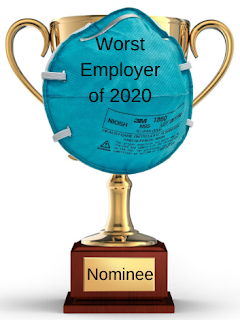
The 6th nominee for the “Worst Employer of 2020” is … the Working Mom Sacker

remote workers, stressed out

Let this woman’s Instagram post sink in, and then let’s talk about why it’s wrong to fire a mom working from home (allegedly) because she has to spend some time tending to her children.


View this post on Instagram


| 28 days ago I finally had enough of the 𝗱𝗶𝘀𝗰𝗿𝗶𝗺𝗶𝗻𝗮𝘁𝗶𝗼𝗻 that my boss was giving me for him not being okay with hearing my kids in the background on calls.|😭😡😖💔 . He wanted me to figure out a way to keep the kids quiet 😣. I went to Human Resources with proof of what was going for the last 3 months and 7 days later AFTER that 𝗜 𝗴𝗼𝘁 𝗳𝗶𝗿𝗲𝗱!!!! 😭 They told me that I should be happy that the outcome to my career there could have been worse. I’m crying as I type this…😭 I was told I had a bright future. That I was doing very well in my position! 💔💔💔😭💔😭 . The last 3 months I have worked around the clock from home while watching my two toddlers😭. I have met all the deadlines they have asked me for, even the unrealistic ones. The situation that I had endured the last 3 months is beyond stressful😭. How does a company that says that they understand and will work around the schedule of parents do the complete opposite with their actions? 😭 I’m devastated. I have poured hours, tears, sweats, delayed giving my child a snack when he wanted one because my boss needed me to do something right away. And what did I get in return? 𝗙𝗜𝗥𝗘𝗗!!! 😭😭😭😭😭 😭😭😭😭😭😭😭😭😭😭😭 . They can keep the 𝗵𝘂𝘀𝗵 money they offered to not bring this up🚫🛑✋! No working mother should be discriminated against , especially during these times for not being able to keep my 𝟭 𝘆𝗲𝗮𝗿 𝗼𝗹𝗱 𝗾𝘂𝗶𝗲𝘁 for a business call 😡For not being able to turn something around in 5 minutes when my baby wants a snack😡. We are in tough times right now. This situation would have been temporary. None of my clients had issues with my kids in the background. 𝗜’𝗺 𝗴𝗼𝗶𝗻𝗴 𝘁𝗼 𝗳𝗶𝗴𝗵𝘁 𝗳𝗼𝗿 𝗲𝘃𝗲𝗿𝘆 𝗺𝗼𝗺 𝘁𝗵𝗮𝘁 𝗵𝗮𝘀 𝗴𝗼𝗻𝗲 𝘁𝗵𝗿𝗼𝘂𝗴𝗵 𝘁𝗵𝗶𝘀 ! 𝗜𝘁’𝘀 𝗻𝗼𝘁 𝗼𝗸𝗮𝘆!!!💪. IT’S NOT OKAY to have to feel that your boss is making you pick your work over your kids during these times!!!𝗜𝘁’𝘀 𝗡𝗢𝗧 𝗢𝗞𝗔𝗬!!! #justice

A post shared by Hi, I’m 𝗗𝗿𝗶𝘀| MODERN CALI MOM (@moderncalimom) on Jun 23, 2020 at 5:13pm PDT

10 News San Diego fills in the details:

A San Diego mother says working from home during the coronavirus pandemic cost her her job. She claims she was fired because her kids were making noises in the background of her teleconference calls …

Like many parents, Rios was unable to find childcare for her four-year-old daughter and one-year-old son. Despite juggling parenting and working from home, Rios claims she was able to complete all her tasks. She adds that her clients never complained about her kids being in the background of her conference calls. The only complaints, she says, came from her male, direct superior.

“I said, ‘Do you want me to lock my kids in the room? My one-year-old in the room? Do you want me to do that?’ And… he responded and said, ‘Figure it out.’” Rios said.

She says she tried to arrange calls to be during her children’s afternoon naptimes but claims her boss continued to ignore and demean her.

“He would purposely overlap schedules,” Rios said.

According to research conducted by Stanford economist Nicholas Bloom, 42 percent of the U.S. labor force is currently working from home full-time. It an ideal way to stay safe and promote physical distancing during the COVID-19 pandemic, but it’s less than ideal for other reasons, especially if you have young children at home. For example, we’ve all seen more than one viral video of a child interrupting a Zoom meeting. (Personally, I had one interrupted by my dogs loudly fighting over a toy. After my apology, my clients said it was the best distraction they had all week.)

worst employer of 2020

Work from home calls for understanding, compassion, and flexibility, not hard lines in the sand, deceit, and termination. If an employee is working well from home, being productive and timely, and putting out a quality work product (as Ms. Rios says she was), let it be. There will come a time when everyone could return to the office, but now is not that time. Work from him is going to be the “new normal” for many for the foreseeable future. If we can’t work with it, we are going to lose too many good employees.
Moreover, it’s just plain illegal to fire a woman based on her parental responsibilities if you don’t hold similarly situated male employees to the same standard. As Suzanne Lucas writes at Inc.com: “If you enforce hours and quiet backgrounds for females but not for males, you’ll violate sex discrimination laws. So, you can’t call it cute when Joe’s baby shows up on film but unprofessional when Caroline’s toddler shows up. It’s all or nothing.”
No working mother should be discriminated against. That’s called sex discrimination. It’s also flat-out wrong to fire an employee in these circumstances, and it might just make you the worst employer of 2020.
Posted on July 9, 2020September 8, 2022

Common scheduling problems: Addressing staff turnover and improving retention

warehouse workers, hourly employees

Employee turnover is a big issue for many employers who hire hourly workers and can help contribute to common scheduling problems like understaffing or last minute schedule changes. And the industries with the highest average turnover are the ones that generally have more hourly workers: 

According to the 2018 Mercer U.S. Turnover Survey, which looked at 163 U.S. organizations, the three highest turnover industries are: retail & wholesale (60.5 percent average turnover), other manufacturing (26.7 percent) and consumer goods (21.5 percent). Meanwhile, those with the lowest turnover include life sciences (14.5 percent), insurance (15.5 percent) and banking/financial services (16 percent).

For businesses, turnover means spending more time and money on the recruiting, hiring and training process. And it also means that making schedules may get complicated when the staff list is constantly changing and when surprise absences come up after someone has quit.

But company leaders and managers are not powerless here. Here are some ways they can address high staff turnover and avoid some of those pesky, common scheduling problems that make managers’ jobs just a little more complicated.

Understand why employees leave

One reason for turnover is when an employee perceives inequitable treatment in the workplace, according to the Academy of Management, which published the paper “Inequity and Its Relationship To Turnover Among Hourly Workers” in 2017. 

The paper explored this relationship within the major production shops of the Boeing company and found that at best inequitable treatment leads employees to not be their most productive selves. At worst, they will leave the job. There are a few ways organizations can address this, the paper added, such as by improving working conditions if necessary and by paying attention to how supervisors treat workers and responding appropriately. 

The adage “employees leave managers, not companies” is a subject of debate among the HR community, but research does support it, said Robert Teachout, legal editor at consultancy XpertHR. The studies above are just a couple that show the potential negative effects of bad management practices.

Bad management practices include not being supportive of employees and being too harsh on employees for making certain mistakes. It boils down to a general lack of respect, Teachout said. Employees want the same basic things, he added: to be treated with respect and fairness, to do something that matters at their job and to get the opportunity to learn, grow, develop and be promoted. 

Teachout used the example of the type of manager that remembers all the mistakes an employee makes but never recognizes the good things they’ve done. When an employee is reviewed unfairly like this, that may contribute to them wanting to leave the job. 

Also read: Absence management is increasingly vital for managers to understand

Provide training for managers

From the manager’s point of view, many of them have been promoted because they were good at their job. But they don’t get training on certain people management skills upon getting that promotion, Teachout said. It’s up to the higher-ups at a company to prepare managers with the needed communication skills like how to engage with employees or how to have difficult conversations with them. 

This type of training is more important for front-line managers than for more mid-level managers, Teachout added. Front-line managers have a direct relationship with staff and have the opportunity to make or break employees’ experiences working for the company. 

“[They] can do more damage. That’s where toxic workplaces get created a lot of the time. The frontline managers don’t know what they’re doing, and you give them a checklist and therefore they don’t act like human beings,” Teachout said.

Lack of hours and flexibility

According to a 2017 FSG and Hart Research Associates survey, 83 percent of employees said if they had more control over their work schedules, they’d be more likely to stay at their current job. 

Also, 61 percent of those surveyed said they’ve struggled at work because they have a hard time making enough money to pay for basics like rent and food. More hours are especially helpful to these people. “Offering existing workers additional hours, rather than hiring new workers, may be one way to save on costs and improve employee satisfaction,” the survey conductors wrote in an article for Harvard Business Review.

There are several strategies to respond to these employee concerns, the article stated. For one, companies can better train managers to support their teams and build a better team/workplace culture. Secondly, employers can offer hourly employees more opportunities for job growth within the company. Third, as lack of flexibility is one of the most common scheduling problems, organizations can be more open to offering predictable schedules to employees.

Also read: Shift scheduling strategies can be improved through technology

 Reconsider existing workplace policies 

While employees do often leave bad managers, bad policies make it even easier for employees to quit, Teachout said. These other factors could include low pay, a lack of benefits or the lack of the opportunity for advancement. 

For example, the COVID-19 pandemic has brought to light the fact that many essential, hourly workers do not get paid sick leave or certain other benefits, Teachout said.

“One would think [that] out of self-interest alone, the restaurant and retail industries would look and say, even if we’re not required to provide paid sick leave, let’s provide paid sick leave. Because it only takes one person with an infectious disease coming in — because otherwise they don’t get paid — to shut down your business for months,” he said. “So isn’t it more cost-efficient to give them paid sick leave and say, ‘If you’re sick, stay home?’”

More than just putting policies in place, organizations must also train managers on how to apply these policies to the workplace equitably and fairly, he said. For example, a grocery store manager may allow through some flexible work policy for a woman to come into work and leave work a little early so that she can pick up her kid from childcare. If the manager does not allow the same for a father, that could be viewed as discrimination. Managers must make sure they are not violating the law when they’re dealing with company policies.  

“You want to create a workplace that people want to work at,” Teachout said. “If people feel this is a place they want to work at, they feel loyalty. They get a sense of teamwork, a huge piece of the puzzle that gets missed all the time. When people work as part of a team, they feel more loyalty and are more engaged than people working individually. ”


Posted on July 7, 2020June 29, 2023

Labor data analytics can inform better talent decisions

labor analytics, people analytics

Labor data can help organizations make more informed talent decisions, but more companies could be taking advantage of it. 

According to Mercer’s “2020 Global Talent Trends Study,” 39 percent of organizations use predictive analytics to inform their people-related decision making. Thirty-one percent said they use a cause/effect analysis of key workforce and business outcomes, and just 18 percent gather data to assess the impact of different pay strategies on performance.  Meanwhile, 61 percent of executives who have used talent analytics said that doing so to inform decision-making is the number one HR trend that has delivered an impact

A workplace strategy expert spoke to Workforce about the potential of people analytics and how organizations can use it in their talent management strategy.

Using labor data analytics to measure employee impact

People analytics can inform complex predictive models, but it can also help organizations understand  how certain decisions have impacted employees. 

One prime example of this is pay equity, according to Tauseef Rahman, partner in Mercer’s San Francisco office. Labor analytics can be used to understand if there are pay gaps at an individual or group level, after taking into account factors like where employees live, what work they do and how long they’ve been working at the company. 

Also read: Labor analytics add power to workforce management tools

Analytics can also help organizations understand performance measurements better, Rahman said. Based on performance ratings and rewards like promotions or raises, are those performance ratings biased toward a specific subset of employees? 

Doing this analysis at a company-wide level is a good place to start, Rahman said. From there, leaders can see if there’s a company wide gap. There may not be a pay gap within the organization as a whole, for example, but through analytics, one can drill down and see if there are gaps in a specific business unit or a specific team. 

“That data can certainly help shine a light on where those patterns are and then that will help redirect efforts and resources to areas that need the most help,” Rahman said.

Using data analytics predictively 

Remote work has become more commonplace for many organizations during the COVID-19 pandemic, and experts expect remote work to continue to be more widely accepted afterward as well. Rahman said that analytics can help organizations interested in adapting an increasingly remote workforce. 

As organizations consider a more geographically distributed talent pool, many questions arise, like: If we hire people from across the country, how does that change how we do talent acquisition? How does that change how we pay people? And how do we manage the employee experience across different locations?

 Data can help answer questions and  inform decisions like this. 

Also read: The most pressing workforce management issues of 2020

Acknowledge the inherent flaws of data collection

No set of data can be completely unbiased, but what organizations can do to address this fact is simple, Rahman said. The key here is to clearly acknowledge that there’s bias in how data is created. 

Also read: Keeping Data Safe: The Next Wave of HR Tech Innovation

People who use data to inform decisions or strategy can acknowledge this bias by considering a few questions when they plan on using a dataset to do or plan something. These questions include: How was the gathering of this data framed? Was anything missing? Was answering these questions optional or required for survey takers? Were survey creators biased to presume certain outcomes?

For example, in recruiting, Rahman has seen the presumption that no one over the age of 65 would be interested in applying to a tech position. The reasoning behind this may be laziness or mental shortcuts rather than malice or age discrimination, but it’s flawed reasoning no matter the intention. “Things that are done in the spirit of making it easy can result in unintended consequences,” Rahman said.

Cross functional teams are critical

labor analytics, people analytics

According to Mercer’s “2020 Global Talent Trends Study,” the  “quality and reliability of data are critical.” Cross functional teams are critical for organizations interested in using data the right way, Rahman said. 

The team shouldn’t only include analysts and statisticians but also people with HR expertise, legal expertise and an ethical understanding of data collection. What data does an organization have access to, and how can it collect it in a way that’s not creepy?

“You can configure technology to do whatever you want. If you do something wrong, you can’t blame the technology. You blame the people who configured it,” Rahman said. 

Managing privacy concerns is an important part of these teams. There are interesting ethical questions that come up with the possibility of using labor analytics predictively. For example, Rahman said, what are the ethics of having a model that predicts how likely an employee is to quit? If they haven’t actually quit, what decisions can you ethically make with that prediction? 

Having someone with policy expertise is also beneficial for a cross functional team. For example, if an employee has a 90 percent chance of quitting according to an analytics model, a policy expert could consider what could be driving the employee’s dissatisfaction and what workplace policy could help them be more engaged. Maybe it’s something related to compensation or work-life balance that can be addressed.

The scope of people analytics 

Businesses go through times of uncertainty for many reasons, from global crises to national recessions and more. Times like this highlight the role of labor data analytics to make the employee experience better, at a time when many employees may be going through financial or personal struggles. 

Still, while focusing on improving the employee experience, organizations cannot lose sight of broader, also important areas of business that analytics can inform, Rahman said. These bigger picture topics include pay equity and diversity. 

“Having a broad mindset is really important,” he said. “You want to solve daily issues, weekly issues, monthly issues and multiyear issues, [all while] not losing sight of the fact that you still have to do your pay equity analysis and you still have to make people engaged in your company. It’s a lot more work, but who better to do it than these strong, multi-disciplinary [people analytics] teams?”

Posted on July 6, 2020July 8, 2020

Tesla fires workers for staying home after giving them permission to stay home

reopen businesses

“Carlos, there is no need to feel that you are going to lose your job. If at this time you do not feel comfortable returning to work, you can stay home without penalty and take the time unpaid.”

That email, sent from Tesla’s acting human resources director to a now terminated employee, will be central to that employee’s wrongful termination lawsuit pending against the automaker.

The employee claims that Tesla retaliated against him because he pressured the company to release information about its health and safety protocols following reports of employees testing positive for coronavirus after returning to work in late May.

The timing does not look great for Tesla. The “you can stay home without penalty” email came one day before the employee spoke out against Tesla at a news conference about conditions at the plant and his fear of returning to work … and one day prior to Tesla emailing the employee to tell him his job was at risk.

Within hours of that news conference, Tesla’s human resources department emailed a “Failure to Return to Work” notice, advising of termination without an immediate return to work. The employee (and a co-worker who received a similar notice and also openly questioned the company’s safety during the pandemic) opted to remain on unpaid leaves because of their health and safety concerns. They claim their terminations are in retaliation for their vocal questioning of their employer’s commitment to safely reopening and operating its manufacturing plant.

Also read: Lawsuit highlights risk of businesses not reopening safely and correctly

There is nothing inherently unlawful about ending an employee’s leave of absence and requiring their return to work (even during this pandemic). However, when an employer ends the leave within hours of an employee openly and vocally challenging health and safety issues, retaliation becomes a real concern.

Whistleblower retaliation is one of the biggest legal risks facing employers during this pandemic. OSHA, the National Labor Relations Act, and myriad state laws protect employees from retaliation for raising health and safety concerns at work. Instead of risking a lawsuit by removing a “difficult” employee from the workplace, employers should view them as an opportunity to improve. Why are they raising issues? How do they feel unsafe? What can we do to improve and make all employees feel safer? If we are doing everything we can to provide as safe of a workplace as possible, how do we communicate that fact to employees?

Also read: When employees return to work, consider these guidelines

Far from an opportunity to terminate, employee health and safety complaints (always, but especially during this pandemic) present an opportunity to listen, improve, and strengthen your relationship with your employees. Employers that do not understand this opportunity are risking dangerous and costly retaliation lawsuits.

Also read: COVID-19 and workers’ compensation

Posts navigation

Previous page Page 1 … Page 5 Page 6 Page 7 … Page 38 Next page


Webinars


White Papers


  • Topics

    • Benefits
    • Compensation
    • HR Administration
    • Legal
    • Recruitment
    • Staffing Management
    • Training
    • Technology
    • Workplace Culture
  • Resources

    • Subscribe
    • Current Issue
    • Email Sign Up
    • Contribute
    • Research
    • Awards
    • White Papers
  • Events

    • Upcoming Events
    • Webinars
    • Spotlight Webinars
    • Speakers Bureau
    • Custom Events
  • Follow Us

    • LinkedIn
    • Twitter
    • Facebook
    • YouTube
    • RSS
  • Advertise

    • Editorial Calendar
    • Media Kit
    • Contact a Strategy Consultant
    • Vendor Directory
  • About Us

    • Our Company
    • Our Team
    • Press
    • Contact Us
    • Privacy Policy
    • Terms Of Use
Proudly powered by WordPress