Skip to content

Workforce

Author: Andie Burjek

Posted on May 4, 2020June 29, 2023

HR needs to build employee trust to address sexual harassment

sexual harassment prevention requirements

While the #MeToo movement has brought some high-profile results including the imprisonment of Harvey Weinstein and Bill Cosby, the reality is that in general there have been few consequences for harassers. 

This is especially true for populations of employees especially vulnerable to sexual harassment, including low-wage workers in the retail and service industries. Looking at data from 1995 to 2016, the Equal Employment Opportunity Commission received more complaints of sexual harassment from the restaurant industry than from any other industry, according to Time. Retail employees, meanwhile, occupy the No. 2 spot in number of sexual harassment complaints filed. 

trust, HR, sexual harassmentAccording to digital media company Racked, what makes service workers vulnerable to sexual harassment includes low wages and complicated, ineffective complaint processes that rarely lead to any consequences. Further, harassers know they can prey on vulnerable workers who are often women or people of color because they can use these vulnerabilities against the person they’re harassing and take advantage of a power imbalance, according to Racked.

As rampant as sexual harassment is, offenders often get away with it and victims don’t believe their complaint will go anywhere. Meanwhile, HR may get the reputation of being more interested in protecting the company than protecting the victim. 

Fifteen percent of employees have been sexually harassed according to “The State of Humanity at Work,” a spring 2020 report from software company Workhuman, which surveyed 2,613 full-time employees. But that number is probably higher given the sensitivity of the topic, the report noted. Of these people, 39 percent said they don’t trust their HR department. Only 47 percent of women and 66 percent of men who have been sexually harassed reported it.

“This mistrust is further manifested in low numbers of people reporting harassment. Changing these numbers is going to take work building up trust and showing commitment to listening and respect,” according to the report. 

What employees can do after being sexually harassed

File a formal complaint: Despite employee concerns that HR will do nothing, filing a formal complaint is still a good idea. 

If your company has a specific procedure for handling sexual harassment complaints, employees should follow it to the letter, taking note of every detail, like any time limits set out in that policy, advises law firm Allred, Maroko & Goldberg. In the case where a company has no formal procedure, an employee can start by reporting the harassment to their immediate supervisor, and, in the case where the supervisor is the one doing the harassing, report it to that supervisor’s manager. “It is important, particularly in hostile environment cases, to make sure that your company’s management knows of the harassment,” the law firm’s blog noted. 

Keep records of everything: If an employee has any uncomfortable incident with their harasser, they can keep a log of times, dates and exactly what the person said or did for reference. They can also note witnesses who may be able to corroborate the incident. When they have digital evidence like texts, emails or instant messages to screenshot, that is further evidence to bring to HR with their complaint. 

Being thorough and detailed is important here. The more details and evidence someone has, the better.

Further steps an employee can take: Sometimes a harassment victim is unable to resolve your harassment complaint by using your employer’s internal procedures, the law firm blog noted. If they still want to pursue the complaint, they can turn to the Equal Employment Opportunity Commission or their state’s human rights or civil rights enforcement agency next. 

This can lead to several outcomes. The agency may decide not to proceed with the complaint but issue the victim a “right to sue” notice, allowing them to bring the case to court. The agency may also choose to file their own lawsuit against the employer.

A lawsuit is not the route an employer wants to take. That’s one reason it’s important to HR to step up and take sexual harassment cases more seriously. 

“HR is like the CIA — when we do the right thing (like getting rid of a harasser) employees might never know about it, but when we screw up (like protecting a harasser), everyone knows,” said Kate Bischoff, an employment attorney at tHRive Law & Consulting LLC. This only magnifies the reputation of HR as a department that ignores critical culture issues like sexual harassment. 

If this is the reputation of HR — and at times it is the reputation HR departments have earned, Bischoff said — then HR professionals must work harder to build trust with employees. They can get to know employees, ask them how they’re doing and find out what HR can do to help with any issues they’re having. 

Building these relationships may help people feel like HR is trustworthy and will take sexual harassment seriously.

HR’s role in building employee trust

“The best way to build a connection with employees is to create a human-centered culture. Leaders can do this by keeping the line of communication open and providing frequent check-ins,” Bischoff said. “[And] good HR professionals build trust and take action to prevent and stop harassment.”

The report stressed the importance of a “human workplace,” defined as an environment where people are allowed to be human, make mistakes and treat each other with empathy, Bischoff said. “If we see each other as humans, we’re more likely to speak up when things are not right, when there are problems, and when we believe we’ve been harassed,” she added. 

Not addressing sexual harassment has a clear negative impact on employees, but it can also adversely affect employers through turnover. Of the 21 percent of employees who are actively looking for a new job, 33 percent have been sexually harassed at work, according to the survey. This number is probably higher, the survey stated. 

The “lawyerly” reason organizations should take sexual harassment more seriously is because of the risks they face due to bad press, lawsuits, charges of discrimination and the costs of settlement. But there’s much more to consider than reputational and financial damage. “Good organizations hear the lawyerly response more clearly, but great organizations hear the human response more clearly,” Bischoff said.

When sexual harassment occurs, a company is not providing an environment for employees in which they can do their best work and voice their concerns, she said. The company is treating their employees poorly, and it’s not providing the best services or products to its clients and customers as well. 

The Workhuman report found that of the women who reported being sexually harassed, 29 percent did not get their claim investigated, Of the men reporting sexual harassment, 12 percent did not get their claim investigated.

This may also contribute to mistrust in HR, Bischoff said. “There’s no good reason for harassment not to be investigated,” Bischoff said. “Serious allegations of harassment should always be investigated.”


Posted on April 27, 2020June 29, 2023

When employees return to work, consider these guidelines

return to work policies

As the debate over relaxing pandemic stay-at-home policies continues, researchers at Harvard caution that it is not safe to restart the economy until officials can perform 500,000 tests per day nationwide — a 350,000 per day increase over the current capacity.

With such guidance being considered to reopen schools, businesses and recreational facilities, organizations must be prepared regardless of the timing. Reopening the economy after a deadly, global pandemic isn’t as simple and flipping a switch and returning to normal. There are many considerations employers must address as employees return to the physical workplace. 

Also read: How to use technology in your internal communications strategy

What employees and employers fear when people return to the work

While many employers want to “rev up the economic engines of their businesses,” they know that if this is not done safely, they risk a second wave of COVID-19 cases and another shutdown, said Michael R. Jaff, professor of medicine at Harvard Medical School, former CEO of Newton-Wellesley Hospital, and member of The Castle Group’s COVID-19 Response Task Force.

return to work policiesEmployers may also have concerns for employees who say they are “ready” to return to work and what ready even means in the context of a global pandemic, according to Dr. George Vergolias, medical director for behavioral health consultancy R3 Continuum. People are ready in the sense that they want their personal lives, jobs, and financial security back to normal, but they’re also worried about personal safety and exposure to COVID-19 if the pandemic is not yet over. 

“It is at such times when we must use our amazing capacity to tap into our resiliency and ability to adapt,” Vergolias said. “It’s important for leadership to both acknowledge the possible struggle in transitioning back to work, and yet don’t expect difficulties in a way that creates a self-fulfilling prophecy.”

Workplace policies and protocols should address employees wanting their employers to keep them physically and emotionally safe as a return to work begins, Vergolias said — physical safety in the sense of being protected from COVID-19 exposure and emotional safety addressing their anxieties and fears.    

Employers must have a clear reentry plan with informed safety protocols and resources to help employees with the emotional adjustment of transitioning back to work, he said. 

Jaff also suggested that a thoughtful return-to-work plan will include clear information about the importance of maintaining safe distances, wearing masks, frequent hand washing, and cleaning all surfaces. Employers also should establish policies for sick employees before they can return to work as well as a clear plan for employees who become ill on the job. 

Hart Brown, senior vice president of crisis preparedness at R3 Continuum, noted that organizational protocols will need to be based on federal, state and local guidelines and, in some cases, based on the industry the company operates in. 

A company’s protocol will need to be flexible, he said. Crisis management during a pandemic requires forecasting and the plan may need to change. 

“Constantly adjusting the two to three-week forecast will allow for better decisions today and the ability to avoid being overwhelmed and learning by surprise,” he said. 

Dana Udall, chief clinical officer at behavioral health provider Ginger, stressed the impact of COVID-19 on employees’ mental health even after the restrictions loosen. She cited an Employer Health Innovation Roundtable survey, which found that 60 percent of employers are not satisfied with their company’s response to employee emotional and mental health during this crisis and that employers are expecting a growing need for mental health resources.

The quarantine has increased the risk of many mental health issues. People in drug or alcohol recovery may start abusing again in quarantine. Social isolation also may negatively impact people with depression or anxiety. And the stay-at-home orders have meant an increase in domestic violence, which has both physical and mental effects. 

“It’s clear that while the peak in the bell curve of COVID-19 cases may be in sight, the mental health peak has yet to come — and when it does, it will likely have a long tail,” she said. 

Employers can acknowledge the return-to-work anxieties employees may have by clearly communicating that they can take time off to manage their mental health, making up for vacations or family visits they may have missed during the quarantine. Employers can also communicate the behavioral health resources available in benefits plans, like coaching, therapy or psychiatry. 

Allison Velez is the chief people officer at Paladina Health, which employs both non-essential corporate workers who can work remotely and essential medical professionals who must be on-site.

Velez agrees that continuing to allow employees to work remotely is an important policy. Employers need to have a flexible, sympathetic approach for people in different home situations.

One strategy Paladina Health uses is a regularly scheduled, bi-weekly video call in which clinical staff can ask the organization’s chief medical officer anything and get real-time answers. Employees can voice concerns, get answers and feel like they’re being heard.

“Organizations need to, as they think about bringing employees back to work, continuing to emphasize listening channels like surveys, focus groups, town halls or open calls,” she said. “Continuing that two-way dialogue between the employer and the employee is critical right now, and finding every avenue to do that allows companies to stay on top of the new arising concerns that employees may have as they return to work — or, if they’ve already been at work, continuing to stay healthy at work.”

An employer’s response is critical, Velez said, and not only for the health and safety of the workforce. How well or poorly they respond will impact the employer brand. 

“No organization wants to be in the headlines about a major outbreak right now,” she said. “That’s both because we want to keep our employees safe and healthy, and it’s also because it’s a reflection of the employment brand and how seriously companies are taking this.” While reputation isn’t the primary concern for employers, “it’s a potential unintended consequence if employers aren’t taking the right steps.”   

Companies must make sure to seek scientific, accurate, clinical information, Velez said. This can help leaders and managers disseminate factual information about COVID-19 rather than the myths and misinformation people often hear. Also, they need to make sure they’re on top of HIPAA regulations, especially as companies and their health plans are now increasingly relying on different technology or virtual tools such as telehealth to help employees rather than in-person care. 

How quickly will restrictions be phased out? 

Despite protests for quarantines to end and normal life to begin again, it’s not that simple. Many factors of COVID-19 make the return to normalcy complicated, Jaff said. It is highly infectious and causes serious illness and death, and it is difficult to predict who will suffer from it. It’s still unknown whether those who have recovered are immune to getting it again. And there’s no definitive treatment or vaccine yet. 

“It is important that the loosening of the stay-at-home orders be done very slowly and quickly reversed if there is a recurrence of hospitalizations and emergency department visits,” Jaff said. “A resurgence in the fall, if timed with the annual seasonal flu season, could be more devastating than what we have just experienced.” 

One area of confusion among employers is that because COVID-19 is a new virus, experts may have different opinions simply because people have not been studying the virus very long, Vergolias said. Some medical experts are calling for further social distancing, while others are suggesting that leaders should begin easing those measures. 

“My recommendation for employers and leaders is to frequently update your understanding and knowledge of medical recommendations from known, credible resources and then disseminate that information to your employees in an accessible and pragmatic manner,” he said. “In general, providing timely and practical medical information coupled with emotional support resources is a solid two-pronged approach.”

Posted on April 23, 2020June 29, 2023

Workforce management software: Don’t underestimate its value

workforce management software; hr tech

Workforce management professionals face more responsibilities than ever before, and workforce management software can help them manage their many responsibilities.  

While workforce management used to be a more focused term — mostly encompassing payroll, timesheets and scheduling — now it encompasses a broader array of duties including recruiting, onboarding, training, technology and more. Some of these duties are owned by HR, while IT, finance or operations take care of others. Balancing this variety of duties is not simple. 

Also read: How technology fits into an HR manager’s job description

Between 2020 and 2025, the workforce management software market is expected to grow at a compound annual growth rate of 4.21 percent, according to India-based market research organization Mordor Intelligence. The report also found that the global workforce management software market was valued at $2.7 billion in 2019 and is expected to reach a value of $3.5 billion by 2025. 

Why use workforce management software?

Organizations are interested in using HR and workforce management software for multiple purposes, and many organizations plan to use certain types of software in their long-term plan, according to the 2019 “HR State of the Industry” report from the Human Capital Media Research and Advisory Group, the research arm of Workforce.com. While 37 percent of the organizations surveyed already use a management software system that addresses all core areas of talent management, 10 percent plan to purchase it in the next year and 8.4 percent plan to in the next three years. 

workforce management software; hr techThe same trend exists for organizations interested in software that specializes in one talent management category. According to the report, 46.4 percent of employers already used recruiting technology software, 9.2 percent planned to in the next year and 6.5 percent in the next three years. With scheduling/time and attendance software, 59.9 percent of respondents already used it, and 9.3 percent and 5.8 percent plan to in the next year and three years, respectively.

Among this huge workforce management software landscape, organizations may have challenges choosing a provider and managing the software. Vendors are releasing new versions of workforce management software every other day while similar companies are also emerging, noted MarketWatch. 

Also read: Workforce management takes time and effort

One important functionality of a workforce management software solution is the capability to create schedules based on varying rules and regulations. For example, numerous cities and states have passed legislation including laws guaranteeing workers the right to request scheduling accommodations and predictable scheduling laws. Meanwhile, an organization may have specific internal rules that apply to just one team of employees, or they may have global employees who don’t fall under American law. 

The benefits of workforce management software 

Workforce.com software, for example, addresses this by allowing users to input a rule or regulation and have it automatically added to the system. This isn’t the case with every time and attendance software, but capabilities like this allow workforce management professionals to create good schedules despite the many rules that impact how they can and can’t schedule employees.  

Also read: 3 steps to navigating effective wage and hour compliance

The benefits of workforce management software solutions are clear. They can save organizations time and automate complicated processes. Still, some organizations haven’t made the leap yet, citing reasons like lacking the time, budget or resources to choose products, assess vendors and deploy new applications.Experts advise companies in this predicament to start small with core software solutions that address payroll, time and attendance, paid time off and benefits. Delaying workforce management software investments will hinder a manager’s ability to automate the necessary tasks and focus on the parts of their job that can’t be automated.

Posted on April 23, 2020

Your employees walk out in protest over coronavirus-related working conditions. Now what?

COVID-19, coronavirus, public health crisis
This week, Amazon workers are protesting what they view as unsafe working conditions. 300 workers from 50 facilities will skip their scheduled shift to protest Amazon’s treatment of warehouse workers.

According to United for Respect, the worker rights group organizing the protest, says that the Amazon employees are hoping to accomplish the following.

  • When an employee tests positive for coronavirus, the immediate notification of all employees at the facility, and the closure of the facility for two weeks with full pay.
  • Regular and deep cleaning of all facilities, including after a positive test.
  • The provision of proper safety equipment to all employees, with training on effective use.
  • 14 days of paid sick leave for anyone with symptoms and 12 weeks of emergency paid family leave for employees to care for loved ones who get sick.
  • Healthcare for all Amazon employees.
  • Hazard pay, including time-and-a-half during the crisis and childcare pay and subsidies.

Amazon employees are not unionized, and this isn’t a strike. It’s a short-term walkout of non-unionized employees. Just because these employees aren’t unionized, however, doesn’t mean that their walkout isn’t protected. In fact, it’s very protected. The National Labor Relations Act covers employees who engage in protected concerted activity—meaning that employees have the right to talk between and among themselves about terms and conditions of employment, including walking off the job in protest.

Also read: What a business operating in the time of coronavirus cannot look like

An employer’s first instinct might be to fire the instigators (as Amazon is accused of doing). That would be a big mistake. The NLRA protects employees from retaliation after engaging in protected concerted activity. It’s also just a really bad look, especially now.

Instead, I’d view these protests as a wake-up call.

For starters, we know that one or more labor unions are in employees’ ears helping them organize their walk-outs. A mass walk-out could easily lead to a mass walk-in to the nearest NLRB field office to file an election petition. Don’t offer the union more ammo by firing the organizers.

Secondly, this type of protest offers employers an amazing opportunity to heal some wounds. Amazon likely won’t offer these employees each item on their laundry list of demands, but it should consider all of them and offer those that can be accommodated.

These employees just want to feel safe and know that their employer takes their concerns seriously. At the end of the day this is not that big of an ask, and treating it as such only makes the situation worse.

Also read: The rise of the sick, distressed and oppressed worker

Also read: The role of businesses in addressing a public health crisis

Posted on April 21, 2020June 29, 2023

How technology fits into an HR manager’s job description

HR tech; hr manager; workforce management software

While human resources used to be a more functional role, over the years it has become more strategic, with more HR executives earning a seat at the table. On the front lines, HR managers also have an evolved job description, increasingly relying on technology to take over the automatable parts of their job so that they can focus on more human tasks.

Just as employees are expected to grow with the times and learn technology skills like data science and programming that make them more attractive to employers and relevant to the jobs of the future, HR managers must do the same. 

Technology is gaining a larger role in many traditional HR duties, from recruiting to scheduling to performance management. This has been happening for a while and means that HR managers must be prepared to learn new systems and skills related to the software an organization uses. Relying on current skills is not going to get an HR manager far. They must be willing to be flexible, show curiosity and learn new skills. 

Also read: HR 101 for new human resources managers

However, if an HR manager is tech-savvy enough to manage various HR technology systems, ultimately they will have more time to focus on the HR duties that require timeless skills like tact and empathy.

Programs enabled with artificial intelligence, for example, can help answer common employee and candidate questions, leaving HR professionals time to focus on other responsibilities rather than repeatedly answer the same common, basic questions. Chatbots can’t answer more complex questions, but they can alert a person to answer those queries.

HR tech; hr manager; workforce management software

In the recruiting context, technology can help HR managers quickly review resumes. This has both advantages and risks. On one hand, employers don’t spend as much time going over resumes. On the other hand, recruiting technology may make biased decisions if it has been programmed with biased training data. Still, with appropriate training data, this has potential to make the recruiting process better. 

Also read: How the talent acquisition game has changed in the past decade

And with scheduling, workforce management software can help HR managers create schedules, even considering compliance laws that make scheduling complicated. Different states and localities have varied regulations regarding paid time off, sick leave and overtime. But the appropriate software can take regulations into account as someone creates a schedule for its workforce. 

Meanwhile, some HR tasks should always retain the human touch. Managers should always terminate employees face to-face, avoiding doing so via text message, email or other forms of virtual communication. Managers also have key communications responsibilities — for those times as common as the annual open enrollment and as unique as a crisis or global pandemic. Being able to effectively, strategically and sympathetically communicate information is part of the HR job description that does not change with the advance of HR technology solutions.

Given these tech-enabled and human-centric HR tasks, when a company is looking for a new HR manager, employers should include certain responsibilities in their job description. Some of these skills are constant:

  • Consults legal counsel to ensure that policies comply with federal and state law.
  • Develops and maintains a human resources system that meets top management information needs.
  • Oversees the analysis, maintenance and communication of records required by law or local governing bodies, or other departments in the organization.
  • Advises management in appropriate resolution of employee relations issues.

Other responsibilities can likely be streamlined through technology:

  • Recruits, interviews, tests and selects employees to fill vacant positions.
  • Responds to inquiries regarding policies, procedures and programs.
  • Administers benefits programs such as life, health and dental insurance, pension plans, vacation, sick leave, leave of absence and employee assistance.
  • Prepares budget of human resources operations.
  • Responds to inquiries regarding policies, procedures, and programs.

Additionally, the rise of technology solutions adds extra responsibilities to that list, like understanding how to use several types of tech tools. These include:

  • Knowing how to use social media to post jobs, research candidates and communicate with employees.
  • Knowing how to use an applicant tracking system.
  • Using talent management software and learning management systems can help you streamline hiring, onboarding, training and retention processes.
  • Using time and attendance software to quickly and efficiently create compliant, fair schedules.

While HR practitioners are expected to do more than ever before, they have more technology and tools available to make their jobs more efficient in many ways. 


Posted on April 17, 2020October 18, 2024

Chief people officer trends: More women, more degrees, more turnover

most chief people officers are women

An organization may call their head of HR a chief people officer, chief human resources officer, chief talent officer or something else. Whatever the title, the chief people officer has evolved over the years, and they should be aware of the macro trend impacting their role.

This is according to “CHRO Trends 2020,” a report from consulting firm Talent Strategy Group. Researchers produced the report by analyzing Fortune 200 companies and publicly available data. They looked at the 36 new Fortune 200 chief people officers who came into the role in 2019 and identified seven distinct trends. These 36 leaders include UnitedHealth Group’s Patricia Lewis, General Electric’s Kevin Cox, PepsiCo’s Ronald Schellekens and American Express’ Monique Herena.

Chief people officers remain one of the only C-suite roles that is dominated by women rather than men, the report found. Seventy-eight percent of new CHROs were women in 2019, and of all Fortune 200 CHROs, 67.3 percent were women, according to the report. This happened in the same time span in which the CEO role in the Fortune 200 saw a decline in female representation.

FhrFurther, in the pool of CHRO replacements in 2019, a woman replaced a man in 43 percent of the instances compared to 7 percent when a man replaced a woman, noted Zac Upchurch, COO at the Talent Strategy Group and a co-author of the report. 

Advanced education is also becoming increasingly important for chief people officers. Compared to 48 percent in 2018, 65 percent of the new CHROs in 2019 hold one or more advanced degrees. Of this majority, 86 percent have earned a master’s degree, and 22 percent have earned a juris doctor. 

This tracks with an overall trend for HR managers as well. HR professionals going to business school is becoming more popular, as they can use advanced education to pick up business skills in finance, marketing and operations that they don’t necessarily learn on-the-job as working in HR. 

Also read: Tesla’s CHRO Director Pick Points to a New Era

Turnover trends 

Another finding from the report was that turnover among chief people officers has increased. In 2019, 19 percent of CPOs turned over, an increase from 16 percent in 2018. In the Fortune 10 alone, the report noted, there were four CHRO replacements in 2019. 

Upchurch wouldn’t attribute the higher rate for larger revenue organizations to anything specific. The average tenure of CHROs is a little over five years, he said, and some of them may have just reached their limit in 2019. 

CEO turnover rates also likely impacted CHRO turnover rates in 2019, he added. The report found a correlation between the two, and 2019 saw a 40 percent increase in CEO turnover. “The high correlation of CEO and CHRO turnover translates to an increase in CHRO turnover that we expect to continue into 2020,” the report stated. 

For example, in November 2019 when McDonald’s CEO Steve Easterbrook was fired after admitting to violating company policy by having a consensual relationship with an employee, Chief People Officer David Fairhurst resigned a day later.

“When the CEO leaves the company, it is very common for it to have a cascading effect. In some cases, other executives leave because they did not get the CEO job and therefore felt passed over. In other cases, they are not aligned with the new CEO and leave to pursue new opportunities. Every executive will now have to switch their personal loyalty to Chris Kempczinski, their new CEO, or consider departing,” said Dave Ramos, chief executive officer of consultancy Shiftpoints Inc., at the time of Fairhurst’s departure.

Upchurch expanded on this logic. A new CEO — especially if they come from outside the company rather than internally — impacts the rest of the executive team, he said. 

“I predominantly attribute [this trend] to the changing of the guard and the accumulation of a new strategy,” Upchurch said. “A new CEO [may establish] a new executive team to drive forward strategy, and that strategy is either going to be similar to or differentiated from the previous one.”

Interestingly, while 35 percent of departing chief people officers retired, 31 percent took new or bigger roles within the company, the report noted. 

Twelve percent took a lateral move into a business role such as a different executive position. One reason behind this is that some companies see the chief people officer as a stop along the way as someone moves up the company, Upchurch noted. Their ultimate goal may be a different executive role. They may not even have HR experience when they take on the CHRO position. In fact, the 2020 report found that 17 percent of CHROs come into the role with limited to no domain expertise in HR. 

Examples of former HR executives who have made these lateral moves in 2019, Upchurch said, include: Jennifer Mann at Coca Cola, who is now senior vice president and president of global ventures; Kathy Gaddes of AmerisourceBergen, who is now chief compliance officer; and Stephanie Lundquist at Target, who is now executive vice president and president of food and beverage. 

Also read: The open road potential of a data-driven CHRO

Conversations with chief people officers

The creators of the report also spoke to many chief people officers to get an understanding of what they see as the biggest priorities on their agenda. These conversations provided some qualitative data to the Fortune 200 analysis. 

A major theme of these interviews was building capability and accountability, Upchurch said. CHROs want the HR function and HR managers to build on their capabilities in order to meet increasing HR standards and to appropriately hold people accountable to these standards

“There’s a lot of good research about the relationship between what we think we hold people accountable for and how drastic it is versus what we actually do. I think a lot of CHROs are clued into that and saying, ‘We have good processes and practices. What we don’t have is how we hold people accountable for these processes and practices, and we need to enable that by providing them the right capability,’ ” he said, citing a 2019 survey that found managers generally don’t hold their employees accountable.

Another trend that emerged from these conversations were the challenges of balancing both short-term and long-term expectations in HR. Short-term tasks include daily or quarterly duties while long-term involves preparing for the future of work and responding to macro trends.

This delicate balance was true before COVID-19 disrupted the workplace and it still holds true now, Upchurch said. 

“All this is now more relevant than it ever has been because CHROs are on the front lines of contingency planning and different ways of working [in response] to COVID-19. But they also need to operate their business. So the question is, ‘How do you do both these things at once?’” he said. HR leaders must manage this complicated relationship “between the quarter-by-quarter basis at which organizations operate while also setting up the runway for perpetual, enduring success.” 

Also read: An important collaboration: CHROs and legal confront a crisis

Posted on April 14, 2020June 29, 2023

Regulating recruiting amid constant technological innovations

recruiting, hiring, interviewing a candidate

As recruiters adopt advanced technologies in their quest to identify, court and hire candidates, attorneys are looking into the legal and regulatory issues those new tools may bring into play.

Lawyers, recruiting experts and technology vendors say legal teams are examining compliance concerns even as their colleagues in HR and IT evaluate products that leverage artificial intelligence, machine learning and other innovative approaches. Not only are they exploring the ramifications of privacy requirements such as Europe’s GDPR, they’re considering the possible impact of biases that may be inherent in a data set or unwittingly applied by algorithms.

recruiting, hiring, talent acquisition “I think we’re at the beginning of sorting out what all this means, but I think it’s definitely something people are thinking about,” said Jeffrey Bosley, San Francisco-based partner in the labor and employment practice of law firm Davis Wright Tremaine. “It’s a new technology and it’s evolving. Whenever you have a new technology, you do have growing pains and you do have these issues that come up,” he said.

Advanced technologies have gotten much attention recently, particularly as people inside and outside the business world consider the impact AI may have on jobs and livelihoods. At the same time, some well-intentioned efforts have generated media coverage for results that were diametrically opposed to what their developers set out to do.

In 2018, for example, Amazon abandoned an effort to build a machine-learning tool for recruiters after the system proved to be favoring men over women. According to Reuters, the tool downgraded resumes that included the word “women’s” as well as the graduates of two all-women’s colleges.

Also read: Is there room for an ethics code for tech companies?

Sources inside Amazon said the system, which had been under development since 2014, was meant to review resumes so recruiters could spend more time building candidate relationships and actually hiring people. It worked by comparing applicants against patterns found among resumes the company had received over a 10-year period. However, it didn’t account for the dominance of men in the technology workforce. As a result, the system machine-taught itself that male candidates were stronger than females.

Advanced technology “is at an awkward stage where it’s not really intelligent,” said William Tincup, president of the industry website RecruitingDaily.com. While he sees great potential for AI and other tools to streamline the work of recruiters and even address bias in the hiring process, he believes systems are limited in how much they can accomplish.

Why? In a word, people. “What are machines learning from their learning from humans?” Tincup asked. Hiring managers can’t help but operate with a number of possible preconceptions in their minds, from unconscious bias about race or gender to a preference for the candidate they most recently interviewed or who seems the most like themselves. Such biases, Tincup observed, live on in the makeup of a company’s existing workforce. And that leads to the troubles Amazon faced, where the data set reflects decisions made in the past more than it positions a process to understand needs of the future.

Technology Races Ahead

The situation is complicated by the idea that technology has outpaced legal and business practices. While they believe that will eventually change, analysts and technology vendors don’t see it changing quickly. 

“Right now, technology’s moving super-fast,” said Ankit Somani, co-founder of the talent acquisition and management platform AllyO, headquartered in Palo Alto, California. “Generally, regulators and the folks who control compliance standards don’t move so quickly. But, honestly, we’re like three lawsuits away from somebody taking it very seriously.”

Also read: Artificial intelligence is a double-edged sword. Here’s how HR leaders can properly wield it

 “Therein lies a real big rub,” Tincup said of regulation’s lag behind talent acquisition and HR practices. Nearly all of the processes involved with turning candidates into employees touch some kind of employment law or EEOC-related issues, but “all of those rules are outdated,” he said. “We’ve been working outside of the rules for 15 or 20 years. I would argue that there isn’t a company in the United States that’s 100 percent compliant from sourcing to outplacement.”

Talent acquisition teams, and HR in general, understand that and are beginning to adopt, said Brian Delle Donne, president of Talent Tech Labs, an industry analyst and consulting firm based in New York. However, he believes determining exactly how and where compliance fits in with the use of new technologies has been complicated by the way “artificial intelligence” has been “grossly generalized” in industry conversations.

“Most of the time they’re talking about machine learning, or sometimes just automated workflow processing,” Delle Donne said. “When you get into true artificial intelligence, where the machine is making decisions, it’s a higher threshold that’s required for our concern about the accuracy of [its] recommendations and predictions.” The distinction between true AI and what might be called “advanced technology” is important, he believes, because people assume that the machine is prescient when it’s usually not. “In most cases, it will be quite a while until machines are actually making decisions on their own,” Delle Donne observed.

Even in today’s state, the use of advanced technology has become widespread enough to raise concerns about whether it might, inadvertently, nudge an employer out of compliance. For example, AI-driven tools may use personal information in unplanned ways that a candidate hasn’t given permission for. That would raise privacy concerns. Or, tools might present results that, intentionally or not, run afoul of fair-employment legislation. “On both fronts, you’re talking about compliance statutory norms,” said Delle Donne.

AI’s Behavior

Such concerns, along with widespread speculation about AI’s impact, has made advanced technology “front of mind for many people,” said Bosley. In response, governments at all levels have begun generating “a patchwork” of laws that sometimes conflict with one another.

For example, Illinois’s Artificial Intelligence Video Interview Act went into effect Jan. 1, 2020. The law sets out transparency and consent requirements for video interviews, as well as limits on who can view the interviews and how long they can be stored. However, Bosley said, the law’s mandate to destroy videos within 30 days may conflict with the preservation requirements of other state and federal laws, including in the Civil Rights Act of 1964 and the Americans with Disabilities Act.

Also read: How Will Staney continues to change the talent acquisition game

“It puts employers in a position where they’re really going to need to assess risk,” Bosley said. “They’re going to need to come up with creative solutions to try and work around some of this risk.” 

Not all employers may feel exposed in the near term, Tincup suggested. He estimates that each year only a handful of legal actions are taken because of a candidate’s unhappiness with the recruiting process. People practices, technology practices and civil and social discourse are “way ahead of employment law,” he explained. “So is this something that’s going to create an immense amount of risk? No.” Employers today, he believes, put themselves at more risk by hiring a salesperson with a history of sexual harassment. In that regard, “you could spend more money in risk mitigation … than in recruitment technology,” he said.

At the same time, an organization’s risk may be based on activities that aren’t related to recruiting or the workforce, Bosley points out. “This isn’t just a human resources issue anymore. It’s not only an employment law issue anymore. It’s much broader than that,” he said. “You have data protection, data compliance, privacy and the potential for disparate impact claims as opposed to disparate treatment claims.”

Bosley anticipates more claims will be filed that look into a database’s contents, what data’s being looked at, how it’s being processed and whether algorithms are static or refined over time. Essentially, these claims will examine how advanced technology is making its decisions. “It’s going to be something where human resources leaders are looking to involve others in the organization and make sure that they’re both issue-spotting and getting ahead of some of these compliance issues,” he said.

 Indeed, Somani believes this notion of “explainability” — laying out what a system does and how it’s doing it — will become more important in the realms of recruiting technology and compliance. “There should, in my mind, be more compliance standards around that,” he said.

Evolving Standards

Even at a basic level, compliance standards for using technology in recruiting “don’t exist,” Somani said. For example, does texting about a job opportunity constitute a form of marketing? Is such a text permissible if it’s personalized? Because the answer’s not clear, he believes many companies are putting stricter guidelines in place.

Somani also said legal departments are becoming more involved in the purchase and implementation of recruiting technology. For tools handling communications, such as those that facilitate SMS messaging between recruiters and candidates, they’re trying to anticipate issues by creating policies that cover not only privacy, but data collection and permissions. “It’s an explicit ask in almost every deal we go into: ‘If a consumer doesn’t want to interact with your system, how do you follow that?’ ” he said. When it comes to issues related to AI’s under-the-hood work, vendors focus on transparency and disclosure by presenting disclaimers on their product or within their privacy policies.  

 For enterprises, compliance issues “can be a deal-breaker,” said Megan Gimbar, the Holmdel, New Jersey-based product marketing manager for iCIMS Hiring Suite, at least at the corporate level. While compliance and consistency are important components of her product, she said, talent acquisition teams often shy away from the topic.

In the past, employers tried to ensure compliance through training. Their approach, said Delle Donne, was to make hiring managers aware of interview questions that shouldn’t be asked (such as inquiring whether a woman intended to have children) or information that shouldn’t be considered (the candidate’s age or ZIP code). “That’s a fairly low bar,” he observed.

The bar began getting higher “once we started saying algorithms are going to make that determination for us,” Delle Donne continued. “Algorithms might actually do a better job, [or] may actually be set up in a way that they might do a better job, than humans do at avoiding compliance issues through bias.” However, he said, that requires planning and a focus on non-discrimination features when algorithms are designed.

Also read: The ethics of AI in the workplace

Compliance Further Afield

The compliance issues raised by using AI in recruiting aren’t limited to talent acquisition alone. For one thing, Somandi notes, recruiters today leverage a variety of tools that were introduced into other functions. 

Think of how candidate management systems and customer management systems align. When using those technologies, compliance may involve adapting the standards used by marketing or sales so they can be applied to talent acquisition and HR.

That road goes both ways. Even solutions designed for recruiters raise issues that aren’t unique to hiring, Delle Donne said. “As HR tries to digitize, there are many, many places where technology can streamline processes and save time and perhaps be more beneficial to the employee or the party,” he said. Many, if not all, of those will lead to some kind of compliance question. For example, a bot used in benefits administration may build a profile of confidential medical information. Or, a learning program might enter performance scores into an employee record without informing the employee. That could be a problem if those scores impact a person’s future promotions or career path.

As it digitizes, the tools implemented by HR “will bring in these technologies and there’s going to have to be some focus or some attention given to not inadvertently creating bias or discrimination, or revealing private information,” Delle Donne said. “If you take a step back, it just could be like whack-a-mole. I mean, ‘Hey, we see it over here in talent acquisition. Let’s go chase that down and… Oh, wait. We just saw this going on over there.’”

Scheduling employees is one major HR task for which technology can help. Make more accurate, data-driven scheduling decisions in just a few clicks with Workforce.com’s comprehensive scheduling software.

Posted on April 13, 2020June 29, 2023

Creativity through crisis: Engaging employees during the COVID-19 pandemic

We’ve been anticipating a seismic shift in the world of work for years. With factors like digital disruption, climate change and divergent geo-politics, it is no surprise that the “future of work” has finally arrived. 

But did we expect it to arrive on these terms? A pandemic is eviscerating our communities, emerging with little warning and threatening lives and the global economy. The sorrow is pervasive. 

At first, we at PwC were workforce strategists living under a cloak of sadness. But we found relief through creativity.

Team-wide doodle challenge; PWC; employee engagement

I’ve been socially isolated in New York for almost a month. I’m finding that by dedicating some right brain thinking to my daily schedule, I’m working in new ways. Not only does my “creativity break” help me relax each day (particularly when it involves paint, glitter and crayons), it helps me re-energize and solve work problems from a new perspective. 

Also read: Senior Living Facility Employees Benefit from Art Therapy

Daily, my daughter and I take a break and do an art project together. I have found that the quality of our art is getting better each day, and with that grows our confidence. This is showing in how I engage with my work when I’m inspired to try new things —  like testing out a new automation tool in PwC’s Digital Lab or communicating with a client using a new technology.  

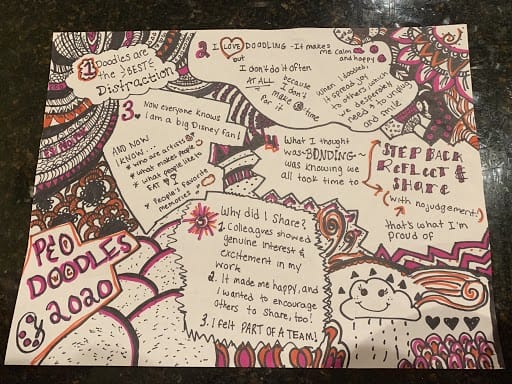
I tested the impact of creative release with my team, which is why we made QUARANTINE DAYS, a collaborative art project involving a collection of drawings and doodles. In my career, I have worked with clients to solve the most complex workforce issues — but QUARANTINE DAYS is one of my most prized projects. It gives me joy to admire what we have built as a team, through times of fear, anxiety and sadness. 

Also read: 7 Tips for Managers to Help Employees De-Stress

The Doodle Challenge: How we made it happen 

Step 1: Know your audience. To make a project like this work, choose an audience that is willing to demonstrate vulnerability. For many, doodling is not a natural pastime. It helps if there is an established level of familiarity across the group.  

Step 2: Establish collaboration tools. We created a virtual chat room called “doodle madness” that allowed us to share drawings in a no judgement zone and did not distract from formal business communications. 

Step 3: Define roles. You need a leader who can  sponsor the project and is willing to embarrass themselves sometimes and demonstrate vulnerability. The sponsor will share the first doodle of the day to encourage others (and in our case, set a very low precedent for artistic talent). You need a project manager to encourage participation and collate the artwork.

Step 4: Give encouragement. A deliberate effort to recognize individual contributions is important to long-term participation. We have promoted QUARANTINE DAYS on social and external channels to give our collaborating artists recognition for their part in this creative process. This has also served as a subtle motivator.

Also read: Consider Fresh Air and Relaxed Hikes to Combat Work Stress

What we’ve learned from the doodle challenge 

When our project ended, we sought results on how the creative process made participants feel. Most loved the distraction and the intellectual liberties they experienced by letting the right brain take over. Some loved how their drawings made people laugh — providing comic relief in taxing times. Others thought it helped us connect as a team and get to know one another on a deeper level.

Hearing this, I am not surprised that Harvard Medical School found that casual doodling not only improves attention span but also relieves psychological stress. I think in the future, I might ask my teams to draw and present their ideas when we problem solve for clients — instead of scribbling down messy thoughts on a faded whiteboard. 

I love this creative depiction of the process from my colleague, Anna Leiman. 

Team-wide doodle challenge; PWC; employee engagement
Employee feedback about the challenge

Staying human, especially during a crisis, matters. It may seem obvious, but creativity is an outlet, and in times like COVID-19, we need it. 

Not everyone likes to draw. Some like to cook, play instruments or dance in the living room. It doesn’t matter what outlet people prefer. The point is that we are human, and even if we can’t be together physically, by sharing in creativity and using these periods of social isolation for gratitude and reflection, we’ll get through COVID-19. And by engaging employees this way, we’ll come out of it stronger and more connected than ever before.

—–

Many thanks to the contributing artists from PwC’s Financial Services People & Organization team for their contributions to QUARANTINE DAYS: Bhushan Sethi, Julia Lamm, Jenna Jackson, Alex Spira-Gutner, Christy Wade, Mona Jolly, Taylor Goodman, Alexandra Hom, Lauren Hammond, Andrew Pallotta, Caroline Brainerd, Meg Connelly, Stefanie Goldberg, Stephanie Madarasz, Stephanie Sullan, Smital Patel, Nick Hladek, Jay Sharma, Anna Leiman, Rebecca Leopold, Nicolette Sortisio, Olivia Hewitt, Madeline Bryke, Zachary Horowitz, Dina Finkel, Charmaine Chan, Carolyn Tomlinson, Nicole Pollack, Armando De la Flor, Jamie Burke, Neil Patel, Alexandra Reyes and Victoria Sulenski.

Thank you also to members of the critical services workforce, including medical staff such as doctors, nurses and hospital administrators who work tirelessly to prevent the spread and destruction of COVID-19.

Posted on April 9, 2020June 29, 2023

Consumerization of benefits appeals to the on-demand workforce

on-demand workforce, benefits, freelancers, collaboration, communication

There is a growing inequality in today’s labor market that is creating a two-tier workforce between a company’s employees and its contingent workforce when it comes to employee benefits.

Some would add contingent workers are being treated akin to second-class workers without access to benefits in contrast to the extensive, high-quality benefits afforded to full-time employees, although they perform the same tasks, according to John H. Chuang, CEO of Boston-based staffing company Aquent.

“That doesn’t mean an HR director wants to eliminate variable pay or a contingent worker,” he said. “There are obviously jobs where you’re going to hire someone for only a year. It’s OK to have a contractor and an employee work together. A flexible workforce is necessary to help American companies maintain their competitive edge.”

on-demand workforce, benefits, freelancers, collaboration, communicationFor Chuang’s company, that means offering benefits to contingent workers.

Also read: 5 ways to inspire employee engagement today

It’s part of the changing consumerization of the workforce, which is leading employers to consider transitioning from a one size fits all approach to wages and benefits toward a model that aligns with employees’ diverse needs.

A Shifting Workforce

Driving this change of dynamics in the American workplace is a generational shift, an increasing interest in gig and remote work and new legislation establishing different employee classification metrics.

Consumerization refers to those in the workforce — more than half of whom are now millennials — who seek an employment experience that empowers them to make at least some of their own choices about tasks and goals, thus bringing a customer-like mentality to the workplace.

“They shop around almost like they’re buying a cell phone,” said Cowden Associates President and CEO Elliot Dinkin, whose company provides actuarial, compensation and employee benefits.

“As individuals and consumers, we’re used to setting our own goals and managing our own tasks, rapidly adopting the apps and tools that enable us to achieve what’s important to us, with ease,” said John T. Anderson, CEO of Smartway2, which provides workplace scheduling solutions for enterprises.

“Rather than putting up barriers that hamper autonomy and rapid adoption of new technology, organizations are now firmly focused on offering a seamless, consumerized employee experience so they can reap the benefits of increased productivity, collaboration and innovation.

“The 2020s will be the decade of autonomy at work and the mainstream adoption of tools that enable us to craft our own unique workplace experience,” he said. “These tools will rival consumer applications in ease of use and ability to sculpt human behavior.”

People Are People, Not “Resources”

Joseph Quan, co-founder and CEO of Twine Labs, which helps integrate HR data to deliver analytics and visualizations for CEOs and HR leaders, labeled consumerization as a fancy way of saying that every company will take a much more humanistic approach with every individual it interacts with.

on-demand workforce and benefits“That applies to customers, partners, investors, candidates, and employees,” Quan said.

Also read: Give your on-demand workforce an arm’s-length embrace

“Forward-thinking companies are shedding the notion that people are just ‘resources’ or ‘capital’ — implicit in the terms HR/human capital — and that attitudinal shift is reflected downstream in the recent mania around candidate experience.” 

Companies can position themselves by building a unique brand based on its distinctive cultural values and over-invest in candidate care and experience, said Quan.

“For us, that means sharing an incredible amount of internal data and communications with candidates before they even join the company,” he said.

Rather than imposing innovation from above, studies show employers should use surveys and group discussions to explore employees’ feelings about new technologies and elicit their help and suggestions through managerial collaboration for successful implementation, said Dinkin.

Dinkin, whose own workforce has mostly full-time and some part-time employees ranging in age from 20s to 60s, said each generation has different priorities regarding pay, benefits, time off, retirement, tuition reimbursement and other factors.

As the employee moves through the company, they can migrate to other packages based on their needs, Dinkin said.

Also read: Here are 4 must-know trends in gig hiring

For example, a 24-year-old college graduate may not be thinking about retirement and may prefer to remain on a parent’s health insurance plan until they are 26 years old rather than obtain insurance through work, Dinkin said.

Some employees may want the option to pass on benefits and make as much money as they can, he said. Another employee may prefer more paid time off because they want to attend their child’s school or sports events or must care for an aging parent.

The Value of Benefits for On-demand Workers

In order for employers to set themselves up as employers of choice in a consumerization environment, Dinkin urges employers to be aware of these developments and consider enabling employees to design a package that fits company operations, is cost-effective and offers choices more aligned with individual career goals, life stages and ranking within the company.

Dinkin cites a recent Deloitte study of millennials in which 49 percent said they would leave their current job inside of two years while about 25 percent actually have done so.

“They’re a product of their education where they’re told the best way to get ahead is to change jobs,” said Dinkin. “They lack information as to what are actually their opportunities.”

It’s best to sit down with an employee and show them how their career ladders can intersect with a wage structure and show them the requirements necessary to move from an entry level position into a higher level and what they will make, he said.

Consumerization extends beyond a full-time employee to contingent and gig employees.

In hiring gig workers, an employer may be trying to save payroll taxes and some benefit costs, said Dinkin.

“Why wouldn’t I create benefit plans for those individuals?” he said. “Don’t I want to make them stick to my company?”

For example, they could be offered a health reimbursement account. “Let this class of employees go out and get medical coverage and reimburse them for a certain amount,” said Dinkin.

Aquent is a talent services company providing marketing and creative talent, managed services, extended workforce benefits, project management and professional development. In 1993 Aquent became the first staffing company to offer full comprehensive benefits to its temporary employees.

Its newly launched service, Square Deal, enables companies to offer equal benefits to their contingent workforce efficiently and at scale.

Aquent’s Square Deal offering includes benefits, policies and eligibility designed for variable work: full- and part-time and long- and short-term assignments that are on par with internal employee coverage.

Its benefits package combines health and dental insurance with accident, critical illness and hospital indemnity insurance; a wellness program; 401(k) or Roth IRA plans; flexible spending accounts for health care, dependent care, parking and transit; an identity protection plan; an employee discount program, and career development and online skills training.

The best and most productive talent has many options and seeks a reason to work for a company through consumerization, said Chuang.

Benefits provide that reason, he said.

“If you have a yearlong project where someone leaves at the six-month point, you don’t have time to hire,” he said. “It’s devastating. If there is no commitment to the employee, there’s no commitment for the employee back to the company.

“By giving benefits — especially since it’s so unique and different among contractors — they really value it. We found that offering a strong benefits package typically increases retention by more than 20 percent.”

Nick Patel is founder and CEO of Wellable, which offers customizable wellness solutions enabling employers to run an engagement program through wellness apps and wearable devices that includes gamification, rewards and incentives. Additionally, it provides education and consulting services on how to set up an office environment to promote wellness.

Such programs may be subject to failure, however, if employees are not keen on their employer being closely affiliated with their health, said Patel.

“It’s creating a culture about educating and letting employees know why the company is doing it,” he said.

The primary benefit to the employer in embracing consumerization is that it cuts down on the high cost of turnover with respect to recruiting, hiring and training, said Dinkin.

“If you’re in a client service business, people are leaving your accounts or if you’re an experienced person on an operating line and you’re leaving, it costs the company so much. Some of it can be measured and some of it can’t,” he said.

Another factor in becoming an employer of choice is that it affords a company to be more diligent in the way it supervises, manages and rates employees, said Dinkin.

“All of this attention to training, development, giving people multiple chances, and looking the other way because it’s so hard to find good people … what does that do to my culture? Is that the best way to run my business?

“You’ll just have a bunch of mediocre people slow down your company because the good people leave anyway. They don’t like that culture if they know you’re keeping around somebody who’s mediocre.”

When it comes to how consumerization benefits companies, Patel said that while return on investment was “strictly defined by the fact that if I invest this many dollars to try a wellness program, I should expect first to make dollars in health care savings,” said Patel.

Also read: Why companies should rethink their approach to freelancers

“We see the industry transition to this trend called value on investment, which is what we ascribe to,” he added.

Value on investment can be difficult to measure and will vary with each company, he added.

“It’s taken to other considerations beyond health care expenses,” said Patel. “Employees may be more productive, for example. Studies have identified millennials as buyers of more wellness benefits. It’s bringing those kinds of broader benefits to help their well-being in terms of determining the value on investment.”

That may help attract and retain talent, he said.

The consumer-in-the-workplace mentality can help raise employee engagement and smooth a path to ROI, but is a double-edged sword, said Dinkin.

The same dynamic found in retail — in which the customer experience is important in gaining an advantage and poor customer service leads to people not returning to the store — also is found in the workplace, said Dinkin.

Dinkin said the economic constraints such as a projected 6 percent increase in employer-based health care costs in 2020 makes it difficult for most employers to offer a significantly competitive advantage in terms of salary and benefits.

The differentiating factor is being a valued supplier to consumerized employees, making them feel they have a stake in the company’s success. 

That will pay off in loyalty, retention, corporate agility and profit, he said.

Posted on April 8, 2020June 29, 2023

Remote workers aren’t lazy. They’re humans responding to a crisis

remote workers, stressed out

If remote employees aren’t living up to productivity expectations right now, employers shouldn’t immediately jump to “slacking off” as the reason. 

Not only is this skewed worldview insulting to employees, but this degree of virtual micromanagement is insensitive to remote workers during the coronavirus pandemic. 

Also read: Remote Work is About Trust, Not Rules

In fact, studies show that employees are usually more productive at home than in the office. One survey of 1,004 full-time employees across the United States found that on average, remote employees worked 1.4 more days every month, or 16.8 more days every year, than those who worked in an office setting. Nicholas Bloom, an economics professor at Stanford University, found similar results in his two-year study about working from home. Remote working made employees more productive and less likely to quit, according to his study.

Working Well blog, workplace health and benefits blogYet there are some paranoid managers who envision their remote workers lying on the couch, shirking work and watching trashy daytime TV. This isn’t the reality for most workers in normal times, let alone during a pandemic. 

Remote workers aren’t on vacation right now. They’re dealing with the very real consequences of a deadly global outbreak. Most people are quarantining at home (if their job allows), avoiding people as much as they can, staying as safe as possible at the grocery store and home-schooling their children on top of their work and home responsibilities. 

Meanwhile, as more companies turn to layoffs and furloughs, even employed people have financial worries. What happens if they lose their job and employer-provided health insurance? What about workers who live paycheck to paycheck and worry about affording rent and food if they get laid off? The vast majority of employees won’t use working from home as an excuse to do less. Instead they’ll do what they can to stay relevant to their employer and not lose their job and their health care. 

The COVID-19 pandemic has brought further responsibilities to many employee populations, like caregivers of children or sick family members. These people don’t have more freedom and free time due to their work-from-home status. According to a survey of 4,293 working parents that was conducted from March 28 through March 30, only 46.23 percent of men and 25.14 percent of women responded that they are able to juggle work and watching children. Even considering this “unequal divide of household labor” and how mothers are impacted most, most fathers are struggling, as well. 

Meanwhile, even if someone doesn’t take care of a child or sick family member, they still need to care for themselves. Maintaining one’s mental health is important during a pandemic, whether you simply feel more stressed than usual or have a mental illness that requires treatment and attention. 

According to the Centers for Disease Control and Prevention, people who may respond more strongly to the stress of the COVID-19 crisis include those who are especially vulnerable to the virus (older people and those with chronic diseases), children and teens, people with mental health or substance abuse issues and caregivers and health care providers who are helping others deal with health issues.

Months before COVID-19 spread to its first victim, I wrote a story for Workforce about presenteeism, and recently on LinkedIn Jude Smith Rachele, co-founder and CEO at management consulting company Abundant Sun Ltd, commented on the story. She made an astute observation concerning COVID-19 and presenteeism. 

“[It] seems the world has gone bonkers about sick leave and time off from work. I’m hoping despite what we are facing that many people STILL have paid vacation leave due to them. This work at home thing — and this even more ever-present ‘digital presenteeism at work’ — may make us forget that we can take time off even if we or those around us are not ill. Remember? We are supposed to take holidays [and] vacations to refresh,” she wrote.

This is a great comment, and not something I’ve seen a lot from employers. I understand that businesses as well as individuals are suffering right now. I’m not suggesting that companies should shift all focus from operations to comforting employees. But there needs to be a balance. 

Rather than expecting employees to be 100 percent productive all the time and expecting them to not take any time off unless it’s for the “right reasons,” employers also need to show sympathy to their workforces right now. People aren’t robots. They respond to the world around them. What we’re going through now with COVID-19 is anxiety-provoking at best and life-destroying at worst. 

Several months ago I interviewed Morgan Young, vice president of client services, employee benefits at Holmes Murphy, and what she said about productivity expectations is especially relevant now.

“You can acknowledge that fact that people are going to have struggles in their life and nobody is going to be at peak performance 100 percent of the time, and that’s OK. Employers can have a healthy conversation about that and know that, ‘If I can get [employees] through the valleys they have and back to their peak, we’re doing great,’ ” she said. 


Posts navigation

Previous page Page 1 … Page 8 Page 9 Page 10 … Page 38 Next page


Webinars


White Papers


  • Topics

    • Benefits
    • Compensation
    • HR Administration
    • Legal
    • Recruitment
    • Staffing Management
    • Training
    • Technology
    • Workplace Culture
  • Resources

    • Subscribe
    • Current Issue
    • Email Sign Up
    • Contribute
    • Research
    • Awards
    • White Papers
  • Events

    • Upcoming Events
    • Webinars
    • Spotlight Webinars
    • Speakers Bureau
    • Custom Events
  • Follow Us

    • LinkedIn
    • Twitter
    • Facebook
    • YouTube
    • RSS
  • Advertise

    • Editorial Calendar
    • Media Kit
    • Contact a Strategy Consultant
    • Vendor Directory
  • About Us

    • Our Company
    • Our Team
    • Press
    • Contact Us
    • Privacy Policy
    • Terms Of Use
Proudly powered by WordPress