Skip to content

Workforce

Author: Rick Bell

Posted on April 12, 2017June 29, 2023

Employee Communication Should Soar When a United-like PR Crisis Lands

Jon Hyman The Practical Employer

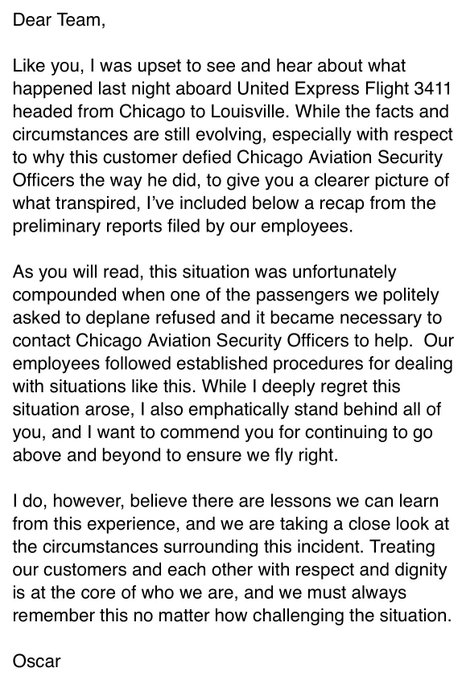
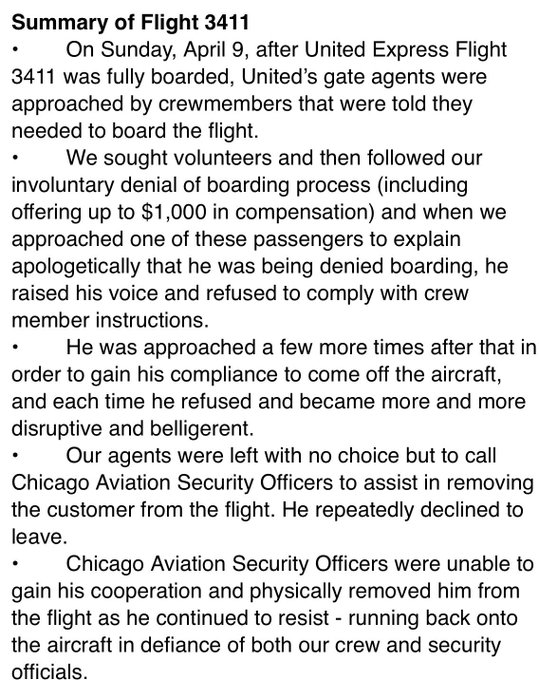
Lots has been said about how United Airlines mishandled violently dragging a passenger from an overbooked flight. And none of it is good. Yet, make no mistake, how United CEO Oscar Munoz communicated with his company’s employees immediately following the incident did not do anything to make it any better.
View image on TwitterView image on Twitter
What can you and your company learn from this public relations nightmare? What you say to your employees matters, a lot. Your employees are your brand ambassadors. Employees should be your best resource to spread the good word about your company. Moreover, they are usually more than willing to do so. How you communicate with them instructs how they deliver that message.
More importantly, you cannot assume what you tell your employee will remain within the four walls of your company. For better or for worse, we live in a viral society. Everything we write, say, and do is likely to end up on the internet. This story became a story because passengers took out their phones, recorded video and posted it across social web as quickly as they could. Just as quickly, Munoz’s tone deaf and insensitive statement to his employees also went viral. And he made a bad situation that much worse.
What if, however, instead of calling the passenger “disruptive and belligerent” (among other mistakes), Munoz wrote something like the following?
Dear United employees:
By now we’ve all seen the disturbing video of a United customer being forcibly removed from one of our planes in Chicago. While we can imagine the type of situation that could lead to reaction such as this, this was not that situation. Overbooked flights happen all the time, but this is not the way we (or anyone) should handle them. It escalated out of control, and for that I am truly sorry.
This unfortunate incident should have never happened, and I will do everything in my control to ensure that as long as I run this company, it never happens again. We are fully investigating how we allowed this occur, and when that investigation is complete those involved will be retrained, or, if necessary, disciplined.
In addition, I am announcing a company-wide initiative (details to follow) to retrain all United employees on the art of customer-first customer service. Our customers always come first. Without our customers, we have no United.  
Should you have any questions, or would like to report (anonymously or otherwise) a customer service failure that you have witnessed, I have set up both a telephone hotline (888-555-5555) and a dedicated email account (complaint@united.com) special for these needs.
Employees, our slogan is, and shall remain, “Fly the friendly skies.” Let’s do everything in our power to live that slogan in everything that we do.
Crisis over, right?

Jon Hyman is a partner at Meyers, Roman, Friedberg & Lewis in Cleveland. To comment, email editors@workforce.com. Follow Hyman’s blog at Workforce.com/PracticalEmployer.


Posted on April 11, 2017June 29, 2023

Bill O’Reilly and Fox News Teach Us How Not to Ignore Workplace Harassment

Jon Hyman The Practical Employer
Bill O’Reilly’s (alleged) lewd comments and inappropriate come-ons may have finally caught up to him and his employer, Fox News. I don’t, however, want to focus my attention on the salacious allegations, which are just that, allegation. Instead, I’d like to focus on Fox News’s response to the allegations, as to why it has so dragged its feet to do anything in response.

I’ll let John Oliver explain only as he can.

Fox News’s full statement (via CNN):

Notwithstanding the fact that no current or former Fox News employee ever took advantage of the 21st Century Fox hotline to raise a concern about Bill O’Reilly, even anonymously, we have looked into these matters over the last few months and discussed them with Mr. O’Reilly. While he denies the merits of these claims, Mr. O’Reilly has resolved those he regarded as his personal responsibility. Mr. O’Reilly is fully committed to supporting our efforts to improve the environment for all our employees at Fox News.

Yes, Fox News did ultimately investigate these allegations, but it appears not until way after the fact.

Readers, is it appropriate to ignore workplace harassment just because no one has brought it HR’s attention? I’ll give you two choices — “no” or “no.”

Under no circumstances should you ever bury your corporate head in the sand in the face of workplace harassment. You must not ignore harassment that you know about or should know about. It is not a defense for you to close your eyes and hope that it will all be gone when you open them. Just ask Fox News (which, according to The New York Times, has settled the claims of five women for $13 million) how that strategy has worked out for it.

Posted on April 10, 2017June 29, 2023

Pret A Manger Closes Shop — for the Right Reasons

When one of the little eateries in our food court is completely dark on a Monday morning it’s normally for the wrong reasons.

When it’s an outlet of a chain of popular quick-serve restaurants — and one I occasionally patronize — my mind instinctively goes for the jugular.

“Whoa, I must’ve missed the news; I didn’t know Pret A Manger shut down,” I thought as I passed the Starbucks and neared the restaurant that in my book makes a damn fine tureen of Moroccan lentil soup.

If you’ve ever visited a Pret, you know that its staff is bubbly to the point of “you can’t possibly be in this good of a mood” obnoxiousness, loud, happy and always there with a kind word even if you’re not stopping for a bite or a coffee. Which is likely why it was even more obvious that something was terribly wrong.

On one hand I’m glad to report that Pret A Manger in the food court of 225 N. Michigan Avenue is not permanently closed. On the other, however, a sign in the darkened window near the coffee read:

“Our shop is closed today.

“We are so sorry to let you know that Dante Colloly, a much-loved member and manager of the Pret team, passed away following a motor vehicle accident on Saturday night.

Pret A Manger
Fast casual restaurant Pret A Manger closed its stores in Chicago after the unexpected death of co-worker Dante Colloly. Photo by Rick Bell

“Our thoughts and prayers are with his family and his many friends.

“The entire Pret team mourns the loss of our wonderful colleague. He will be forever missed.”

Pret A Manger

I walked away stunned — stunned initially about the news of the death of someone who very likely offered me a friendly howdy and rung me up. But as I passed the other chain establishments both large and small — Dunkin’ Donuts, Jaffa Bagels, Potbelly, McDonald’s, Burrito Beach — I wondered if they would do the same if a team member suddenly died. Really, would any company in the entire Illinois Center complex — literally thousands of businesses, ranging from international consulates to FOX 32 to well-heeled law firms to Human Capital Media — shut down for a day if someone died?

The answer is, probably not. And that’s OK. Every business has to evaluate what a death in the workplace family means to the organization — personally, professionally and financially.

Mr. Colloly was 29 when the motorcycle he was driving Saturday afternoon struck a guardrail on South Lake Shore Drive. He was thrown onto the bike path, according to the Chicago Sun-Times and died at a hospital a short time later.

When our co-owner Norm Kamikow died suddenly in the summer of 2014 there were many heavy hearts and tears shed, but the doors remained open as we worked through our grief. I didn’t think it was wrong then, and even after today’s shocker, I still don’t think it was.

We later discovered the store closures extended beyond our food court. My colleague Bravetta Hassell passed by another Pret A Manger during a midday walk Monday and it, too, was closed. We found this Twitter post:

“We regret to inform you that our Chicago shops are closed today to mourn the loss of a dear colleague. We apologize for the inconvenience.”

I can’t begin to calculate what one Pret A Manger location brings in on a Monday in April. But multiply that by the dozen or so in the downtown Chicago area alone and it has to be a sizeable chunk of change.

Also, consider that in roughly 24 hours Pret team leaders came to the conclusion to close not just one store but locations across the city. Dante Colloly died on Saturday afternoon and by early Monday morning a well-thought out, clear, passionate message about a beloved colleague was posted at all its locations. Credit Pret corporate executives for ceding a lot of control to managers on a local level. A gofundme page has been posted for Mr. Colloly, too.

True, Pret has been maligned in the past for manufacturing its air of employee happiness. But it’s clear that in the wake of Mr. Colloly’s death, the British-based chain has developed a deep culture of trust and concern for its workers’ well being.

As people passed the sign during a busy Monday lunch hour, one woman commented to her colleague, “That’s so sad; they are all such nice people there.”

Not an unexpected refrain when you put your people ahead of profits.

Rick Bell is Workforce’s editorial director. Comment below or email editors@workforce.com.

Posted on April 10, 2017June 29, 2023

The Pepsi Ad Debacle and Reminding Managers About Inclusion

There’s no need to rehash the recent Pepsi ad seen ’round the world. The commercial that featured Kendall Jenner handing a can of the pop to a police officer as the healing balm for the day’s pressing social issues was tone-deaf, a reach and a failure. Did I mention it was also cheesy?

Plenty of marketing experts — and tons more people in the Twittersphere and other social media spaces — have taken the company to task for doing more things than I care to go over in this post. I hope the following covers it all when I say Pepsi attempted to reach as wide an audience as it could by, oddly, attempting to conflate its branding of being free-spirited, happy and whimsical with the energy of discontent, dissatisfaction and injustice that has prompted people across the country to demonstrate and protest.

You just can’t mix the two.

There’s no shared space for what looks like a block party and what is a protest against police brutality. But Pepsi attempted to create such a place. The ad instantly raised questions about the state of the advertising industry, how Pepsi’s half-baked concept even got off the table in the first place, and who was and wasn’t at the creative and decision-making meetings for this ad but should have been.

Whenever completely offensive pieces like the Pepsi ad see the light of day, the assumption is that “the table,” wasn’t diverse enough. Surely, with a wider range of cultural and life experiences at the table, the ad concept would have been axed right out of hand:

“Kendall Jenner? Modeling? During a protest that alludes to Black Lives Matter? With police? With her handing an officer a Pepsi and everyone cheering? What?” Awkward silence. “Um, are there some other ideas … better ones? Team?”

culture at work

Sadly, African Americans made up on 5.8 percent of the ad industry in 2014. In 1978, just 5 percent of the ad industry was made up of black and Hispanic employees. So there’s a decent chance that Pepsi’s creative was more on the homogenous side than it was, well, like that ad, to be honest.

But I’ll give them the benefit of the doubt on that for the moment. I don’t work there. I’m not in their HR department. Maybe there were diverse voices at this table. But then I ask, were those diverse voices heard? Was space made for these employees to share their ideas and opinions? Was the environment they contributed to one where they were treated like equal team members or dismissed as tokens?

Because diversity is one thing, but inclusion is quite another. By way of the Pepsi ad, a gift from the blog gods, I’ll take the time to encourage learning leaders to — in the midst of supporting their organization’s strategic diversity and inclusion efforts — work with managers on being inclusive leaders.

In Harvard Business Review, HBR Guide to Office Politics author Karen Dillon reminds managers to recognize the dangers of playing favorites — whatever favorites might look like. “If you’re narrowly focused on always picking your dream team, you’re putting your eggs in one basket.” Plus by not playing fair, managers are undercutting what their team could accomplish when everyone’s abilities and contributions are utilized. Playing favorites limits team development and that of the excluded individual, and it holds back the manager’s own professional development, too, Dillon told HBR.

Dillon also encourages managers to keep track of who is doing what on the team. That way they are consciously making an effort to delegate work more equitably. People who aren’t picked for the best assignments are keenly aware of it, Dillon said. So managers should keep tabs on whose turn it is to do things like run team meetings and so forth.

Of course, in behaving inclusively, managers need to think inclusively. They should be looking for ways to make sure everyone is included in the group work even if it is by way of a minor role. Managers should also encourage their reports to speak up and to make sure team meetings are participatory.

The HR Council of Canada reminds managers about the importance of relationship building with all of their direct reports. In learning about employees’ backgrounds, lives and interests outside of work, managers can build relationships “through increased understanding and trust,” which helps to foster inclusion.

But pulling back from the few tips I’ve just shared, inclusion of diversity in all its forms is ultimately what drives greater innovation. Closer to the Pepsi story, inclusion of diversity will enable companies to do a better job of reaching and connecting with their customers. Because having underrepresented groups at the table is decent but becomes game-changing when leaders allow them the floor to contribute, to opine, to create, to challenge, to collaborate, to help decide.

Creativity suffers otherwise. Individual morale and productivity suffer, too. And companies like Pepsi scramble to salvage their image while apologizing for shoddy work.

Bravetta Hassell is a Workforce associate editor. Comment below, or email editor@CLOmedia.com.

Posted on April 10, 2017June 29, 2023

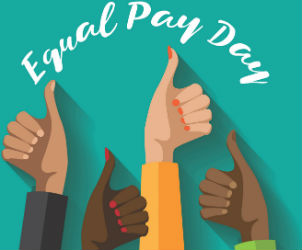
Equal Pay Day and Voting with Your Feet

April 4 was Equal Pay Day. It’s not a bank holiday, so no one got to stay home from work, but it is an important date for women.

LeanIn.org, the nonprofit Facebook COO Sheryl Sandberg created to make the workplace better for women, launched its latest campaign/hashtag on the 4th. Joining #BanBossy and #LeanInTogether, #20PercentCounts shines a bright light on the fact that, on average, women make 20 percent less than men in the U.S.

According to the Forbes piece where I learned about the campaign, that stat is quite a bit worse if you’re a woman of color. Black women make 37 percent less, and Hispanic women make 46 percent less. Over the lifetime of a woman’s career that disparity could cost her a good half million dollars.

Ouch. I’m bleeding over here, metaphorically speaking. But, in an effort to stem some of the pain, starting on the 4th hundreds of companies around the country are offering a 20 percent discount to draw attention to wage disparities.

That’s great. But you know me. I want to know why. Why does this pay gap still exist? Why are so few organizations correcting these obvious inequities? They know about the problem; the data certainly isn’t a secret. The scope of the issue is not small; it touches every industry with the possible exception of the fashion industry; female models traditionally make more than their male counterparts.

Even if companies could reasonably pretend ignorance President Obama publicly tried to put us on the path to financial parity. Though his efforts have been neatly undercut, or should I say revoked, by the current administration.

So why the whole ostrich act? It’s a complex answer related to widespread workplace culture change, budgets, leadership accountability, commitment to diversity and inclusion and a host of other strategic concerns that impact most dimensions of diversity in some shape or another. But the short answer is, companies don’t want to fix this problem.

But here’s the thing. Women are fed up, and we’re speaking out. Executives like Sheryl Sandberg, actresses like Jennifer Lawrence, Emma Watson and a host of others — including some big name men — are creating a stink that could have direct implications for the talent marketplace.

So, diversity and talent leaders, if your company isn’t making an effort to make its pay practices fair, you’ve been officially put on notice. Do it, or you will lose talent, you will lose discretionary effort, you will lose engagement, productivity and more. You will incur negative costs related to turnover, retention, recruiting, litigation and brand reputation. All it takes is one tweet or video to go viral, and your standing in the global marketplace will take a hit so big it’ll make a gunshot look like a scratch.

Ask Lyft. It has been thoroughly enjoying the customer-related fruits of Uber’s female-centric missteps. Ask Pepsi. That team can tell you what happens when you make light of the issues that minorities care about. And women — all numbers aside — are very much considered minorities.

We’re also not stupid. We know the only thing standing between us and a fair wage is desire. If I’m not being clear, I’m saying: Women aren’t being paid the same salaries as their male peers for the same work because companies don’t want to pay them the same salaries as their male peers for the same work.

Companies don’t want to invest the time or the resources to investigate and identify pay inequities and root out the issues that perpetuate this cycle of discrimination. That would take time, effort and require a ton of change, and we all know change is rarely easy for any person, let alone an entire organization.

Companies don’t want to acknowledge that they may be — are — systemically cheating a sizeable chunk of their workforce out of their hard-earned pay. It could throw the door to legal sanctions wide open, bring the wrath of a thousand lawsuits down on their heads, not to mention giving women ideas about what else they deserve in the workplace.

But companies are going to pay one way or the other, whether in cash or in kind. Think about this scenario.

A hard-working woman with great ideas and a knack for business development requests a raise after learning her male peer is making more money than she is. She is denied. She leaves, starts her own company, and many of the clients she brought to her former employer choose to leave with her. See, they know where the talent and creative juice comes from.

She pulls so much business away from her old employer they have to hire her as an external consultant to get back some of that innovative, market savvy they shortsightedly let go. Her rate as an independent operator is triple — or more — what it was when she was an employee.

I didn’t just make that story up. It happens all the time because more women than ever are choosing to leave the workforce and start their own businesses.

Companies have a choice to make. Will they pay on the front end — top talent recruiting, brand reputation, customer loyalty — or will they pay on the back end — legal fees, turnover, retention issues? Will they acknowledge that pay gaps exist and do the work required to close them, or will they turn a blind eye and unwittingly encourage their female talent to vote for a better way of life and career with their feet?

It’s up to talent leaders to decide how and when they’ll take that bitter pill, and whether or not they’ll choke while it’s going down.

Kellye Whitney is associate editorial director for Workforce. Comment below or email editor@workforce.com.

Posted on April 10, 2017June 29, 2023

WorldatWork Names Scott Cawood as New President and CEO

Human resources association WorldatWork named Scott Cawood as its new president and CEO.

WorldatWork
Scott Cawood

“I’m eager to join an organization that is so well poised to influence the daily experience of thousands of employees worldwide,” Cawood said. “It’s an exceptional honor, and I look forward to making even greater strides with the amazing team at WorldatWork.”

Cawood will succeed Anne Ruddy, who has served as WorldatWork president and CEO for 17 years. Ruddy will step down from the leadership role in June 2017. “The WorldatWork Board of Directors is looking forward to welcoming Scott to our organization,” said Lead Director Sara R. McAuley. “His combination of deep business experience, energy, knowledge of best practices in talent management, and broad-based leadership capabilities make him exceptionally qualified.”

Cawood joins Scottsdale, Arizona-based WorldatWork from his most recent position as global leader, organizational effectiveness at W.L. Gore & Associates Inc. He led the organizational efforts to achieve the enterprise strategy, including maximizing associate engagement and aligning the culture with critical business priorities.

Cawood held positions as president of Synygy, a global compensation and sales software company. Prior to this, he was chief operations and people officer. He also has held senior leadership positions at Revlon and the Great Place to Work Institute.

Cawood holds an M.S. in education and Ed.D. in organization- and work-based learning from the University of Pennsylvania. He also is certified as a Senior Professional in Human Resources from the HR Certification Institute.

Cawood will officially join the association full time May 15.

Mia Mancini is a Workforce intern. Comment below or email editors@workforce.com.

Posted on April 10, 2017June 29, 2023

Promotion After Protected Activity Dooms Employee’s Retaliation Claim

Jon Hyman The Practical Employer

What does unlawful retaliation not look like? Burton v. Board of Regents of Univ. of Wisc. Sys. (7th Cir. 3/17/17) offers a good example.

Sabina Burton, a tenured track professor at the University of Wisconsin, claimed that she suffered retaliation after complaining about witnessing sexual harassment within her department. As a result, she claimed that her colleagues withdrew support for a new curriculum for which she had been advocating. Ultimately, however, the court concluded that a promotion and pay raise after Burton’s claimed protected activity doomed her retaliation claim.

Professor Burton undoubtedly feels that she has been treated unfairly by some of her superiors at the University because she reported alleged harassment and proceeded with this case. Yet the record does not support her claims. During the relevant period, Burton was granted tenure by a unanimous vote and the University held a public ceremony celebrating Burton’s receipt of a grant from AT&T. Dean Throop even sought an upward salary adjustment for her after she had brought a charge with the Wisconsin ERD. Burton’s frustrations may be significant, but they do not amount to actionable retaliation.

 This court (correctly, in my opinion) concluded that no reasonable juror could find that an employer which promotes an employee only months after an alleged harassment complaint would nevertheless harbor a retaliatory motive.
The lesson here is not to promote or give a raise to every employee who engages in protected activity. Instead, take away this lesson. At the end of the day, retaliation and discrimination cases hinge on a “more likely” standard. In considering the totality of the evidence, is it more likely than not that the employer retaliated/discriminated against the employee? That burden becomes difficult for an employee to overcome when an employee — despite some slights and unfair treatment following protected conduct — enjoys subsequent benefits.
Jon Hyman is a partner at Meyers, Roman, Friedberg & Lewis in Cleveland. To comment, email editors@workforce.com. Follow Hyman’s blog at Workforce.com/PracticalEmployer.
Posted on April 7, 2017October 8, 2021

Evolution of the HR Executive: From Personnel to Organizational Secret Weapon

We hear a great deal about how the function of human resources has evolved over the years, but this might never have occurred without today’s HR executive, who has driven this change through their own business savvy and knowledge.

In the role of director, we saw the HR leader function primarily as a personnel management facilitator. But as organizations grew and globalized in exceptionally challenging business environments, so did the need for HR in a different capacity. HR was drawn further and deeper into organizational decision-making and planning, addressing a much-needed void.

The shift in role from director to executive evolved as a direct response and is due largely to HR’s unique combination of experience, exposure to the inner sanctum of upper-level executives and organizational issues, and unmatchable knowledge that has been valued and expanded upon in recent years. Human resource executives are often considered the right arm of an organization because they make things happen that no other single department can.

Today, human resource executives:

  • Build knowledge to ensure an organization’s growth, strong leadership, and sustainability in highly competitive environments.
  • Ensure longevity of an organization through thoughtful succession planning that protects key intellectual capital and key positions, as well as the larger organization.
  • Oversee smart and ongoing regulatory compliance.
  • Participate in planned mergers and acquisitions by determining knowledge valuation and human capital assets to justify proceeding, then work to effectively merge the different cultures.

It would be challenging to identify any other department or division executive who does all these things as part of their regular agenda. But this is the reality of the HR executive today.

Yesteryear’s HR Picture

Many of us reported to HR on our first day of work, perhaps in a trailer behind the building that housed the business functions and corporate offices — an afterthought location for the personnel-only functions. That was during a time when the broad and diverse talent potential of the HR executive — then an unknown commodity — was unnoticed and untapped. It is where the HR executive began, with a hand to the dynamic line of employees and an eye to the organization and its future, then evolved into a key force for the C-suite to fuel and turn loose. Not unlike the famous scientific illustration of evolution that began with the caveman and fluidly grew into the perfectly upright human, the HR executive of today has truly transformed.

Today’s Head-of-the-Line Picture

Today’s organizations need every manager and leader, particularly those in HR, to see the organization through a systems view that is connected to the global environment. However, they must also have an eye for detail, in order to optimize the talent and knowledge needed to achieve full organizational capacity in every part of the world where the company operates. This must all be achieved while maintaining full compliance within a profoundly diverse set of country-specific mandates. If the HR executive is not one of these fully evolved leaders, that organization loses in the race for savvy and smart employees and the operating edge in very aggressive markets.

Human resources is in the unique position of touching every single employee at every level, connecting with every major organizational initiative, and teaming with the legal team to protect both the employees and the organization.

Emotional Intelligence

The HR executive has become one of the strongest executive team members in guiding organizations through global waters, mergers and acquisitions, and even market expansions, because without their unique knowledge and experience, critical elements could be missed. This makes sense in a practice field whose origin was singularly people-focused. That personnel-focused beginning, while limiting, when blended with emotional intelligence and a global view, allows organizations to understand what inspires, drives and motivates people, providing a strong basis for HR’s leadership role in the multinational and multigenerational global workplace.

Emotional intelligence is what has differentiated the HR executive from others because it requires an almost inherent ability to relate well to those around you, to separate oneself from one’s ego and the omnipresent larger and strategic organizational view. Author Daniel Goleman reflected the heart of this in his book, “Working with Emotional Intelligence”: “The rules for work are changing. We’re being judged by a new yardstick: not just by how smart we are, or by our training and expertise, but also by how well we handle ourselves and each other.”

The Effective Executive

Utilizing emotional intelligence to understand how people tick and what inspires or motivates them, while at the same time keeping a long-term global view, turns out to be a perfect blend for executive leaders — attributes that are not easily found.

The evolution of the HR executive has created a highly desirable mix of knowledge, capability and wisdom, so essential in a world where leadership and leaders’ decisions are less confident and less predictable than ever in history. Human resource executives have grown into their new role with a substantial foundation of experience, while many other roles within companies are trying to catch on or up. This slow but steady evolution from a sole focus on personnel to a solid executive, C-suite team player, and a neutral advocate with an executive global view, is here to stay.

Wanda Gravett is a core faculty member for Walden University’s master’s in human resource management program. Before joining academia, Gravett was a corporate HR executive, serving as the organizational change leader with the Sisters of Charity Healthcare System, Houston corporate headquarters. She also served as CEO and board chair for the Seattle/L.A.-based Omicron Group, designing and improving the HR audit process.

Posted on April 6, 2017June 29, 2023

A Lesson on Workplace Posters From of All Places, ‘Homeland’

Jon Hyman The Practical Employer

If you’re on the Showtime TV feature “Homeland” and operating a covert, CIA backed, sock-puppet misinformation operation, where do you hang your workplace posters? In your interrogation room, of course.

State and federal laws require that all employers have posters conspicuously placed in the workplace.
What posters are you required to post? There are a bunch, although your mileage will vary based on which statutes cover your business and which do not.
  • Employee Polygraph Protection Act (all employers)
  • Employee Rights for Workers with Disabilities/Special Minimum Wage (all employers with disabled workers employed under special minimum wage certificates)
  • Equal Employment Opportunity is the Law (all employers with 15 or more employees, and all federal contractors and subcontractors wtih contracts of $10,000 or more)
  • Equal Employment Opportunity is the Law Supplement (all federal contractors and subcontractors wtih contracts of $10,000 or more)
  • E-Verify Participation and Right to Work (all employers participating in E-Verify)
  • Fair Labor Standards Act (all employers)
  • Family and Medical Leave Act: Your Rights Under the FMLA (all employers with 50 or more employees in 20 or more workweeks in the current or preceding calendar year)
  • Federal Minimum Wage for Contractors (all employer who contract with the federal government)
  • Notification of Employee Rights Under Federal Labor Law (all federal contractors and subcontractors)
  • OSHA Job Safety and Health: It’s the Law (all employers)
  • OSHA Form 300, 300A, and 301 (most employers with 10 or more employees)
  • Uniformed Services Employment and Reemployment Rights Act: Your Rights Under USERRA (all employers)
  • State Minimum Wage (all employers)

Additionally, states have their own additional posting requirements. The good news is that all of these posters are available for free from state and federal agencies. Just make sure they are posted conspicuously, which, “Homeland” not withstanding, is likely not in your locked interrogation room.

Jon Hyman is a partner at Meyers, Roman, Friedberg & Lewis in Cleveland. To comment, email editors@workforce.com. Follow Hyman’s blog at Workforce.com/PracticalEmployer.

Posted on April 5, 2017June 29, 2023

Historic Ruling Bans Workplace LGBT Discrimination

Jon Hyman The Practical Employer

If you spend any time reading or watching the news today, you will inevitably encounter much about the 7th Circuit’s historic (and correct, in my opinion) decision in Hivley v. Ivy Tech Community College [pdf]. You can read the background of this case here.

The court expressly held that “a person who alleges that she experienced employment discrimination on the basis of her sexual orientation has put forth a case of sex discrimination for Title VII purposes.” Hivley now stands in direct contradiction to the opinion of the 11th Circuit in Evans v. Georgia Regional Hosp., which sets up this issue for a showdown in the Supreme Court.

Which turns my attention to the more interesting aspect of this case — the court’s discussions of the role of judges in interpreting statutes. Much was made about this issue in the recent Senate hearing on the nomination of Neil Gorsuch to fill Justice Antonin Scalia’s Supreme Court seat. On this issue, this court has a lot to say.

Let’s start with the concurring words of Judge Richard A. Posner (which include a not-so-veiled shot at Fox News and its view of originalism in statutory construction), who astutely explains that one can act the judicial conservative and interpret original statutory intent as changing with the times.

In 1964 (and indeed until the 2000s), and in some states until the Supreme Court’s decision in Obergefell v. Hodges, men were not allowed to marry each other, nor women allowed to marry each other. If in those days an employer fired a lesbian because he didn’t like lesbians, he would have said that he was not firing her because she was a woman — he would not have fired her had she been heterosexual — and so he was not discriminating on the basis of sex as understood by the authors and ratifiers of Title VII. But today “sex” has a broader meaning than the genitalia you’re born with. …

But it has taken our courts and our society a considerable while to realize that sexual harassment, which has been pervasive in many workplaces (including many Capitol Hill offices and, notoriously, Fox News, among many other institutions), is a form of sex discrimination. It has taken a little longer for realization to dawn that discrimination based on a woman’s failure to fulfill stereotypical gender roles is also a form of sex discrimination. And it has taken still longer, with a substantial volume of cases struggling and failing to maintain a plausible, defensible line between sex discrimination and sexual-orientation discrimination, to realize that homosexuality is nothing worse than failing to fulfill stereotypical gender roles. …

We now understand that homosexual men and women (and also bisexuals, defined as having both homosexual and heterosexual orientations) are normal in the ways that count, and beyond that have made many outstanding intellectual and cultural contributions to society … . We now understand that homosexuals, male and female, play an essential role, in this country … . The compelling social interest in protecting homosexuals (male and female) from discrimination justifies an admittedly loose “interpretation” of the word “sex” in Title VII to embrace homosexuality: an interpretation that cannot be imputed to the framers of the statute but that we are entitled to adopt in light of (to quote Holmes) “what this country has become,” or, in Blackstonian terminology, to embrace as a sensible deviation from the literal or original meaning of the statutory language.

Compare this definition of “originalism” to that of the dissenting opinion of Judge Diane S. Sykes:

Of course there is a robust debate on this subject in our culture, media, and politics. Attitudes about gay rights have dramatically shifted in the 53 years since the Civil Rights Act was adopted. … This striking cultural change informs a case for legislative change and might eventually persuade the people’s representatives to amend the statute to implement a new public policy. But it does not bear on the sole inquiry properly before the en banc court: Is the prevailing interpretation of Title VII — that discrimination on the basis of sexual orientation is different in kind and not a form of sex discrimination — wrong as an original matter? …

But the analysis must begin with the statutory text; it largely ends there too. Is it even remotely plausible that in 1964, when Title VII was adopted, a reasonable person competent in the English language would have understood that a law banning employment discrimination “because of sex” also banned discrimination because of sexual orientation? The answer is no, of course not. …

To a fluent speaker of the English language — then and now — the ordinary meaning of the word “sex” does not fairly include the concept of “sexual orientation.” The two terms are never used interchangeably, and the latter is not subsumed within the former; there is no overlap in meaning. …

The words plainly describe different traits, and the separate and distinct meaning of each term is easily grasped. More specifically to the point here, discrimination “because of sex” is not reasonably understood to include discrimination based on sexual orientation, a different immutable characteristic. Classifying people by sexual orientation is different than classifying them by sex. The two traits are categorically distinct and widely recognized as such. There is no ambiguity or vagueness here.

This debate over the meaning of originalism will resume when this issue reaches SCOTUS, and will likely hold the key to how SCOTUS decides whether Title VII’s definition of sex includes LGBT rights. Of course, Congress could moot this entire issue simply by amending Title VII, but I don’t see that happening anytime soon.

Jon Hyman is a partner at Meyers, Roman, Friedberg & Lewis in Cleveland. To comment, email editors@workforce.com. Follow Hyman’s blog at Workforce.com/PracticalEmployer.

Posts navigation

Previous page Page 1 … Page 75 Page 76 Page 77 … Page 95 Next page


Webinars


White Papers


  • Topics

    • Benefits
    • Compensation
    • HR Administration
    • Legal
    • Recruitment
    • Staffing Management
    • Training
    • Technology
    • Workplace Culture
  • Resources

    • Subscribe
    • Current Issue
    • Email Sign Up
    • Contribute
    • Research
    • Awards
    • White Papers
  • Events

    • Upcoming Events
    • Webinars
    • Spotlight Webinars
    • Speakers Bureau
    • Custom Events
  • Follow Us

    • LinkedIn
    • Twitter
    • Facebook
    • YouTube
    • RSS
  • Advertise

    • Editorial Calendar
    • Media Kit
    • Contact a Strategy Consultant
    • Vendor Directory
  • About Us

    • Our Company
    • Our Team
    • Press
    • Contact Us
    • Privacy Policy
    • Terms Of Use
Proudly powered by WordPress