Skip to content

Workforce

Author: Rick Bell

Posted on December 19, 2016July 24, 2024

Onboarding Apps Can Aid Adding New Employees

onboarding process
wf_1216_onboarding_story
Mobile apps are one to to enhance the employee onboarding experience.

Every year more than 25 percent of the U.S. working population changes jobs, according to research by the SHRM Foundation. This means at least 25 percent of the workforce annually goes through the onboarding process that aims to make a new hire an inherent part of the organization. Human resources normally handles onboarding, and the faster and smoother the process, the sooner and more effectively a newcomer can contribute to the company.

Software can effectively support the onboarding process, and apps can aid what SHRM calls its “4 levers of successful onboarding”: role clarity, self-efficacy, social integration and knowledge of culture.

Depending on the role and the industry, onboarding may take from one week to 90 days. Many large organizations think of onboarding as a longer and a more delicate process: IBM’s assimilation process plan integrates a new hire into a company for a year, while L’OrĂ©al offers its newcomers an onboarding program that lasts two years.

The use of IT is one reason why companies can afford such prolonged, multi-level and deep employee assimilation. Onboarding software can help employees complete onboarding in 30 days or less and helps reduce managerial efforts.

Having their own approach to introducing new employees to the business, every company can benefit from technologies in different ways. Foodmaker Kellogg Co. used a “track record tool” that helped to tailor an onboarding plan according to employees’ descriptions of their previous onboarding experience, while Microsoft has come up with an entire computer-based onboarding program.

Consultancy Deloitte’s research targeted at HR management shows that mobile employee apps increase employee engagement, real-time response as well as workforce satisfaction. However, 50 percent of the HR professionals admitted not using apps for onboarding and named the need to integrate an app with their existing HRM processes and corporate software as the main impediment.

That said, an onboarding app can be introduced to companies both with an onboarding IT system in place and without one. Even if not developed as a part of an onboarding solution from the very start, a mobile app can complement the existing onboarding software by either replicating its functions or extending them, being integrated via a backend. Alternatively, a mobile app can be a standalone tool with self-sufficient features. Native or not, mobile apps can be brought in to any infrastructure, so the choice of a mobile development platform is not the matter of technological aptness. If there’s no preference over a certain mobile brand in the company, a good chance to reach out to newcomers will be with cross-platform mobile development.

Onboarding With an App

SHRM’s research introduced the HR community to its four levers of successful onboarding: role clarity, self-efficacy, social integration and knowledge of culture. An app is one way to get the most out of each.

Role Clarity

If expectations and responsibilities are stated clearly at the very beginning, onboarding will lead to better job satisfaction. Being able to check with a portable onboarding plan, a new hire will get a comprehensive understanding of their role in the company along with the objectives they are to achieve. A mobile plan can also help employees fall into the habit of their daily activities by sending reminders about the next necessary step.

Self-efficacy

It’s important for a new hire to gain confidence in their skills at a new place. An interactive manual in a mobile app could get them accustomed to new procedures such as handling certain equipment/business-specific software or installing a product on a customer’s premises. The app can help a new employee feel less stressed and pressured even while going through their onboarding in the field.

Social Integration

An onboarding app with a calendar can inform workers about corporate holidays and birthdays with customizable notifications, while a special guide can, for instance, let a new hire find out about the nearby places to have lunch. The app also can help newcomers navigate the company office. At large offices, some gaming elements can be added to raise motivation to explore the property; for instance, a new employee could earn an achievement badge for discovering certain locations for the first time.

Knowledge of Culture

A company can introduce its both formal and informal regulations in a mobile handbook. Apart from mere ‘static’ rules, the handbook feature can contain tools that will get a new hire accustomed to behavior, generally accepted by the company’s culture. For example, a new hire in a restaurant can make use of a checklist that reminds to greet a client, a special offer after taking the order and thank them — all in the manner specific to the company.

When automated with the help of an app, onboarding turns into a process that is deeper at its core but easier on human resources and line management. Replicating an existing onboarding solution, extending its functionality or creating a standalone app — the choice is up to every company and depends on particular business needs. Yet regardless of the specifics, such an app can support all onboarding with onboarding plans, interactive manuals, training and review modules, as well as handbooks and office augmented reality maps.

Tatiana Lebedzeva is a business analyst at ScienceSoft, a software development and consulting company in McKinney, Texas. With three years’ experience as a human resources manager, Lebedzeva has expertise in staff performance, HR administration and HR software.

Posted on December 18, 2016June 29, 2023

Dropbox Learns — Painfully — One Twitter Snafu and You Are Toast

Media can be tricky. Especially social media. One poorly written sentence, ill-timed tweet or poor photo choice, and you’ll end up with your corporate image in a sling.

Ask cloud storage company Dropbox. They know.

Poor Dropbox. When they released their diversity numbers earlier this week, they meant well, really they did. If only the trolls would stop trolling, and the eyes would stop rolling long enough to realize, the picture in their unfortunate Dec. 14th tweet was not connected — in a perfectly straight line — to the associated content’s message.

I get it. Tweet, “Diversity at Dropbox: http://bit.ly/2hFEqlS” and then show a picture of five white people and an Asian woman — who you might confuse for a sixth white person if you’re not looking closely — and it’s bound to cause a bit of confusion. But I sincerely believe the company and the unfortunate media/marketing person who created the tweet and is now locked in a dark room with an ice pack over his/her eyes was referring to the information, not the picture. It was just poorly done; a mistake.

According to an Inc. article: “About five hours after Dropbox sent out its report, the company clarified that the picture includes Dropbox co-founder Arash Ferdowsi who is Iranian, Head of People Arden Hoffman who is lesbian and Lin-Hua Wu, a vice president of communications, who is Asian.

“This photo was meant to highlight the increase of women in senior leadership roles,” the company said in a statement. “We realize it doesn’t fully represent the diverse workforce we strive for at Dropbox. Improving our diversity continues to be one of our top priorities in 2017 and beyond.”

OK, Dropbox. We’re here for that. We know perfection does not exist. People make mistakes. Companies do too. The thing is, it’s absolutely terrible to make them on social media. Really. It’s terrible.

For instance, I’m starting a YouTube channel — no, there will be no makeup tutorials; I’m not that skilled — and my sister, trying to help me get the 100 subscribers I need to get a custom URL and not the hodgepodge of numbers and letters that currently represent me, posted a notice on Facebook. But she spelled my name wrong, and she didn’t have a call to action: Please click here to subscribe to Kellye’s channel. So, essentially, she was misrepresenting me, and there is no point to it. I was not pleased.

You know me. You do not see my work full of errors. My picture choices may not always be fabulous, and they may occasionally veer over the controversial line, but they’re usually appropriate, my links work, and the basics are there. You get the message whether you agree with it or not.

But when I tried to correct her, she acted like I’d just kicked her brand new, shiny black fur, gold-eyed puppy across a field. Image is important! Especially when you’re trying to get a new project off the ground in a visual platform — or in Dropbox’s case, when a company is trying to convey valuable information, set a tone and position its brand a certain way.

The venom that followed Dropbox’s mistake — the tweeted photo of a row of different mayonnaise jars seemed especially painful — the heat? It was telling. It was also excessive and unnecessary, but people are tired of companies soft soaping them when it comes to diversity and inclusion.

Potential customers, clients and employees want vendors/employers to do better. In, many cases, they demand it. Just last week I blogged that organizational diversity is a key motivator for Millennial job seekers. Image is everything.

“It’s important that marketing material make people feel welcome,” said Deldelp Medina, director of the residency program at nonprofit organization Code2040, in the aforementioned Inc. article.

Diversity and inclusion in the workplace is not something one can be careless about. Not today. Not with what’s going on in the world. And certainly not with the shortages of skilled talent that so many industries — like tech — are currently suffering from. Companies cannot afford to needlessly alienate anyone.

The sad part is Dropbox’s new diversity report actually had promising data to share: It’s representation of women in leadership increased 6 percentage points, and its number of black employees rose from 2 to 3 percent in 2016. The number of Hispanics also increased from 5 to 6 percent.

“We’ve made modest strides,” Dropbox said in its report, “but we still have work to do.” The company called them modest strides. I’d probably say baby steps, but I’ve been known to quibble over word choice. Whatever progress they’ve made, now no one cares. All because of one photo.

Sure, it would have been kinder to say: “Um, guys? You might wanna send another tweet clarifying that you were actually announcing your diversity numbers. Also, a new photo would be great, as diversity amidst white-ish people — and one Asian — isn’t as visually compelling as a more colorful array of employees.”

But kind has no place on the internet. This is the era of Glassdoor and keyboard courage. Pick the wrong pic, and you should expect headlines like this: “Dropbox Roasted for ‘Diversity’ Tweet Featuring Too Many White People” and “Dropbox Photo Fail Shows How Not to Celebrate Diversity.”

Kellye Whitney is associate editorial director for Workforce. Comment below or email editor@workforce.com.

Posted on December 12, 2016June 29, 2023

Common Sense (Sort of) Prevails in Ohio Over Gun-Owner Discrimination Law

Jon Hyman The Practical Employer
Last week,
My Twitter feed absolutely exploded with confusion and outrage.
I am happy to report that the Ohio Senate relented to common sense, and amended the bill to remove any reference to Ohio’s employment discrimination law and any inclusion of gun ownership as a protected class. What remains in Sub. S.B. 199 [pdf], however, is the unabridged right of concealed handgun license holders to store their firearms in their vehicles parked on the property of their employers.

2923.1210. (A) A business entity, property owner, or public or private employer may not establish, maintain, or enforce a policy or rule that prohibits or has the effect of prohibiting a person who has been issued a valid concealed handgun license from transporting or storing a firearm or ammunition when both of the following conditions are met:
(1) Each firearm and all of the ammunition remains inside the person’s privately owned motor vehicle while the person is physically present inside the motor vehicle, or each firearm and all of the ammunition is locked within the trunk, glove box, or other enclosed compartment or container within or on the person’s privately owned motor vehicle;

(2) The vehicle is in a location where it is otherwise permitted to be.

All signals point the House and Senate passing this amended bill, and Gov. John Kasich signing it into law before year’s end.

So, if Ohio law is going to permit your employees to store handguns in their cars on your property, what are you, as a business, to do to protect your business, its employees, customers, vendors and others? One option is to engage in pre-work security screenings, including posting guards, installing metal detectors, and engaging in pat-down searches. The expense, however, is cost-prohibitive for most businesses, and nevertheless it is the epitome of overkill.

A logical and more cost-effective starting point for most businesses is with an Active Shooter / Emergency Action Plan, so that your business knows how to respond in the event this evil enters your workplace.

The Department of Homeland Security published a guide [pdf] on how to respond to an active shooter. The guide instructs:

  • How to respond if an active shooter is in your vicinity (evacuate, hide, or, as a last resort, take action).
  • How to respond when law enforcement arrives.
  • How to train your staff (including implementing an Emergency Action Plan and running training exercises).
  • How HR and management should prepare for, and respond during, an active shooter event.

DHS also suggests that an effective Emergency Action Plan contains each of the following:

  • A preferred method for reporting fires and other emergencies.
  • An evacuation policy and procedure.
  • Emergency escape procedures and route assignments (i.e., floor plans, safe areas).
  • Contact information for, and responsibilities of individuals to be contacted under the EAP.
  • Information concerning local area hospitals (i.e., name, telephone number, and distance from your location).
  • An emergency notification system.

I hope this is an issue your never business never has to confront. If you must, however, never has the proverb “an ounce of prevention is worth a pound of cure” been more apt.

Jon Hyman is a partner at Meyers, Roman, Friedberg & Lewis in Cleveland. Comment below or email editors@workforce.com. Follow Hyman’s blog at Workforce.com/PracticalEmployer.
Posted on December 11, 2016June 29, 2023

Millennials Dig Diversity

wf_1209_atwhitsend_wfarticle
A new survey questions many of the stereotypes attached to millennial workers.

I do not like stereotypes.

They’re simplistic and occasionally – maybe more than occasionally – stupid. And while there is some truth to them in the same way people who share an astrological sign also share some personality traits, large group assumptions are so easy to disprove it’s ridiculous. There’s always one or two standouts in the group who are so fabulous. Then, if you’re reasonable, you have to question everything.

For instance, popular generational comparisons posit that most millennials are entitled and lazy. It’s just not true. You know why the older generations are so quick to pooh-pooh millennial ideas and work habits? Fear. Fear and faulty memories.

Gen X or boomer leaders see all of that energy, that certainty not yet terribly shaken by life’s turbulence, and they forget that they were once like that. We forget that we too wanted information and opportunity sooner rather than later, and that we didn’t – we don’t – necessarily want to wait until someone else is ready to give it to us.

Take my former direct report Kate, for instance. Tall, white, perennially cute with short, spiky brown hair and an excellent earring aesthetic, she’s upper middle class, funny, smart and one of the hardest workers I’ve met of any age. The girl is a rock star, and I miss her every day. She asked questions, yes, lots of them; but she was respectful, she always took the initiative, pitched in when our backs were to the deadline wall, never shirked a task – no matter how small – and she listened, very well.

She saw the value in my old lady wisdom – my words, not hers – and she soaked it up like a sponge. She also skipped off to a better job after less than two years, and I wasn’t mad at her. It was an opportunity, and one should never turn one’s nose up at a great opportunity.

You know what else? Millennials have much better attitudes about diversity and inclusion than other generations. This is my personal observation as well as the dominant message from some new research I was briefed on this week.

The Institute for Public Relations partnered with Weber Shandwick to survey more than 1,000 U.S. adults this past August, then they analyzed the data to determine various perceptions about diversity and inclusion by generation. The result was Millennials@Work: Perspectives on Diversity & Inclusion, and one of the standout findings was that 47 percent of the millennials surveyed believe that diversity and inclusion is important criteria they actively look for in potential employers.

Sarab Kochhar, director of research for the Institute for Public Relations, told me the idea that millennials are the least engaged of other generations, that they’re primarily seen as job hoppers, is faulty. Then she reiterated that D&I is an important factor in millennials’ job search. She didn’t say it explicitly, but I’m comfortable making a connection between those two pieces of information: Diversity and inclusion is important for working millennials. Maybe it’s so important, when they don’t get it on a job, they bounce.

The survey data also showed only 44 percent of millennials agree that their employers do a good job communicating their diversity and inclusion goals. That’s not good. Leslie Gaines-Ross, chief reputation strategist for Weber Shandwick, said diversity and inclusion has to be mandated and discussed at the top to cascade throughout an organization. If it isn’t, and it’s important to you as an employee, that lack is a pretty good reason to leave a gig, no?

The survey also asked respondents to what extent do they hear or see any form of discrimination at work. Gaines-Ross said across the board the numbers were pretty high, but some 69 percent of employed millennials have seen or heard something related to discrimination at work; racial discrimination is a leading topic among millennials and Gen Xers. For boomers it’s age discrimination.

Not only are they good at spotting it, according to the data, millennials are also more comfortable talking about workplace diversity and inclusion than other generations. I’ve seen that at play many times. Older adults are more likely to change the subject when D&I topics come up. They’re eager to defend themselves and are far more interested in reducing any semblance of taint than they are in listening.

Kate, for instance, is great at listening with the purpose of understanding, not waiting for her turn to talk. Even when I can see that what I’m saying is making her uncomfortable or confusing her, she doesn’t shy away from the discussion. She just listens and asks questions. That’s what we should all do when it comes to diversity and inclusion. There’s no shame in not knowing, only in refusing to learn.

I’m not saying my former direct report is the poster child for millennials. Kate’s a special person, period. But she proves my point neatly: when it comes to generational stereotypes – any stereotypes – there’s an exception to every rule.

Kellye Whitney is associate editorial director for Workforce. Comment below, or please email editor@workforce.com.


Posted on December 7, 2016June 29, 2023

7 Tips to Avoid the Holiday Party Nightmare

Jon Hyman The Practical Employer

’Tis the season for workplace holiday parties. It a time to reflect on the past year and celebrate all your organization has accomplished. It is also a time to avoid liability, hopefully. A lot can go wrong at a holiday party.

For example, consider Shiner v. State Univ. of N.Y. (W.D.N.Y. 11/2/12).

Lesley Shiner worked as a clerk at the University at Buffalo Dental School. Dr. Jude Fabiano was the school’s associate dean and Steve Colombo its director of clinical operations. Each year the school holds an annual Christmas party. Shiner attended the 2010 party despite her reservations about sexually inappropriate conduct and sexually explicit comments made by Colombo and Fabiano during the 2008 and 2009 parties.

Shiner should have listened to her inner voice and stayed home. In her lawsuit, she alleged that during the party Fabiano:

  • Fondled her breasts.
  • Inserted his tongue in her ear.
  • Chased her around a table.
  • Grabbed her by her neck and bent her over a table.
  • Pushed her face together with that of another female employee and told them to kiss, stated that he wanted some “girl on girl” action, and asked for the three of them to be together sexually.
  • Pulled her on his lap and asked her to meet him somewhere after the party.
  • Pinched and squeezed her ribs when she resisted his advances.
She also alleged that Colombo encouraged and cheered Fabiano’s behavior, and also grabbed her hand and pulled her onto his lap, stating to Fabiano “you might be the boss, but I have her now.”
All you need to know about Shiner case is that, unsurprisingly, the court denied the school’s motion to dismiss.
How do you avoid your workplace turning into Shiner? Consider the following seven tips:
  1. Normal work rules and standards apply to holiday parties. As a subtle reminder, consider holding an anti-harassment refresher in anticipation of the party.
  2. Review your insurance policies for alcohol-related exclusions.
  3. When scheduling your party, consider that employees are less likely to indulge on a work night than a Friday or Saturday.
  4. Remind employees to drink responsibly and plan ahead for safe transportation. Help employees by limiting consumption via drink tickets, offering plenty of non-alcoholic options, and providing designated drivers, cab vouchers, or hotel rooms for those unfit to drive home.
  5. Have trained and experienced bartenders, and emphasize that they should not over-pour drinks, or serve guests who appear intoxicated or underage.
  6. Designate one or more managers or supervisors to refrain from drinking and monitor the party for over-consumption.
  7. Close the bar an hour or more before the party ends.

At the end of the day, it all comes down to culture. If your company has a culture of condoning Shiner’s misbehavior, no policy or training will render your holiday parties (or any workday, for that matter) safe.

You need to decide what kind of company you want to be, and set the tone year-round. Then, when it comes time for the annual holiday party, you will not have to worry about an employee being bent over a table or asked for a threesome. And, if it happens, your employees will have confidence that your company will address the offending behavior quickly and severely.

Cheers, be safe, and enjoy your holiday celebrations.

Posted on December 7, 2016October 18, 2024

Old School Diversity Doesn’t Work; New School Diversity Does

If 2016 brought us anything, it’s the death of the status quo. If 2016 has taught us anything, it’s that those of us who have a progressive vision for the workplace — and humanity in general — must change our tactics. Evolutionary leaders committed to increasing diversity, equity and inclusiveness in American workplaces aren’t exempt. Nothing less than a safe, abundant and mutually prosperous future is at stake.WF_WebSite_BlogHeaders-12

One tactic that needs to change is how we think, speak, and act around diversity and inclusiveness. Voices that have been emboldened by President-elect Donald Trump, plus a series of articles published this summer in the Harvard Business Review, are the most recent jury that’s delivered a landmark verdict: “Old school” diversity approaches don’t work.

“Old School” Diversity doesn’t work because it:

  • Focuses primarily on what I call “the Skittles Approach” — increasing the numbers of underrepresented groups (especially people of color) to create a more colorful rainbow.
  • Defines no clear, meaningful goals or specific outcomes (beyond changing racial or gender demographics).
  • Conducts its main activities around compliance with various laws, regulations and industry- specific requirements.
  • Outside of compliance, is mainly motivated by social justice values, or a desire to look good or “do the right thing.”
  • Can have a “charity” feel since it’s oriented toward helping members of certain groups — usually historically marginalized groups like women, people of color, LGBT and/or people with disabilities.
  • Includes an often unspoken belief that investing in diversity and inclusion means sacrificing quality and excellence.
  • Promotes initiatives owned solely by one area or department (typically HR or a dedicated diversity office).
  • Promotes initiatives with no accountability and limited power to effect meaningful change.
  • Pays little to no attention to developing leaders or creating a great culture.
  • Involves training that provides awareness and knowledge, but no skill building or clear, actionable takeaways.
  • Explores the cultural or intercultural dynamics of human difference devoid of power relationships.

However, “new school” diversity does work, because it:

  • Focuses on attracting more members of strategic underrepresented groups plus creating an inclusive culture where everyone can bring their brilliance and excellence to work (and without which diversity alone can impede progress and diminish results).
  • Defines measurable outcomes that are mission critical.
  • Conducts its main activities around reducing the unintended effects of individual and systemic biases; developing leaders’ ability to make effective, equitable decisions; and creating an inclusive culture where brilliance and excellence thrive.
  • Is mainly motivated by meaningful, high-stakes business goals which either solve an existing pressing problem or take the organization from good to great.
  • Recognizes and demonstrates that a diverse, inclusive environment includes and benefits everyone.
  • Understands and leverages the extensive research showing diversity plus inclusion increase quality and excellence.
  • Requires that diversity and inclusiveness results be owned by senior leaders in all areas including finance.
  • Holds all leaders and employees accountable for diversity results and inclusive behaviors.
  • Views developing effective leaders and creating a great culture as top priorities for senior leaders, and acted on as integral to the organization’s success.
  • Involves training that provides skill building and clear, actionable takeaways that are reinforced and hardwired in daily operations.
  • Explores and navigates the cultural and intercultural dynamics of human difference within the context of unequal power relationships in the organization and society at large

Management guru W. Edwards Deming once said, “Learning is not compulsory. Neither is survival.” To survive we must adapt to new information and new realities.

Just as it’s clear (in dozens of studies) that New School Diversity works, it’s clear the Old School way has outlived its usefulness, and we must evolve. Courageous leaders and visionary organizations are already evolving, and leveraging the brilliance and excellence unleashed by a commitment to New School Diversity.

Are you ready to join them? Share your success stories and questions below, and let me know how I can help you get there! #NewSchoolDandI.

Susana Rinderle is president of Susana Rinderle Consulting and a trainer, coach, speaker, author and diversity & inclusion expert. Comment below or email editors@workforce.com

Posted on December 6, 2016August 31, 2023

Boomer Bust — Ageism in the Workplace

age discrimination
Tony Cortese of Herman Miller, left, and Amy Hiles-Maynard offer thoughts and experiences regarding age bias at work.

Amy Hiles-Maynard knew that the odds were against her when she found herself job-hunting at age 62. So she pulled out all the stops.

In addition to updating her resumé, Hiles-Maynard overhauled her social media pages with professional headshots and upbeat posts worded to convey youthful exuberance. She dyed her salt-and-pepper hair, revamped her wardrobe and scoured websites for older women that offered tips on acing job interviews and turning back the clock with clever makeup techniques.

“I’ve learned that mascara for someone who is older should never be worn on the lower lashes,” said Hiles-Maynard, a former travel industry executive. “It casts a shadow and makes you look tired.”

She searched for role models of a certain age and found her fashion muse in actress Susan Sarandon, who according to one article, favors white tuxedo shirts. Hiles-Maynard bought one.

She even resorted to stalking the parking lots of prospective employers, studying what people wear to get a sense of the company culture.

“I sat in my car with my cellphone and took the occasional photo of someone who looked particularly nice and noted differences between people in entry-level positions and those in business suits,” she said. “It was a humbling experience.”

While her methods might seem extreme, her struggles to rebuild a career at an age when many people plan to retire are likely to be familiar to people over 45.

The number of older workers is on the rise. As their ranks grow they will play an important role in the U.S. economy, according to the National Council on Aging. By 2019, more than 40 percent of Americans over 55 will be employed, making up more than one-fourth of the U.S. workforce, according to the not-for-profit advocacy group. In 2014, older workers made up 22 percent of the workforce, according to the council.

Today’s mature workers are generally healthier and more active than their predecessors and offer a wealth of experience and knowledge, yet they are far more likely to experience age-related job discrimination than their younger counterparts, according to a 2013 study by the AARP. In fact, age discrimination complaints filed with the Equal Employment Opportunity Commission have increased dramatically in recent years. Between 1997 and 2007, 16,000 to 19,000 annual complaints were filed, compared to 20,000 to 25,000 filings per year since 2008, according to the EEOC.

wf_1116_feat1_amyhiles-maynard_300px
“It was clear that they were expecting someone younger. It seemed like they were thinking, ‘She can’t cut it.’ ” — AMY HILES-MAYNARD

The notion of retirement is changing with workers staying on the job longer than ever before. While some companies believe older employees provide a competitive advantage, most cling to outdated stereotypes, according to Ruth Finkelstein, associate director of the Robert N. Butler Columbia Aging Center at Columbia University.

“We are comfortable making fun of old people and we do it routinely,” she said. “Ageism is alive and well. We show old people as decrepit, ugly, forgetful, yet at the same time many of the most powerful people in the world are old. The pope is old, the presidential candidates (were) old, most members of Congress are old, and the Supreme Court justices are old. There is this really weird disconnect.”

The most common stereotypes of older workers are that they are expensive to employ and to insure, they are slow learners and they lag technologically, according to Finkelstein.

“The idea that older workers are more expensive to employers has been hard to prove,” she said. “Many don’t want to work full time so if there is more flexibility, such as job sharing or phased retirement, you get the benefit of their knowledge and experience without the determinant of higher cost. Also, when it comes to the idea that older workers are most expensive to insure, as rules around health insurance change, Medicare becomes the primary payer and the employer becomes the secondary payer. Then these workers become bargains.”

Ageism, or discrimination based on someone’s age and not objective performance criteria, is one of the last “isms” to be tolerated in the workforce and is far more socially condoned than sexism or racism, according to a recent report by the Society for Human Resource Management Foundation. In fact, about two-thirds of older employees say they have seen or experienced workplace discrimination and an overwhelming 92 percent say that it’s common, according a 2013 study by AARP.

wf_1116_feature1_cortesemug_300px
“Our belief is that if we can continue to invest in employees irrespective of where they are with their career we will have a much stronger workforce.” — TONY CORTESE, SVP PEOPLE SERVICES, HERMAN MILLER

While the federal Age Discrimination in Employment Act of 1967 protects workers over age 40 from harassment and discrimination in all aspects of employment, such as hiring, firing, training and promotions, such cases are extremely hard to prove, said Laurie McCann, a senior attorney with AARP.

“Age discrimination is viewed by the courts and society more as an economic issue and we defer to the employer’s prerogative,” she said. “Even employees will say, ‘Well it’s their business and I understand why they want to save some money.’ But you wouldn’t say that if the employer said, ‘We want to save money so we’ll get rid of all of the women,’ but we tolerate it when it’s age.”

Age discrimination in hiring is even harder to prove, which accounts for the high number of older workers who are long-term unemployed, according to McCann. While the overall unemployment rate for older workers is slightly lower than the national average, nearly half of all those who have been out of a job for more than six months are over 50, according to the Bureau of Labor Statistics.

“You’re putting all these resumĂ©s out there and they’re going into a black hole,” said McCann. “You don’t know who got called for the interview or why, so it’s hard to prove that age was a factor.”

It didn’t take long for Hiles-Maynard to conclude that her age was working against her. Although she had decades of executive experience in the travel industry, nearly all her cover letters went unanswered. When she did get an interview, she said that the look on the interviewer’s face spoke volumes.

“I could tell that they were surprised,” said Hiles-Maynard, who was laid off from her job as vice president of marketing for a cruise ship line in 2013. “It was clear that they were expecting someone younger. It seemed like they were thinking, ‘She can’t cut it.’ ”

After losing her job, Hiles-Maynard spent time in the vacation rental business with her husband and had a short stint at an advertising firm, but her goal was to return to the industry that she loves. She was starting to lose hope when earlier this year she read an article in Forbes magazine about an internship program for older women at a New York advertising agency. The firm’s founders were inspired to create the program after watching the Robert De Niro film “The Intern.” In the movie, De Niro plays a retired executive who applies to a senior citizen internship program at a fashion startup.

Called an “enternship,” the program at Wunderlich Kaplan Communications is designed to help older women return to the workforce with updated skills, like using social media and personal branding, according to Gwen Wunderlich, cofounder and CEO.

“You can’t say I’m too old, I don’t know this,” she said. “You need to project confidence.”

Please also read: Creating an Age-Friendly Workplace

The notion that older workers are resistant to change doesn’t fly at furniture design firm Herman Miller, according to Tony Cortese, senior vice president of people services. The Zeeland, Michigan-based company is frequently recognized for its efforts to attract and retain older workers.

“Our belief is that if we can continue to invest in employees irrespective of where they are with their career we will have a much stronger workforce,” said Cortese. About one-fourth of its 8,000 employees worldwide have been there for at least 20 years.

In addition to continued training for older workers, Herman Miller also offers a phased retirement program that allows employees to gradually exit the workplace by reducing their hours.

“We recognized that we’re poised for a significant amount of potential retirements in the next decade,” Cortese said. “Phased retirement gives us more time to think about how to transfer knowledge and it helps the employee be deliberate about their retirement planning, both economically and socially. There is a significant psychological change that comes with retirement.”

One of the more unique programs that the company offers is a mentorship program called “water carriers.” The concept is based on the idea that older workers carry institutional knowledge that must be passed on to the younger generation.

“When somebody has been somewhere for a long period of time they’ve probably developed job skill expertise and know how to navigate the culture,” he said.

Employers who are not actively trying to retain and hire older workers are missing a golden opportunity to boost their bottom line, according to Kathleen Christensen, director of the Working Longer program at the Alfred P. Sloan Foundation, a philanthropic organization based in New York.

“If they are thinking of older workers at all, they are thinking only about graceful exits,” she said. “It’s a major missed opportunity for American businesses. They are framing the question in terms of how will our older workers leave, rather that how can we harness the potential productivity of our older Americans. That’s the real challenge.”

Rita Pyrillis is a freelance writer in the Chicago area. Comment below or email editors@workforce.com.


Posted on December 6, 2016June 19, 2018

Creating an Age-Friendly Workplace

There are a number of things that employers can do to create a workplace that is friendly to older employees, according to Ruth Finkelstein, associate director of the Robert N. Butler Columbia Aging Center at Columbia University.

Every year the center and the New York Academy of Medicine select the winners of the Age Smart Employer Awards. The initiative, which is funded by the Sloan Foundation, recognizes employers for their age-friendly policies and practices. Past winners include clothing retailer Brooks Brothers, NYU Langone Medical Center and pharmaceutical company Pfizer.

Please also read: Boomer Bust — Ageism in the Workplace

Here are recommendations for employers seeking to improve their efforts to recruit and retain older workers from the Sloan Center on Aging and Work at Boston College:

Identify opportunities for older adults to support organizational missions and/or business strategy.

Explicitly state in job notices that mature workers are welcome.

Educate managers and HR leaders to identify and address misconceptions about older workers.

Create non-virtual, alternative pathways for job applicants.

Partner with community-based and/or educational organizations to reach older adults.

Provide technology training as part of the job applicant screening process to ensure access to a wide possible pool of talent.

Use older adults as interns to try out the “job fit.”

—Rita Pyrillis


Posted on December 5, 2016June 29, 2023

Diversity Training in the Era of Trump

A few people have emailed me since the election wanting me to write something scathing and heated about the outcome, but I didn’t for two reasons. One, the less I talk about that situation the better I feel. I have to live it, as do many Americans, and that’s more than enough. Two, politics has its connections, but not necessarily a place in this workplace diversity-themed blog.

That changed when I ran across an NPR article detailing the drama diversity trainers are facing post-election. The piece, from writer Kat Chow, described it as a heightened sense of us vs. them, and spoke from multiple diversity consultants’ perspectives.

For instance, consider Dorcas Lind. As the election results rolled in and it became clear that Donald Trump would be the next president, Lind, founder and president of Diversity Health Communications, wondered if she should think about another career.

Lind was shocked when she saw how many people supported Trump — “the stretch of red in her district, a New Jersey suburb, which she said had once been celebrated for its diversity.” She experienced feelings of hopelessness and futility as she contemplated the amount of work that needed to be done and her marked lack of interest in doing it.

Like many, Lind associated a vote for Trump with a vote for intolerance, the antithesis of strategic diversity and inclusion practice. But Chow wrote that many consultants are expecting an increase — however slight — in calls for business in the near future. Why? “The corporate world is a microcosm of the larger world. People who voted for Trump work at the same companies as those who voted for Hillary Clinton or other candidates. And with a contentious post-election environment, employees will inevitably clash over matters of race.”

Basically, HR and business leaders will be super busy, and many have little to no experience dealing with the kind of problems that will crop up thanks to the political polarization in the country right now. Lind said leaders will need to create an entirely new language to deal with the election aftermath. It sounds exhausting.

Chow also interviewed Luby Ismail, head of Connecting Cultures, a diversity consulting business in the Washington, D.C., area. Ismail, an Egyptian-American Muslim, helps companies like Sodexo, Nike and Walt Disney Co. better understand American Muslims and Arab-Americans. She said the quandary in the workplace — should we talk about politics and religion or not — is tricky because right now, since people actually need to talk about these things. They’re actively processing what’s happened and what are the potential implications for them and for their families.

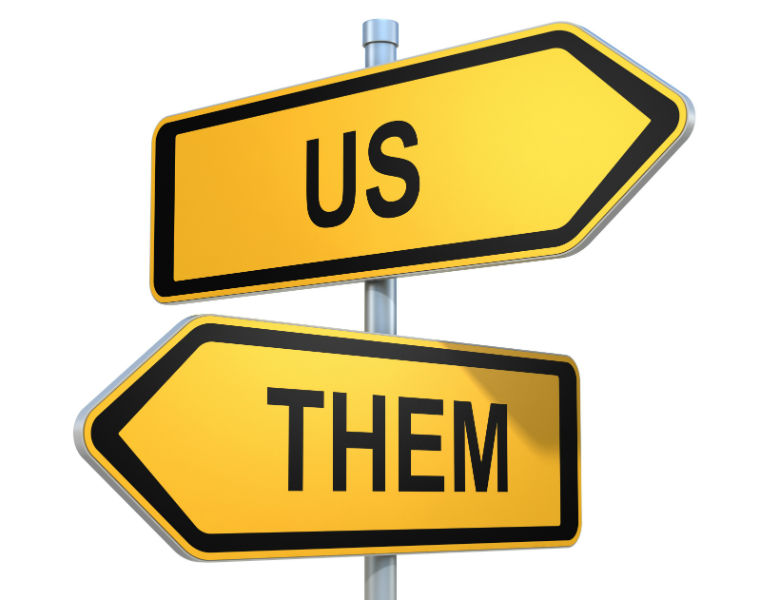
wf_1216_atwhitsend_usthem760There is no if. That us vs. them feeling, Trump vs. Clinton, or whatever camp you may fall into, will filter into the workplace. To ignore it, feeling that avoidance of this particular issue is possible because professional courtesy will mitigate or suppress issues, simply won’t work. To coin the popular vernacular, people are feeling some type of way about the current state of political affairs. And that’s putting it mildly.

Now more than ever diversity executives have to ensure that everyone’s concerns are addressed — including white men, said Doug Harris, head of the Kaleidoscope Group, a Chicago-based diversity company. “I think right now there’s a temperament within society of exclusion on both sides of the table,” Harris said. “And those who may have been seen to have been historically included are feeling just as excluded as everyone else.”

On the one hand, that shared sentiment might be used as a connector, common ground — however wretched and ill conceived — but it doesn’t make things any easier for diversity trainers and consultants who have to deal with this angst on top of historically rooted bias, ignorance, racism and all the other dimensions of diversity that we shake our heads over.

Lind said one can’t think of all challenges as equal because the rhetoric at play is, “One side has lost, one side has won, and everybody needs to get together and move forward for all Americans in the country.” Diversity executives and consultants are left to walk a very narrow and rocky line to keep everyone engaged in productive dialogue and to promote positive action and behavioral change.

Even using the word diversity before the word consultant is a problem for some. Leah P. Hollis, president of Patricia Berkly LLC in Philadelphia, specializes in workplace bullying. She said as soon as she uses the word diversity “she loses the room.”

It’s tough. Rather, it was tough before, and it’s even tougher now. Diversity executives have to not only pursue their individual missions to advance equality and tolerance and strategic diversity management for their respective workforces and businesses, they have to navigate a sticky layer of political sensitivity as well. I don’t envy them the task.

It reminds me of an old Guns N’ Roses tune, “Welcome to the Jungle.”

Kellye Whitney is associate editorial director for Workforce. Comment below or email editors@workforce.com.

Posted on December 4, 2016June 29, 2023

Prescribed Drugs Blur Policies

There is no doubt that America is in the grips of a prescription drug crisis. You cannot turn on the news without seeing a story about the dangers of opioid addiction.

And prescription medications, including dangerous opioids, provide risk for employers. The ADA’s reasonable accommodation obligations for employee medical conditions extends to the medication prescribed to employees to treat those conditions. Thus, an employer can be liable for failing to accommodate an employee’s use of legally prescribed medications.

For example, the EEOC recently sued a Georgia medical center for disability discrimination after it fired a physician for revealing that he was treating chronic neurological and musculoskeletal problems with legally prescribed narcotics. The lawsuit alleged that the employee supplied a doctor’s note explaining that he was being treated for chronic pain with a prescribed narcotic, and further explaining that he was subject to urine tests and monitoring via the Georgia Board of Pharmacy to ensure compliance with his treatment plan.

The employer, however, allegedly assumed that the medication rendered him unable to meet his job requirements and failed to engage in the interactive process with this employee to determine whether he could perform the essential functions of his job with, or without, reasonable accommodation based on the medical certification.

How is an employer supposed to maintain a safe workplace and lawfully test for legally prescribed drugs that could impair an employee’s performance? Consider these four thoughts.

Blanket prohibitions are illegal. The ADA imposes on employers an obligation to make individualized inquiries about implications such as reasonable accommodations and direct threats. A blanket prohibition against on-the-job use of prescription medications violates this obligation.

Drug testing. Drug testing programs can include legally prescribed drugs. An employer cannot, however, have a blanket policy excluding from employment any employee testing positive for a prescribed drug. Instead, following a positive test, the employer should ask if the employee is taking any prescribed drugs that would explain the positive result.

Drug-free workplace policies. It is permissible to include prescription drugs in drug-free workplace policies. These policies can require employees to disclose prescription drugs that may adversely affect judgment, coordination, or the ability to perform job duties. After disclosure, an employer must, on a case-by-case basis determine whether it can make a reasonable accommodation to enable the individual to remain employed.

Post-disclosure handling. After an employer learns that an employee is taking a prescription drug that may affect job performance, it should request a medical certification regarding the effect of the medication on the ability to safely perform essential job functions. That certification will enable the employer to engage the employee in the interactive process and making the individualized determination of whether a reasonable accommodation is even possible.

What about marijuana? Currently, medically prescribed marijuana is lawful in 25 states plus the District of Columbia. Does the ADA treat marijuana like any other legally prescribed drug, limiting an employer’s ability to terminate for marijuana use?

Thankfully for employers, every state and federal court that has examined this issue so far (and, granted, the sample size is small), the answer is no, employers have no duty to accommodate disabled employees’ lawful use of medical marijuana.

Why? Because even though the use might be lawful under state law, federal law still criminalizes it. The ADA does not protect an employee currently using illegal drugs as a qualified individual with a disability.

Moreover, the ADA does not consider testing for illegal drugs to be a protected medical examination. Thus, the ADA does not restrict how or when an employer tests for illegal drugs, or what employer chooses to do with the results.

As a result, every court that has examined the issue so far has concluded that an employer can enforce a drug-free-workplace or zero-tolerance policy against off-duty marijuana use.

The bottom line for legal drugs? The ADA is all about engaging in conversations and avoiding assumptions. When dealing with an employee’s medications, silence on an employer’s part equals liability. When an employee presents for duty with a prescription medication, ask, certify, verify and, if possible, accommodate.

If you cannot make a reasonable accommodation after engaging the employee, then, and only then, are you free to consider termination.

Jon Hyman is a partner at Meyers, Roman, Friedberg & Lewis in Cleveland. Comment below or email editors@workforce.com. Follow Hyman’s blog at Workforce.com/PracticalEmployer.


Posts navigation

Previous page Page 1 … Page 83 Page 84 Page 85 … Page 95 Next page


Webinars


White Papers


  • Topics

    • Benefits
    • Compensation
    • HR Administration
    • Legal
    • Recruitment
    • Staffing Management
    • Training
    • Technology
    • Workplace Culture
  • Resources

    • Subscribe
    • Current Issue
    • Email Sign Up
    • Contribute
    • Research
    • Awards
    • White Papers
  • Events

    • Upcoming Events
    • Webinars
    • Spotlight Webinars
    • Speakers Bureau
    • Custom Events
  • Follow Us

    • LinkedIn
    • Twitter
    • Facebook
    • YouTube
    • RSS
  • Advertise

    • Editorial Calendar
    • Media Kit
    • Contact a Strategy Consultant
    • Vendor Directory
  • About Us

    • Our Company
    • Our Team
    • Press
    • Contact Us
    • Privacy Policy
    • Terms Of Use
Proudly powered by WordPress