Skip to content

Workforce

Author: Rick Bell

Posted on June 29, 2016June 29, 2023

Your Employees Are Using Social Media at Work; Deal With It


WF_WebSite_BlogHeaders-09

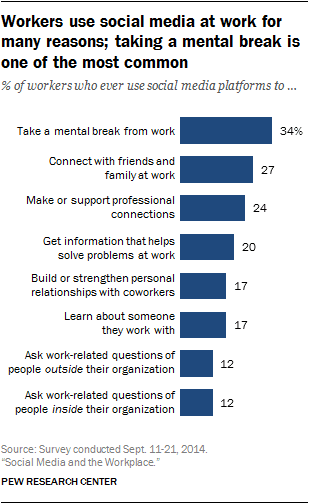
A recent survey conducted by the Pew Research Center confirmed what I have long thought. Your employees are using social media at work — 77 percent of them. And I believe even that number is low.

Meanwhile, another recent survey, this one by CareerBuilder (h/t Ragan.com) attributes smartphones to the fact that 20 percent of full-time workers say they work less than five hours per day.

It’s not all bad news for employers. The same study found that evidence that workplace social media policies concerning impact on-the-job use. Workers whose companies have policies regulating social media use at work are less likely to use social media in certain ways:

  • 30 percent of workers whose companies have an at-work social media policy say they use social media while on the job to take a break from work, compared with 40 percent of workers whose employers do not have such policies.
  • 20 percent of workers whose employers have at-work social media policies say they use social media to stay connected to family and friends while on the job, compared with 35 percent  of workers whose social media use is not regulated at work.
  • Only 16 percent of workers whose companies regulate social media at work say they use social media while working to get information that’s helpful to their job, compared with 25 percent of those whose workplaces have no such regulations.

What does all this mean? Despite the help that social media policies provide, employers that try regulate personal social media use out of the workplace are fighting a losing battle. I call it the iPhone-ification of the American workforce. No matter your policy, if your employees can take their smartphones out of their pockets to circumvent the policy, how can you possibly police workplace social media access? Why have a policy you cannot police and enforce? And, don’t forget, the NLRB is watching, too.

Instead of regulating an issue you cannot hope to control, treat employees’ use of social media for what it is — a performance issue. If an employee is not performing up to standards because he or she is spending too much time on the internet, then address the performance problem. A slacking employee will not become a star performer just because you limit his or her social media access; he or she will just find another way to slack off.
Jon Hyman is a partner at Meyers, Roman, Friedberg & Lewis in Cleveland. Comment below or email editors@workforce.com.
Posted on June 13, 2016July 26, 2018

Illegal Retaliation Doesn’t Meet Threshold for Constructive Discharge

employee compensation

Henry v. Abbott Laboratories (6/10/16) [pdf] is what I would call a curious case, and one that I plan to liberally use any time I’m defending a case in which claims both of discrimination/retaliation and constructive discharge are asserted.

A constructive discharge is when an employer makes ones working conditions so intolerable that a reasonable person under such circumstances would have felt compelled to resign. It is not an independently unlawful act, and must be tied to some underlying illegal conduct (i.e., unlawful discrimination, harassment, or retaliation) to support a claim. Thus, if the misconduct is alleged to have violated Title VII, and if the employee resigns in the face of such circumstances, Title VII treats that resignation as tantamount to an actual discharge.

It seems pretty cut and dry, then, if an employee resigns because she feels that she was retaliated against for engaging in some protected conduct, the resignation should rise to the level of a constructive discharge, if the underlying retaliation is also unlawful.

Not so cut and dry, however, to the 6th circuit court of appeals, which, in Henry v. Abbott Laboratories, concluded that the alleged retaliation alone does not suffice to support a constructive discharge claim, and that the underlying retaliatory adverse actions must independently rise to the level of severity such that a reasonable person would have felt compelled to resign.
If unlawful retaliation isn’t sufficiently intolerable such that it would support a constructive discharge claim, then what is? Or, looking at it another way, the 6th Circuit Court seems to be saying that one cannot look to the alleged statutory violation to support a constructive discharge claim, but instead to the conduct that underlies the alleged violation—in this case, a low performance evaluation, increased scrutiny, a letter of expectations threatening further action if performance did not improve, and being kept on the training line. Yet, if those adverse actions support a retaliation claim, as the court held a jury should conclude, shouldn’t a jury also have the opportunity to decide whether a resignation in the face of such alleged retaliatory adverse actions supports a constructive discharge claim?
While this case certainly favors employers, it is nevertheless one that I think should have gone the other way on this issue.
Jon Hyman is a partner at Meyers, Roman, Friedberg & Lewis in Cleveland. To comment, email editors@workforce.com.
Posted on June 1, 2016June 29, 2023

By the Numbers: June 2016

Each month Workforce looks at important stats in the human resources sector. Here are the topics we're keeping an eye on for June 2016. Comment below or editors@workforce.com. Follow Workforce on Twitter at @workforcenews.

By the Numbers June 2016

Posted on May 26, 2016November 27, 2018

Beware Eldercare Discrimination Claims

elder care
One of the very first posts I ever wrote on this blog, almost nine years ago to the day, discussed the EEOC’s then-new Enforcement Guidance on Unlawful Disparate Treatment of Workers with Caregiving Responsibilities. One of the key issues noted by the EEOC in that document, and three years later in its follow-up document, Employer Best Practices for Workers with Caregiving Responsibilities, was eldercare discrimination:

Of course, workers’ caregiving responsibilities are not limited to child care, and include many other forms of caregiving. An increasing proportion of caregiving goes to the elderly, and this trend will likely continue as the Baby Boomer population ages. As with child care, women are primarily responsible for caring for society’s elderly, including care of parents, in-laws, and spouses. Unlike child care, however, eldercare responsibilities generally increase over time as the person cared for ages, and eldercare can be much less predictable than childcare because of health crises that typically arise. As eldercare becomes more common, workers in the “sandwich generation,” those between the ages of 30 and 60, are more likely to face work responsibilities alongside both childcare and eldercare responsibilities.

Nine years hence, it appears that employers haven’t gotten the message. Fortune recently reported that more employees are suing over family care—and winning:

Between 1998 and 2012, federal employment discrimination cases declined overall. But not employee lawsuits over family-leave discrimination: They shot up 590 percent. In the past 10 years … the fastest-growing type — up 650 percent — was brought by employees who were taking care of elderly relatives. Nor is this a “women’s issue.” Well over a third (39 percent) of those eldercare actions were brought by men, who also filed 336 percent more paternity-leave lawsuits than in the decade before.

For employers, this gets expensive. Plaintiffs have been winning cases about 70 percent of the time, the study says, or more than twice as often as they prevail in other kinds of employment suits. Altogether, litigation over what the study calls “FRD,” for family responsibilities discrimination, has cost employers almost half a billion dollars ($477,009,417) between 2006 and 2015, more than double what it cost in the previous decade. And that’s a conservative estimate, because it doesn’t include the cost of confidential out-of-court settlements.

This issue hits workers my age particularly hard, as we are bookended by caregiving responsibilities. We not only have our children to which to attend, but also our parents. Employers that mis-perceive employees’ dedication to their families as a lack of dedication to their jobs are missing the bigger picture. It is not only the right thing to grant your employees the flexibility to attend to family issues when they arise, but it is also the legal thing. Because $477 million dollars suggests that employers, unfortunately, have not received this message.

Posted on May 25, 2016July 26, 2018

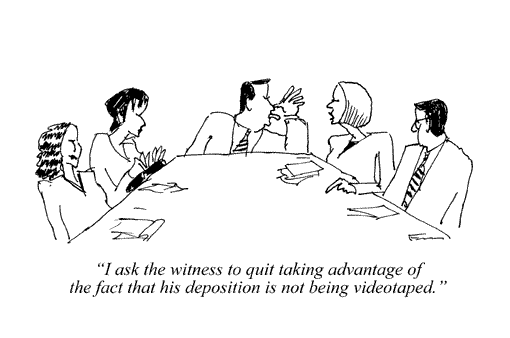
How to Behave (and not Behave) in a Deposition

I spent yesterday in a deposition. That fact is not all that unusual for a litigator. What makes yesterday’s exercise stand out is that I was the deponent, not the attorney. I spent my day under oath, answering questions.

As the mind of a blogger works, I thought to myself, “How can I turn this experience into a blog post?” And then I realized that I already had, six years ago, in a post entitled, 10 tips for preparing for your deposition. So join me on this trip back through the archives.

  1. Tell the truth. Enough said.
  2. Answer the specific question asked. Do not volunteer other information. Do not explain your thought process. You are only required to answer the question that is asked. The lawyer on the other side is being paid to ask specific questions to elicit the specific information being sought. Do not do his job for him by unnecessarily offering other information.
  3. If you do not understand a question, do not answer. Simply say that you do not understand. It is the lawyer’s job to formulate understandable questions, and not your job to guess at what is trying to be asked of you.
  4. Do not guess. If you cannot remember something, your answer should simply be: “I do not remember.” If you have a vague memory, give that vague memory with a qualification.
  5. A deposition isn’t a memory test. If you are asked for a time or date, and you cannot recall specifics, it is okay to give an approximation. Just qualify the answer by saying that it is an approximation or an estimate.
  6. Beware leading questions. An examiner is usually allowed to try to put words in your mouth with leading questions. Do not agree to inaccurate statements contained within the question. To same end, do not automatically accept the questioner’s summary of your prior testimony, unless it is 100% accurate.
  7. Give complete answers, and then stop. Always finish your answer. If you are interrupted, let the lawyer finish the next question, and then go back and finish your prior answer. If you are finished with an answer and it is complete, accurate, and truthful, stop talking and stay silent. Do not add to your answer because you feel a need to fill the silence.
  8. Documents. If you think you need a document to help you truthfully and accurately answer a question, ask for it. But, do not agree to supply any documents requested by the questioner. All such requests should go through your lawyer.
  9. Objections. Even if your lawyer objects, you usually still have to answer the question. You will only not answer if your lawyer expressly instruct you accordingly (usually because the other lawyer is asking about attorney-client communications).
  10. Humor doesn’t work. Sarcasm and humor do not translate well on the written page. Also, never express anger or argue with the questioner, or use even the mildest of off-color language. A deposition is a professional event, and you should act professionally.

Bonus tips—Don’t act like this:

Or like this:

Or like this:

Posted on November 22, 2015June 29, 2023

Washoe County School District: Optimas Silver Winner for Managing Change

The old proverb urges us to look before we leap.

The Washoe County (Nevada) School District could rephrase the familiar saying just a bit: LEAP and then look — at how the district is helping manage the evolution of a high-tech workforce.

Learn & Earn Advanced Career Pathways, known as LEAP, is the result of a yearlong collaboration with a variety of local agencies to address employee shortfalls in advanced manufacturing — an area of employment tagged as the Silver State’s future highest-growth sector.

The district’s program will create a pipeline of workers over the next five years to manage the changing dynamics of the burgeoning tech climate.

The initiative was launched in August 2014 when agencies and stakeholders recognized a problem and planned a strategy to connect human capital resources to a business need.

Because Washoe County School District is playing such an integral role in helping manage the shifting workplace needs, it is the silver 2015 Optimas Awards winner for Managing Change.

Posted on November 22, 2015July 30, 2018

The Last Word: Optimas and Its Silver Lining

Think for a minute where you were 25 years ago.

Where did you work? What was your title? Who was your boss? Were you even in the workforce? Considering that the economy was shaking off a decade’s worth of corporate downsizings (“right-sizings” was the annoyingly PC term at the time), interest rates were circling the double-digit range and unemployment hovered between 7 and 10 percent for good portions of the 1980s and into the early ’90s, just having a job was something of an accomplishment. 

While the fits and starts demarcating a quarter-century’s worth of work can seem like an eternity for an organization and especially a person’s career, there are certainly some constants that thread through that lengthy swath of time.

Among them is a business’ need to innovate and evolve. Rather than sit back and try to predict the future, the best companies employ people with the moxie and drive to instinctively seek better ways to improve not only the world around them, but also positively alter their own workplace.

That’s a corporate quality we like to recognize and honor. This year marks the silver anniversary for the annual Workforce Optimas Awards program. Like the evolving world of business, a lot has changed in the quarter century since the Optimas were conceived.

At the time we faxed and phoned clients and sources; updating a doc meant calling the podiatrist about your problems with plantar fasciitis, not adding an entry online.

A quarter-century ago, I was a scrubby new night copy editor on a suburban north San Diego County daily newspaper. The Persian Gulf War had just concluded, and the town I worked in bordering Marine Corps Base Camp Pendleton celebrated its returning heroes.

About 60 miles to the north of me, Personnel Journal, a monthly trade magazine directed at the rapidly evolving practice of human resources, was busy hatching the Optimas Awards, a program that was dedicated to similarly recognize and honor the achievements of a job well done.

The debut winner in the General Excellence category of that inaugural Optimas Awards was banking giant First Chicago Corp., which at the time was among the nation’s largest financial institutions.

Well, 25 years later, Personnel Journal has gone through two changes in ownership while the publication’s name switched three times — to Workforce, then Workforce Management and then back to Workforce.

Whither First Chicago Corp.? The bank ultimately merged with NBD Bancorp in 1995, which was then gobbled up by Banc One Corp. in 1998, which later merged with JPMorgan Chase in 2004, which … well, you get the picture.

Like I said, much has changed in the past 25 years.

What hasn’t changed, however, is that determination to innovate and solve the complex challenges of managing a workforce. And for 25 years, the Optimas Awards have celebrated those people management techniques.

Some programs have been groundbreaking. In 1996, the Internet was still new and shiny, and Cisco Systems was awarded an Optimas for “an internal home page that keeps employees informed and cuts paperwork, while an external page boosts recruiting efforts.” An intranet and a branding-centric home page — pedestrian by 2015 standards but edgy stuff two decades ago.

There were practical management techniques taken to another level, like Valero Energy Corp., winners in 2006 for implementing the industry’s first labor supply chain designed to provide “global labor on demand.” Think a sharing economylike labor pool of a decade ago.

Still others have risen from the ashes of need — literally. Malden Mills Industries Inc., which won the Managing Change category in 1999, had lost three of its buildings in a fire. Human resources ultimately created a special center to inform and retrain 1,400 displaced employees, drawing nationwide praise as a role model for employee training and development.

Rereading entries of the past 25 years have been enlightening, engaging and amusing. And 25 years from now some Workforce editor — the future Rick Bell — will look back at five decades of winners.

What will those practices be when Workforce honors its golden anniversary winners? The technology will be dramatically different (remember, the Internet was in its infancy when Workforce — errr, Personnel Journal — launched the Optimas).

And the millennials of today will be the boomers of tomorrow struggling to engage an as-yet-unnamed cohort of employees when the Optimas turns 50.  

Posted on October 20, 2015July 30, 2018

The Last Word: Cadillac Tax Could Drive Business into a Wall

It’s becoming clear that no matter how good, fair or mediocre an organization’s health care plan may be, employers are beginning to sweat the fact that their employee benefits could be roadkill when the so-called “Cadillac” tax arrives in 2018.
 
Originally touted as an excise tax on “rich” benefit plans — the ones that bear the brunt of health care costs through minimal copays, expansive provider networks and hefty coverage of expensive procedures — the Cadillac tax was touted as a fiscal white knight, helping fund coverage access on the Affordable Care Act’s public exchanges.

The tax was buried somewhere within the 900-plus pages when the ACA became law in 2010 and was largely overlooked — understandably so, considering that pre- and post-passage hysteria surrounded death panels and individual mandates, never mind that 2018 seemed like a lifetime away as our economy was being throttled at the time.

Well, eight years has dwindled to 26 months, and while the Caddy hasn’t pulled into the garage yet, it’s fast approaching. The Cadillac tax is playing a fast and furious game of chicken with the potential to cripple thousands of organizations and the workers who depend on their employers for health care coverage.

Organizations should be deep in the planning stages of how the Cadillac tax will affect them, especially when considering that in a recent Kaiser Family Foundation analysis, 1 in 4 companies could be subject to the tax. But federal agencies constantly rewrite the owner’s manual, releasing mixed messages through its FAQs and formal guidance.

As one speaker at the recent EBN Benefits conference admitted to an audience of several hundred HR and benefits managers, “It’s hard to tell which companies will be subject” to the Cadillac tax. About the deepest insight she could offer was “plan for it, and if it doesn’t happen, be pleasantly surprised.”

Not only is this pending wreck happening in the dark,  no one knows who’s steering and the owner’s manual contradicts itself.

Despite the confusion, the Cadillac tax could be towed to the junkyard before hitting the showroom floor. Despite the president's recent threat to veto any attempt to repeal it, a groundswell of bipartisan support wants the tax overturned and has given rise to the Alliance to Fight the 40, a broad-based coalition of insurers such as Aetna and Cigna, advocacy organizations including the American Benefits Council and WorldatWork and several labor unions.

The coalition pointed out in September just how devastating the Cadillac tax could be to nonprofits and religious organizations, saying it will likely affect a greater share of nonprofit employees than for-profit employees. Citing the U.S. Agency for Healthcare Research and Quality, premiums paid by nonprofit employees average higher than premiums paid by the general working population. Even more ominously, they add that it will tax charitable not-for-profits at the highest for-profit corporate tax rate for offering health care to their employees.

And as automakers and the UAW negotiate a new contract, it appears that the Detroit Three won’t bat an eye to maintain superior coverage for employees. One report noted an agreement would “limit the impact on union members of a threatened excise tax on high-end health care plans as part of the Affordable Care Act, either by amending the benefit plan by mutual agreement or limiting deductibles for those that are hit with the excise tax.”

Sadly, smaller organizations and nonprofits have no such luxury. In the comments section of a story on Workforce.com titled “Coalition Sets Collision Course With Cadillac Tax,” Karen Oakes summarizes what many thousands of employers are coming to grips with: This tax could put them out of business.

“We, as a nonprofit, are going to be hit with a $175,000 ‘fine’ because a majority of our staff opted for Covered CA. As an organization that barely hits revenue over expenses each year, there is no room for this fee. And because we have an aging population of staff and two really bad claims years, our health insurance premiums cost enough to trigger the Cadillac tax when in fact our plan is awful. Our dollars are purchasing a crappy plan and yet we get hit with a Cadillac tax? We are a struggling nonprofit trying to stay afloat in California, where minimum wage is expected to go up to $15 per hour in five years. Unless the ACA exempts nonprofits from the fines and the Cadillac tax, and the government can see it in their hearts to increase our funding, we will likely no longer be in business in 2020.”

You can’t help but feel for Oakes and thousands of managers and small-business owners in her shoes. The ACA is supposed to level the playing field so all Americans have access to health care. But there also needs to be equity for businesses and their employees when it comes to the affordability of health care by the time the Cadillac tax parks itself in January 2018.

Or we can close our eyes and wait for the collision. That is, unless it’s repealed or rewritten. If so, we’ll all be pleasantly surprised.

Rick Bell is Workforce’s managing editor. To comment, email editors@workforce.com.

Posted on August 6, 2015July 24, 2018

On Optimas Awards, Deadlines and … SpongeBob SquarePants?

A screen grab from the SpongeBob SquarePants episode "You're Fired." Photo courtesy of Nickelodeon.

Hey. Heyyy. HEYYYYYYY!!!

OK, I’m over it. Tired of it. Sick and tired, in fact. If I get one more call, email, fax, letter, or note via carrier pigeon seeking a deadline extension to enter Workforce’s 25th annual Optimas Awards, I will scream (and you can ask James Tehrani if I do).

Applications for Optimas are due Monday, Aug. 10, at 11:59 p.m. CT. File it or forget it. And believe me, you want to be part of this 25th anniversary class of 2015.

So, you are on deadline, folks — hard and fast deadline, as I like to call it. If you thrive on pressure, just picture me, green visor on my forehead, spectacles barely hanging on the end of my nose, shouting, “Where’s that Optimas entry, consarn it?” And you, sweat beading on your forehead, trickling down your cheek mingling with tears of fear and loathing, pecking away on your keyboard to beat the deadline.  

Like I have written previously, I am all about deadlines. My life professionally as a journalist would bleed ink into my personal life to the point where I raised my kids under the threat of deadlines: “I need that floor mopped by 11 a.m. or I’ll put you on a performance improvement plan so fast your head will spin clean off!” Which of course never worked, because there was always the excuse of, “Just one more episode of ‘SpongeBob,’ Dad. Puhhhleeeeeease?” Well, OK. I mean, it’s “SpongeBob,” not “My Little Pony” after all. What could I do, but sit down and watch it with them?

But not for you. Nope. No deadline extension for you! Nosirree Bob — or … SpongeBob. Hmmmm … SpongeBob. He’s so funny. And maybe there’s time. Maybe we should watch just one more episode from Bikini Bottom. I mean, it’s the one where they try to steal Mr. Krabs’ Krabby Patty recipe, and … oh heck, let’s make it longer. Like two weeks of “SpongeBob SquarePants,” and while we’re at it, let’s extend the Optimas Awards deadline by a couple of weeks, too.

So, don’t email or call or throw rocks through my 12th-story window asking for an extension of the Optimas Awards deadline. You got it!

Your new Optimas Awards deadline is: Monday, Aug. 24 at 11:59 p.m. CT.

And I promise not to scream. Hey, we have a “SpongeBob” marathon to watch.

That Patrick … he’s such a dimwit.

Posted on February 17, 2015June 29, 2023

Scott Bolohan: The ACA Consumer

Scott Bolohan
Freelance Writer

Scott Bolohan is a freelance writer who lived in Chicago until early this year, when he moved to England to attend school at Oxford. This is the tale of one millennial’s reluctant adventure into using Obamacare.

“There’s nothing cool about health insurance. It won’t get you followers or likes or help you on Tinder. When I hang out with my friends, we don’t talk about our copays and premiums.

“To be honest, health insurance was always a bit of an afterthought. Or at least something I thought I didn’t need. I freelance for a living, which means I have all sorts of flexibility and get to do exactly what I love, but it also means I don’t get health insurance.

“And that wasn’t a big deal. I had only been to the doctor once in the last couple years, so the $150 for a visit was significantly less than what I would have paid monthly for insurance. It was a risk I was willing to take, especially on my rather modest income. After all, I was healthy and active and young. You don’t think about not being that way — ever.

“When Obamacare was unveiled, I figured it was something I should do. Then I sort of forgot about it. On the final day of enrollment, I finally decided to enroll, mostly because my mom worriesabout me.

“Enrolling wasn’t perfect. The process was confusing and, at the end, I wasn’t even really sure what I had just done. I didn’t have a primary-care physician and the one assigned to me ended up not having an office near my apartment. It was reassuring to have, even if health insurance was something I didn’t anticipate needing.

“But health insurance is one of those things you don’t think you need until you do. I hurt my ankle playing baseball. Since I had insurance, I decided to go to the hospital. It’s a good thing I did; I broke the fibula. When I went back two weeks later, they told me I would need a plate and five screws put in my ankle. My summer was ruined. But my life wasn’t. Without Obamacare my hospital visits, surgery and physical therapy would have been around $30,000. That’s a sum I would be spending years … trying to pay back.” 


Posts navigation

Previous page Page 1 … Page 91 Page 92 Page 93 … Page 95 Next page


Webinars


White Papers


  • Topics

    • Benefits
    • Compensation
    • HR Administration
    • Legal
    • Recruitment
    • Staffing Management
    • Training
    • Technology
    • Workplace Culture
  • Resources

    • Subscribe
    • Current Issue
    • Email Sign Up
    • Contribute
    • Research
    • Awards
    • White Papers
  • Events

    • Upcoming Events
    • Webinars
    • Spotlight Webinars
    • Speakers Bureau
    • Custom Events
  • Follow Us

    • LinkedIn
    • Twitter
    • Facebook
    • YouTube
    • RSS
  • Advertise

    • Editorial Calendar
    • Media Kit
    • Contact a Strategy Consultant
    • Vendor Directory
  • About Us

    • Our Company
    • Our Team
    • Press
    • Contact Us
    • Privacy Policy
    • Terms Of Use
Proudly powered by WordPress