
Skip to content

Workforce

Category: HR Administration

Posted on June 13, 2016July 24, 2024

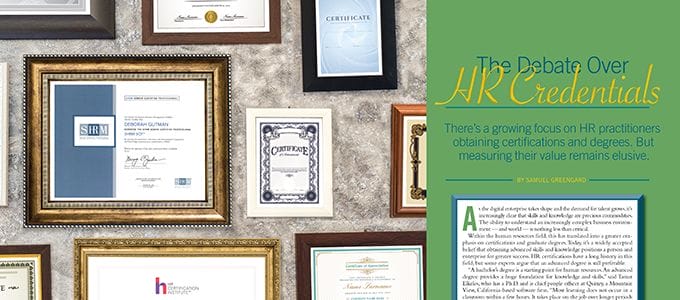
HR Credentials: Evaluating Their Value

As the digital enterprise takes shape and the demand for talent grows, it’s increasingly clear that skills and knowledge are precious commodities. The ability to understand an increasingly complex business environment — and world — is nothing less than critical.

Within the human resources field, this has translated into a greater emphasis on certifications and graduate degrees. Today, it’s a widely accepted belief that obtaining advanced skills and knowledge positions a person and enterprise for greater success. HR certifications have a long history in this field, but some experts argue that an advanced degree is still preferable.

“A bachelor’s degree is a starting point for human resources. An advanced degree provides a huge foundation for knowledge and skills,” said Tamar Elkeles, who has a Ph.D. and is chief people officer at Quixey, a Mountain View, California-based software firm. “Most learning does not occur in a classroom within a few hours. It takes place on the job over longer periods of time.”

She said she typically ignores certifications when making hiring and other HR decisions. “Certifications, other than perhaps in the benefits and compensation field, have nothing to do with real-world business skills. For 20 years, we’ve been hearing about how HR has to become more business-focused, and it still hasn’t happened.”

Herman Aguinis, a management professor at the Kelley School of Business at Indiana University, added, “It’s no secret that there is a strong desire to elevate the status of HR and that credentials and degrees add value.” Yet, it’s also clear that “a lot of time and money goes into obtaining all of these certifications and degrees,” which can range from a few hundred dollars and a few classroom hours to tens of thousands of dollars and a couple of years at a university. Unfortunately, their actual value isn’t always measurable — for both the individual and the business, he said.

Things certainly haven’t gotten any simpler over the past few years. After the HR Certification Institute and Society for Human Resource Management parted ways in an acrimonious breakup in May 2014, SHRM began offering its own credentials. Today, HRCI offers seven credentials, including the Professional in Human Resources and the Senior Professional in Human Resources, and SHRM offers two: the SHRM Certified Professional for those in the early stages of their careers and the SHRM Senior Certified Professional for practitioners with at least six years of experience.

There’s a growing focus on HR practitioners obtaining certifications and degrees. But measuring their value remains elusive.


A Matter of Values?

Amid a dearth of data about the value of HR certifications for organizations, a March 2016 report from the HR Certification Institute and the Top Employers Institute, “Emerging Evidence: Business Performance and the Validation of HR Best Practices,” offers some insight into the value of certifications. Among other things, it noted that companies that place a premium on HR certifications outperformed the stock indexes in their respective countries by an average of 51 percent over the same five-year period and outperformed the industry average by 14 percent over the same period.

In addition, stock prices of companies with more than five HRCI-certified professionals increased an average of 95 percent between 2011 and 2015, while the relevant stock indexes increased an average of 38 percent over the same five-year period. Meanwhile, companies with more than five practitioners holding HRCI certificates outperformed relevant stock indexes by 57 percent over the five-year period.

On an individual level, the study found that the average rating for Top Employers’ certified companies on German job site Kununu is 3.5 stars (out of 5) vs. the overall Kununu average of 3.1. The average rating for Top Employers’ certified companies rated on Glassdoor is 3.5 stars (out of 5) compared with the overall Glassdoor average of 3.2.

According to Top Employers Institute CEO David Plink, the findings deliver a “clear message that exceptional human resource management — from applying HR best practices to the competencies of the HR professionals who design and implement them — can demonstrably and positively contribute to the bottom line.”

—Samuel Greengard


And in April, the HR Open Standards Consortium Inc., a 17-year-old nonprofit based in Windermere, Florida, announced a new certification program for HR tech professionals.

Amid all the upheaval and the resulting confusion about what career and hiring decisions to make, there’s a need for HR professionals to face some tough choices. Peter Cappelli, a management professor at the Wharton School of the University of Pennsylvania, said that in today’s business and HR environment, it’s vital to understand how, when and where credentials and degrees matter. “It certainly complicates things for HR people,” he said.

Paper Chase

Most HR executives believe certifications are a good thing — particularly early in a career. And there’s some evidence to support it. A 2015 HRCI-HumRRO study of about 12,000 practitioners holding certifications found that those with SPHR credentials earned $19,712 more annually than their peers while individuals holding a PHR pulled down $4,547 more than those without any certification. In addition, the report noted that 90 percent of people with PHRs and 87 percent of those with SPHRs were employed full time in an HR position compared with 69 percent of their noncertified peers. Finally, the report found that certified HR professionals reported greater income growth over time and higher career satisfaction.

While these results sound impressive, it’s unclear whether other factors and variables enter into the equation, such as whether those who pursue advanced learning and certifications are intrinsically more driven and productive. “Certifications definitely hold some weight. I would select a person with a certification vs. somebody who doesn’t have it,” said Deborah Gutman, human resources manager at Sierra Nevada Brewing Co. She holds an SPHR, SHRM-SCP and a master’s degree in HR management. “Basically, it means you have gone through a process and you have taken steps to gain a foundation of knowledge that is applicable to the field. It adds a level of credibility.”

Lupe Mujica, chief people officer at First Service Residential, a Dania Beach, Florida-based property management services firm, also said she believes certifications have value. “They provide an excellent foundation for HR,” said Mujica, who holds a bachelor’s degree in organizational development and is a longtime member of SHRM and the National Human Resources Association. “For someone who is at an entry level or new to HR — basically, someone who has little or no experience, it shows a certain level of proficiency.”

In addition, “there is a tangible benefit for the business,” mostly revolving around the individual understanding HR concepts and basic tasks and managing work more effectively, she said. Like others, Mujica said work experience and graduate degrees — particularly in areas such as business, psychology and information technology — are far more important for individuals as they work their way up the corporate ladder.

Of course, there’s also the issue of which organization to choose: HRCI or SHRM. While HR executives may have preferences — Mujica likes SHRM because of its global presence, and Gutman said HRCI holds a great deal of credibility — one of the problems is that there’s no exact way to compare the two certifications. “One of the challenges is that the SHRM certification is relatively new, and it appears they are trying to make the process very inviting in order to attract people,” Gutman said.

She points to the fact that SHRM’s pass rate is about 68 percent for its SHRM-CP program and 56 percent for its SHRM-SCP, compared with 53 percent for HRCI as a whole. Whether HRCI’s lower pass rate is a result of more rigorous standards or that it attracts a different group of people is debatable.

Not surprisingly, each organization believes its approach has advantages and that it is better aligned with the needs of today’s HR practitioner. “The primary difference,” said Linda Anguish, director of certification products for HRCI, “is that we are an independent certifying body with a core competency in the HR field. We have been doing this for 40 years and we have an accreditation from a third-party certifying agency.”

In addition, HRCI does not require a practitioner to take any particular program or learning track in college prior to taking a certification exam. Anguish holds SPHR and Global Professional in Human Resources certifications.

On the other hand, SHRM has adopted a competency-based model that more closely supports the way businesses and various organizations operate from an HR perspective, said Alexander Alonso, SHRM senior vice president of knowledge development, who holds a Ph.D. and a SHRM-SCP certification.

The 285,000-member organization relies on the SHRM Body of Competency and Knowledge, also known as the SHRM BoCK, as the foundation for these certifications, which center on eight key behavioral skills and 15 HR functional areas that it deems critical to the success of any HR professional. As a result, Alonso said, SHRM is equipped to address core skill requirements represented in Fortune 100 organizations and beyond.

About 12 percent of HR professionals in the U.S. hold a certification. HRCI boasts about 145,000 current certifications and SHRM boasts about 92,000. According to Cappelli, a certification delivers niche benefits while a “master’s degree and experience dominate any credentials.” Moreover, he said certifications serve partly to “compartmentalize” the profession and create “subfields.”

“In general, employers want to think of HR people more as ‘managers’ and ‘executives’ rather than ‘professionals,’ which is where credentials point them,” he said.

On top of all this, the HR Open Standards Consortium recently launched its training initiative geared toward HR tech professionals. “The HR Open Standards’ Individual Certificate provides an inaugural opportunity for HR Technology professionals to be recognized for their proficiency in and experience with HR-XML and HR-JSON data exchange standards,” said Suneel Mendiratta, president of the consortium’s board of directors, in a news release. Certificates are currently being offered in assessments, recruiting and screening with other tech certificates in the works for areas such as recruiting, benefits and performance management, according to the organization.

On the Money?

One of the problems with the current environment, Indiana University’s Aguinis said, is that while the goal of making HR practitioners more proficient is a good one, and any programs and activities that elevate the field are a positive, there’s never been any objective research conducted about certification programs and what precise value they provide for various stakeholders. This would require access to databases — something he said he hasn’t been able to obtain. Meanwhile, students and others collectively fork over millions of dollars for certifications. “Nobody knows if practitioners get hired faster, promoted faster or make more money than their counterparts,” he said.

HRCI’s SPHR exam, for example, costs $495 plus a $100 application fee and is good for three years. SHRM charges $300 for members to take the SHRM-CP or SHRM-SCP exam and $400 for nonmembers, and the certification is also good for three years.

Aguinis describes the situation as nothing less than a “conflict of interest.” He believes that greater transparency is essential. He would like to see research teams composed of both practitioners and researchers; conflict of interest disclosures that indicate whether these organizations paid a consulting firm or individual researcher to study a certification program; any findings from studies undergo a peer-review process; and data that are open to other researchers so that they can analyze and validate it.

“Now that SHRM and HRCI have split,” he said, “the situation is even more confusing. There are more choices and the question arises: ‘Do I need to be certified by both organizations?’ ”

Among other things, Aguinis would like to know whether job candidates with credentials are hired faster than others, and whether an HR certification equates to better job performance and value for the company. Quixey’s Elkeles agrees that there’s a dearth of impartial data about the value of certifications — and without a standards body in place, results are somewhat vague and relative. What’s more, she said she’s concerned about the quality of individual instructors and how well curriculum matches the skill sets required for a person to make the leap to an HR executive.

“These programs are huge moneymakers, and it’s in the best interest of these organizations to promote the concept that certifications are beneficial for practitioners and organizations,” Elkeles said. “The question is: Does the amount of time and money spent deliver a real-world return on investment?”

Whatever HR practitioners can do to advance their skills and knowledge is generally a good thing, HRCI’s Anguish said. In the end, “the most important thing is to make a commitment to personal development and the profession,” she said.

Editor’s note: This story was updated on June 15, 2016, after SHRM contacted us with the current number of people with SHRM certifications.

Samuel Greengard is a writer based in Portland, Oregon. Comment below or email editors@workforce.com. Follow Workforce on Twitter at @workforcenews.


Posted on June 1, 2016June 29, 2023

By the Numbers: June 2016

Each month Workforce looks at important stats in the human resources sector. Here are the topics we're keeping an eye on for June 2016. Comment below or editors@workforce.com. Follow Workforce on Twitter at @workforcenews.

By the Numbers June 2016

Posted on May 25, 2016July 30, 2018

The Trap of Big Data in HR

As it happens with so many things in life, big data has not only come to human resources, but it’s also rapidly making its way from the HR executive suite to the HR trenches.

What could go wrong?

Whether you call it “big data,” “small data” or “HR analytics,” odds are that HR pros in your organization all the way down to the manager level are actively being pitched on the benefits of making data-driven decisions.

If you’re an HR leader contemplating big data in the world of HR, I’ve got good news and bad news for you.

First the good news. If you’ve got control over the systems used in your HR practice, you’ve got a unique opportunity to train your minions and make big data work for you — companywide.

To make sure you give your HR pros data and analytics that don’t blow up in their face, let’s talk about what’s real and what’s not.

But with every silver lining comes a thunderstorm. Even if you control the analytical solution set across your HR practice, you’ve still got the challenge of making sure your teams can accurately engage the operations side of the business related to what the data mean and what adjustments are necessary to maximize the effect of talent on the business.

Did you just gulp? 

Your HR pros in the trenches are all good people. To make sure you give them data and analytics that don’t blow up in their face, let’s talk about what’s real and what’s not.

One of the biggest lies the data devil ever told was that we can base talent analytics on our performance management process. Don’t get me wrong; I’m pro performance management. It’s just that we all struggle with rater bias, calibration issues on ratings, etc.

Big data based on performance ratings is a dumpster fire outside a two-star restaurant in the bad part of town. The only exception is for lower-level positions that have clear production metrics. If that’s you, shine on you crazy diamond. The rest of us need to look elsewhere for analytics that matter.

And what about quality of hire? I know, you really want to talk about it. You’re right about one thing: It’s the holy grail. But it’s too linked to performance data for you to pull off across the enterprise. 

At this point, I’m the world’s biggest data buzz kill. But wait! I do have good news. 

There are two keys to launching HR analytics. To succeed, you need to focus on how the data are sliced for reporting purposes, then you need to train your HR pros in the field about how to be consultative with the operations leaders they support.

Let’s focus on data slices first. To truly maximize the effect of any data sets you report, you need to be brave. Courage with big data in HR means that you set up reporting to establish scoreboards designed to put pressure on managers in your organization. Key choices in this regard include the development of reports that compare locations, functional areas and, yes, even managers against each other across your company.

Need an example? Here’s a favorite analytical track of mine: hiring manager batting average. This average assumes any employee who leaves before their one-year anniversary is a hiring miss. Regardless of what caused the bad selection process, it’s all embedded in the calculation.

Calculating the hit-miss percentage on this data point across the past 12 months at your company is easy. Develop scoreboards that show which department or hiring manager is the best at this and you’ve got a shot at having meaningful conversations about how to improve.

But the big data secret sauce in HR is the negotiation and consultative skills of your HR pros in the field. If your trench-level HR team can’t perform in these areas, any analytical platform you’re trying to develop will be dead on arrival.

The skill set needed by your HR pros in the field isn’t complicated, but it requires confrontation. First, they need to be able to review the data for the groups they support and identify underperforming units using analytics.

The next step is more complex. Your line HR pros have to be confrontational with the operations side of the house, tell them where they have a problem, and then offer consulting services to help the underperforming manager or unit improve.

Big data in HR can thrive, but only if you understand and develop the consultative skills necessary for your field HR pros.  

Without these skills and a willingness to engage or confront, big data is just a fancy phrase for another report that no one is going to use.

Posted on May 23, 2016September 5, 2023

Workforce 100: A Best Workplace Takes Hard Work

To give readers a deeper dive into what companies are doing to create a cool culture,Workforce asked Glassdoor Inc. to dig into its data to provide insight into what common traits employers should look to emulate to become better workplaces themselves.


What do companies like Facebook Inc., Delta Air Lines Inc. and Nike Inc. have in common? These companies all share one key attribute: People love working there. They have all been featured on Glassdoor Inc.’s Best Places to Work list, based entirely on employee feedback, and they all appear on this year’s Workforce 100 list as well for good reason. Here are seven things great employers have in common.

To see the 2016 Workforce 100 rankings, click here.

7 Common Traits of a Best Place to Work 

Glassdoor Logo June 20161. Mission and values matter. A well-articulated mission gives employees a sense of purpose and motivates them to come to work every day. Research by Josh Bersin, principal at Bersin by Deloitte, shows that mission-driven companies have 30 percent higher levels of innovation and 40 percent higher levels of retention, and they tend to be first or second in their market segment. Does your company have a clearly defined mission? Once it has one, use it to cultivate company values, which dictates workplace culture.

2. Invest in culture. Top-performing companies tend to have high marks for culture as well as overall experience. Glassdoor economic research shows a positive company culture accounts for nearly 25 percent of employee satisfaction. Career opportunities come in second at 22 percent and strong senior leadership third at 16 percent. Unfortunately, culture isn’t something one entity can create. If you’re trying to improve company culture, make sure to incorporate feedback from across your organization.

3. Put people first. If culture is all about the group mentality that makes an organization great, a focus on people is about empowering individual employees. A people-focused organization helps its employees grow to become their best. Putting people first means giving credit where credit is due, saying thank you and encouraging employees to bring their whole selves to work.

4. Embrace transparency. Making any top-company list doesn’t mean being perfect. This transparency is reflected in management’s approach, and in the companies’ willingness to engage on job sites by completing a robust profile and responding to reviews. In a Glassdoor survey from January, nearly two-thirds (62 percent) of users said that their perception of a company improves after seeing an employer respond to a review. The changing business landscape requires companies to get involved in the conversation and embrace transparency. Make sure key departments understand what is expected of them from a communications perspective.

5. Believe in career opportunities. Top companies offer great career advancement opportunities. The average employee rating for career advancement of all Glassdoor-rated companies is 3.0, but Best Places to Work winners scored an average of 3.9. How can you ensure all employees have access to the best opportunities for career growth? Instigate employee and manager training programs, schedule weekly employee-manager feedback loops and regular reviews, create employee recognition programs and promote people from within.

6. Promote strong leaders. Data prove what everyone knows intuitively: No one wants to work for a jerk. The quality of upper management makes a statistically significant effect on whether a company is a good place to work; furthermore, employees rate senior leaders most highly when they set a positive tone for the company’s culture and values. In fact, some of the lowest-ranked companies on Glassdoor have one thing in common: many complaints about tone-deaf, negative and uninspiring leaders. Look to hire leaders who are smart, visionary and compassionate, and give them opportunities to grow.

7. Understand it’s not all about pay. We know that pay tops the charts when it comes to getting a candidate in the door, but it’s not the most important factor to keeping and engaging your employees. A recent study by Glassdoor Chief Economist Andrew Chamberlain found salary does have a statistically significant effect on job satisfaction, but it’s quite small. In fact, it’s toward the bottom. The most important factors influencing satisfaction are culture and values, career-advancement opportunities and the opinion of senior leadership. So make sure employees are paid fairly, but focus on cultivating culture and opportunities to foster long-term satisfaction.

Becoming a Workforce 100 or Best Place to Work company doesn’t happen overnight. By applying these lessons, your employees will feel more embraced and excited to come to work every day, which is the first step in becoming a top workplace.

Kirsten Davidson is head of employer brand at Glassdoor. Comment below or emaileditors@workforce.com. Follow Workforce on Twitter at @workforcenews.

Posted on April 5, 2016June 29, 2023

No Matter What the Producers of ‘Hamilton’ Tell You, Race is Never a BFOQ

True confession time. I am not a fan of Hamilton. I don’t get it. Never have, never will. I will probably go to my grave having never seen what people tell me is the greatest thing to come to Broadway in the last few decades. And I’m perfectly OK with that.

I say this as prologue to today’s thought, which discusses this ad (h/t HuffPost), in which the producers of the Broadway seek “NON-WHITE men and women, ages 20s to 30s, for Broadway and upcoming Tours!”

The age part of the casting call is easy to handle. If age is a BFOQ (bona fide occupational qualification) for a position, the employer has a defense to the age-discrimination claim.

The race aspect of the ad, however, is trickier.

The producers claim the ad “adheres to the accepted practice that certain characteristics in certain roles constitute a ‘bona fide occupational qualification’ that is legal.” But does it?

According to the EEOC's Compliance Manual, “race and color can never be BFOQs.” The EEOC continues, in its fact sheet on race/color discrimination: “Title VII also does not permit racially motivated decisions driven by business concerns – for example, concerns about the effect on employee relations, or the negative reaction of clients or customers. Nor may race or color ever be a bona fide occupational qualification under Title VII.”

So, how can Hamilton’s producers rely on a BFOQ for its discriminatory ad? Consider this language, taken from Ferrill v. Parker Group, Inc. (11th Cir. 1999): “A film director casting a movie about African-American slaves may not exclude Caucasians from the auditions, but the director may limit certain roles to persons having the physical characteristics of African-Americans.”

Thus, although actors may be hired by physical characteristics, the law expressly prohibits consideration of race as a BFOQ. Racial discrimination in hiring is illegal, even if the hiring is to cast an actor in a race-specific role, period.

Posted on February 18, 2016June 19, 2018

Essential Reading: Harvard Business Review’s Step-By-Step Guide to Fire Someone

File this under posts I wish I’d written. On Feb. 17, the Harvard Business Review published A Step-by-Step Guide to Firing Someone.

Firing an employee is the most difficult job any business owner, executive, manager or HR person has to do. I’ve been there. It absolutely sucks. (And it absolutely sucks even more when the fired employee breaks down and starts crying). HBR synthesizes the process in three essential tips to handle the decision, and five (not-so-easy) steps for the termination itself.

When I say that I wish I’d written this post, that’s only partly true. In fact, I wrote part of it many years ago.

The HBR article suggests that before you pull the termination trigger, you run the decision by a hypothetical jury:

To make sure that you’re on solid ground in terminating an employee, imagine yourself defending your action in front of a jury. Assume that you are on the witness stand and the employee’s lawyer is attempting to prove that the firing was unjust, unfair, and vindictive. Look for anything that could be twisted to suggest that the real reason for the termination is not the individual’s performance but rather a pretext or personal grudge. Isn’t that the real reason why you fired poor Smedley on his birthday, on the day before his tenth anniversary with the company, on the day before his pension vested, on the day his wife went into the hospital, on the day his mom died?

I’ve called this mock-jurying the Golden Rule of Employee Relations.

If you treat your employees as you would want to treated (or as you would want your wife, kids, parents, etc. to be treated), most employment cases would never be filed, and most that are filed would end in the employer's favor. Juries are comprised of many more employees than employers, and if jurors feel that the plaintiff was treated the same way the jurors would want to be treated, the jury will be much less likely to find in the employee's favor.

If you’re not asking yourself this question before firing someone, you are skipping the most effective risk-management tool available.

Posted on February 2, 2016July 30, 2018

It’s Groundhog Day: Here Are the Top 10 Mistakes Employers Keep Repeating

Feb. 2 is Groundhog Day, which, because of the eponymous Bill Murray movie, has become synonymous with repeating the same mistakes over, and over, and over. 

In that spirit, I thought we’d take a look at the 10 biggest mistakes that employers keep making.

In no particular order: 

  1. Failing to document employee performance issues.
  2. Ignoring routine updates to your employee handbook.
  3. Omitting preparation for a union organizing campaign.
  4. Not regularly auditing your workplace safety and other OSHA issues.
  5. Placing hard caps on an employee’s leave of absence, or assuming that the FMLA’s 12 weeks are a ceiling for an employee’s leave.
  6. Skipping the interactive process when considering accommodations for an employee’s disability or religion.
  7. Terminating an employee without warning for anything other than the most egregious of infractions.
  8. Not staying up to date on cybersecurity and other technology concerns.
  9. Skipping annual harassment training.
  10. Asking your employees to perform work off-the-clock.
Posted on November 22, 2015June 29, 2023

WVU Medicine: Optimas Winner for General Excellence

From left: WVU Medicine’s Jennifer Mackovjak; Ralph Lambert; Cheryl Travis; Katie Hannah; Annette Belcher; Kelsey Wilson; Maraia Gonelevu; Darlene Davisson; John Bihun; and Meredith Weaver.

A year ago, the threat of Ebola had the United States in a panic, and understandably so. As outbreaks of the deadly virus spread across African countries Sierra Leone, Guinea and Liberia, politicians called for an end to flights to that region while scientists posited theories of how Ebola might “go airborne.” Their alarm bells worked. A Washington Post-ABC News poll from Oct. 14, 2014, found that two-thirds of Americans were worried about a possible widespread Ebola epidemic in the United States.

While the majority of Americans were giving in to fear, WVU Medicine did the opposite: It collaborated to find a solution. Due largely to the efforts of its human resources department, WVU created the Special Event Readiness Program dedicated to the treatment of patients with suspected or confirmed Ebola cases while still ensuring the safety of health care staff and other patients being treated at the hospital.

WVU Medicine is made up of two corporations: University Health Associates and WVU Hospitals. Together they provide health care to people across the Morgantown region of West Virginia. Given the organization’s demonstrated commitment to patient care, as the threat of an Ebola outbreak in the U.S. became increasingly possible, a multidisciplinary team was formed in August 2014 to develop an action plan, said Annette Belcher, senior human resources generalist at WVU Medicine.

The efforts required representatives from HR, infection control, environmental services, the laboratory, quality and information technology to collaborate and devise an effective response. Bringing together employees with such vastly different strengths might typically end in a butting of heads, but not at WVU Medicine.

“Collaboration across the organization is something that we do very well here,” Belcher said. “We strive to make sure that all the right people are included in decisions as we move forward with new initiatives.”

Still, Belcher and her team were not willing to sit back and hope collaboration occurred organically. HR leaders put in a lot of effort on the front end to ensure that the goal is achieved. Before the representatives ever met, they recruited staff members who possessed qualifications that would be useful for getting such an initiative off the ground.

We knew that we had a core group of folks that had not been through Ebola specifically but maybe had been on trips to other types of countries for other efforts, served in the military in health care and had been parts of similar things,” Belcher said. “We reached out to those folks first. Then we partnered with our nursing leaders to go out and determine senior staff who would be willing to help us in this situation. We gathered all those names, talked one-on-one with all those people, made sure they understood the commitment and then went on with the training once we had our pool of volunteers.”

Belcher credits the size of the organization with being able to achieve this goal. At 7,500 employees, HR knows the WVU Medicine staff on a personal and professional level, which allowed them to recognize potential leaders within the organization.

Once the team was formed, HR organized a series of weekly in-person meetings and follow-up emails so that the initiative’s groundwork could be laid quickly.

After forming their team, communication became the next hurdle for HR. Belcher anticipated that many staff members would have heightened concerns about treating the deadly virus. Instead of pandering to a fear of the unknown, HR put a face to their cause and had its chosen leaders head town hall-style meetings to address any concerns staff members might have about the initiative.

“We also provided talking points to our leadership team across the organization,” Belcher said. “Leaders in areas that weren’t directly involved with this would have specific talking points to review with their staff during staff meetings. That was the expectation.”

While it was important to achieve staff buy-in for the Special Events Readiness Program, it was even more important to make sure that those who agreed to be a part of the program were appropriately trained to do so. WVU Medicine has an on-site center for training and education staffed with nursing educators. As part of the Ebola-readiness preparation,

Senior human resources generalist Kelli Piccirillo, third from right, talks with other members of the WVU Medicine staff.

these nurses developed an entirely new curriculum for training that would be delivered to staff members.

“This training wasn’t specific to nursing,” Belcher said. “We also needed to be able to train the housekeeper how to clean appropriately. Housekeeping, nursing, medical staff, physicians and anybody that would be working with this patient population needed training.”

Belcher and her team looked to the U.S. Centers for Disease Control and Prevention as well as other organizations that had taken on similar tasks in order to develop their own best practices. Training is offered in multiple shifts to accommodate staff and unit needs and is ongoing to keep staff in a constant state of readiness.

Staff members weren’t asked to take on such additional training and responsibilities out of the goodness of their hearts, though. A special compensation program was also developed to offer incentives to employees responsible for patients being treated in the Infection Prevention and Containment Unit. Based on duties and duration of service, they may receive incentive pay, lump-sum pay, on-call pay and paid time off for their commitment to care for select patients.

WVU Medicine’s program is considered a success. Earlier this year, the CDC designated WVU Medicine as an Ebola treatment center. This distinction was based on the organization’s proven ability to provide the necessary staff, training and equipment that patients requiring unique care would need.

While Ebola never reached epidemic levels in theUnited States, the efforts WVU Medicine’s HR department put into creating and executing an organizationwide effort did not go to waste. Quite the opposite. It demonstrated an organizationwide commitment to collaboration that can be used to overcome any challenge that WVU Medicine may face.

“I’m really proud to say that I work within a human resources department that sits at the table with executive leaders,” Belcher said. “We are part of the decisions and part of a lot of initiatives as it comes from a concept to actual realization in the organization. This wasn’t new to us to be part of a bigger concept and be directly involved in that. It happens pretty often to be honest with you.”

For its workforce initiative, which demonstrates excellence spanning several Optimas categories including partnership, training, vision and managing change, WVU Medicine is the 2015 Optimas Award General Excellence winner. 

Posted on November 22, 2015June 29, 2023

Washoe County School District: Optimas Silver Winner for Managing Change

The old proverb urges us to look before we leap.

The Washoe County (Nevada) School District could rephrase the familiar saying just a bit: LEAP and then look — at how the district is helping manage the evolution of a high-tech workforce.

Learn & Earn Advanced Career Pathways, known as LEAP, is the result of a yearlong collaboration with a variety of local agencies to address employee shortfalls in advanced manufacturing — an area of employment tagged as the Silver State’s future highest-growth sector.

The district’s program will create a pipeline of workers over the next five years to manage the changing dynamics of the burgeoning tech climate.

The initiative was launched in August 2014 when agencies and stakeholders recognized a problem and planned a strategy to connect human capital resources to a business need.

Because Washoe County School District is playing such an integral role in helping manage the shifting workplace needs, it is the silver 2015 Optimas Awards winner for Managing Change.

Posted on November 22, 2015June 29, 2023

Tenaris: Optimas Gold Winner for Training

Tenaris, which is a global supplier of tubes and services for the energy industry, sought to position itself as a leader in corporate education using an innovative new technology.   

The initiative, MOOCs and SPOCs: Pioneering Innovation in Corporate Education, took advantage of the recent, cost-effective and global phenomenon in education, massive open online courses. The mass classes that can be accessed from around the world were especially useful to Tenaris, which has highly specialized employees across the globe. It also took advantage of small private online courses, which offer more specialized classes to Tenaris employees.

The New York Times labeled 2012 as the “Year of the MOOC,” and by 2013 the Buenos Aires, Argentina-based company had launched the MOOCs and SPOCs project at TenarisUniversity, which was created to reduce the cost of corporate education while improving quality. Creating an online university also appealed to Tenaris’ digitally fluent employees.

The 2014-15 MOOCs, which reached an audience outside of Tenaris employees, included introduction to steel and introduction to numerical control courses. The SPOCs, geared toward specialized employees, included relationship marketing, thermo-mechanical processing of metals and other specialty courses. Tenaris University plans to develop more MOOCs and SPOCs for the 2015-16 calendar year.

The formation of Tenaris University has helped the company teach on a global scale, and attract a new generation of digitally inclined employees to the oil and gas industry.

The initiative was cost-effective and provided solid results in strategic positioning. Tenaris said by using MOOCs and SPOCs it was able to spend 20 percent of the amount it would have cost using traditional methods to the tune of $800,000 in savings.

For its use of emerging MOOC and SPOC technology to improve its corporate education and reduce costs, Tenaris is the gold 2015 Optimas Award winner for Training.

Andie Burjek is a Workforce editorial intern. Comment below or email editors@workforce.com. Follow Workforce on Twitter at @workforcenews.

Editor's note: This article was updated Nov. 23, 2015, to clarify that the MOOCs and SPOCs project began in 2013. TenarisUniversity was created in 2005.

Posts navigation

Previous page Page 1 … Page 14 Page 15 Page 16 … Page 45 Next page


Webinars


White Papers


  • Topics

    • Benefits
    • Compensation
    • HR Administration
    • Legal
    • Recruitment
    • Staffing Management
    • Training
    • Technology
    • Workplace Culture
  • Resources

    • Subscribe
    • Current Issue
    • Email Sign Up
    • Contribute
    • Research
    • Awards
    • White Papers
  • Events

    • Upcoming Events
    • Webinars
    • Spotlight Webinars
    • Speakers Bureau
    • Custom Events
  • Follow Us

    • LinkedIn
    • Twitter
    • Facebook
    • YouTube
    • RSS
  • Advertise

    • Editorial Calendar
    • Media Kit
    • Contact a Strategy Consultant
    • Vendor Directory
  • About Us

    • Our Company
    • Our Team
    • Press
    • Contact Us
    • Privacy Policy
    • Terms Of Use
Proudly powered by WordPress