
Skip to content

Workforce

Category: HR Administration

Posted on September 8, 2022August 3, 2023

Policy management: What is it and what does it look like for HR?

Summary

  • Policy management involves the creation and maintenance of administrative procedures and guidelines within an organization — More

  • There are four circumstances in which HR management should introduce new policy — More

  • Policy management automation is becoming increasingly common with frontline HR teams — More


Below the surface of any organization is a process that, perhaps while not the most glamorous, serves to create order, fairness, and standardization. Few people like to talk about it, and even fewer enjoy directly working with it. 

This, of course, is policy management. While sometimes an afterthought, its importance cannot be overstated and it ought to be carried out efficiently and effectively throughout a workforce. 

But let’s back up a second. How about we first pinpoint a clear definition for policy management? Beyond that, where is policy management even going, particularly for HR teams? And how do you automate it? Well, let’s take a look.


What is policy management? 

Policy management involves the creation, distribution, and maintenance of different administrative procedures and guidelines within an organization. Modern approaches to policy management seek to not only manage but also automate how policies are applied across different business functions. 

The purpose of policy management is to essentially ensure HR compliance, reduce risk, and protect stakeholders at every turn of a business’s operations. It achieves this by introducing the standardization and centralization of different policies in the workplace. Implementing and properly following these policies creates an audit trail that can protect an organization from all kinds of liability. 


The different kinds of policy management

Since policy management spans a wide variety of industries, what it looks like can change drastically – this naturally obfuscates how one should manage it properly within their own business.  

You’ll typically find that the organizations most concerned with compliance and risk management tend to lean heavily on policy management – think local government, public safety, IT, and legal services. However, there is a certain kind of policy management that often gets overlooked: hourly employee HR.

While HR policy management for hourly workers may not be as technical as IT policy management or as critical as public safety policy management, it nonetheless affects the lives of countless hardworking people and frontline businesses. To understand it is one thing; to get it right is another matter entirely. Let’s take a closer look at what policy and procedure management mean for your human resources department. 


HR policy management for hourly employees

Streamlining the creation and application of HR policies is becoming increasingly important for hourly workforces, particularly in hospitality, retail, and QSR. While quite extensive, HR policy management in these areas is extremely important to get right in order to protect both employers and employees alike.  

Unfortunately, frontline employees can often experience a disconnect with HR when it comes to understanding and following policy; this can lead to breaches in labor compliance, codes of conduct, and much more. To avoid these issues, it’s best to understand where your company needs to implement policy as well as how to easily communicate and follow that policy. 

Here are some of the most common areas where HR policies are put into place for hourly workers:

  • Leave and time off: Covering such things as vacation, sick leave, and holidays, time off policies should be clearly communicated in an employee handbook and fall in line with state and federal labor laws. More than this, employees should be able to easily interact with and utilize leave policies within a scheduling system. 
  • Meal and rest breaks: Every state has its own laws regarding the length and frequency of breaks in the workplace. HR policy needs to account for these laws by transparently meeting all requirements throughout the scheduling process. 
  • Time tracking and pay: Employees should always have an understanding of how their work hours are being tracked, as well as what their pay rate is, the frequency of paydays, and any special procedures for holiday pay, overtime rates, or absenteeism. At the same time, management needs to be able to apply and follow these policies across their workforce accurately. 
  • Health and safety: Beyond the obvious equipment and food safety protocols, health policy recently has impacted the way COVID-19 is dealt with in the workplace. Procedures can be put in place to track and manage things like vaccine status, exposure, and symptoms. 
  • Attendance and tardiness: Attendance policies can vary greatly between organizations. Clear guidelines mapping out how tardiness, unexcused absences, call-outs, and no-shows will be interpreted should be communicated to all employees and closely followed. 
  • Job and shift qualifications: Some organizations may require specific training, licenses, or qualifications to work specific shifts/roles. It helps to have policy that manages, records, and enforces these requirements within the scheduling process so that work standards are met and laws are followed. 
  • Training and handbook acknowledgments: Organizations should have a central repository of training material and other important documentation for employees to refer to whenever needed. More than this, they should have a simple attestation process and a clear paper trail to ensure all workers are complying with the required materials. 
  • Disciplinary actions and termination: As a tremendously sensitive area of employment, termination procedures and disciplinary documentation should be clear, concise, and followed very closely. Effective policy management here prevents lawsuits and removes the volatility of human emotion from difficult situations. 
  • Tipping: F&B and hospitality businesses can choose from a variety of unique ways to distribute tips, but it should be based on sound and accessible policy. 
  • Overtime: Employees should understand their overtime rates as well as their employer’s tolerance for overtime occurrence. Moreover, the employer should have procedures in place to closely approve, track, and pay overtime accruals. 
  • Incident reports: Without strict procedures and reminders in place, it is sometimes easy to forget about documentation amidst the chaos of a workplace incident. However, it is crucial for liability reasons that organizations have policy in place to remind and guide employees through the reporting process. 


When to introduce new HR policies

While the purpose of HR policy is to introduce order to how people are managed in the workplace, it would be a mistake to assume that all policy is static and unchanging in nature. In fact, according to a Forbes quote from veteran CHRO Rohit Manchua, “Policies ought to be living documents that are reflective of collective human consciousness … [they] ought to be updated on an ongoing basis.” These updates should be relevant to employee sentiments and should align with the overall strategic initiatives of the company. 

Indeed, examples of policy management updates can be seen everywhere. In 2019 a study of C-suite executives in the healthcare industry found that more than 50% of those surveyed would be revising their privacy policies and conducting new training regiments to comply with new data privacy regulations in the industry. 

So this begs the question, when is the right time to introduce new policy? Well, here are a few circumstances according to Forbes’ Human Resource Council:

  1. During the launch of a strategic initiative

  2. During growth and decline periods

  3. In response to employee feedback

  4. If an urgent matter arises

HR managers should use any of these situations as an opportunity to review, rework, and roll out new policies and procedures to guide their hourly workforce. 

But the work should not stop there. Beyond simply updating policy, managers should utilize the four circumstances listed above to introduce automation in any way they can to improve policy adherence and streamline procedural workflows. 


Policy management automation – the future for HR teams?

Particularly in larger organizations, policy management can often swell into an unwieldy behemoth filled with red tape and bottleneck. Ensuring all employees and managers follow carefully planned policy procedures is no easy task, often resulting in countless errors when done completely manually. It’s not enough anymore to simply write down policies and hand out booklets. 

Luckily there seems to be an emerging answer for these HR issues. 

In recent years there has been a growing push to automate many policy management functions. Things like attendance strikes, overtime approvals, meal breaks, qualification-based scheduling, and more are now being handed over to policy management software. 

These tools often come with a high degree of configuration, allowing HR professionals to create and manage nearly any kind of policy workflow. Automation like this reduces human error, increases employee accountability, and speeds up administrative tasks at every point of the policy lifecycle. 

Perhaps most importantly, policy management automation understands the living and breathing nature of policies – they cannot sit idle in a notebook collecting dust. Instead,  policies and procedures are automatically applied to your employee scheduling and time-tracking processes to ensure compliance and improve employee engagement. 

For more information about how to perfectly sync policy management with things like scheduling, check out the free webinar below about employee call-out policies:

Webinar: The Best Way to Replace Call-Outs

Posted on May 17, 2022October 31, 2023

Workforce Planning: Overview, Steps, and Checklist

31 core competencies

Workforce planning is a systematic process that involves proactively analyzing current workforce gaps and forecasting future staffing needs to avoid potential shortages and surpluses of human capital.

It is based on the premise that a company can be staffed more efficiently if it takes initiative to regularly analyze and forecast its talent needs as well as the actual supply of talent that is or will be available.

Here are some of the benefits of workforce planning:

  • Rapid talent replacement: Having the capability to rapidly figure out positions that are vacant due to sudden (or unavoidable) employee turnover so that production or services don’t miss a beat.
  • A smooth business cycle: You can smooth out the cycles by developing processes that ramp up and down your talent inventory and work effectively during both good times and lean times.
  • Lower turnover rates: Employees are continually groomed for new opportunities that fit their career interests and capabilities. They transition easily and rapidly to them.
  • Lower labor costs: Labor costs are rapidly reduced as the right people are hired, at the right time, in the right place, and are managed correctly, all without the need for large-scale layoffs.
  • Fewer future layoffs: Managing headcount ensures that the company won’t have a surplus of talent.
  • Increased internal opportunities: Efficient workforce planning will free up HR professionals so that they can take advantage of talent-sourcing opportunities from a competitor as a way to find exceptional talent during tough economic times.

The primary reason for doing strategic workforce planning is economics. If done well, workforce planning will increase productivity, cut labor costs, and dramatically cut time-to-market because you’ll have the right number of people, with the right skills, in the right places, at the right time.

Workforce planning works because it forces everyone to begin looking toward the future, and prevents surprises. It requires managers to plan ahead and consider all eventualities.

While it is one of the most important issues that HR leaders and operations directors are talking about today, many have not gone beyond the talking stage as the task of actually implementing workforce planning is often seen as a daunting one. Don’t worry, we are here to break it down for you here so it’s not so intimidating.


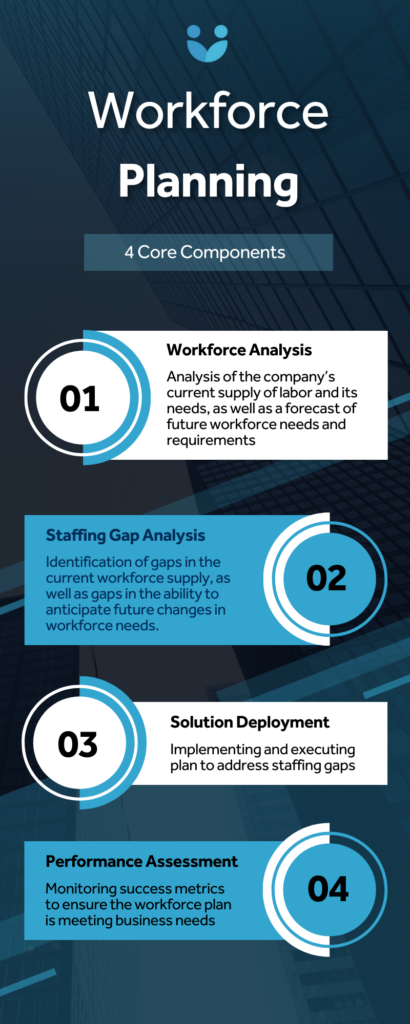
Infographic of Workforce.com's four core components of workforce planning

Core components of workforce planning

While there is no standard “one size fits all” structure for the workforce planning process, below are some key elements of most plans, including some supplementary components that can and will work better for some companies than others.

The most common parts of a workforce planning model are:

  • Workforce Analysis: Analysis of the company’s current supply of labor and its needs, as well as a forecast of future workforce needs and requirements
  • Staffing Gap Analysis: Identification of gaps between the current workforce supply and demand, as well as gaps in the company’s present ability to anticipate future changes in workforce needs.
  • Solution Deployment: Implementing and executing a plan to address staffing gaps
  • Performance Assessment: Monitoring success metrics to ensure the workforce plan is meeting business needs

Being prepared is better than being surprised

If a company is more efficient, it can avoid the need for layoffs or panic hiring. By planning ahead, HR can provide managers with the right number of people, with the right skills, in the right place, and at the right time. Workforce planning might be more accurately called talent planning because it integrates the forecasting elements of each of the HR functions that relate to talent management–recruiting, retention, redeployment, and leadership and employee development.

Businesspeople who just wait and then attempt to react to current events will not thrive for very long. The new standard is to provide managers with warnings and action plans to combat full-blown problems before they become more than a blip on their radar.

The human resource management world is no different.

The rate of change in the talent market is dramatic. We now know how important talent is to the success of a business. It’s time to make the talent pipeline more efficient.

Many of the other overhead functions–like procurement, manufacturing, and even the mailroom–have developed effective “pipelines.” If human resources cannot develop effective pipelines, then the alternative option is to have its entire function outsourced to an external vendor.

HR should be aware of the business cycle

HR professionals often face the painful boom-and-bust cycle of budget cuts, rapid growth, and more budget cuts. What they want is stability. Unfortunately, the way that some HR people act or fail to act compounds the pain of the boom or bust phases.

Everyone knows that the business cycle has ups and downs. There are phases of growth and phases of recession; each seems to happen every few years. The surprising thing is that HR, rather than preparing customized approaches for the different phases of the business cycle, tends to do things the same way no matter what the economic climate, operating independently of the business cycle.

The main reason that HR suffers through these phases is that it has no business strategy or plan to participate in its company’s business cycle. Rather than seeing the big picture and setting a strategic direction, HR departments sometimes tend to coddiwomple with temporary programs that only address crises in the moment.

HR should have two distinct reasons for planning ahead. The first reason is to lessen the impact of the boom-and-bust cycle on the management and operation of the HR department itself. The second–and perhaps more important–reason for planning ahead is that HR manages the new hire pipeline for the organization. It’s crucial to maintain both that pipeline and the talent inventory at the right levels.

This is where workforce planning strategy comes in.

A closer look at workforce planning

To better prepare a company to handle current and future staffing needs, human resources should generally follow the four-step workforce planning process listed earlier in this article. Here is a closer look at what each of those steps entails:

1. Workforce Analysis

This first step in workforce planning involves assessing both the current state of your company’s workforce as well as its ability to address future changes in staffing needs. Additionally, it is also important here to analyze the current external labor market, company revenues, expenses, and growth opportunities.

There are three primary areas of the Workforce Analysis:

  • Current labor supply & demand: checking the supply of labor the company currently has available, as well as the level of labor it currently demands.
  • Forecast of future workforce needs: taking initiative on discovering what external and internal variables could impact workforce needs, and understanding where the company will need to be agile in the future to ensure staffing levels are always correct
  • Skills and interest inventory: Identifying current and required job and competency needs as well employee skill sets.

From the workforce analysis, you should uncover a deeper understanding of your company’s current staffing situation, including its strengths, shortcomings, opportunities, and threats.

2. Staffing Gap Analysis

In this step, you take the information gathered from the workforce analysis and use it to pinpoint the talent gap between the company’s overall staffing needs and the identifiable supply of labor.

There are three parts to the staffing gap analysis:

  • Surplus/shortage determination: Reviewing the current supply and demand of labor, as well as current and future workforce needs, and determining the presence of either a surplus or shortage of labor.
  • Potential retirements: Figuring out the demographic of who is eligible, when they are eligible, who will replace them, and what alternative work arrangements are available that could prevent vacancy issues stemming from retirements.
  • Talent action plan: Outline what specific actions all (HR or otherwise) managers will have to take in terms of talent management. The action plan designates responsibility and outlines the specific steps that should be taken in order to fill the talent pipeline, address skill gaps, and maintain the talent inventory at the levels required for the firm’s projected growth rate.Each action plan has a set of goals, an individual who is responsible for making sure the plan objectives are met, a budget, a timetable, and a measurable result.

3. Solution Deployment

This is where everything comes together. Once the workforce analysis is complete, gaps are determined, and a talent action plan is made, a solution is determined and then executed.

Deploying a workforce plan is not a once-and-done situation. It is an ongoing process built on agility and continuous improvement. Once current staffing gaps are filled and the overall workforce is strengthened, the deployment continues in the form of adjusting and adapting to changes in future needs.

Here are some of the main areas of solution deployment:

  • Succession planning: Designating the progression plan for key positions.
  • Leadership development: Designating high-potential employees; coaching; mentoring; rotating people into different projects.
  • Talent recruiting: Estimating headcount, positions, location, timing, and more for new employees.
  • Talent retention: Forecasting turnover rates; identifying current employees who are at risk and how to keep them.
  • Redeployment: Deciding who is eligible for redeployment, and from where to where.
  • Contingent workforce: Designating the percentage of employees who will be contingent, and in what positions
  • Career path: Career counseling for employees to help them move up.
  • Backfills: Designating key-position backups.
  • Internal placement: Developing job-posting systems for internal employees to get a leg up on new openings.
  • Outsourcing: Determining business functions that would be better accomplished by labor outside of the organization
  • Contractors and consultants: Determining what new business requirements would be best met by specialized workers or consultants

4. Performance Assessment

Finally, the last step of a workforce plan is performance assessment. Again, this is an ongoing process, alongside solution deployment, in which select members of your organization monitor predetermined workforce success metrics to make sure strategic objectives are being met. These metrics should speak to if the workforce plan is actually benefiting the organization at all, and should indicate if the plan was flawed to begin with or if it is not being executed properly.

The future of workforce planning

Putting together an abstract workforce plan is one thing. Executing it across your entire workforce is another. Managers need the right tools and systems in place to monitor staffing levels, productivity, labor costs, and more.

While workforce planning has been around for a long time and has gone through many changes and multiple iterations, one thing is for certain: it is getting much easier.

Thanks to modern advances in workforce management software technology, workforce planning is becoming easier to visualize, deploy, and actively monitor.

Benefits of workforce management software

In order to execute effective workforce planning and achieve your business goals, HR leaders need a whole host of software solutions at their disposal. Chief among these is obviously HR software for talent and performance management. But other solutions are also required, including workforce management and labor forecasting software, both of which are extremely important to workforce planning.

Here are some of the ways workforce management and labor forecasting can streamline your workforce planning:

Everything on a single system

Nearly all the workforce planning data you need is housed in workforce management software. From time clock and scheduling data to employee records like pay rate and ob titles, everything is held in a single, cloud-based system optimized for easy access.

More visibility into labor costs

By combining scheduling and time tracking into a single system, workforce management software allows managers to leverage real-time data on labor costs. They can view costs per team, individual, week, or location to better understand where and how they are spending money on talent. Moreover, managers can view potential wage costs on schedules, and compare scheduled costs with actual costs on timesheets to pinpoint overspending.

Increased user self-service

Onboarding and retaining employees is critical to workforce planning. With workforce management software, employee self-service is maximized – users have access to a simple system to view schedules, request leave, pick up and swap shifts, clock in and out, and approve timesheets.

Easy insight into labor needs

The right labor forecasting software optimizes your workforce planning with AI and machine learning. It predicts demand and automatically matches labor ratios to that demand, making it easy to determine shortcomings in your supply of human capital. Clearly seeing where you lack the staff necessary to fulfill labor forecasts helps you hire more purposefully moving forward.

Comprehensive BI reporting

Managers can generate reports on historical wage costs, employee engagement, absenteeism, overtime, and more. These reports can be filtered by team, location, or job title, providing more clarity for managers when they are analyzing workforce trends.

Ensure labor compliance

Upon deploying a workforce plan, it is important to make sure your organization is complying with all necessary labor laws. It is particularly easy to misclassify contract workers, owe back pay, or violate various provisions of the Fair Labor Standards Act. Avoid all these issues when deploying your workforce plan with labor compliance software that schedules and pays employees accurately with the help of an extensive Wage & Hour Compliance library.

Optimize your workforce planning with Workforce.com

As a best-in-class workforce management platform, workforce planning is what we do. To learn more about how to streamline your business objectives with market-leading scheduling, compliance, and time tracking software, contact us today or sign up for a free trial.


FAQs

  • What is workforce planning?
    • It is a proactive and systematic process that involves analyzing the current supply of talent in your workforce, identifying gaps in your labor supply, forecasting future staffing needs, and developing shift plans to close gaps and meet budgets to avoid potential shortages and surpluses of human capital.
  • Who does workforce planning?
    • It is a collaborative effort between managers in multiple departments with a range of specialties since organizational alignment is important. Typically, HR and operations are most heavily involved.
  • Why is workforce planning important?
    • It is important for preventing over and understaffing as well as for building agility into a company’s talent management, retirement, and succession planning processes.
  • What tool do I use for workforce planning?
    • Typically you’ll need a robust HRIS system integrated with a specialized workforce management platform. The HRIS system should feature talent management, acquisition, onboarding, and payroll, while the workforce management platform should provide scheduling, time and attendance, and labor compliance.
  • How does workforce management software help with workforce planning?
    • Workforce management software helps managers execute and monitor the success of workforce planning. It allows businesses to schedule and track time accurately and compliantly. It also lets them view reports on labor costs, attendance, and engagement, which are all vital for keeping a business agile in its ability to forecast and react to changes in workforce needs.
  • Is workforce planning difficult?
    • No! Workforce planning generally involves four core steps and is continuously improved as businesses move forward. With the help of various software solutions, workforce planning is simple yet very rewarding.
  • How is workforce planning different from talent acquisition?
    • Talent acquisition is simply a small function of HR involving the identification and acquisition of workers for your company. Workforce planning is much broader, involving assessments of current talent supply, future talent supply needs, gaps in labor, and much more.


Posted on July 27, 2021July 5, 2023

Shift bids vs shift swaps – which is right for your business?

Being flexible with shift work is good for business. Even before the pandemic created a nationwide staffing shortage, employees were making it clear that a better work/life balance was becoming a top priority.

A 2019 survey (https://www.prnewswire.com/news-releases/new-research-shows-that-flexible-working-is-now-a-top-consideration-in-the-war-for-talent-300818790.html) by IWG found that 80% of workers would choose a job with a flexible schedule over one that did not, and more than 30% considered flexibility more important than extra vacation days or a prestigious job title. In addition, a different survey (https://www.flexjobs.com/blog/post/survey-flexible-work-job-choices/) in the same year found 80% of workers would be more loyal to their employer if they had more flexibility over when they worked, with over half trying to negotiate adding this perk with their current manager.

There are two popular ways to inject flexibility into your shift scheduling: shift bids and shift swaps. While they appear similar, they differ in subtle but important ways, and the right one for you will depend on the specifics of your business.

Shift bids and shift swaps – what’s the difference?

Put simply, shift bids are when the manager invites workers to put themselves forward for open shifts. Shift swaps allow workers to arrange to take each other’s shifts directly.

Shift bid example: A retail worker informs the manager that they can’t come in as scheduled on Friday because of a medical appointment. The manager chooses which staff members are best suited to fill that shift and lets them know an extra shift is up for grabs. The manager then chooses who will take the shift from those that express an interest.

Shift swap example: A restaurant worker has a childcare emergency and can’t come in for their scheduled afternoon shift, so they ask their colleague to swap shifts. The colleague agrees, and they present the solution to their manager, who approves it.

Each approach has the desired result: the empty shift is filled. Both are also easily implemented with the right scheduling software, but which method works best for your business depends on several factors.


Shift bids keep the manager in control

There are benefits and limitations to shift bids that you should be aware of before considering using them.

Benefits of shift bids

  • The manager gets a choice of different staff members to fill a shift and can pick the best suited. This helps maintain a well-rounded shift with employees who possess all the required skills and experience and work well together.
  • Managers using shift bids may also keep an eye on who is close to working overtime and favor those with fewer hours on the clock, thus controlling costs and spreading available work more evenly.
  • A shift bids system can expand to fill all shifts, not just absences. Workers can rank all available shifts according to their preference, and the manager can use that data to put together a schedule that accommodates as many people as possible.
  • Staff using shift bids have more control over when they work by only putting themselves forward for shifts that fit around their life.

Limitations of shift bids

  • The shift bids approach won’t suit every worker, and some can find the need to bid for their shifts to be stressful.
  • Shift bids can be prone to favoritism and need to be carefully monitored to ensure bids are being handled fairly. This is an area where scheduling software can help, as you can easily check your shift data over time and identify patterns where certain staff members are scheduled – or not – more than others.

Shift swaps can be quick and painless

Shift swaps are simpler to manage than shift bids, but have other pros and cons worth considering.

Benefits of shift swaps

  • By having staff arrange coverage between themselves, shift swaps save the manager’s time.
  • With reliable staff, shift swaps can solve many scheduling issues before they even become a problem.
  • Shift swaps are better suited to solving urgent staffing needs, such as last-minute absences, as they don’t require employees to go through the bidding process.

Limitations of shift swaps

  • The manager has less control over who takes a shift, so unbalanced staff rosters are a risk.
  • Unregulated shift swaps can be prone to over-use by employees and require a robust company policy to clarify the conditions under which shift swaps will be approved.

Choosing the right approach for your company

The scheduling method best suited to your company will depends on several factors.

Company culture

In environments where top-down management is the norm, shift bids are likely to be a better fit. But in businesses where employees are used to having greater autonomy, they’ll likely prefer to arrange shift swaps themselves.

Company size

The larger the company, the more effective shift bidding becomes, as having more staff available to bid on shifts means more choice for managers. And vice versa; the fewer staff members there are, the fewer variables the manager has to keep track of when shifts are swapped.

Worker and managerial experience

A shift swap system works well for companies or locations with reliable long-term staff. For that reason, shift swaps can also benefit new managers or managers who are unfamiliar with all the employees, as it means there is less need to match workers to shifts personally.

All these factors are prone to change over time, but resist the temptation to mix and match shift bids and shift swaps at the same time. Instead, it is better to pick one flexible scheduling system and stick with it for clarity for staff and simplicity for managers.

Flexible shifts help attract and retain staff, and whichever way you approach them will require well-thought-out processes. However, if the practical complexities still seem intimidating, remember that scheduling solutions such as Workforce.com can help automate and track shift bids and shift swaps, freeing up valuable time and headspace for managers.

Posted on July 27, 2021August 3, 2023

The 10-minute guide to 2021 labor law compliance

Labor laws are a potentially lethal minefield for companies, particularly in today’s turbulent labor market, as the cost of labor law compliance failures can be enormous.

Labor law fines tend to stack per infraction so with large employee numbers the financial risk can grow exponentially, as with the recent high profile example of New York City suing Chipotle (https://edition.cnn.com/2021/04/29/business/chipotle-nyc-lawsuit-labor-law/index.html) for $151 million over 600,000 labor law violations accumulated within the city. In Tennessee, a home health care provider misclassified fifty workers as independent contractors rather than employees and was hit with a $358k penalty (https://www.workforce.com/news/worker-misclassification)by the Department of Labor to make up back wages and overtime.

Ignorance of the law is no defense, so even in situations where labor law compliance is complicated by different federal, state, and city rulings, it’s up to companies to stay on top of what is required. In situations where federal and local laws differ (i.e., the state minimum wage is higher than the federal), companies are expected to adhere to whichever is most stringent (i.e., they would have to pay the higher state minimum wage, not the federal).

It’s all too easy to make labor law compliance mistakes, but awareness of your responsibilities and impeccable record keeping will help to protect your company. Here are the key areas to keep in mind.

Minimum wage

Minimum wage laws are getting a lot of attention at the moment, with President Biden’s executive order raising the salary for federal workers to at least $15 per hour being seen by many as a prelude to a nationwide rise in minimum wage levels. Compliance with these laws can seem cut and dried, but there are aspects unique to some industries that you should be aware of if they affect you.

For example, industries where workers earn tips have a unique minimum wage law to follow, called Minimum Tipped Wage. “Minimum tipped wage makes it quite a bit more complicated,” says Workforce’s chief strategy officer Josh Cameron. “In hospitality or anything where you earn tips, you can pay the staff a minimum wage much lower than the normal one. So it would be $7.50 an hour if they’re not tipped, but it’s $2.50 if it’s tipped. As long as they get enough tips to get them over that—it’s called the tip credit—then they can receive the lower $2.50 per hour from their employer.”

There are reasons to keep on top of minimum wage laws beyond the threat of fines. For example, 29 states currently require a minimum wage higher than the federal standard, and you are obliged to pay the higher sum. Underpaid workers are unlikely to show any loyalty to a company, and underpayment can cause PR problems as well. “An underpayment scandal can bring companies to their knees,” says Andrew Stirling, head of product compliance at Workforce.com. “Customers can decide to take their business elsewhere. People are less likely to visit a restaurant or shop that has been reported for underpaying their people.”

Paid and unpaid breaks

One of the areas of labor law compliance with the least clarity is breaks for workers, making it especially important for companies to err on the side of caution. The legal requirements can be found on the Department of Labor website, but there are significant areas of ambiguity to watch for:

  • Federal law does not require companies to offer lunch or coffee breaks.
  • Where short breaks are allowed by a company, short breaks (i.e., toilet use) of up to 20 minutes should be paid.
  • Breaks of 30 minutes or longer (i.e., lunch) are considered outside of workable hours and do not need to be paid.
  • Waiting time or on-call time does not count as a break and should be paid.

“There’s this gray area,” says Josh Cameron. “Say you take a break for 21 minutes, is that paid or unpaid? Is it okay to make that unpaid? If you’re a lawyer looking at this, it’s really an opportunity because you can say, ‘This employee always had a 23-minute break, always had an 18-minute break, and they never got paid for it. Maybe they should have been.’ That’s something that employers should really be aware of and keep an eye on.”

This is an area where accurate and exhaustive employee data can really help, and if your company still relies on timecards and manual spreadsheets or pen and paper logs to track breaks, you could be leaving yourself open to big problems in the future.

Paid and unpaid leave

Thirteen states, plus Washington DC, currently require private companies to offer paid sick leave. The Families First Coronavirus Response Act added an additional responsibility for companies with less than 500 employees to allow workers to take paid time off if infected with COVID-19, to isolate following contact with an infected person, or to care for a family member. The same act also introduced a tax credit to offset the loss for affected companies.

California, New Jersey, Rhode Island, and Washington have all passed laws that also require paid family leave, and President Biden’s administration has set its sights on a federally mandated period of 12-weeks paid leave that would allow, for example, parents to take time off to care for newborn babies or other family needs.

For now, the only federal law involving medical and family leave is the Family and Medical Leave Act, which requires employers with more than 50 staff to offer 12 workweeks of unpaid, job-protected leave in a 12-month period for:

  • The birth of a child, adoption, or fostering of a child
  • A seriously ill spouse, child, or parent
  • A serious health condition that makes the employee unable to perform the essential functions of his or her job
  • Any qualifying exigency arising out of the fact that the employee’s spouse, son, daughter, or parent is a covered military member on “covered active duty;” or Military Caregiver Leave—26 weeks in a 12-month period to care for an injured or seriously ill spouse, son or daughter, parent, or other next of kin who is a covered service member

This is an area of labor law compliance that is only going to become more prominent in the coming years, so shrewd managers should ensure they are on top of current requirements, which are largely dependent on where you operate and how many staff you have, and be prepared for change.

Healthcare

Another area of labor law that has been fraught with political debate, the Affordable Care Act requires that if an employee works more than 30 hours a week over any single year look-back period, then the employer must provide health insurance. While the ACA is a federal law, the portion of the medical insurance that the employer has to pay is determined by the state. In New York, for example, the employer must pay 80%.

The 30 hours a week cut-off requires particularly careful management where shift workers are concerned, as their hours may fluctuate over time. “This whole area is a big pain point,” explains Josh Cameron. “It’s a very difficult conversation to have with an employee that has become eligible for healthcare, then loses that eligibility the next year. Taking it away from someone feels very harsh to the employee.”

Keeping track of employee hours and keeping accurate records is yet again a vital part of compliance for companies here. Qualifying for healthcare is a strong motivator for retaining staff, but for those companies that are concerned about shouldering the additional costs, Workforce.com can be calibrated to warn managers when employees reach the 30 hours threshold and can even prevent managers from publishing schedules that extend past 30 hours.

Predictive scheduling

A recent addition to the labor law conversation, predictive scheduling laws – also sometimes known as “fair workweek” – place restrictions on how shifts are assigned and require companies to give advance notice of new schedules.

Two states – Vermont and Oregon – and eight municipalities – San Francisco, Berkeley, Emeryville, San Jose, Seattle, New York City, Chicago, and Philadelphia – have passed such laws, and more states and cities are considering legislation in this area. The specifics of the laws vary from region to region, but the core principles are:

  • A minimum notice period for upcoming schedules (usually two weeks) with compensation for workers who are not given enough notice of their schedule or changes to that schedule
  • A ban on “clopening,” meaning that a staff member working the closing shift cannot be scheduled to work the opening shift the next day
  • Mandatory rest periods that vary from between 9 to 11 hours between shifts

Failing to maintain compliance with these laws is expensive. The Chipotle example mentioned earlier, in which NYC sued the fast-food chain for $151 million, was caused by hundreds of thousands of predictive scheduling infractions across its many locations in the city.

Even if your business is not based in a state or city with predictive scheduling laws, it is still worth adopting the principles behind them. Partly because these laws may yet impact your business, but also because they have had a notable improvement on staff retention and job satisfaction.

Discrimination laws

There are thankfully few employers looking to openly discriminate in their hiring processes these days, but you should still be aware of which groups the law applies to when hiring and firing, as well as setting the terms of employment and how much people are paid.

  • The Equal Opportunity in Employment Act covers all the areas of discrimination that are forbidden. This concise PDF from the Department of Labor spells out everything employers should know.
  • The Americans with Disabilities Act (ADA) applies to companies with 15 or more employees and makes it illegal to discriminate in employment on the basis of a person’s disability. This also requires companies to make “reasonable accommodation” to allow a disabled person to work there, including making modifications to the working environment to not only allow disabled people to work there but also participate in the application process.
  • Ever since the Civil Rights Act of 1964, there have been several laws and amendments which make it illegal to discriminate against anyone because of their Ethnicity, Gender, Race, or Religion. Nationality is also a protected category, so, for example, it would be illegal not to hire someone because they were from Poland, regardless of their race or ethnicity.
  • The Age Discrimination in Employment Act offers protection to employees and applicants on the basis of their age. This law applies to anyone aged 40 or older, a far younger cut-off than many companies realize.

Labor law compliance is easier with good record keeping

If this all seems like a lot to keep track of, you’re not alone. The USA has relatively light-touch regulations for businesses compared to Europe, for example, but that doesn’t mean the task of staying compliant with labor laws can’t feel overwhelming—especially if you’re new to management and dealing with all of this legislation for the first time.

Regardless of which law is involved, one of the recurring causes of labor law breaches is poor record keeping. There’s one surefire way to ensure that your labor law compliance is rock solid, and that’s to keep excellent data. While it’s possible to maintain your records the old-fashioned way, with paper and pen or spreadsheets, the potential for human error is high.

When the cost of non-compliance can be so steep, using dedicated staff management software like Workforce.com to track staff hours and automatically flag labor law compliance issues offers much-needed peace of mind.

Posted on July 26, 2021August 3, 2023

How to reduce labor costs and attract quality staff in a post-Covid market

The challenge of attracting quality staff while trying to reduce labor costs is one that has taken on fresh urgency in the post-Covid labor market. This is particularly true where hourly shift work is concerned, as staff question their priorities after a year in lockdown.

Thankfully, there are several ways to find – and retain – good workers while still controlling your labor costs. It just requires a little recalibration of how you think about incentives and staff management.

Use flexible working rather than salary incentives

One myth that we can dispel quickly is that the only way to attract quality staff is by offering larger salaries. That’s been the assumed wisdom for decades but is now an outdated view of what people want from a job.

Increasingly workers are saying that flexible working hours are now their priority, with multiple studies showing that the ability to fit work around other areas of their life is a key consideration when job hunting. One pre-pandemic study found that if given the option of a job with flexible hours and one without, 80% of workers would choose the job with flexible hours. The same study found that 30% considered flexible working more attractive than extra vacation days or a prestigious job title.

Offering flexible hours not makes your company more attractive to workers, but it makes staff more likely to stay with you for the long term. A survey for FlexJobs found that 80% of workers would be more loyal to their current job if it gave them more flexibility.

The reason for this is that the way we perceive value in work has changed. “If you’re a parent and you have three kids to pick up from school every day at 3:30, then flexible working actually adds a lot of value to you”, explains Josh Cameron, Workforce’s Chief Strategy Officer. “If you can pick or swap out of the shifts, that’s more important to you than getting an extra $2 an hour, because you have to pay someone to pick up and look after your kids. The extra dollars are not adding value.”

Systems such as shift bidding are an excellent way to incorporate flexibility into a business, help reduce labor costs by not adding additional expense on your payroll, and are easily managed using staff management software such as Workforce.com.

You don’t need to cut wages to reduce labor costs

It’s a mistake to think that the only way to reduce labor costs is to cut staff or lower wages. One of the best ways to save money is by getting more value for what you already spend, and one of the most common ways that businesses fail to do this is by losing track of productivity against wages.

You can save money in real terms by ensuring that hours worked and hours scheduled match up, cross-referencing with hourly income using workforce analytics to check you are getting the productivity you’re paying for. It may sound basic, but you’d be surprised how many companies still have their data spread across multiple files or systems and simply assume the numbers match at the end of each day.

“Most people never check the schedule matches what people actually work,” says Josh Cameron. “They might have a really good shift plan, and that’s in one system, but then the attendance data is in another system, and people are clocking in and clocking out of that. And the manager is basically just blindly ticking things because that’s what was clocked. If they even wanted to cross-check that, it would be a big exercise. People don’t do it. What’s much better is to have the schedule and the attendance in one system, so you can tick these things off throughout the day or at the end of the shift and if there are differences, you can go see why that happens.”

Listen to feedback to stop staff churn

Once you’ve attracted good workers with flexible hours and made sure you’re getting full value for those hours worked, it’s important to remember that you can help to reduce labor costs by keeping those staff in your business. Replacing employees costs money in advertising the vacant roles, onboarding and training, and lost productivity as working routines are disrupted. Gallup found in 2019 that US businesses lose a trillion dollars every year simply from the cost of replacing staff.

How do you stop staff from leaving? Listen to what’s bugging them about their job, and fix problems wherever possible. The idea of employers giving performance feedback to employees is widely accepted, but it’s also important for employees to be able to give feedback on the company.

“If you’re asking why people quit, by allowing people a way of giving feedback on their shifts, they feel ‘Hey, I have a way of being heard in this job, I actually am important,’” says Josh Cameron. “Managers can look at that feedback and analyze it and be like, ‘This is what’s causing problems. We’ve got these structural things that make it hard to work in this shift and that’s making it hard for people.’”

This is why Workforce.com allows staff to give feedback not just in general, but on the specific shifts they work. This allows managers to identify the pain points that cause staff to leave, and make changes. It may be something as common as a particular manager being hard to work with. It may be that a certain location gets uncomfortably hot on summer afternoons. Whether the answer means shuffling the staff roster, or something as easy as investing in an aircon unit, you’re empowered to spot the leaks in your staffing and plug them before they cost you any more revenue.

Think beyond the hiring process

There will always be sledgehammer approaches to reducing labor costs, but the current labor market conditions where potential employees are empowered to say “no” to jobs that don’t work for them, require a more nuanced approach. Companies save money when they hire the right people and get the best out of those people, and that means making sure they want to stay with you for the long term. From offering more flexible working arrangements to identifying the problems that drive staff away, Workforce.com can help at every stage.

Posted on May 26, 2021

Vaccination status harassment

COVID-19, vaccine, flu

“I can’t believe you got vaccinated. It’s an experimental drug that I’m not injecting into my body. Besides, I heard that Bill Gates and the global elites implanted 5G trackers in the vaccine. All the government wants to do is control us, and you’re letting them by submitting to these shots. Sheeple!”

OR

“I can’t believe you’re not getting vaccinated. Don’t you care about protecting yourself and others? This vaccine has been tested, vetted, and is safe and effective. We need to reach herd immunity if we want this pandemic to end, and you’re not doing your part. Selfish!”

Some version of this drama is likely playing out in your workplace. And it has to stop, ASAP.

For starters, one’s choice not to get vaccinated might be because of an underlying physical or mental impairment, a pregnancy (or hope to become pregnant), or a sincerely held religious belief, practice or observance. In any of those cases, harassing a co-worker because of his or her unvaccinated status might cross the line into unlawful protected-class harassment.

Additionally, whether another is or is not vaccinated is really none of anyone’s business. As noted in this post, it’s confidential medical information under the ADA (not HIPAA). It’s an employer’s business whether unvaccinated employees are following the CDC’s guidelines and keeping their masks on while at work.

But whether they’ve gotten the Pfizer, Moderna, or J&J jab? Not a co-worker’s business. And certainly not something anyone should be harassing or bullying anyone else over. Civil discourse is one thing. Harassment, bullying and disrespect is another altogether.

It’s simply not realistic to eliminate all vaccine-related discourse from the workplace. We’ve lived with COVID for over a year. With a few exceptions it’s all we’ve talked about. How can we expect employees simply to ignore conversing about issues such as vaccines for the eight-plus hours a day they are at work?

Instead of banning these discussions, remind employees of your expectations regarding all workplace conversations — that they are civil, professional, respectful and do not intrude on protected classes. And, if an employee violates these precepts, an employer should (or, in the category of protected-class harassment, must), address the issue.

Discussions over divisive issues need not be nasty, uncivil or contemptuous as long as we respect the rights of others to think differently and hold them accountable when they fall short of this standard.

Posted on April 19, 2021

How to identify and handle an employee at risk for workplace violence

termination, covidiot, workplace violence, gun, weapon

It’s been four days since Brandon Hole returned to the Indianapolis FedEx facility at which he previously worked, and killed eight people.

I’ve previously written about how to spot an employee at risk for workplace violence. And while I’m not sure FedEx could have done anything to prevent what happened here, this tragedy nevertheless is a reminder of what employers need to do when they suspect an employee presents a risk of violence.
Here is my post from Feb. 18, 2019, following a workplace shooting in Aurora, Illinois.

Early Friday afternoon, Henry Pratt Co. informed one of its employees, Gary Martin, of his termination. Shortly thereafter, he opened fire with a .40-caliber Smith & Wesson, killing five of his co-workers and wounding five police officers. Martin himself was the sixth casualty, killed in a shootout with police.

After the news of this tragedy broke, reports surfaced of Martin’s history of violence — six prior arrests by the local police department for domestic violence, and a decades-old felony conviction for aggravated assault.

All of which begs the question, should this employer have known that Martin was prone to violence, and if so, should it have taken added measures in connection with his termination.

A criminal history of violent arrests and offenses is not necessarily a predictor of workplace violence. Still, there are certain warning signs for which an employer can look to help determine whether an employee is at risk for potential violence.

According to ESI Group, these warning signs include:

  • A chronic inability to get along with fellow employees
  • Mood swings and anger control issues
  • Expressions of paranoia or persecution. Being a “victim”
  • A history of problems with past jobs and and/or personal relationships
  • An inability to get beyond minor setbacks or disputes at work
  • A fascination with guns, weapons, or violent events
  • A sudden deterioration in work habits or personal grooming
  • Signs of stress, depression, or suicidal ideation
  • A major life problem, such as divorce or legal problems

If one more of these red flags surface, it is recommended that you refer this employee to an employee assistance program, for assessment and treatment.

If you are compelled to fire an employee who you think poses a risk of violence, it is recommended that you take further steps to mitigate against the risk of your termination transforming into a workplace tragedy.

ESI Group recommends the following:

  • Consider a professional threat assessment.
  • Consider using a neutral manager or outside security consultant to carry out the termination.
  • If there is manager or supervisor who has been the object of threats or anger, that person should not be the person to conduct the termination.
  • Have security nearby—not in the same office, but close enough to hear signs of a problem and to act.
  • Do not take a break. There are numerous instances of an employee asking for a bathroom break or time to compose him- or herself, and using the break to retrieve weapons.
  • Wait until the end of the workday to terminate, if possible. This protects the dignity of the fired employee and minimizes the number of employees on hand should a situation escalate.
  • Minimize any reasons why the employee would have to revisit the workplace. Mail a check; have uncollected belongings sent to the person’s home via a delivery service.
  • Allow the person as much dignity as possible, but be brief and to the point. Do not get into a back and forth.
  • Emphasize any severance benefits and outsourcing help that may be available. Some organizations decide they will not contest unemployment or offer the option of resigning.

As with most issues in the workplace, the proverbial ounce of prevention really matters. While there exists no foolproof way to protect your workplace against these kinds of tragedies, a few preventative steps can go a long way to putting you in the best place to deter and respond.

Posted on April 12, 2021May 17, 2022

It’s time to end pandemic PTO hesitancy

leave management, PTO, vacation, PTO

I haven’t taken a proper vacation in 25 months. We were supposed to go to Portugal last March, but then COVID-19 happened. In the 13 months since, there’s been little point in taking off from work for any length of time because I haven’t been able to go anywhere. “I can’t go anywhere, so I might as well work,” has been a popular pandemic refrain (me included).

Americans were bad at vacations before COVID. The pandemic certainly hasn’t helped our PTO hesitancy.

Consider the following from The Atlantic.

Americans are good at lots of different things, but going on vacation is not one of them.… Guess which industrialized country is the only one that doesn’t guarantee time off to its workers? Guess which country left 768 million vacation days on the table in 2018?

The pandemic has not been great for America’s vacation malaise. When there are few new places to go and few new things to do, what’s the point of asking for time off? Yes, many Americans who have made it through without losing their jobs have taken a break to discover nature or their apartment balconies, but largely, we do not seem to be PTO-ing our way through this god-awful year. In February, time-off requests on the HR platform Zenefits were down 26 percent from the year before, a spokesperson told me, in line with what the company has seen since July.

I’m ending my vacation moratorium this summer with a week in a cabin in the Blue Ridge Mountains. I suggest that you strongly encourage your employees to do the same, lest you risk the burnout I warned about last week.

Here are four tips to help push your employees to use their PTO and take a vacation.

1. Teach your employees the benefits of taking a vacation. Make it a part of your wellness education. Communicate the health and wellness benefits of taking a vacation. If employees understand that vacations lead to improvements in performance productivity, they will be more likely to leave work behind for a few days.

2. Take your own time off. If the boss never takes a vacation, employees won’t either. If you want your employees to take time away from work, do so yourself. Leadership and messaging start at the top. If you make vacations a priority, your employees will, too.

3. Ease employee back to work. When asked why they don’t take time off, most employees historically cite the fear of returning to a backlog of work and thousands of emails to which to respond. COVID hasn’t helped, as fewer are away from work. Plan for coverage when employees are out, and provide a day upon their return for them to catch-up, so that they won’t fear the return-to-work ambush or avalanche.

4. Prohibit vacation shaming. No one should be permitted to discourage or tease employees who take a vacation. If you send or permit negative messages about vacations, your employees won’t take them. They will fear letting the team down, or the time-off impacting their employment. This form of bullying cannot and should not be tolerated.
Posted on April 5, 2021

Employers, the COVID-19 lawsuits are coming

essential workers; workers' compensation, mask

Thirteen months into the pandemic, the COVID-19-related employment lawsuits are starting to roll into courthouses. Consider the following, all of which made headlines over the past couple of weeks.

A former crew member who worked for Universal TV is suing his former employer claiming discrimination stemming from his termination after his COVID-19 diagnosis.

A COVID-19 long hauler is suing her former employer after she was fired for missing too many days of work while recovering from her illness.

A doctor is suing after he was fired over his vocal opposition to his employer’s COVID-19 response.

And these lawsuits don’t even scratch the surface of employees fired for other COVID-related reasons, such as those fired for refusing the vaccine or complaining on social media about unsafe working conditions.

Employers, you need to understand that if you fire someone related to the pandemic, their first stop likely might be the office of their friendly neighborhood plaintiff attorney. Do yourself a favor a don’t go this alone.

Take the time to vet these terminations pre-termination. The time you spend on the phone with your employment lawyer will be time and money well spent if it helps you not to walk in front of a runaway lawsuit.

Posted on January 12, 2021

8 of the 10 deadliest days in U.S. history are because of COVID-19

VF Corp., COVID-19, mask, education
While we’ve all been mentally overcome by the rebellion that unfolded at the Capitol and the civil war that I fear it started, COVID-19 continues to rage around the country. Hundreds of thousands are falling ill each day, hospitals are stretched to capacity, and thousands are dying daily.
The circle of people with COVID is closing in personally, and the number of calls I am receiving from clients with the question, “We’ve had an employee test positive; what do we do?” has increased exponentially. All the while, the rollout of the vaccine, which was supposed to save us from this pandemic, has been too slow and uneven.
The bottom line is that COVID-19 continues to win.
So please, let’s not forget that we are still in the middle of an awful pandemic even as our democracy is splintering. Wear your mask (over your mouth and nose), keep your distance, wash your hands and please stay home, especially, but not only, if you’re sick or have been exposed to the virus.
While the vaccine rollout has been mismanaged and mishandled, the vaccines still offer us a light of hope of a return to normalcy. I’d like to make it there, and I’d think you would, too.

Posts navigation

Previous page Page 1 Page 2 Page 3 Page 4 … Page 45 Next page


Webinars


White Papers


  • Topics

    • Benefits
    • Compensation
    • HR Administration
    • Legal
    • Recruitment
    • Staffing Management
    • Training
    • Technology
    • Workplace Culture
  • Resources

    • Subscribe
    • Current Issue
    • Email Sign Up
    • Contribute
    • Research
    • Awards
    • White Papers
  • Events

    • Upcoming Events
    • Webinars
    • Spotlight Webinars
    • Speakers Bureau
    • Custom Events
  • Follow Us

    • LinkedIn
    • Twitter
    • Facebook
    • YouTube
    • RSS
  • Advertise

    • Editorial Calendar
    • Media Kit
    • Contact a Strategy Consultant
    • Vendor Directory
  • About Us

    • Our Company
    • Our Team
    • Press
    • Contact Us
    • Privacy Policy
    • Terms Of Use
Proudly powered by WordPress