
Skip to content

Workforce

Category: Benefits

Posted on November 10, 2017June 29, 2023

Benefits Round-Up: Domestic Abuse, Extra Vacation and Ingrained Health Attitudes

Andie Burjek, Working Well blog

This month has been a rough month in the business news space, with sexual harassment in the spotlight and open enrollment stressing people out in both the individual and employer markets. I’m working on a separate post about open enrollment (feel free to contact me via email, twitter or the comment section below if you have valuable thoughts about open enrollment). Meanwhile, there are a lot of other things going on besides these big stories that are worth mentioning.

Domestic Abuse Victims and Paid Safe Time: A recent Time article gave me info on something I did not realize fell under the umbrella of paid time off: paid safe time for victims of domestic abuse, sexual assault, stalking and human trafficking survivors.

A few main ideas from this piece:

  1. Certain states are stepping up to guarantee paid time off to victims so that they can meet with law enforcement, move away from an abuser, and arrange for other potentially life-saving services without having to worry about the state of their employment or loss of income.
  2. Domestic violence can have a profound impact on victims, their job and their economic struggles. This is illustrated by the anecdotal lead in this article, which takes us through one woman’s four-year-long struggle with this problem. Also, there are statistics that back this up. According to the Centers for Disease Control and Prevention, victims of severe intimate partner violence lose about 8 million days of paid work each year.
  3. More than half of workplaces don’t guarantee paid safe time. But this is partly because of the isolating nature of domestic abuse. Companies might not be aware of how these situations can impact employees unless they witness it directly.

Meanwhile, advocates see the national conversation surrounding Harvey Weinstein and similar allegations and think this could be a catalyst for national change, according to the article.

Vacations for Non-Smokers: A Japanese company is giving nonsmokers six more vacation days than smokers this year, according to a recent article. Apparently the motivation behind this policy is that nonsmokers complained they spent more hours working than smokers, so the company decided to give them more vacation time. The article reported that it was not motivated by the health/negative side effects of smoking, although when you use phrases like “standing around sucking on their death sticks” and “the company hopes [this policy] will encourage smokers to quit their filthy habit,” it’s hard not to believe that was part of the motivation.

This story is interesting to me because I have a complicated relationship with wellness incentives, especially when it comes to lifestyle choices. Oftentimes, the example people give for unhealthy lifestyle choices is smoking. It’s the easy, straightforward example because no one could possibly argue that they’re not aware of the negative side effects of smoking nowadays.

A few thoughts come to mind for “lifestyle” based decision like this one. First, what constitutes a smoker? Does that include somebody who only smokes socially every so often? Second, the domino effect argument comes to mind. If this move is being attributed to time loss and not something related to health or incentives, are there actions other than smoking that could warrant the same response? Consider social media use, time spent on bathroom breaks, etc. Third, if this is based on the time argument, wouldn’t it matter how much break time each employee is entitled to? If smokers are using legitimate break time, and smoking is how they choose to spend it, then giving them less vacation days than other people would be unjust.

Maybe it doesn’t make sense to think this much about the policies of a Japanese company, but I don’t think it’s too off-kilter to see potential for similar policies in the United States. Smokers and non-smokers are treated differently in the workplace. Will U.S. employers go beyond shifting costs of health care premiums and begin shifting earned vacation days? Is that ethical? Feel free to share your thoughts below.

Ingrained Health Attitudes: Don’t underestimate how much work it might take to incentivize an employee toward a certain health behavior. For example, while out at an Indian restaurant with some friends the other week, they began talking about getting sick and going to the doctor. One girl mentioned that her parents ingrained in her from a young age that she should get a physical every year, no matter how healthy she feels. Now, every August “schedule physical” is on her to-do list. Another friend hasn’t been to the doctor since before college because her parents taught her the exact opposite. They were generally healthy, so why go to the doctor? This friend always manages to forget to make that appointment because it’s never been an item of importance on her radar.

Certain attitudes toward health care are more ingrained than you think. It takes more than a push from your employer to motivate someone to reverse a habit or attitude they’ve had their whole lives.

“Using Incentives to Drive Employee Wellbeing,” a recent episode of Health Advocate’s “Ask the Expert” series, explored this topic. “Behavior change happens over a long period of time. If you really are going to expect employees to make changes, it needs to be reasonable for them to be able to make those changes,” said Iris Tarou, director of wellness program services with Health Advocate. She added that employers have to realize they may not see a change for three to five years.

Something else that’s important is giving employees choice in the type of program they pursue. “With longer programs and more choices, people feel like it’s something that’s more realistic. They’re beginning to see that they want to make changes and that they have the time,” said Tarou.

Andie Burjek is a Workforce associate editor. Comment below or email editors@workforce.com.

Posted on November 9, 2017June 29, 2023

Employees Use InDays to Improve the World Around Them

LinkedIn
A monthly InDay theme pushes LinkedIn employees to benefit the community or themselves through volunteering and other efforts.

On the third Friday of every month, a LinkedIn employee somewhere around the world may be telling young adults to call their parents or help pay for a wedding at city hall. Maybe they’re volunteering at their child’s school or with their favorite charity.

These Fridays are called InDays. Each month has a theme chosen by someone on the executive team, and employees have that day to focus on transforming themselves, their team, the company or the world with that theme in mind, said Nina McQueen, vice president of global benefits and employee experience at LinkedIn. Five people run the program globally for the 30 countries in which LinkedIn has offices, and 240 “culture champions” help manage it in individual locations.

“InDay is meant to have you catch your breath and focus on something that inspires you that you’re passionate about,” she said. “It fuels you for the next 30 days ahead.”

These themes create the essence of what it means to work at LinkedIn, she added, and they stay the same year to year. They include vision, reflection, environment, play, culture, relationships, wellness and learning. Employees, in groups of three or four, can either participate in an event on a LinkedIn campus or outside of it. They show their participation by posting on social media with the hashtag #LinkedInLife.

February’s InDay had the theme of “Community” and each employee received $25 with instructions to “pay it forward” through a random act of kindness. Employees went into their community to do what inspired them, McQueen said. One team in India pooled their money and bought lunch for the office’s janitorial staff, she added. Another team in London bought several prepaid Starbucks cards and hung outside with a sign saying, “Let us buy YOU a cup of coffee.”

“They take pictures, they come back, they tell their story,” McQueen said.

Family was the theme in November 2016, and it provided a unique spin on a well-known work practice.

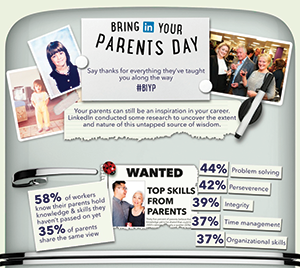
“Rather than do ‘Bring Your Child to Work Day’ we do ‘Bring Your Parent to Work Day’ because we have quite a large millennial population and we understand that parents are still a huge resource for young people,” McQueen said. The CEO and head of HR also brought their parents.

Once an InDay ends, McQueen said, “We take visual accounts, participation counts, we look at social media and see how many posts we had and the different places it’s mentioned in social media.” A team then puts together a package for the executive staff on the following Tuesday’s executive meeting including photos and anecdotes of the activities LinkedIn employees accomplished around the world.

Setting days aside for specific purposes isn’t unique to LinkedIn.

“We’ve seen an uptick in companies taking time during the workday to promote self-care and self-improvement for employees,” said Richard A. Chaifetz, CEO of employee assistance program provider ComPsych. The Chicago-based EAP has received requests to host training sessions and workshops on topics such as legal, financial and caregiving matters. Other popular topics include stress, mindfulness and relationships, he added.

SunTrust Banks provides employees a fiscal health day every year for employees to get their finances in order, according to The New York Times. Entrepreneur recently listed the types of activities companies plan correlating to the seasons, including a summertime camping trip by a Salt Lake City marketing company.

“These practices are part of employers’ efforts to improve and enhance their culture,” Chaifetz said. “Which is especially important for attraction and retention of millennials, who value work-life balance and self-improvement.”

Andie Burjek is a Workforce associate editor. Comment below or email editors@workforce.com.

Posted on November 9, 2017June 29, 2023

More Employers Are Dropping Domestic Partner Benefits

The legalization of same-sex marriage was a win for civil rights but it could mean lost health care coverage for some American couples as more employers drop domestic partner coverage.

In 2016, the year after the U.S. Supreme Court legalized same-sex marriage across the country, 48 percent of employers provided benefits to same-sex partners compared to 59 percent in 2014 — a decline of 11 percent, according to a recent study by the International Foundation of Employee Benefit Plans, a research organization based in Brookfield, Wisconsin. Gay marriage was deemed constitutional in June 2015.

“We expected to see a drop and it’s not insubstantial,” said Julie Stich, associate vice president of content at the foundation. “Many employers were covering same-sex domestic partners when they could not get married, but the ruling changed that. Another factor is that it’s an administrative complexity to have all these different programs and keep track of who is a domestic partner versus a spouse. It’s understandable that they wanted to get rid of them.”

Health care benefits for domestic partners has grown slowly but steadily since 1992 when the first Fortune 500 company began offering them, according to statistics from the Human Rights Campaign, a Washington-based LGBTQ advocacy group. At the time fewer than two dozen U.S. employers offered “spousal equivalent” benefits to same-sex couples. By 2006, more than half of the Fortune 500 offered them, according to the HRC.

The trend continued until 2015, according to figures provided by consulting firm Mercer. In 2010, 39 percent of large employers offered same-sex domestic partner benefits increasing to 62 percent in 2015 before seeing a slight drop last year.

“There was a gradual but steady increase in number of large employers offering coverage but subsequent to the Supreme Court case we saw the first downturn in many years,” said Barry Schilmeister, a consultant at Mercer. The drop occurred mostly among employers that provided health benefits to same sex partners only, he said.

“The data suggests that there were two employers out there: Those who covered same sex partners only and the much larger group that covered both,” he said. “The employers who dropped coverage came from group that covered only same sex couples. The group that covered both same-sex and opposite-sex partners didn’t change very much. It suggests that those covering both groups were doing it as a philosophical position, offering coverage to those who couldn’t legally marry.”

In states that legalized same-sex marriage before the Supreme Court decision on Obergefell v. Hodges, some employers began dropping coverage after the legislation passed. Soon after New York legalized same-sex marriage in 2011, Corning, IBM and Raytheon began requiring same-sex partners to marry in order to qualify for coverage, according to The New York Times.

Some employers cite the administrative headaches as one reason to drop coverage for domestic partners and require all couples to marry, according to Schilmeister.

“In order to qualify for domestic partner coverage you need show an affidavit, something that shows that you are financially interdependent, like a joint checking account or a mortgage,” he said. “That’s outside the automated administration system and it’s more cumbersome. Another administrative difference involves taxes.”

After the Supreme Court decision, executives at EnerNOC, an energy software company, briefly discussed dropping domestic partner benefits but decided to keep them, according to Laurana Bianco, benefits manager at the Boston-based firm. The company began offering these benefits in 2008.

“As you know, benefit offerings are a key factor in deciding to join an organization and being in a tight recruiting space we want to attract the best and the brightest,” she said. “We have a number of employees in domestic partnerships in both categories that had coverage and we didn’t want to take it away from them. The ROI outweighs any administrative burden, which is really quite minimal.”

While more employers will likely drop coverage in the coming years, the majority of companies will continue to offer benefits to both same and opposite sex domestic partners, according to Schilmeister.

“I think the biggest shift has occurred already and we’ll see a leveling off,” he said.

Rita Pyrillis is a writer in the Chicago area. Comment below or email editors@workforce.com.
Posted on November 8, 2017June 29, 2023

The Price of a Family-Friendly Workplace

The common argument by employers against instituting a more robust paid family leave policy is its prohibitive cost. That certainly was the thinking at Bora Architects, along with fears that employees would misuse the policy.

Amy Donohue with Oregon Gov. Kate Brown, who asked to meet with her regarding supporting families in the workplace.
Amy Donohue with Oregon Gov. Kate Brown, who asked to meet with her regarding supporting families in the workplace. Photo credit: Bora Architects.

That mindset quickly changed in 2015 for the Portland, Oregon, firm when a valued receptionist announced she was going to become a single mother. The pending birth and the possibility of losing a quality employee set off alarm bells for Amy Donohue, a principal with the firm, and Dawn Ridenour, the chief financial officer, launching them into a cost-benefit analysis. They had 65 employees at the time.

Ridenour pored over company data from the previous five years and identified all the instances in which an employee could have triggered a paid family leave policy. Donohue said she discovered the cost was reasonable. Specifically, the events she looked at fell under the Oregon Family Leave Act, which covers maternity and paternity leave, time off for adoption and foster care, and care for self, spouse, parent or child.

“It was something we could put in our budget every year,” Donohue said. “Some years we’re going to spend less, and others we might spend more. But on average it’s not a significant expense, especially compared to what it would cost to replace that person if they left. It isn’t just the Googles of the world that can afford it. Smaller companies can, too.”

The patchwork of paid family leave policies dotting the United States reveals a desire on the part of states, municipalities and businesses advocating for such programs. New York is the next state implementing paid family leave beginning Jan. 1, 2018, joining California, Rhode Island and New Jersey.

Sixteen percent of full-time civilian workers have access to paid family leave benefits.

Politically, paid family and medical leave is supported by 71 percent of Republicans and 83 percent of Democrats, according to the May 2017 “Paid Family and Medical Leave” report by the AEI-Brookings Working Group on Parental Leave. The disagreement for a comprehensive federal policy lies not in the real need for the United States to adopt a solution, but in the messy details of how leave is funded, how long it lasts and who is eligible, the report states.

Although the Trump administration has not given any indication that federal paid family leave is on the horizon, first daughter Ivanka Trump has advocated for its implementation in some form, said Tracy Billows, partner at Chicago-based law practice Seyfarth Shaw.

“Whether that will ultimately come to fruition, we’ll have wait and see,” she said.  “I don’t think that paid family leave on a federal level is completely off the table as we’ve sometimes seen in prior administrations.”

Meanwhile, a growing number of employers are adopting policies of their own.

Financial service company State Street Corp., which employs 33,000 people, is one of the many companies to enhance its paid family leave policy. Part of the reason the company chose to improve the policy in 2014 was to be a more attractive employer. “Our global total rewards team is constantly looking at the competitiveness of our paid leave policies,” said Mike Scannell, senior vice president and president of the State Street Foundation, the company’s charitable arm.

State Street also solicited feedback from employees through surveys and listening sessions, he said. The executive team wanted to create more channels for employees to share what’s on their minds. “A significant and consistent theme was the value of flexible work time, personal time off and the need for greater work life balance,” Scannell said.

Larger employers with deep financial resources, such as State Street, may be able to afford to offer these policies more easily, while small to midsized employers may be more sensitive to cost or temporary lack of manpower while an employee is out of the office.  There are ways around these challenges, though, as Bora Architects and others show.

Companies’ Practices 

The structure of Bora’s policy is such that employees would not take advantage of it, according to Donohue. Employees who have been there a year get six weeks and can receive 20 percent of their salary. Employees who have been there two years get six weeks at 40 percent. And those who have been there for three years or more get the full benefit, six weeks at 60 percent of their salary. “We want to make sure people have been here a while to realize the full benefit,” Donohue said.

Even a person receiving the full benefit won’t be motivated to stay home from work longer than necessary, Donohue said, because 60 percent of one’s salary is still a challenge for a family to take on. These people would be living on a compromised salary for six weeks, and they’ll make the point to thoughtfully decide how much time to take.

While an employee is on leave, work still must run smoothly for up to six weeks.  This transfer of power can go well if the company culture is supportive, according to Donohue. At Bora, where teams usually run from four to 12 people, those groups may be able to function one person short if a project is winding down. It’s also possible for them to borrow someone from a different team for a short length of time.

A supportive culture is also imperative at Change.org, said Allie Roseman, HR operations director for the petition website, which has 150 employees, 10 of whom took paid family leave in the past year. Stressing that if people are overworked, they hire a contractor. Roseman noted that taking on extra work can be a valuable learning experience.

“It’s often a very good learning opportunity for more senior employees to be able to take on some work and learn something new outside of their scope,” she said.

In 2015, Change.org began to offer 18 weeks of paid family leave for both mothers and fathers, Roseman said. The policy is flexible in that employees can take time off in one block or in smaller, staggered amounts of time, as long as the time is used within a year after the child’s birth.

Roseman took on extra work when the HR department’s most senior member, who is now the chief operating officer, went on leave to take care of his baby. She felt like she was ready to take on new duties, and some have since become her responsibility.

Allie Roseman, HR Operations Director at Change.org

“I see that across the organization,” she said. “A more junior employee will take on a project that a more senior employee had when they were out on leave.” Then, she added, they have a new skill set that they’re happy with and they can contribute on a higher level.

Employers’ Attitudes and Actions 

These organizations were able to make something work, but that’s not a common theme for much of the business community. The AEI-Brookings Working Group report addressed the challenges employers may face and potential solutions. The working group, comprised of a politically diverse group of individuals, discussed paid family leave and came up with a compromise policy. Although it did not satisfy everyone, it was an idea that everyone could get behind, said Isabel Sawhill, senior fellow in economic studies at the Brookings Institution.

A major idea behind the compromise was that it could not take form as an employer mandate or as something that would burden businesses with more taxes. “Even if you have a payroll tax to both employers and employees, most economists think it ends up being paid by employees because the employer could pass that along in the form of lower wages,” Sawhill said. The group decided an additional payroll tax on employees was the best option.

Despite the cost concerns of employers, the group ultimately believed it would be in employers’ best interests to offer paid leave. Research suggests that there is less turnover when a company allows paid time off. “Turnover is more disruptive and expensive than any temporary interruption,” Sawhill said.

Temporary absences or inconveniences in the workplace while an employee is on leave is something employers will have to get used to if they care about supporting parents. “It’s going to be inconvenient when an employee gets pregnant and has a baby, period, whether there’s paid time off or not,” Sawhill said.

The current paid family leave landscape, although riddled with its own contradictions, debates and tensions, is not nearly as controversial as other types of paid leave. Seyfarth’s Billows compared the current employer attitudes about paid family leave with that of paid sick leave, which confuses employers because of the variations in state laws.  Acceptable reasons of use, family members covered and employee eligibility could differ widely between states, which creates an administrative nightmare for nationwide employers.

She doesn’t expect the same concern regarding paid family leave.

Amy Donohue with Dawn Ridenour, former CFO at Bora Architects, who helped spearhead the Paid Family Leave at the company. Photo credit: Bora Architects.

“Many companies are supportive of paid parental leave and they’re doing so for a number of reasons. For many clients, they’re already doing this because they know it’s an important benefit for recruiting and retaining top talent,” Billows said. “From my perspective, I don’t think there will be any backlash to paid parental leave or paid family leave.”

The voice of businesses is important in the discussion of paid family leave. Bora Architects’ Donohue met with Oregon Gov. Kate Brown to talk about paid leave policy. She, along with other business owners, discussed with the governor what the companies were doing, what had been successful, what the challenges were and what could potentially be implemented at a state level. Donohue also testified in front of the Oregon House of Representatives as a business owner who supports a statewide paid family leave policy.

“Businesses have taken this into their own hands because the governments have been slow to act,” she said. “It’s nice to see people understand this is an investment that pays off in the future.”

Andie Burjek is a Workforce associate editor. Comment below or email editors@workforce.com.


Posted on November 7, 2017June 29, 2023

Cravings Are Key to Long-term Wellness

Humans are very bad at making good decisions about things that matter in the long term. Whether it’s choosing to workout over watching TV, a cookie over a salad, saving money or a new car, there are so many ways we satisfy our desires today instead of doing what we know will set us up for success tomorrow. 

It’s not that we don’t know what’s good for us. It doesn’t take rocket science to figure out that if we keep eating those cookies every day, we’ll eventually gain weight. Rather, it’s that we value what feels good in the moment more than what we know is right for us in the long term. This phenomenon is widely studied by behavioral economists and is called “hyperbolic discounting.” HR leaders and benefits pros see this in action — and are frustrated by it — every day.

Much of benefits design and communication is about overcoming this incredibly ingrained human trait. We know employees can — and should — just do simple things today that would pay off big time down the road. But they don’t. Understanding why they don’t and how to counter this behavior can help you create more effective benefits programs and better outcomes for your organization.

One of our favorite experts on the topic, Nir Eyal, published a recent guest post on his blog “Nir And Far” by Lakshmi Mani on this topic. Titled “Why You Make Terrible Life Choices,” it explained hyperbolic discounting and the ways to overcome it. Mani summarizes the dilemma perfectly:

“A caveman did not have to contend with the same complex choices we do today. Cavewoman Lakshmi never had to choose between eating a pig today versus investing it in a pig 401(k) that would yield a 4x return in the future. Under harsher living conditions, we didn’t know if we would survive till the end of the day so our species evolved to choose the immediate option that most increased our chance of passing down our genes. Our brains are wired to choose immediate sure-things rather than the potential of a far-off future reward.”

So, there you have it — getting people to save more in their 401(k) requires overcoming the cognitive traits developed over thousands of years of evolution. No easy task!

But acknowledging this challenge gives us more perspective into how to help people make good decisions. We must remember that what we ask employees to do today for their health or financial security doesn’t come naturally to them. Simply not having to worry about surviving every day is a relatively recent development for humankind. Even more recent is the idea that you should stash away a lot of money over the span of 40 to 50 years so you can spend it in the future. Or that you should give up a meal today so that you’re healthier in the future.

Does this mean the situation is hopeless? Not at all. But we have to be realistic about what it takes to get people to trade short-term rewards for long-term potential.

One of the lessons we have learned time and again is that education isn’t enough. We can’t just tell people what they should do — they still won’t make the trade-offs between now and the future.

But we can make good decisions easier and bad decisions harder by taking a very deliberate and thoughtful approach to designing smart plans and systems. Whether that is by automatically enrolling employees in their 401(k) or putting the fruit on the counter and the candy in a drawer, there are countless ways to design programs and workplaces to support smart choices.

Another way we can do this is through the messages we choose to push out. Instead of focusing on what someone needs to do in the future, focus on the things they want to do now. Someone may need to lose weight to prevent the onset of diabetes a few years down the road, but that same person may want to lose weight now to look good in the designer clothes they’ve been coveting. That’s exactly where you should focus: what feels good now.

Most importantly, we can and should embrace HR’s role as the architect of these choices. We know what employees should do to protect their long-term health and financial security. Every choice about designing programs and communicating them should help nudge and influence the right behaviors.

Posted on November 6, 2017June 29, 2023

Parental Status Discrimination Is NOT a Thing. But Should It Be?

Jon Hyman The Practical Employer

I received some great feedback on LinkedIn on last week’s post on New York’s new paid family leave law.

That law grants paid leave for the same general reasons one can take unpaid leave under the FMLA. What it does not do, though, is create a new protected class.

Indeed, discrimination based on one’s status as a parent is, in and of itself, NOT illegal.

Case in point? Spink-Krause v. Medtronic (E.D. Mich. 10/23/17).

In that case, the plaintiff, a medical sales rep and working mom, claimed sex discrimination. The alleged discrimination? Her boss made her job as working parent more difficult by reassigning all of the accounts close to her home to other reps, thus requiring her to travel further from her children.

The court dismissed her sex discrimination claim, because Title VII protects against sex discrimination, not parental discrimination:

If Plaintiff were to allowed to take her sex discrimination claim to trial by showing that she was treated differently than a female who does not have children, then the claim she would present to the jury would be a parental discrimination claim — not a gender discrimination claim.

This is not to say that “parental status” can never be a valid basis for a discrimination claim, but it must equate to sex discrimination. In other words, one can claim parental status discrimination, so long as one can show that the employer treated the parent differently because of the parent’s gender (i.e., the employer treats working moms worse than working dads, or vice versa).

So, here’s my Monday question for y’all. SHOULD parental status discrimination be a thing?

Leave me your comments below, or jump over to LinkedIn and let me know your thoughts there. I’ll curate the best thoughts in a future post.

Jon Hyman is a partner at Meyers, Roman, Friedberg & Lewis in Cleveland. Comment below or email editors@workforce.com. Follow Hyman’s blog at Workforce.com/PracticalEmployer.

Posted on November 2, 2017June 29, 2023

Is New York the Beginning of the End for America’s Terrible Family Leave Laws?

Jon Hyman The Practical Employer

It is freakin’ hard to be a working parent in America. It is even more difficult when both mom and dad work.

It’s not just child care, but also doctors’ appointments, kids’ sick days, summer vacations, winter and spring breaks, Labor Days, Memorial Days, and all the other “Days” (and don’t get me started on “teacher in-service days”).

Beginning Jan. 1, New York is implementing the start of solution for any employees that work in that state.

On that date, New York’s Paid Family Leave law — the nation’s most comprehensive to date — takes effect.

It provides job-protected and employee-funded paid leave (eight weeks in 2018, scaling up to 12 weeks by 2021) to care for a spouse, domestic partner, child, parent, parent-in-law, or grandparent with a serious health condition; to care for a newborn child during the first 12 months after the child’s birth or after the first 12 months after placement of the child for adoption or foster care; and for when a spouse, domestic partner, child, or parent is called to active military duty.

In other words, it takes the FMLA, adds “domestic partners,” and pays for the job-protected time away from work via insurance proceeds funded by mandatory employee payroll deductions.

If your business employs anyone in New York, this law, for obvious reasons, is a really big deal.

Yet, New York’s move on paid family leave should matter to all employers even if you never have and never will employ anyone in that state. This law matters to all because it moves the needle on this issue.

To compete in the job market against those employers that offer paid leave, other companies will have to begin voluntarily offering paid sick leave as a fringe benefit. Thus, over time, paid sick leave will spread to most, if not all, employers nationwide, whether by government fiat or voluntary adoption.

Those of you who’ve been reading for a while know that I’m not a fan of government mandates. Yet, it is embarrassing that America lags so far behind the rest of the world on employee paid time off.

This law illustrates what happens when the private sector delays making necessary changes. Because our nation’s businesses are so out of touch on the issue of paid leave, governments are compelled to step in.

Bottom line? It’s time to get ahead of the curve on the issue of paid sick leave. Given how far we have to catch up, it presents an amazing recruitment and retention opportunity for the American employer.

Or, look at it this way. Now is the time to board the paid sick leave train. It’s leaving the station one way or the other. The only question is who is going to be the conductor — employers or the government.

Jon Hyman is a partner at Meyers, Roman, Friedberg & Lewis in Cleveland. Comment below or email editors@workforce.com. Follow Hyman’s blog at Workforce.com/PracticalEmployer.

Posted on October 26, 2017June 29, 2023

Not Everyone Is Open to the Open Office Space

Having recently completed my first video story “Modern Workspaces,” for Workforce, office space design has been constantly on my mind. So, it was valuable to come across a Twitter chat this month on trends in office design and see what other people had to say.  Although open office spaces gets a lot of love, others had strong opinions against open spaces that are worth noting.

Employees may feel distracted when they’re working so close to their coworkers with less personal space than they’re used to.

G&A Partners recently held this chat that allowed me to read HR pro’s praises and concerns about trends in office design. One Twitter user, @amoyal, wrote, “Don’t assume employees want flex space because it’s a trend. Ask them!”

You could say the same about any design trend. There are obviously some business/financial reasons for adopting a different type of office space, like the open office space. But what about the personal reasons? What about companies that just want to adopt a more open environment because it’s trendy? If you’re going to do something just to appeal to employees/job candidates, make sure they actually want it.

Some responses to the pitfalls of open plans included:

  1. Employees are more distracted because they want to chat with their neighbors and see what their coworkers are working on.
  2. Some types of people need isolation to focus and be productive.
  3. Increased competitiveness and pressure.
  4. No escape from certain coworkers’ behavior.

One user, Antonio Santos at @akwyz, mentioned that “#OpenOfficePlan is usually horrific for #neurodiverse employees,” so I asked him for more information on the topic. The article he sent me was fascinating.

It examines six potential barriers for neurodiverse employees in an open office plan and suggests some strategies to alleviate those barriers. Some examples of conditions that fall under that category include ADHD, autism, dyslexia, dyspraxia, Tourette syndrome, some mental health conditions and more. “What often seems unimposing and innocuous to the neurotypical employee can turn out to be a wolf in sheep’s clothing to the neurodiverse employee,” the article states.

Neurodiverse employees may be especially sensitive to light or background noise, making a sunny open space or a work station with distracting background noises (such as phones ringing and heavily used printers, shredders or photocopiers) difficult to work in.  Also distracting: when staff or visitors are constantly entering and exiting a door.

I mention this because, considering even employees who are not neurodiverse could easily be distracted by these stimuli, it should be obvious that neurodiverse employees find those distractions even more annoying or difficult to deal with.

Adding some practical light to this topic was Bonnie Scherry, director of corporate HR at G&A Partners. She helped plan the company’s headquarters in Houston. Although the office has an open layout, it also utilizes conference rooms and private rooms for employees who have different needs.

It’s wise to consider both the pros and the cons of the layout when you’re designing it, Scherry said. There are some things you can do to mitigate any challenges associated with the open plan, and you should address them as soon as possible in the planning process because it’s not a task you can easily redo.

She added that people involved in planning the design spoke to employees to gauge their concerns. Many design elements came out of this. For example, noise and privacy issues came up a lot among employees. “We spent a lot of time focusing on what we knew we could do to help out with those barriers,” said Scherry. “One of the things that we did is that our panels and our cubes absorb sound. We spent some extra time and money to make sure that we had something that would help absorb that sound rather than something that reverberates the noise.”

They also installed a white noise system to address noise concerns.

During this conversation, I had in mind many friends who simply dislike the open office idea because loss of personal space and similar concerns. Scherry had some advice on how to appease these types of employees.

First, the company first moved in and there was still some minor construction going on, they turned the white noise machines on higher than usual to make the transition easier. Second, Scherry said that most employees self-adjusted their voices in the new space. When they had tall cubicle walls, they were more likely to be louder. But when those cube walls became low, many employees lowered their voice.

Meanwhile, an informal conversation with loud employees can serve as a reminder to people who don’t self-adjust as easily.

[Also read: “Finding the Right Balance for Employees in Office Design”]
[Also read: “Millennials Opening the Doors to Communal Modern Workspaces”]

Andie Burjek is a Workforce associate editor. Comment below or email editors@workforce.com.

Posted on October 2, 2017June 29, 2023

Just Try to Curb Your Enthusiasm About This Post on the ADA and Attendance

Jon Hyman The Practical Employer

On last night’s season nine premier of HBO’s “Curb Your Enthusiasm,” Larry David was faced with this age old problem.

How does an employer handle an employee who skips work because she’s constipated?

Larry handled it by foisting his problem employee (his personal assistant) onto someone else.

What should you do?

It depends.

First, is constipation an ADA-protected disability?

Likely, the answer is yes.

The ADA defines an “actual disability” as “a physical or mental impairment that substantially limits one or more major life activities.”

Major life activities not only include the handling of day-to-day manual tasks, but also the operation of major bodily functions, including the digestive system and the bowel. As a result, severe constipation likely qualifies.

Assuming that constipation that is severe enough to keep one home from work qualifies as an ADA disability, what does one do with an employee who simply fails to come into work, without notice, because of the disability?

Take a look at your attendance policy. Does it penalize employees who no-call/no-show? A protected disability (or FMLA qualifying event, if you are FMLA-covered) does not justify an employee to ignore your attendance policy, or its requirements. If your policy requires that an employee call out (when feasible), then you can enforce that policy even if the absence is related to a medical condition.

Assuming the employee asks for a few days off to get things moving, you likely have to grant the request as a reasonable accommodation. For the record, I would not recommend Larry’s offered accommodation, a desk chair that doubles as a toilet.

Your homework assignment? Dust off your attendance policy and review its requirements for sick employees missing work. If you do not have call-in/call-out procedures in place, consider adopting them so that you are sufficiently positioned to discipline your AWOL employees.

Jon Hyman is a partner at Meyers, Roman, Friedberg & Lewis in Cleveland. Comment below or email editors@workforce.com. Follow Hyman’s blog at Workforce.com/PracticalEmployer.

Posted on September 27, 2017June 29, 2023

Employers Embrace Telemedicine But Employees Exhibit Uncertainty

telemedicine

Lee Damiano felt ill one day in May 2015. The previous year when she signed up for her employer’s new telemedicine benefit that would allow her to contact a doctor any time, any day of the week, she thought she’d never actually use it.

She was wrong. Initially thinking, “I might as well wait until Monday,” Damiano ultimately called and was speaking to a doctor within 10 minutes. “As we went through the symptoms, the doctor encouraged me to go to the ER. I’m so glad I listened,” she said. “I had several pulmonary embolisms that could have been fatal over the weekend.”

Damiano, the senior vice president of Denver-based Westerra Credit Union, is now a big proponent of telemedicine for the organization’s 260 employees. “A number of things happen off hours and on the weekend,” she said. “It is critical to provide our employees cost-effective options.”

Westerra is one of many U.S. companies offering telemedicine, which is the usage of technology to deliver medical care that would otherwise be delivered on-site or in person. Telemedicine — a term that’s commonly used interchangeably with telehealth, although technically the words have slightly different meanings — can include texting, video and phone calls.

But despite employers’ newfound infatuation with it, employees don’t appear nearly as enamored. Only 3 percent of employees in the companies that offer telemedicine used those services in the first half of 2016, according to the National Business Group on Health’s “Large Employers’ Health Plan Design Survey.” Conversely, the same report found that 90 percent of the large employers offered the service in 2016.

As more employers look toward telemedicine as a low-cost, convenient alternative to an in-person visit for routine types of medical care, they’ll need to address skeptics’ concerns. Many employees are not accepting the technology as an appropriate substitute for in-person doctors with the same enthusiasm as their employers.

Meanwhile, some physicians remain neutral regarding telemedicine. Dr. Jack Resneck, professor and vice chair of dermatology at the University of California at San Francisco and an American Medical Association board member, said telemedicine is not something they are for or against.

“We see it as an additional tool that actually has great potential,” Resneck said. “This is an area we’re excited about. We just want to see it done right so patients get good quality care.”


Employee Utilization and Communication 

Although the trend for employers is rapidly increasing adoption of telemedicine, employees aren’t necessarily buying in as quickly, said Dr. Aamir Rehman, partner and senior clinical and total health management strategy consultant at Mercer. Growth is steadily increasing, but it’s still low.

A couple of factors may influence low utilization rates, Rehman said. In some cases, it’s simply informational. Employees might not know that their employer offers it.

Other employees may know it’s an option for them but feel more comfortable seeing a provider face to face. Rehman added they could be uncomfortable using telemedicine and have qualms or questions such as, Is this person a real doctor? How can this doctor tell what’s wrong with me without being in the same room?

“These are issues employees have brought up, and employers with a high utilization rate have succeeded in communicating and addressing these concerns,” said Rehman.

There are certain talking points for employers to focus on when communicating telemedicine, he added.

“If you can get me to the right provider at the right time, then the outcomes will be better. If you have a problem at midnight or it’s noon and you’re at work and (telemedicine) can take that hassle out of accessing health care, then the outcomes will be better. That is the primary message,” he said.

Clinical outcomes are often equal to that of a brick-and-mortar provider while costing less, said Rehman. It’s less expensive to access care through telemedicine than an office visit. On average, a telemedicine consultation costs $40 compared to $125 for an office visit.

About half of Westerra Credit Union’s workforce use telemedicine throughout the year, said Damiano. One important factor in getting that high usage was a robust communication strategy, especially during allergy season in the spring and flu season in the winter. This communication included giving instructions about using telemedicine and in which cases it should and should not be used.

The Alvin Independent School District in Alvin, Texas, also successfully uses communication strategies to increase utilization. Donnie Marek, director of risk management, runs a self-funded medical plan for the district, which employs about 3,000 people across 30 campuses.  “Any time you have a self-funded plan, you look for opportunities to slow down claims and provide better services for your employees,” he said.

The district began offering telemedicine in September 2014 through Teladoc Inc. after Marek researched opportunities to reduce claims. It averages a 21 to 25 percent monthly utilization rate, which is good for an organization of its size, he said. Communication is key to its success rate, he added.

“Our district was a very reactive district for health insurance. When I was hired I flipped that to be very proactive. [Employees] are constantly getting information from my office,” he said.

Marek sends out monthly emails to all employees, provides information to new hires and looks for employee testimonials with a positive experience with telemedicine. “If I get a good testimony from someone who has used it, I’ll ask them to write up a quote, and I’ll put it in the next blast that goes out. We’ve branded it well at our district,” said Marek. It’s also helped to have leadership buy-in from several school principals.

To communicate the telemedicine benefit to employees who still do not use it, Marek has other plans for the fall 2017 semester. He, along with one other person, will visit each campus throughout the calendar year and attend faculty meetings at the current 30 campuses, along with two more opening up this fall.

“We’ll talk about insurance and wellness, and telemedicine will be a huge part of the presentation. Getting in front of each employee in a smaller setting, they’ll listen,” he said. “I’m sure I’ll be blown away by how many people don’t know about it, simply because people still don’t read emails. I’m excited about this.”


Making the Practical and Ethical Choice

There are hundreds of telemedicine providers with varied focuses, said Richard Foust, chief business officer of Chicago-based laboratory diagnostics company Analyte Health.

When choosing a provider, “It’s important to ask questions about their approach to telehealth, because they’re all different,” he said. “If the HR manager is really thinking about what’s important, based on the size of the company and the employees they have, the decision will be different.”

Employers should question the telemedicine company’s growth, Foust said. Adding lab testing will become increasingly critical to a telemedicine company’s development since physicians would then be able to make decisions not only based off what they see and hear from the patient, but also medical facts that come back from a test.

Questioning quality is also important. “If I am going to be getting access to a physician at any point in time, how does that telehealth company ensure that I will get a good doctor?” said Foust. “And is that doctor part of a practice that readily reviews how they are treating patients, the outcomes they get and the feedback they receive?”

When an employer chooses a provider, it also has a responsibility to offer telemedicine ethically, said Resneck. “I’ve seen some things that have worried me and been challenging around some quality and patient-safety issues.”

The AMA released a set of guidelines for ethics in telemedicine in June 2016. It took three years for the AMA to develop the guidelines, which define a high standard of care to strive for in telemedicine.

“The area that’s concerned me the most is care coordination,” said Resneck. Care coordination — defined as “deliberately organizing patient care activities and sharing information among all of the participants concerned with a patient’s care to achieve safer and more effective care” by the Agency for Healthcare Research and Quality  — is an area where employers may fumble, said Resneck.

“In the employer market, we have seen a lot of employers reaching out and looking at this as a benefit for employees, which is great, but the temptation I think has been to take the thing that’s the easiest to scale up quickly,” he said. Sometimes what’s been the easiest to scale up has been telemedicine providers that provide fragmented care.

Resneck sometimes sees a patient using a telemedicine model where the provider of care doesn’t know who the patient is, doesn’t have their medical history and doesn’t share medical records after the virtual visit. Also, sometimes when a patient uses a telemedicine service to set up a consultation, the health plan may not cover a follow-up with the primary care physician they regularly see.

Large and midsized employers shopping for health insurance or working with health plans are in a unique position to drive the conversation. They have an opportunity to say, “If we are going to work with a health plan to include telehealth as a benefit, let’s sit down and talk with the health plan and talk about ways to cover this coordinated care,” Resneck said.

“If we saw employers pushing health plans to actually cover things like follow-up care with established physicians and care teams who know those patients, we could provide high-quality, coordinated care in a way that would be more efficient for patients,” he added.

Employers should also push for proper identification of the physician, he added. Patients should know who their physician is and what their credentials are when they are seeking out care via telemedicine. “We definitely see telehealth providers where that is the case and others where that is not the case,” said Resneck. Employers should encourage proper identification and transparency of credentials when they’re in talks with these health plans.

That all being said, doctors and physicians embrace innovation, he added, and they see incredible potential for telemedicine to improve patients’ access to care.

Westerra’s Damiano has seen this potential in her employees’ experiences. Many of them access the service off hours and avoid going to the ER for something that ends up being relatively minor, like an earache. Meanwhile, in her own experience, it’s meant something even more significant than one unnecessary ER visit. A pulmonary embolism, a sudden blockage of the major blood vessels in the lung, can be deadly.

“If I hadn’t called the doctor, I wouldn’t have gone to the hospital,” said Damiano. “It was a lifesaver for me.”

Andie Burjek is a Workforce associate editor. Comment below, or email at editors@workforce.com. Follow Workforce on Twitter at @workforcenews.

Posts navigation

Previous page Page 1 … Page 17 Page 18 Page 19 … Page 63 Next page


Webinars


White Papers


  • Topics

    • Benefits
    • Compensation
    • HR Administration
    • Legal
    • Recruitment
    • Staffing Management
    • Training
    • Technology
    • Workplace Culture
  • Resources

    • Subscribe
    • Current Issue
    • Email Sign Up
    • Contribute
    • Research
    • Awards
    • White Papers
  • Events

    • Upcoming Events
    • Webinars
    • Spotlight Webinars
    • Speakers Bureau
    • Custom Events
  • Follow Us

    • LinkedIn
    • Twitter
    • Facebook
    • YouTube
    • RSS
  • Advertise

    • Editorial Calendar
    • Media Kit
    • Contact a Strategy Consultant
    • Vendor Directory
  • About Us

    • Our Company
    • Our Team
    • Press
    • Contact Us
    • Privacy Policy
    • Terms Of Use
Proudly powered by WordPress