Skip to content

Workforce

Category: Benefits

Posted on May 16, 2017June 29, 2023

A Benefits Round-up: Thought-provoking Ideas of the Week

Andie Burjek, Working Well blog

Trying something new here: these are some valuable ideas and stories I’ve come across these past couple of weeks.

  1. An Office Schvitz, Anyone?

“Office Sauna: Must-have or Hot Air”: This article highlights a trendy office space in London, one of whose many nontraditional perks include a sauna. One thing this piece does well is point out the downside of perks (“Compare the cost of buying a ping-pong table to offering a living wage, rather than a minimum wage, and you start to cut through to the reality,” says one source) as well as the upside. For example, in an age where people are more inclined to work from home, having office perks can be a good way for people to stay in the office. (Side note: one of my half-baked business ideas is a sauna/spa called “Schvitz Box.” Any investors interested?)

  1. Not an Isolated Incident: Loneliness has Real Consequences

Dr. Jeremy Nobel, medical director of the Northeast Business Group on Health, brought up something very interesting in a recent interview about the mental wellness space: the impact of loneliness and isolation on health. This is one issue that hasn’t been picked up by popular media yet but should be more visible, he said. He added that these two factors contribute to mental health problems like substance abuse, depression and suicide, and that they also have a link to early mortality.

In a time when more companies are adopting mental health programs, I wonder if any of these programs account for these two biggies, loneliness and isolation. Is there a way to tackle these in the workplace? Feel free to share your ideas/ suggestions if you have any.

  1. I’m Too Burned Out to Think of Anymore Kitschy Titles …

Social psychologist Christina Maslach, who gave a very instructive talk on burnout at a conference a few weeks ago, shared this story from HealthLeaders Media: “Beating Clinician Burnout.” The gist? For physicians on a national level, the burnout rate is somewhere between 30 and 50 percent. This means major issues with morale, productivity and turnover.

“Burnout is not, as many believe, a failing of an individual,” the article states. “Rather, it’s a sign that something is amiss within an organization, and that systemic dysfunction can prevent an organization from achieving the desired outcomes of today’s value-based care efforts.”

This piece goes into more detail about the real impact of burnout and how some organizations have dealt with it, for example Vandervilt and its Nurse Wellness Program.

  1. A High Growth Industry

“Pot Industry Cultivates a New Branch with HR”: This is a stellar Workforce article, written by Max Mihelich, on HR in the legal marijuana industry. A lot of solid information here about a “budding” industry. Hehe. What HR professionals do in this space now matters, the article argues, because “the policies and procedures developed over the next few years as the industry grows could set the precedent for how HR departments of dispensaries are run for years to come.”

Another side note: A Mother’s Day distillery tour this past weekend re-sparked my interest in this story because the tour guide made some comparisons between the whiskey biz of the 1900s and the marijuana industry today. For example, during Prohibition, you could literally get a whiskey prescription for medical reasons from your doctor; there were complicated regulations involved with this as well. Looks like the issues surrounding marijuana now are pretty timeless.

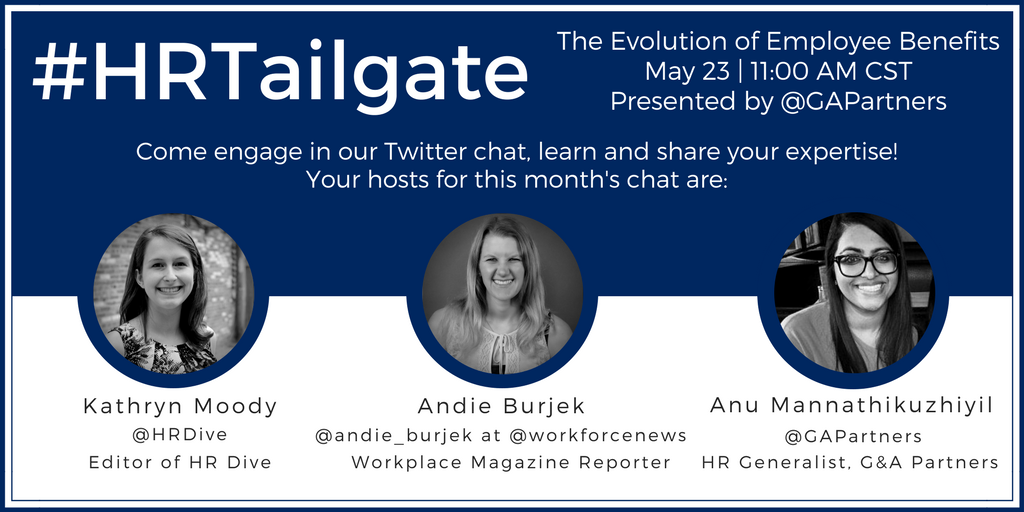
Finally, I’d like to mention that I’ll be participating in G&A Partners’ #HRTailgate Twitter chat next week, Tuesday May 23, at 11 a.m. CT. The topic is, “The Evolution of Employee Benefits,” and the other panelists and I will be answering a series of eight questions via Twitter (see below). I’ll be on sharing information from my own sources, stories and research as well as pieces written by other Workforce contributors. For more information, check out this link.

I’ll be participating via this Twitter account: @andie_burjek. Other panelists include Kathryn Moody of HR Dive and Anu Mannathikuzhiyil of G&A Partners. Looking forward to discussing benefits with my fellow panelists and tweeters!

These are the eight questions we’ll be discussing:

  1. What are the most significant trends you are seeing in employee benefit programs?
  2. In your opinion, what is the most valuable benefit or perk a company can offer?
  3. What offerings do you feel best attract new talent and retain employees?
  4. With financial stress as the #1 inhibitor of productivity, what are companies doing to help employees in that facet of the wellbeing space?
  5. From paternal to “paw-ternal” leave, what ways can companies uniquely care for employees who are growing their families?
  6. Should employee benefits be tailored to different generations? Why or why not?
  7. How can companies promote their benefits programs to attract new talent?
  8. Where do you see employee benefits programs heading in the next decade?
Andie Burjek is a Workforce associate editor. Comment below, or email at aburjek@humancapitalmedia.com. Follow Workforce on Twitter at @workforcenews.

Posted on May 16, 2017June 29, 2023

Mental Health Takes on New Meaning for Millennials at Work

Young cartoon person speaking about mental health and wellness

Charles Lattarulo joined American Express to lead its behavioral health program five years ago, employees seeking mental wellness services were typically referred to a phone-in employee assistance program that few people utilized. With more and more young employees joining the workforce, he realized that a different approach was needed to meet their unique needs.

Young cartoon person speaking about mental health and wellness
Millennials aren’t shy about sharing the details of their lives, forcing employers to rethink how they communicate about mental health.

“Millennials are under different stressors than older workers,” he said. “They are the first generation to make less money than their parents, the first generation with a lot of debt coming in to work, and the first generation to grow up with social media. They don’t mind posting about their lives, but they may not seek help.”

Those born between 1978 and 1999 are also struggling with depression in greater numbers — more so than other generations in the workforce, according to a 2013 survey by the American Psychological Association. Given that millennials make up the largest segment of the U.S. workforce, employers have reason to be concerned, according to Mike Thompson, mental health advocate and president and CEO of National Alliance of Healthcare Purchaser Coalitions.

“Considering how important millennials are to the current and future makeup of their workforce it’s critical that employers address their expectations and needs,” he said. “The fact that depression rates among young adults could be increasing should be highly alarming.”

In fact, between 2005 and 2014 the number of depressed teens jumped by more than half a million, according to a recent study in the Journal of Pediatrics. Many seem to be bringing these struggles to work.

According to the American Psychology Association, 39 percent of millennials say their stress increased last year, compared to 36 percent of Gen Xers, 33 percent of baby boomers and 29 percent of “matures” — workers over 67.

To educate employees about mental illness, particularly younger workers, and encourage them to seek help, American Express launched the Healthy Minds program in 2012. The initiative, headed by Lattarulo, uses upbeat messages and novel approaches to mental health awareness, such as bringing in a standup comic to talk about depression.

Unlike many of their older colleagues who are uncomfortable talking about mental illness, millennials aren’t shy about sharing the details of their daily lives on social media or at work, forcing employers to rethink how they communicate about mental health, according to Clare Miller, director of the Partnership for Workplace Mental Health, a program affiliated with the American Psychiatric Association.

“Millennials don’t have feel the stigma that other generations do when it comes to talking about mental health issues,” she said. “They’ve grown up in an era when social media is part of their lives and there are no demarcations between personal and work life. This is something new for employers. It’s bringing things to a head as to how you manage these discussions in the workplace.”

She points to American Express’ decision to invite a comedian to talk about mental illness as one example of innovative approaches to reaching younger workers. “A comedian talking about it is a tricky thing, but it speaks to this new world that we are in.”

[Related story: “Is Your Workforce Happy?”]

At consulting firm Ernst & Young, where the average age of its 240,000 employees is 27, company leaders have no choice but to tailor their mental wellness efforts to a younger population, according to Sandra Turner, director of EY Assist, the company’s EAP.

“We don’t have special programming to target a segment of our population because that is our population,” she said.

Last year the firm launched its R U OK initiative, which encourages employees to reach out to colleagues who may be struggling with depression. It’s a based on a suicide prevention program developed in Australia in 2009. Since it was launched in October, EY’s employee assistance program has seen a 30 percent increase in utilization, Turner said.

While she can’t say if the spike could also be a reflection of an adversarial election season last fall, the launch of the initiative seems well timed.

“I’m sure that issues around police violence in the community and the election cycle has caused a lot of tension and stress in the workplace,” she said. “I wish I could say we timed it to address some of that, but we had this planned in January 2016. Still, I’m so glad that we had this program available.”

Rita Pyrillis is a writer based in the Chicago area. Comment below or email editors@workforce.com. Follow Workforce on Twitter at @workforcenews.

Posted on May 12, 2017June 29, 2023

The Power of a Plug-and-Play Benefits Platform

I first started thinking about the power of plug-and-play platforms in my childhood, well before I joined the HR industry.

benefits
Integrated plug-and-play benefits systems have proven to be more nimble in responding to consumer needs and business trends.

It all started with a sleek, all-inclusive console stereo system. With its built-in turntable, AM/FM radio, amplifier and speakers, I loved that stereo despite its all-in-one vertically integrated design.

But one day the amplifier broke, rendering the entire unit non-functional. As a result, the console was kicked to the curb.

Years later, my parents bought me a new stereo system with separate components. Even though the system included so-so speakers, I was thrilled. Although the sound quality was not up to my teenage standards, I eventually purchased an excellent set of speakers that enabled me to rapidly upgrade my stereo to meet my expectations.

This plug-and-play approach to my updated stereo allowed me to integrate high quality speakers into my existing system of separate but integrated components. Most importantly, this allowed me to replace the speakers while keeping my stereo and wallet intact.

The plug-and play-platform is a great example of the beauty of a horizontally integrated model with separate components designed to work seamlessly together. Applying this example to benefits packages, horizontally integrating separate vendors, enables organizations to quickly and efficiently plug-and-play benefits and services within their existing offering.

Benefits Matter

The importance of benefits in recruiting and retaining top talent is well documented. An Aflac “WorkForces Report” found “Workers who are extremely or very satisfied with their benefits program are six times more likely to stay with their employer compared to workers who are dissatisfied with their benefits program.” A 2016 “Workforce Mindset Study” found one of the top factors differentiating employers from the competition was providing “better than average benefits.” Finally, a 2016 MetLife study found 70 percent of employees say that benefits that can be customized to meet their needs would increase their loyalty to their employer.

Let’s examine the current approach to benefits in the HR industry. It is increasingly common for vendors to offer multiple benefits and services integrated vertically, similar to the old console stereo system. Vendors frequently package wellness, disability, life insurance, voluntary benefits and more. The problem with vertically integrated design is if only one of the packaged benefits or services needs to be replaced, it often becomes necessary to replace the entire integrated offering because it is owned and operated by a single vendor. This is a major problem when trying to offer an agile, competitive benefits package that meets the needs of today’s diverse, multi-generational workforce. It is much easier and more cost effective to replace one component of your benefits package in a separate but integrated “plug-and-play” platform.

Vertical Integration — the Old Benefits Delivery Model

What exactly is vertical integration and why is it inferior to the plug-and-play platform? It is a business model in which all stages of production and delivery are owned by one company. As industries mature and try their hand at integration, they are often drawn toward vertical integration as it seems easiest to control and most cost effective. In reality, vertical integration results in poor quality and service, a slower response to the ever-changing needs of an organization’s employees, and higher costs in the long run. Because of an inherent monetary conflict of interest, vertically integrated models are resistant to replacing one of their own benefit offerings with a competitor’s offering even though it may better meet your organization’s rapidly changing needs.

A company contracts with one provider for all benefit needs, similar to vertical integration. However, with horizontal integration all benefits are not owned by that particular vendor, but are managed by them. Instead, the integrated benefits provider selects separate best-fit vendors whose offerings match the organization’s identified human capital needs. The integrated benefits provider contracts directly with each vendor, using performance agreements, and then provides the client with one horizontally integrated benefit package. The outcome is one contract, covering separate vendors, with an integrated plug-and-play approach to benefits.

In today’s marketplace, utilizing a horizontally integrated plug-and-play benefits model is imperative. Meeting the needs of a workforce that employs five generations working side by side, balances on-site employees with a growing number of remote telecommuters and the increasing focus on mobile technology demands a benefits platform that is agile and responsive.

Historically, horizontally integrated plug-and-play systems have proven to be more nimble in responding to consumer needs and business trends while still providing high-quality, cost-efficient products and services. This plug-and-play model of horizontal integration results in:

  • Superior quality.
  • Rapid innovation.
  • Rapid response to organizational and human capital needs.

The bottom line is that the power of competition among separate vendors drives quality, cost containment and innovation. To achieve this plug-and-play platform, horizontally integrating separate vendors is the clear choice in producing the best benefit offering for your people.

Gene Raymondi is the founder and CEO of eni. He is a national expert in the field of benefit engagement and integrated benefits, with over three decades of experience in HR. He is a panelist on SHRM’s Technology and HR Management Panel and is a SHRM chapter past president. Comment below or email editors@workforce.com.

Posted on May 11, 2017June 29, 2023

Millennials FIREd Up Over Retirement Plans

Many of the folks trying to become FIRE members have made minimal spending for maximum benefit an art form. Photo credit: ournextlife.com.

Online financial blogger Ms. Our Next Life is hoping that she and her husband stay on track to get fired from their jobs by the end of the year.

She isn’t the only one, said this blogger, who is better known as Ms. ONL. Lots of millennials like her want to get fired, too.

Not terminated in the traditional sense, though. More accurately, “fired” comes in the form of an acronym. They want to be FIREd: Financially Independent, Retiring Early.

It’s a trend that is taking hold, mostly through blogs, and is waking up a lot of millennials to the idea that they could be done with work by the time they hit their late 30s or 40s. Many of the folks trying to become FIRE members save a minimum of 50 percent of their income each year, max out on retirement accounts, live in modest homes or apartments and overall have made minimal spending for maximum benefit an art form.

FIRE wannabes don’t seem to skimp on technology, though. They have taken to their tablets, laptops and smartphones to read the myriad blog posts that teach how to do it. Most bloggers shield their names but give out a lot of personal financial information, mostly on spending budgets and savings tips; it’s an easier and safer way to help people understand how to adapt to some unconventional strategies without having them show up on their doorstep or having their bosses discover what they’re planning.

With the multitude of bloggers posting their paths to the FIRE community, individuals can search for the one who matches their profile best, said Ms. Montana, a blogger, mother of five and 15-year FIRE veteran.

“Millennials are looking for much more than punching a clock,” said Ms. Montana, who also shows people how to save enough to at least take one year off of work every decade. “If I can do this, I want to give hope to other people.”

Ms. ONL’s blog posts overlay a big smiley emoji over her face to hide her identity. Even her work colleagues don’t know her plan.

“Yeah, people around us don’t know,” she said. “I see [early retirement] as a way to free up my job for someone who might be more excited than I am to do it.”

But retire early? Richard Reyes, a personal financial adviser who is known as the Financial Quarterback, said these folks aren’t really retired. They’re merely moving on to something a little less formal than a 9-to-5 job.

“They’re working. It’s just that they’re doing it on their own terms,” Reyes said. “It’s a little easier to do that today with the way technology has advanced.”

Ms. ONL agreed, saying that her definition of retirement means that work is voluntary.

“If I want to write a book and it doesn’t sell, well that would be OK,” she said. “I don’t know of anyone [wanting to join the FIRE community] planning to sit in a recliner to watch game shows. It just means that work is optional.”

While it’s hard to tell how many are involved in the movement, experts agreed that it is growing. Ms. Montana added that corporations must adapt to millennials’ need to take time off or be content with losing talent to things they find more significant.

“I think there are ways HR can tap into that desire to have a meaningful life,” Ms. Montana said. “If [companies] can give workers a chunk of time, they might create something brilliant. If [companies] don’t, then they don’t have the best of [their employees] anyway.”

Still, Reyes said working and living off the grid might not be something that can be maintained forever.

“This can be done, it’s just a matter of knowing what kind of lifestyle you are used to and what kind of lifestyle you want going forward,” Reyes said. “At some point, it’s not going to be fun to live on $25,000 a year.”

Patty Kujawa is a writer based in Milwaukee. Comment below or email editors@workforce.com. Follow Workforce on Twitter at @workforcenews.

Posted on May 10, 2017June 29, 2023

The 9th Nominee for the ‘Worst Employer of 2017’ Is … the Harassment Ignorer

I was going to blog this morning about President Trump’s firing of FBI Director James Comey, and how, if you’re a CEO, and your company is investigating you for some misconduct (or even worse, potential illegal activity) related to your job, it’s bigly not good to fire the person leading the investigation, no matter the excuse you trump up.

Instead, however, today’s nominees are Target Corporation and MarketSource, (which operates mobile-phone kiosks in Target stores). Why do they make my list? Take a look at Abdel-Ghani v. Target Corp. (8th Cir. 5/5/17) [pdf].

Abdel-Ghani, a Palestinian immigrant, worked for MarketSource at a Target Mobile kiosk selling mobile phones. During the two months of his employment, he was subjected to repeated harassment about his ethnicity:

Abdel-Ghani alleged that some of the Target employees called him names like camel jockey, Muslim, Arab, terrorist, and sand nigger, often from behind shelves in the employee backroom. He claims he heard such comments at least ten times during his two months working at the Bloomington Target. He also claimed to have overheard another employee say “[y]ou should be rounded up in one place and nuke[d].”

Abdel-Ghani alleges that he reported the harassment to management of both companies. Instead of investigating the harassment or implementing any corrective action, however, Abdel-Ghani was suspended and fired based on complaints about his interactions with co-workers and customers.

The appellate court affirmed the dismissal of his harassment complaint because the none of “morally repulsive” comments to which he had been subjected were accompanied by threats of violence.

Here, Abdel-Ghani has not alleged facts which show he was subjected to a hostile work environment by Target or MarketSource. Some of the approximately ten comments Abdel-Ghani heard in Target’s backroom may have been “morally repulsive,” but they were not physically threatening. The one physically threatening comment he overheard (referencing being nuked) was not said directly to him. Furthermore, Abdel-Ghani has not shown that any of these comments interfered with his work performance. We conclude that the record does not show he was subjected to a hostile work environment.

Since when does Title VII require that a hostile work environment be accompanied by threats of violence? (Hint: it doesn’t). The standard for a hostile work environment is that the offensive conduct must be so severe or pervasive so as to alter the employee’s terms or conditions of employment.

This employee was subjected to approximately ten hateful and disgusting comments about his ethnicity during the lone two months of his employment. To my management-side sensitives, that meets the pervasiveness standard. Indeed, I could make a good argument that even one “sand nigger” could meet the severity standard. Indeed, as one federal appellate court observed, “Perhaps no single act can more quickly alter the conditions of employment and create an abusive working environment than the use of an unambiguously racial epithet such as ‘nigger’ by a supervisor in the presence of his subordinates.” Regardless, however, you can’t ignore the harassment and do nothing (other than fire the victim).

Congratulations Target and MarketSource for your nomination. If you condone the use of ethnic (or, for that matter, racial, sexual or otherwise) epithets, no matter how many are uttered, you might be the worst employer of 2017.

Jon Hyman is a partner at Meyers, Roman, Friedberg & Lewis in Cleveland. Comment below or email editors@workforce.com. Follow Hyman’s blog at Workforce.com/PracticalEmployer.

Posted on May 1, 2017June 29, 2023

Green Thumbs and Living Walls in Urban Areas

Apartment-hunting in the city, I’ve been disappointed in the lack of community gardens in these spaces. Apparently that’s not a common thing? Is there no room for green thumbs in city life?

living walls
A residential project in Woodside, California.

David Brenner had a similar idea in 2008. He’s the principal and lead designer of Habitat Horticulture, a Bay Area-based organization that brings greenery to city spaces, particularly through living walls. His educational background is in horticulture, environmental psychology and landscape design at the California Polytechnic State University, and he also did an apprenticeship at the Royal Botanic Gardens of London where he worked at a tropical nursery.

There, “I got really excited about the ability to grow plants vertically,” said Brenner. He returned to CalPoly, where he started experimenting with growing vertical growth, and since then he’s brought this type of unique garden to corporate and city spaces.

Brenner and his team have put together installations for organizations like the San Francisco Museum of Modern Art, Cisco and Facebook, as well as smaller spaces like a Peet’s Coffee in San Francisco. Part of the beauty of these installations is that they can be grand or small, depending on important considerations like space or budget.

living wall
A living wall at Cisco’s office in California.

“I really wanted to bring plants in urban areas and into people’s lives in different ways,” he said. “I was really in tune with the psychological benefits plants have early on, as I grew up watering my grandparent’s plants.”

Several benefits are associated with being in green spaces. Plants have an air purification effect, said Brenner, and they’re one way to bring a diversity of species into the city. Companies could also increase efficiency by filtering storm water or recycled water into living walls. Finally, plants can have a powerful impact on well-being, he added. For example, they can help with stress reduction and lowering heart rates. He also mentioned the revitalization impact plants can have.

living wall
A living wall at the Del Amo Fashion Center in Torrance, CA.

From personal experience, I can say that taking a break from being at a desk all day to be outside or experience nature in some way does help me feel more refreshed for the rest of my day. Hearing about this company also brought to mind all the people I know who are gardeners: from my dad to my grandparents to a few coworkers. Realistically plants aren’t a passion for everybody, but for many people it’s a major stress relief. Something lush and green is an amazing break from concrete and congestion, especially in a city like Chicago.

Habitat Horticulture was the first companies in the Bay Area to offer a product like this, in 2010. And in the past several years the trend has grown. A quick google search brought up many, many other companies in areas specializing in interior plant design around the U.S., including Chicago-based NPK Associates, Michigan-based LiveWall, and Des-Plaines-Illinois based Ambius.

For Brenner and his team of 22 at Habitat Horticulture, the whole process starts with, what does the client want? “I don’t like to say no. I think there’s a way to do everything,” said Brenner, who thinks it’s fun to experiment with new ideas. The organization conveys the type of installation they’re looking for (Is it lush or natural? Any color preferences? What texture? Etc.), and Brenner draws the design out on an Ipad. His team includes people who specialize in installation, irrigation, project management and, very importantly, maintenance.

I was interested to hear about how he decides what type of plants fit a company’s vision and workspace. For example, with the San Francisco Museum of Modern Art, the design focused on California-native species. Brenner thought of what people could find in California. The wall ended up being something very lush and green and inclusive of local species.

Another way he might decide what fits the space is the environment in which the wall exists. The Jaspar building had a very tall, vertical, outdoor wall. To create movement throughout wall, Brenner chose some not-so-wind-resistant plants to get a windswept look to the wall. Rather than working against the environment, the design embraced it. “The beauty of plants is they interact with their environment, and wind is part of that,” said Brenner.

For some businesses, something of this scale may not be possible, for space and money reasons. Other options Habitat Horticulture offers are picture-frame sized installations and living tables.

“Living walls is the primary focus,” said Brenner. “But our broader goal is to bring greenery into office spaces in different ways.”

Andie Burjek is a Workforce associate editor. Comment below, or email at aburjek@humancapitalmedia.com. Follow Workforce on Twitter at @workforcenews.

Posted on May 1, 2017June 29, 2023

Too Many Products, Not Enough Education Hampers Financial Wellness Plans

financial wellness
A new study shows just 16 percent of employers have a policy outlining a financial wellness objective.

Defined contribution plan sponsors are not waiting for politics or the market to dictate financial wellness strategies, a recent retirement consulting firm survey showed, but experts still warn that there are danger areas when starting or expanding these benefits.

Today, 92 percent of plan sponsors say they will focus on workers’ financial health beyond their progress with their 401(k) plans, data from Aon Hewitt’s 2017 Hot Topics in Retirement show. Right now, 58 percent of employers offer tools aimed at improving financial wellness; by the end of this year, Aon Hewitt expects that number to jump to 84 percent.

“In the past, it had always been a few intrepid souls trying these new things,” said Rob Austin, director of retirement research at Aon Hewitt. “Now it’s really catching on and becoming a bigger trend in the industry.”

Austin said financial wellness is a person’s ability to financially take care of things today, to be ready for tomorrow and for any surprises along the way. It’s not just saving for retirement or paying off debt. It’s a holistic strategy aimed at helping manage issues like purchasing a home, evaluating various insurance options and paying off student loans. Aon Hewitt found 57 percent of employers hope that by offering these programs, workers will be more productive and spend less time with their personal money issues.

“It’s one way to help improve other investments that companies are making with their employees,” Austin said.

The number of products coming out combined with plan sponsors’ desire to get a program in place or expanded may be going too fast, experts agreed. Even though it seems like every plan sponsor has or is working on some kind of financial wellness strategy, Aon Hewitt’s survey showed that only 16 percent of employers have a policy outlining a financial wellness objective and nearly half of employers are just in the development phase.

“It seems a little backwards,” Austin said.

Financial Finesse, a company that has been offering financial wellness programs for nearly two decades, is seeing the rush to market — on the provider and user sides — as well as a lot of confusion.

“There are a lot of employers who want to offer something, but they don’t even know what financial wellness means,” said Liz Davidson, CEO and founder of Financial Finesse. “There are firms advertising financial wellness, but what they are really doing is financial sales or financial advising. It is a term that is being used and misused.”

To clarify definitions and to help everyone get on the same level of understanding, Financial Finesse created an FAQ white paper and best practices guide.

Financial Finesse focuses its services on larger companies, but Davidson said the area for misuse of the term may be more abundant in smaller markets. The FAQ’s main purpose is to provide information to those companies that may not have the resources found in larger companies, she said.

It lays the groundwork for understanding financial wellness and gives employers a list of areas to examine to see whether the company even needs this kind of program. One area Financial Finesse suggests evaluating is employees’ level of financial stress. The paper also provides links to other reports that dive deeper into the subject.

Davidson stressed the importance of knowing the program that is being offered to employees. Sometimes financial wellness initiatives are simply modules or videos that employees review on their own. Other programs are simply tools to sell other products the provider offers. For Davidson, financial wellness is an interactive program where there are incentives to learning and follow up that can be used to measure success or failure of a program.

Without these minimum steps, the term financial wellness gets polluted and loses its value, which is dangerous for the entire segment of the retirement industry, she said.

“There is a huge missed opportunity to help people if the term gets hijacked,” she said.


Posted on April 3, 2017June 29, 2023

One Employee Says He’s Sick of Wellness Carrots and Sticks

personal genetic information
Not everyone is onboard with HR 1313, which allows employers to offer lower insurance premiums for employees who share their personal genetic information.

Last week I posted a news brief about a new bill that caused some controversy. That bill, the Preserving Employee Wellness Program Act, or HR 1313, would allow employers to offer lower insurance premiums for employees who share their personal genetic information with their employer.

Kurt Schanaman, a freelance technical writer and roofing supply specialist in Gering, Nebraska, left a comment on my story as an employee concerned about his privacy. So I asked him to write a little more about his position on this topic.

[Read: “New Wellness Bill HR 1313 Gets Flak for Genetic Privacy Concerns”]

[Read: “Swapping DNA for Lower Insurance Costs Is One Wellness Step Too Far”]

Supporters of HR 1313 point out that sharing one’s genetic information is in fact voluntary. The opposition states that although not technically forced, they are being coerced. Schanaman’s argument is a fleshed-out version of the latter. “If a person feels coerced into signing away rights to his or her body and possessions under threat of financial (or other) penalties, it is an abrogation of that person’s rights entirely and ceases to be truly voluntary,” he wrote.

Below you can read his argument, edited for clarity and space:

“In August 2016 I was informed by my employer that I must choose to do a health risk assessment survey and submit to an annual biometric physical to qualify for the lowest possible health insurance premium for 2017. Included in the packet was a form I was to sign and provide to the medical practitioner so that my sensitive health data could be shared with a third party composed of people I don’t even know. Since I was facing up to a thirty percent premium increase for refusing to sign that paper and participate in these intrusive requirements, I realized that this amounted to a punitive form of coercion against me. There was no way I was going to sign away constitutional privacy rights to my medical (and soon, genetic) data to complete strangers.

“Human resources in today’s corporation would be in for a shock of a surprise were they to visit the workforce to ask how people feel about these outcome-based wellness programs with incentives (carrots) and disincentives (sticks). They may also be surprised to find out that workers are beginning to visit amongst themselves over these coercive encroachments on their privacy rights. It can be reasonably expected that before long, HR departments are going to learn that a large grassroots action campaign is brewing against them for implementing such draconian, intrusive rules. There is going to be a political backlash in 2018 over this also.

“None of these things will likely be realized by human resources officers, however, until enough workers have finally dumped their health benefits altogether in protest of such inhumane, unconstitutional practices. Such protest has already begun since I, and others, have started to notify workers across this nation about their constitutional privacy rights to this data, how valuable it truly is, how it can be abused or stolen and distributed via hacking and commercially backhanded activities, and how once a person has signed away rights to medical and genetic privacy (such as that which will be allowed to be asked for via bills like the ‘Preserving Employee Wellness Program Act – H.R. 1313’), all control is lost and the signing away of that information can never be undone.

“Human Resources should reconsider their actions. The proverbial ‘cat’ is out of the bag.”

Indeed, when I first began reporting and blogging about wellness, the disagreement over incentives was one of the first things I discovered and have heard a lot about ever since. The basic question is, by rewarding one group of people (example: wellness program participant sharing medical or personal information, people who try to quit smoking), are you inherently punishing the other group of people (example: employees concerned about their privacy, smokers not trying to quit)? Or is it a perception problem, a way in which an embittered employee chooses to perceive the situation because they didn’t get something?

My two cents? For something small — a $15 gift card to Starbucks or a 10 percent discount at the company gym, something relatively inconsequential like that — I understand that perception argument. But applying that lens to something that amounts to thousands of dollars a year in insurance premiums doesn’t hold. It’s much easier to see the situation as coercive, especially when sensitive genetic information is concerned.

Andie Burjek is an associate editor at Workforce. Comment below or email editors@workforce.com.

Posted on March 29, 2017June 29, 2023

New Surveys Reveal That Most Employees Favor Paid Leave and Flexible Schedules

Jon Hyman The Practical Employer

America remains the only industrialized nation that doesn’t mandate some level of paid maternity and/or family leave for employees. Meanwhile, while the FMLA provides 12 weeks of unpaid leave, many will tell you that benefit is woefully inadequate for employees. Indeed, more than 40 percent of employees are not covered by the FMLA and are not eligible to take FMLA leave.

http://dilbert.com/strip/2013-05-10

Thus, the results of a recent survey conducted by the Pew Research Center should surprise few.

Chew on these key findings:

  • 85 percent say that workers should receive paid leave for their own serious health conditions
  • 82 percent say that mothers should receive paid leave following the birth or adoption of a child
  • 69 percent say that fathers should receive paid leave following the birth or adoption of a child (notice the disparity, and what this says about our deeply held stereotypes over the roles of mothers versus fathers in the family and in the workplace)
  • 67 percent say that workers should receive paid leave to care for a family member with a serious health conditions
Yet, despite the call for paid leave, only the smallest of majorities (51 percent) believe it should be a government mandate, with the remainder holding that it should be up to each employer to provide it as a benefit. And, when asked to rank public policy priorities for 2017, paid family leave came in dead last at 35 percent.
Meanwhile, another survey suggests that most employees (60 percent) value flexible work schedules more than any other benefit, and the ability to work from home or set one’s own schedule (65 percent) more than how much one earns. Why do I mention these statistics? Because it is clear that workers need and value flexibility, and if you are not going to offer paid leave to accommodate these needs, then you should be considering flexible work schedules and telework as an option for those for whom it makes sense.
“Employees aren’t productive at home,” you say. SHRM begs to differ, reporting, “Telecommuters log five to seven more hours per week than non-telecommuters, often working even when they’re sick or on vacation.”
What does all this mean? Paid leave and telecommuting are tangible benefits that promote work-life balance. If employees value these benefits as highly as these surveys suggest, why aren’t you offering them to your employees?
Jon Hyman is a partner at Meyers, Roman, Friedberg & Lewis in Cleveland. To comment, email editors@workforce.com. Follow Hyman’s blog at Workforce.com/PracticalEmployer.
Posted on March 20, 2017June 29, 2023

New Wellness Bill HR 1313 Gets Flak for Genetic Privacy Concerns

A new workplace wellness bill is coming under fire.

HR 1313
A bill in Congress could slap penalties on workers who don’t participate in corporate wellness programs.

The House Education and the Workforce Committee passed the proposal for the Preserving Employee Wellness Programs Act on March 8. Introduced by panel chairwoman U.S. Rep. Virginia Foxx, R-North Carolina, HR 1313 would “reaffirm existing law to allow employee wellness programs to be tied to responsible financial incentives,” according to the committee’s website.

It would allow employers to offer health insurance premium rebates to employees who take part in workplace wellness programs, many of which include genetic screenings. Those who decline to participate are not forced to pay any additional health care costs, nor would they see any increase in their health insurance premiums.

The bill has received criticism because, as a result, employees who refuse to participate and make their genetic information available to their employer may have to pay thousands of dollars more a year on health insurance than those who do participate.

Employees would not be forced to disclose genetic information to employers, as some critics have suggested. But, according to online news site Vox, those who opt out would have to pay $5,400 more a year for the average family plan than those who opt in, based off of 2016 insurance price data. This sum might make opting out not viable to some employees.

Those supporting HR 1313 point out that providing this genetic information is, in fact, voluntary. Employees have a choice to opt in or opt out.

“Those who are opposed to the bill are spreading false information in a desperate attempt to deny employees the choice to participate in a voluntary program that can reduce health insurance costs and encourage healthy lifestyle choices,” said committee spokeswoman Bethany Aronhalt, according to health-oriented news website STAT.

Read: “Genetic Testing Gets Toothy as a Workplace Benefit”

The American Benefits Council, a trade association that advocates for employer-sponsored benefits plans, also is a proponent of the bill.

Critics of bill include AARP and the American Society of Human Genetics, which argues that HR 1313 would eliminate privacy protections provided by the Americans with Disabilities Act and the Genetic Information Nondiscrimination Act of 2008.

“If enacted, this bill would force Americans to choose between access to affordable healthcare and keeping their personal genetic and health information private,” commented Derek Scholes, director of science policy at ASHG. “Employers would be able to coerce employees into providing their genetic and health information and that of their families, even their children.”

Notably, Health and Human Services Secretary Tom Price has also expressed concern over the bill.

Andie Burjek is a Workforce associate editor. Comment below, or email at aburjek@humancapitalmedia.com. Follow Workforce on Twitter at @workforcenews.

Posts navigation

Previous page Page 1 … Page 20 Page 21 Page 22 … Page 63 Next page


Webinars


White Papers


  • Topics

    • Benefits
    • Compensation
    • HR Administration
    • Legal
    • Recruitment
    • Staffing Management
    • Training
    • Technology
    • Workplace Culture
  • Resources

    • Subscribe
    • Current Issue
    • Email Sign Up
    • Contribute
    • Research
    • Awards
    • White Papers
  • Events

    • Upcoming Events
    • Webinars
    • Spotlight Webinars
    • Speakers Bureau
    • Custom Events
  • Follow Us

    • LinkedIn
    • Twitter
    • Facebook
    • YouTube
    • RSS
  • Advertise

    • Editorial Calendar
    • Media Kit
    • Contact a Strategy Consultant
    • Vendor Directory
  • About Us

    • Our Company
    • Our Team
    • Press
    • Contact Us
    • Privacy Policy
    • Terms Of Use
Proudly powered by WordPress