Skip to content

Workforce

Category: Compliance

Posted on October 11, 2023

Time clock rounding: best practices & compliance risks

Painting of a man adjusting a clock

Summary

  • The FLSA allows for time clock rounding, provided that it is done either neutrally or in a way that favors the employee.

  • Rounding to the nearest 5, 6, and 15 minutes are accepted under labor rules, but knowing when to round up or down can be tricky.

  • The right technology can equip companies to conduct time clock rounding while avoiding compliance violations.


Time clock or timesheet rounding allows organizations to round an employee’s clock in or out time by up to 15-minute intervals, often giving them cleaner employee hour numbers to work with. Still, the practice of time clock rounding has its limitations. 

While it is a common practice, there are liabilities that companies may face by relying on it, and the use of certain technology solutions may simplify the timekeeping and payroll process so that time clock rounding becomes easier. 

But first, let’s look at what labor laws say about it.  

Is time clock rounding legal?

According to the FLSA (Fair Labor Standards Act), employers can round their employees’ clock-in and clock-out time to the nearest 5 minutes, the nearest one-tenth of an hour or 6 minutes, or the nearest quarter hour or 15 minutes. 

So, yes, it’s legal, but you can’t just implement it haphazardly. The Department of Labor (DOL) allows this provided “it is used in such a manner that it will not result, over a period of time, in failure to compensate the employees properly for all the time they have actually worked.” 

On the other hand, the law also recognizes that there can be “infrequent and insignificant periods of time beyond the scheduled working hours, which cannot as a practical matter be precisely recorded for payroll purposes, may be disregarded. The courts have held that such periods of time are de minimis (insignificant).” However, it’s important to note that employers must count every actual minute spent working and should tread with timesheet rounding and de minimis time with common sense. 

When does timesheet rounding become illegal?

Time clock rounding becomes warrants legal action when it’s unfair to the employees and leads to inaccurate time cards.

At the maximum, employers can only round to 15 minutes or a  quarter of an hour. It’s a violation if an employee comes in at 8:12 and you round it to 8:30. Considering the 7-minute rule, you should round it to 8:15. 

If, for example, you round to the nearest one-10th of an hour or 6 minutes, and an employee clocks in at 8:58 and leaves at 6:04, it becomes a violation if you round to 9:00 and 6:00 because it is clearly to your advantage and you underpaid them for 5 minutes. It should be 9:00 and 6:06 to account for all time worked. Six minutes may not seem much, but if it’s consistently done, it can amount to hours of unpaid work overtime. And that can ultimately lead to wage theft and a costly lawsuit. 

While the law allows timesheet rounding, it can be tricky to navigate. And it would be best if you only did so unless it’s really necessary for you. 

Should you do time clock rounding?

It depends, but the most important thing to remember is that time clock rounding rules should be at least neutral and more to benefit employees. So, if your goal with rounding is to save on labor costs, there are honestly better ways to do this than timesheet rounding. Focusing instead on labor forecasting and scheduling based on demand as a means to optimize your costs is probably a smarter (and less risky) way to go.

Webinar: How to Forecast Your Schedule Based on Demand

The primary reason why business owners turn to timesheet rounding is for easier payroll processing, especially for those organizations that don’t have an automated system to track time. Rounding employee time gives organizations cleaner numbers to work with for payroll calculations.

Employers also do time clock rounding to promote flexibility and simplify billing and invoicing. 

But keep in mind that you need to consider employee perception in all of this. Employees might think that time clock rounding is being used to shortchange them. In the same vein, employees could also exploit the rules as a means of time theft.

The key here is to understand whether there is a need for timesheet rounding in the first place. And if there is, you must clearly communicate the policy to your employees. See to it that they understand why and how it’s done. 

Timesheet rounding rules

Three rules govern standard practices for timesheet rounding, and these are acceptable increments under the FLSA. You can opt to round time to the nearest 5 minutes, 6 minutes, or 15 minutes. 

Whatever increment you choose, know when to round up or down. The threshold is the halfway mark between these rounding increments and would determine whether you should round up or down. Say you’re conducting 5-minute rounding; the threshold is at 2.5 minutes. So, for instance, if an employee clocks in at 8:02, that should be rounded to 8:00. 

The key here is to know how to round employee time according to FLSA rules. While it seems straightforward, it can be tricky as there appears to be some ambiguity around de minimis time. 

“The de minimis doctrine is important in timesheet rounding cases because it asserts that the law can disregard infrequent or insignificant periods of time that would be impractical to precisely record,” Michael Cardman, legal editor at XpertHR, said. 

In Corbin v. Time Warner Entertainment, for example, the plaintiff alleged that he lost $15.02 because of his company’s compensation policy, and the court ended up rejecting the plaintiff’s argument that the company’s rounding policy violated the federal rounding regulation.

Meanwhile, Starbucks saw a different outcome in Troester v. Starbucks Corp. The plaintiff would clock out at night and still have a few tasks to complete to close the store. It added up to a short period of time every night, Cardman said. Starbucks wanted to exclude that time under the de minimis doctrine, but the costs added up along with potential overtime pay. According to the California Employment Law Report, over 17 months, the plaintiff did not earn wages on 12 hours and 50 minutes of work, adding up to $102.67 in wages.

Best time rounding practices

Should you need to implement time clock rounding, here are a few best practices to consider:

When in doubt, round in favor of employees

If for some reason you can’t round neutrally, always round in favor of the employee and not the employer; this limits your liability in the long run. 

For example, say a staff member clocks in at 7:57 a.m. and clocks out at 3:56 p.m. Rounding the start time to 7:55 a.m. and the end time to 4:00 p.m. would be in favor of the employee and maximize their earnings. Putting the employee first is always a safe bet for rounding time. 

Follow FLSA rules

Always adhere to federal law for timesheet rounding. More than following the accepted increments and thresholds—nearest 5, 6, and 15 minutes- you must also practice fairness when rounding employee time.

See to it that you’re not unconsciously underpaying your staff. A 3-minute discrepancy today may not seem much, but when these variances frequently occur, they can quickly balloon into a considerable amount.

Be careful with unpaid meal breaks

Rounding break times is not advisable, as you can violate state-based and federal rules. Employees must take these breaks and should be free from any work duties at this time, so it’s best to track actual minutes.

A good time-tracking software dramatically helps with this. For instance, Workforce.com has functionality that allows employees to clock in and out during break times. This helps ensure they take breaks and use all their entitled minutes. Not only will this promote a good working environment, but it will also help ensure that you remain compliant with applicable break rules.

Audit your timesheet rounding policy on a regular basis

Like any HR practice or policy, you must regularly revisit your time rounding policies. Operations evolve over time, and it’s best to reevaluate whether this policy still serves its purpose periodically. If you’re timesheet rounding policy makes bookkeeping and payroll easier, then you’re on the right track. However, if the policy is in place purely to save on labor costs, you’re treading dangerous waters. The law clearly states that rounding should be at least neutral and for the benefit of the employees. Labor forecasting and demand-based scheduling are more sound strategies for optimizing labor costs than rounding times to save a few minutes here and there. 

Get it right with automation

Rounding employee time without the aid of time and attendance software is risky. Without the proper safeguards in place, you could find yourself with erroneous data and consistently underpaid and unhappy staff. 

A time and attendance system streamlines how you record time entries and saves you from non-compliance issues caused by inaccurate rounding practices.

Workforce.com is a best-in-class HCM platform that simplifies time clock rounding. It tracks and records employee work times down to the second and can be configured to automate your very own time clock rounding policy. 

Discover how Workforce.com can help you simplify time and attendance, employee scheduling, payroll, and labor compliance. Book a call to know more.


Posted on February 6, 2023October 31, 2023

Most Common 12-hour Shift Schedules (2023)

Post Summary

  • 12-hour shift schedules boost morale and lower inconsistency

  • Pick from a variety of the best 12-hour shift scheduling examples

  • Labor law compliance and occupational fatigue concerns need to be accounted for


So, you are considering a 12-hour hour shift schedule. This is a bold move that has the potential to increase both employee efficiency and morale. But how do you properly manage to transition your workforce to four extra hours per shift? Debbie in HR needs her priorities balanced with that of Dale down in the warehouse; their daily routines are at the mercy of you, the all-powerful manager. This is a lot of pressure, I know. 

This pressure to make the perfect schedule stems mostly from all the potential benefits your company stands to gain from making the change. Workers get extended time off, allowing for a generally better work-life balance in the long run. 12-hour shifts also have lower turnover, resulting in fewer errors in employee miscommunication and inconsistency between shifts. Lower shift turnover also means less unproductive downtime – the value from this adds up quickly after a year. 

All of these benefits are great and all, but let’s slow our roll. The first step is to choose a specific type of 12-hour schedule. Fortunately, there are many options to choose from for organizations operating 24/7. 

So, let’s dive into some of the best 12-hour shift schedule examples. Make sure to evaluate them with your employees before adopting any particular one.


The DuPont

Named after the company where it originated in the late 1950s, its most notable feature is seven straight days off during every 28-day rotation. It uses four teams and two twelve-hour rotating day and night shifts to provide 24/7 coverage on a four-week cycle. Each team works 4 consecutive night shifts, followed by 3 days off duty, then 3 consecutive day shifts, followed by 1 day off duty, then 3 consecutive night shifts, then 3 days off duty, then 4 consecutive day shifts, then finally 7 consecutive days off duty.


The 2-3-2

This schedule emerged in the 1960s and became popular in the 1980s. It’s sometimes known as EOWEO or “every other weekend off.” Employees follow a 14-day pattern of 2 days on, 2 off, 3 days on, 2 off, 2 days on and then 3 off.

Workers know they’ll have a three-day weekend off every other weekend and won’t have to work more than three-night shifts in a row. However, workers don’t get more than three days off in a row unlike with many other 12-hour rotating schedules. Also, this schedule often requires workers to rotate rapidly between night and day shifts – this can be quite fatiguing.

A slightly adjusted version of this schedule is called the Pitman schedule and features the same 2-3-2 format. However, with the Pitman, there are two or more teams. Some of these teams are on day shifts while others are on nights.


4 On, 4 Off

Here, employees work four days or nights and then have four days or nights off. At some companies, workers stay on nights for as long as 24 days; at others, they switch every eight days. It usually consists of two teams, one covers day shifts and the other covers night shifts.

This schedule offers workers enough time off to recuperate. Also, in every eight-week cycle, workers have one period in which they get three straight weekends off.

Alternatively, management could adopt a three on, three off schedule, which, I would hope, should be fairly self-explanatory to you at this point.


5-5-2-2 and 5-2-2-5

If you are looking to maximize days off, this one might be for you. Two sequences are in the schedule here. On a two-week cycle, one squad works 5 days on then has 5 days off, then 2 days on 2 days off. The second squad works 5 days on and has 2 days off, then 2 days on and 5 days off. This sequence is repeated with two more squads for night shifts. 

This method is great for getting consistent long breaks. However, workers are also subject to working five 12-hour days over a seven-day stretch with only a two-day break in the mix.


Solving the 12-hour Shift Schedule

Overwhelmed yet? I wouldn’t blame you. Crafting these schedules for yourself may seem like a daunting task. Luckily, Workforce.com has a solution for this task, offering software that combines a simple user interface with comprehensive employee scheduling automation. If you are a business staffed by hourly employees in retail, hospitality, food & beverage, or healthcare, workforce management software could be the answer to your 12-hour shift problems. 

Here are a few of its key features:

Shift Patterns

The shift pattern tool allows managers to create schedules that follow “rules” like the recommended schedules listed above. Employees can be assigned to teams that follow certain patterns. Once a shift pattern is created, managers can then save and use it to auto-generate future schedules. 

Shift Parameters

Workforce.com also allows managers to auto-build shifts based on demand. Managers can set parameters for every shift, like making them all 12 hours minimum in length. While this method sacrifices a consistent 12-hour shift schedule pattern, it properly adjusts for consumer demand and makes the scheduling process even faster. 

Compliance

Beyond the obvious logistical hurdles of manually creating a 12-hour schedule, errors in labor compliance and break scheduling are additional causes for concern. Luckily, Workforce.com has compliance features such as classification tags designed to conform your business with regional labor and union policies regarding minimum wage, overtime, and break schedules.

Breaks in particular are a tricky part of the 12-hour schedule equation. Employee burnout resulting from excessive work demands and mismanaged break planning can be quite a common problem with this style of schedule. 

Oh, you want an example? I’ll give you one. Nurses are especially prone to a condition deemed “occupational fatigue” when working 12-hour shifts according to a study published earlier this year in The Journal of Nursing Administration. The last thing a hospital or a patient wants is a bleary-eyed nurse haphazardly administering the wrong meds. 

Employee burnout like this is something you absolutely want to avoid. Proper measures need to be taken to ensure workers subject to 12-hour shifts have sufficient recovery time between and during shifts. Luckily, Workforce.com makes it quick and easy to set up breaks to be automatically built into every employee’s schedule. Managers can also track breaks in real-time via notifications to ensure employees are taking properly timed breaks. 

Labor Tracking

And remember: often, switching from an 8-hour to a 12-hour shift schedule can increase wages by around 2%. Workforce.com ensures cost neutrality during the switching process via live labor tracking that can tell you exactly when employees are working and how they are being compensated for their time.


Not for everyone

It is also worth knowing that 12-hour rotating shifts are not always applicable to every industry. For jobs requiring strenuous physical activity or long hours in the outdoors, 12-hour shifts may be too physically draining for employees to handle on a daily basis. Older employees and single parents may also find difficulty adapting to 12-hour shift schedules.

Moreover, workforce management software is best suited for automating 12-hour shifts for hourly workers in retail, hospitality, staffing, and sometimes healthcare. If your business is in a much more niche industry with highly specialized needs, it would be best to look for software specific to your use case.

Get Started

Are you ready to get started scheduling 12-hour shifts? Workforce.com has your back. Go ahead, book a call today or see it in action with a free trial.


(Psst…be sure to check out our user reviews below!)

Workforce.com is a leader in Employee Scheduling on G2

Posted on October 3, 2022April 11, 2023

Exempt vs. non-exempt employees: knowing the difference

employer looking at posted notes

Summary

  • Employees are exempt from FLSA requirements when they meet specific exemption criteria based on how much they earn and what their duties are.

  • State and federal laws have multiple exceptions and differences depending on location, industry, and job, so HR needs to be vigilant in determining each new classification.

  • Failure to classify employees properly can lead to DOL penalties and employee dissatisfaction.


Exemption in the context of employment classification refers to whether or not a worker is eligible for certain Fair Labor Standard Act protections regarding overtime and minimum wage. Exempt employees are non-eligible for these FLSA rights, while non-exempt employees are eligible.

The difference between exempt and non-exempt employees is often not fully understood. For instance, some people will incorrectly say all salary workers are exempt while all hourly workers are non-exempt.

While this oversimplification may often be correct, it distorts the actual difference between these two classifications and can lead to dangerous outcomes. The difference between exempt and non-exempt employees has to do with how much these workers make and the duties they perform; any employees who meet these specific (and sometimes subjective) criteria are exempt from FLSA-mandated minimum wage or overtime pay requirements.

Understanding which criteria qualifies an employee for exempt status affects both your hiring and payroll practices. Misclassifying an employee, even unknowingly, can result in serious DOL investigations and fines. Once you understand what a non-exempt employee is and why, you can hire with confidence, knowing that there are no reclassification surprises awaiting your company moving forward.

What is an exempt employee?

An exempt employee is anyone who earns a salary or makes more than $684 a week and falls under one of these specific exemption categories:

  • Exemption for executive employees: Anyone whose primary duties primarily are concerned with running the business or a major division of a company. Read the specific requirements required to qualify for the executive exemption.
  • Exemption for administrative employees: Anyone who primarily does non-manual work that relates to the management of business operations or customers. They must also be free to use their own discretion on “matters of significance.” Read the specific requirements required to qualify for the administrative exemption.
  • Exemption for professional employees: Anyone whose duties require an advanced background in the sciences or learning. Read the specific requirements required to qualify for the professional exemption.
  • Exemption for employees in computer-related occupations: Anyone whose duties primarily include advanced computer skills, including things like computer programming or data analysis. Read the specific requirements required to qualify for the computer employee exemption.
  • Exemption for outside sales employees: Anyone whose duties primarily include selling products away from the business, like a traveling salesperson. Read the specific requirements required to qualify for the outside sales exemption.
  • Exemption for highly compensated employees: Anyone who earns more than $107,432 in non-manual work that also at least partly overlaps with the executive, administrative, or professional exemptions. Read the specific requirements required to qualify for the highly compensated employee exemption.

It’s important to note that job titles alone do not satisfy these exemptions. Job duties should align with job titles in case your classifications are ever contested.

What is a non-exempt employee?

A non-exempt employee is anyone who does not meet any of the exceptions listed above. This includes anyone considered blue collar or who is employed as a first responder. Generally, salaried workers fall under some form of exemption; however, this is not always necessarily the case.

All non-exempt employees receive certain protections under the Fair Labor Standards Act (FLSA). These protections include:

  • Minimum wage requirements set by both federal and state governments.
  • Overtime wages of no less than 1.5x normal hourly rates when employees work more than 40 hours a week. In some states, overtime is calculated daily, so anyone working more than 8 hours a day is entitled to this benefit. 
  • Records for each employee that include information like hours worked each day, pay rate, and overtime earnings. Time & attendance software can help you keep these records up to date and compliant.
  • Youth employment standards that lay out whether minors are eligible to work, for how long, and what duties they can perform.

These standards are updated from time to time, so be sure to check back periodically with the DOL website for any changes made to the FLSA.

What are the repercussions of misclassifying non-exempt employees?

Employee misclassification is no small matter. Even honest mistakes can lead to financial hardships and reduced morale for your employees. Here’s what you can expect if you’re forced to reclassify an employee.

  • Fines and penalties from regulators
  • Back pay for unpaid overtime or minimum wage violations
  • Employee dissatisfaction

All of this can add up to thousands of dollars for your company and be a major headache for HR as you scramble to deal with the fallout.

How to ensure you’re classifying employees correctly

To avoid the costs associated with misclassification, get all of your employee classifications accurate from the start. Here are some tips you can follow to get it right every time.

Check industry specifics

Although there is a standard set of rules for classification, there are also exceptions and distinctions for specific industries or jobs. For instance, the DOL explicitly details what youth lifeguards are allowed to do and at what age.

Before you classify an employee, be familiar with relevant exemptions that may affect the employees you hire. You can find all of these exemptions on the DOL website — just look through to see if there are any factsheets that might affect your hires.

Be wary of classifying as an independent contractor

Some businesses try to get around the exempt vs. non-exempt distinction by classifying employees as independent contractors to save money. Like exempt employees, independent contractors do not get protection under the FLSA, so businesses don’t need to pay them overtime or minimum wage. As well, because they aren’t technically employees, businesses don’t need to provide benefits or pay certain employment taxes.

However, misclassifying your employees as independent contractors runs similar risks as misclassifying non-exempt employees. Your company could be on the hook for thousands in fines, back pay, back taxes, and more if you’re forced to reclassify.

Know the state laws where you operate

Know the state laws, if any, that add extra protections for employees. A common example of this in play is in California where they have implemented more stringent salary requirements to meet exemption criteria.

Each state may have its own laws that affect minimum wage, exemption requirements, or more. Frequently review these laws to make sure they’ve not been updated and that you’re still in compliance.

Ensure duties align with job descriptions

Exemption classifications are based on what employees actually do on the job and not what their job description says. For instance, if someone holds the job title “manager,” but doesn’t have the ability to influence hiring or firing, they wouldn’t qualify under the exemption for executive employees.

HR needs to be aware of gaps between what employees do and what their stated duties are. If this gap exists and a misclassification has occurred, it’s better to deal with this problem sooner rather than later to avoid further disruptions and financial penalties.

Be proactive when it comes to compliance

Staying compliant with employee classification is just one facet of what HR departments need to handle every day to keep their businesses out of trouble with labor laws and regulations. To help them do their job more effectively, they need the right workforce management tools and education that’ll allow them to proactively make sure every facet of hiring and payroll is compliant with relevant labor laws.

To learn more about keeping your business compliant, read our Complete Guide to Wage and Hour Compliance. In this guide, you’ll see what you can do to ensure your business keeps up with the ever-changing rules and expectations of our modern economy.

Posted on September 16, 2022July 24, 2024

California fast food workers bill: why it’s more than meets the eye and how to prepare

california fast food restaurant digital art

Summary:

  • California signs bill establishing a “fast food council” that has the power to raise the industry’s minimum wage to $22 and set fair labor standards

  • The bill marks major advances for joint liability and sectoral bargaining in the U.S. — More

  • Fast food franchise owners should prepare for rising labor costs and tighter regulations by reevaluating how they schedule and track employee hours — More


If you live in California, there is slightly more going on behind the counter of your local Burger King than just your order of medium fries being dumped into a vat of hot oil. 

The local fast food industry has been embroiled in a fierce debate over labor issues in recent years. It seems to have reached a conclusion earlier this month…somewhat. 

On Labor Day, Democratic Governor Gavin Newsom signed into law a bill passed by the California State legislature that effectively increases the collective bargaining power of nonunionized fast food workers throughout the state via the establishment of a “fast food council.” Since the signing, a referendum spearheaded by the International Franchise Association and the National Restaurant Association has been filed in an attempt to delay the bill’s enactment until the November 2024 ballot when voters can have a say in the matter.

Assembly Bill 257, or the “Fast Food Accountability and Standards Recovery Act” (FAST) creates a council of 10 unelected stakeholders representing California’s fast food industry, including workers, franchisors, franchisees, and government officials. The council will have the power to set various standards and protections for minimum wage, maximum work hours, and labor conditions.

If the referendum fails, AB 257 will go into effect on January 1, 2023. The National Restaurant Association says similar legislation in New York, Oregon, Washington, and Illinois could very well be on the horizon. 

The signing of the bill marks a pivotal moment for low-wage fast food employees facing persistent wage and hour violations and poor working conditions. But the ramifications for franchisors and franchisees go much deeper. 

While many of the headlines surrounding the bill point to the council’s ability to raise the minimum wage from $15 to as high as $22 next year, the more significant story here is the bill’s impact on wage and hour liability and the relationship between franchisees and their corporate overlords. 

Why the bill came to be

The history of labor violations in California’s fast food sector is a long one. Put simply, many workers over the years have experienced ongoing instances of wage theft – the goal of the council is to stamp out these violations. 

According to a study from earlier this year, nearly 85% of California fast food workers surveyed claimed to be victims of wage theft. Of this group, 59% reported denial of sick pay and 27% reported violations in overtime and minimum wage. And thanks to California’s notoriously complex break laws, 53% reported having their rest breaks withheld or interrupted without proper compensation. 

This disturbing trend has been the norm for a while now. A similar study conducted in 2014 across multiple states found that 89% of fast food workers experienced various forms of wage theft. To make matters worse, franchise owners and frontline managers apparently are not helping matters. 

According to a McDonald’s employee featured in “Skimmed and Scammed: Wage Theft from California’s Fast Food Workers,” managers consistently engage in “fixing” timesheets to avoid instances of wage and hour violations.

“Meal and rest breaks are impossible when it’s busy. Instead of paying us for missed breaks, management goes into the timekeeping system and changes the time records to make it look like we took breaks that we weren’t able to take. Additionally, the time machines do not properly log overtime on certain shifts.”

Frontline reports such as these have fueled the fire for labor reform across the state.

What proponents say

Some see AB 257 as the answer to California’s battle with labor violations. Supporters believe the fast food council will provide Californian workers with more of a voice in the fight for labor rights. By convening all stakeholder voices into a single body representative of the industry as a whole, it will be easier to implement new minimum standards to limit wage theft and workplace harassment. 

Supporters also argue that the bill will ease the financial burden hourly workers face with rising inflation and California’s high cost of living. The likely minimum wage increase will be a welcome relief for low-income families relying on frontline QSR jobs throughout the state. 

What opponents say

A major concern with Sacramento’s passing of the FAST Act is that it will spike the cost of labor for employers. Even without a minimum wage increase, local franchise owners can expect to pay much more for labor with rules in place to monitor variable costs typically swept under the rug like break premiums and overtime hours. Assuming the $22 minimum wage is implemented, The National Restaurant Association reports that California fast-food restaurants could face an additional $3 billion in costs per year; this could cause chains to shut down locations, lay off workers, and avoid opening future locations in the state. 

Before Newsom’s signing, McDonald’s USA President Joe Erlinger criticized the FAST Act for being “lopsided, hypocritical and ill-considered legislation,” pointing out that targeting fast food restaurants with unfair bureaucratic restrictions would do more harm than good for the industry. “California’s approach targets some workplaces and not others. It imposes higher costs on one type of restaurant while sparing another.”

Another point of contention is that with increased labor costs, consumers can expect higher prices. A recent UC Riverside School of Business study found that increasing the minimum wage to $22 could cause menu prices to climb by as much as 17%.

An increase in the minimum wage and overall labor costs for fast food employers who already experience extremely tight profit margins could have some severe consequences according to Sean Redmond of the U.S. Chamber of Commerce. Not only will consumer prices go up, but employers might be forced to seek technological alternatives to automate away typically human roles – a consequence quite contrary to the pro-labor narrative of AB 257. 

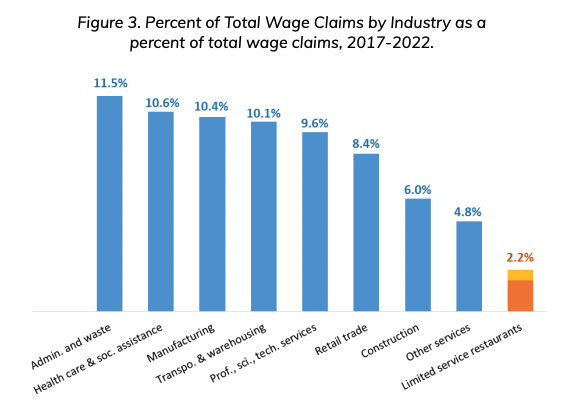
Opponents are also quick to point out that the fast food industry does not experience higher than average wage and hour violations when compared to other industries in California. On the contrary, fast food restaurants actually only account for 2.2% of the total average wage claims filed annually with California’s Division of Labor Standards Enforcement from 2017 through 2022. 

Graph of the percent of total wage claimstotal wage claims by industry
Compiled from California Department of Industrial Relations data. From “Not So FAST: Analyzing Labor Law Compliance at California Fast Food Restaurants,” Employment Policies Institute, August 2022. https://epionline.org/studies/not-so-fast-analyzing-labor-law-compliance-at-california-fast-food-restaurants/

Based on the figure above from the Employment Policies Institute, it almost appears that in the grand scheme of things, wage violations in California’s fast food industry may not be as prominent of an issue as proponents of AB 257 would have the public believe. However, the question then shifts to whether or not California should stand for labor violations of any kind, regardless of what they may look like between industries. After all, a staggering majority of fast food workers suffer from wage theft, even if they only make up 2.2% of total wage claims – surely that means something. But maybe it doesn’t mean enough to the business and livelihoods that could go under due to increased bureaucracy. It’s a heated debate that won’t be settled any time soon, even with the recent legislation. 

Joint Liability

Perhaps the most fundamental change brought about by AB 257 is the enforcement of joint liability. Now, instead of just the franchisees being liable for wage and hour violations, the franchisors themselves can also be held accountable as joint employers.

In the U.S., the franchise model has become so successful due in part to its limited liability. While franchisors control food prices, menus, uniforms, and the number of workers scheduled, they leave wages, working conditions, and all labor liability in the hands of local franchise owners.

This separation of liability creates a dichotomy between franchisor and franchisee interests. According to a 2021 study by the University of Miami and Cornell University, franchisees have a “free-rider” interest in increasing profit margins by “shirking on franchisor standards that reduce profit.” Franchisors, on the other hand, would rather build customer loyalty and maximize store revenue. 

“Franchisor pressure can sometimes lead franchisees to violate employment law,” an economist from the study says. “Franchisees can respond to intensive franchisor monitoring and tight profit margins by unlawfully chiseling wages as the only cost variable that the franchisor does not directly monitor.”

So what does this all mean? Well, it means that the franchise model has long been a breeding ground for wage and hour infractions. The FAST Act is an attempt to fix the misalignment between franchisor and franchisee by holding them both accountable. 

In fact, AB 257 would actually allow a franchisee to sue a franchisor if their contract contains conditions that leave them no choice but to violate employee wage and hour rights. 

While joint liability is not settled at the federal level, enforcing it is nothing new in California. Both the Cheesecake Factory in 2018 and Tesla in 2019 were held responsible alongside their janitorial contractors for underpaying workers. Since settling the two cases, joint liability for contract companies and their clients has generally been recognized in California. 

So, why is it such a big issue for joint liability to be established for fast food franchises? Well, doing so would bring to light an even larger discussion, this time surrounding unions. 

Sectoral Bargaining

In the U.S., unions practice enterprise-based bargaining. This essentially means that they only negotiate wages and working conditions with individual organizations. In contrast, sectoral bargaining is when a union negotiates labor standards with multiple companies across an entire industry. Sectoral bargaining is common practice in places like Europe and Australia.

So, AB 257’s fast food council is effectively a pseudo-sectoral bargaining body within the fast food industry because its policies will impact a vast range of organizations, not just one. This is a massive shift in the way collective bargaining is achieved, not only in California but in the nation as a whole. 

While doubtlessly a big step, bureaucratic wage and hour boards are not entirely new to this country. Similar legislation straddling the line of sectoral bargaining was passed in New York back in 2016. An “all-industry” wage board was convened by Governor Cuomo to increase the state minimum wage to $15. 

What to expect moving forward

If the concerns surrounding AB 257 materialize, consumers can expect menu prices to rise at their favorite fast food chains, and perhaps even see some locations shut down. On the flip side, wages will almost certainly increase for employees, and instances of wage theft will hopefully become less common. 

For business owners, labor costs will most likely rise. A higher minimum wage and stricter enforcement of break penalties and overtime rates will put a strain on profit margins. Compliance measures will also become tremendously important for avoiding costly lawsuits and penalties. Luckily franchisees should be able to fall back on holding their franchisors accountable for unfair contracts, reducing the pressure to cut corners. 

With the increase in costs, franchisees will be looking to higher fewer people going forward, opting instead for the use of technology. Utilizing automation in this way will hopefully cut down on human error, wage costs, and compliance risks. 

On a larger scale, major fast food chains will most likely be hesitant to open up new locations in the state. Outside of fast food, other industries can probably expect similar labor-regulating legislation to come their way in the next few years. 

What employers should do to prepare

In light of the changes brought about by AB 257, it’s important that fast food chain managers understand what they can do to keep wage costs low and comply with labor laws. Here are a few things to consider:

1. Audit the payroll process

Gone are the days of calculating inaccurate overtime and break penalties. Employers need to be on top of making sure all timesheets are correct, no matter what happens during a pay period. The best way to make sure your payroll runs as smoothly and accurately as possible is to catch all wage and hour errors BEFORE they even reach payroll. Employers can do this by prioritizing how they go about tracking time and attendance. Timesheets should be automatically calculated and reviewed every day by both managers and employees to prevent simple errors from compounding into major lawsuits. 

2. Keep detailed paper trails

These paper trails don’t need to be made of paper. In fact, they really shouldn’t be. Franchise owners should make sure they have an online system in place that automatically maintains wage and hour records for every pay period and every employee in order to hedge against labor liability. 

3. Review scheduling and timekeeping practices

Correctly scheduling and recording employee hours is a foolproof way to prevent labor law violations. Franchisees should look into automated employee scheduling systems built around strict compliance engines – technology like this makes it tremendously easy to schedule fair and cost-effective hours for workers. It’s not enough to just schedule employees correctly, however; employers need to have a time tracking system in place that accounts for all kinds of complications like break rules, overtime rates, and tardiness. 

4. Seek out automation

With the looming rise in labor costs, employers should look to workforce management automation to improve their margins and eliminate wasted time and money. Using AI to automate scheduling, forecasting, and timekeeping not only decreases admin time and human error, but also optimizes how labor is distributed, reducing things like overstaffing, wage theft, and overtime accruals. 

Posted on November 5, 2021January 22, 2024

What you need to know about the Biden Administration’s new vaccine mandate

Summary

  • The Biden Administration issued a new vaccine mandate on Thursday, Nov. 4

  • The mandate includes two different rules, one from OSHA and one from CMS. Both have Jan. 4 deadlines.

  • Businesses must reassess how they track vaccination, testing, and PTO for their employees.


Back in September of this year, the Biden Administration announced a controversial vaccine mandate. On Thursday it released an update, explicitly outlining two new rules for U.S. businesses to follow heading into the new year. 

Here is what you need to know.

Rule #1

Issued by OSHA, businesses with more than 100 employees must require all their workers to be vaccinated or to provide weekly negative test results. The rule affects roughly 84 million workers across the United States. Here are some further details:

  • The deadline is Jan. 4. Businesses must ensure that all their employees are vaccinated or at least are willing to provide weekly negative test results before this date.
  • Employers are subject to fines up to $13,653 per willful violation of the mandate.
  • Unvaccinated employees must wear masks while at work.
  • Workers must receive paid time off to get vaccinated as well as sick leave if additional recovery time is needed.
  • Employers do not need to pay for weekly testing.
  • The federal rule will take precedence over any inconsistent state laws that deny employers the authority to require vaccination, masks, and testing.
  • While it is mostly up to employers to enforce these rules, OSHA does plan to conduct workplace inspections to check that employers are staying in compliance.

Rule #2

Beyond the OSHA mandate, the Centers for Medicare and Medicaid Services has also issued a rule requiring 17 million people working in Medicare and Medicaid facilities to be fully vaccinated, with no weekly negative testing alternative. It will impact 76,000 federally funded healthcare facilities in the United States. Below are a few extra details:

  • All Medicare and Medicaid facilities must ensure their employees are completely vaccinated by a Jan. 4 deadline – the same deadline as the OSHA rule.
  • Facilities that do not comply could face fines, denial of funding, and possible termination from the Medicaid and Medicare programs.
  • Workers can apply for medical or religious exemptions

Going forward

With Biden’s new vaccine mandate comes the inevitable pushback. It’s a tale as old as…well 2020 I guess. 

While Republican lawmakers in various states have already begun drafting efforts to combat the requirements, the private sector is also raising concerns regarding supply chain issues in the cargo industry and labor shortages within healthcare. Regardless of where employers stand on the matter, the fact remains that thousands of dollars are on the line for non-compliance. As such, proper measures need to be taken to maintain a safe and organized workforce. 

Employers should reassess how they are currently tracking employee vaccinations and negative tests. Is there a system in place maintaining up-to-date records for each employee? Are managers automatically notified when a non-compliant employee is scheduled for a shift? Is there a compliance paper trail easily accessible to OSHA auditors when they come knocking? These are all important questions to consider when reviewing how well one’s workforce management system handles the new vaccine mandates.

Employers must also have a plan in place for how to tackle vaccination PTO and sick leave. Implementing specialty time off like this into scheduling processes and effectively tracking it for payroll can sometimes prove tricky without the right solutions in place. 

Interested in finding out more about how your business can prepare for the Jan. 4 deadline? We are here to help. Book a call with us today, or leave your email below and we’ll get back to you. 

Posted on September 30, 2021August 25, 2023

Online time and attendance tracking can save you more than money

If you are still tracking staff attendance using offline methods, such as paper timesheets or even computer spreadsheets, your company is at risk of more than just money lost to inefficiency. With increased scrutiny over working hours and pay—and new labor laws likely to favor workers—sticking with outdated and inaccurate offline methods of recording on-the-clock hours can expose you to expensive legal risks. Here are the key ways in which switching to online time and attendance software for staff management will allow you to stop worrying about legal compliance and concentrate on managing your business.

Be ready for predictive scheduling

One of the most talked-about developments in labor law is predictive scheduling, or “fair workweek.” These laws are designed to protect hourly workers from unpredictable schedules and ensures they are given ample rest between shifts. Predictive scheduling laws are already on the books in multiple states and cities, with more likely to follow.

Complying with predictive scheduling laws without using online time and attendance software is a huge task. Offline staff scheduling systems require managers to spot shifts that clash with these laws by checking and cross-referencing every timesheet and schedule manually. Even with only 10 employees mistakes are easy to make and problematic shift patterns are hard to track.

The risks of getting it wrong are high, as non-compliance results in punitive fines that usually stack per individual infraction. Break the law for one worker’s shift, and you may be fined $5,000. If the same problem occurs for 10 staff, you’re facing a $50,000 penalty. Since scheduling errors rarely impact only one employee, your risk grows exponentially the more workers you have. In April this year, New York City sued Chipotle for $500 million for 599,693 infractions of the city’s 2017 predictive scheduling law. Even if you’re not operating at the level of a brand like Chipotle, the more staff you have, the more shifts you run, the higher the cost of scheduling mistakes.

The benefit of using online time and attendance software such as Workforce.com is that it can be set up with the specifics of any local state or city labor laws, automatically preventing managers from creating a schedule that will break the law. At a stroke, you’ve minimized your exposure to predictive scheduling class action and ensured your staff receives fair treatment that respects their work-life balance.

Avoid costly wage and hour lawsuits

Wage and hour litigation currently makes up the majority of employee class-action suits. Not only are they the most common legal threat faced by businesses, but more suits than ever are successful. That trend isn’t going anywhere soon. The Biden administration is making large-scale changes to the law in this area, extending coverage to protect part-time and “gig economy” workers and the payment of tips to service staff.

It’s never been more important for companies to be sure that they are correctly logging hours worked and wages paid. Using offline time and attendance methods to keep track of these business essentials is prone to error and manipulation, by both managers and employees, and problems quickly become systemic. When that happens, it only takes one employee to cause everything to unravel, as Chicago restaurant Tank Noodle discovered when one employee’s complaint about wage discrepancies snowballed into a federal investigation and a $700,000 bill for back pay to 60 staff.

Online time and attendance software covers you both ways where wage and hour suits are concerned. Software that automatically clocks staff in and out, recording their hours worked down to the second, makes it easier to spot problems and produce data in your company’s defense. At the same time, automatically connecting that attendance directly to your payroll systems means that workers get paid exactly what they have earned—and you have the data to prove it if needed.

Comply with data laws

Unlike some other countries, the US has no clear and simple federal law covering data protection or privacy. Instead, there are various proposed bills making their way through the legislatures of multiple states. California and Virginia have passed data privacy laws, but similar laws were defeated in Washington and Oklahoma. All told, 25 states are considering—or have considered—legislation that dictates how businesses handle personal data.

Excel and paper timesheets can often contain personal identifying information—phone numbers, email, home addresses, etc.—for contact reasons. These can be lost, shared, or printed out and disseminated, creating a compliance nightmare. The rise in biometrics in the workplace adds a new layer of complexity as businesses will not just be storing addresses and phone numbers but fingerprints and retinal scans, too. The Biometric Information Privacy Act (BIPA) passed in Illinois gives a good example of what such laws are likely to require.

Data protection and privacy in the US is very much an evolving topic, but whatever happens, it’s clear that spotless record keeping is going to be more important than ever. Using online time and attendance software that unifies as many of your HR functions as possible—schedules, payroll, on- and offboarding—means all that vital data is stored securely in one place but easily accessed as and when you need it should the legal position change.

Online time and attendance makes old methods obsolete

These are turbulent times for business. The world of work is changing rapidly, legislation is increasingly favoring employees, and successful workplace class-action suits are on the rise. Relying on filing cabinets full of old timesheets or a folder full of spreadsheets on an office hard drive is simply too error-prone and vulnerable in this new landscape. Investing in online time and attendance software is a long-term investment in legal compliance but also gives you the confidence that you are ready for whatever comes next.

If you are intrigued and want to learn more about how to improve in this area, our team is here to help.

Posted on September 22, 2021March 17, 2022

Vaccine mandates: what are they and how should businesses handle them

Summary

  • Under Biden’s mandate, companies with 100+ employees now must require vaccinations or weekly testing for all workers

  • Vaccine mandates face pushback, both currently and in the past, with 45% of the U.S. population choosing not to be vaccinated

  • Businesses can use qualification tags, notifications, and shift questions to manage employee vaccination and testing status

The COVID-19 delta variant is becoming a serious threat across the nation. Mask mandates are back in vogue and remote work is once again looming on the horizon – all this and flu season hasn’t even begun.

In light of all this, many businesses have turned to their own internal vaccine mandates. One of the largest breweries in the world, Molson Coors, announced earlier this year a vaccine mandate for all non-union corporate, sales, and contract employees. Some states like Washington and Connecticut have also issued strict mandates for government and healthcare employees.

Biden’s Mandate

This trend has made its way into federal policy recently with the introduction of President Biden’s new vaccine mandate that will affect around 80 million people. Businesses with over 100 workers now must require vaccinations or weekly testing for all their employees – the alternative is a $14k fine. Ouch.

And the mandate does not stop there.

Anyone involved with the federal government in any capacity must show proof of vaccination with no weekly testing as an alternative. This means federal employees, contractors, and federally funded healthcare workers all are required to be vaccinated.

Government officials in states like Texas, South Carolina, and Florida are pushing back, with many citing the new mandates from the administration as overreaching and unconstitutional. Florida governor Ron DeSantis recently signed an executive order in direct retaliation to Biden’s mandate. The rule bans Florida employers and businesses from requiring people to provide proof of vaccination. Failure to comply with the vaccine passport ban results in a $5,000 fine per case. How this state rule will clash with the federal mandate remains to be seen.

This kind of contention is nothing new.

A Divisive History

Vaccine requirements in the past have almost always been met with resistance, and occasionally even full-blown lawsuits. Medical workers in Houston are suing their hospital a second time now after their first case was dismissed earlier this year. The 61 employees are suing in the wake of being suspended and fired for failure to comply with their hospital’s stringent vaccine requirements.

Unions have also traditionally held anti-vaccine mandate policies.

In Chicago, the police union refused to comply with local vaccine requirements announced last month. In fact, the union is reportedly prepared to go to court over the matter. However, many other unions have changed their policies in light of both Biden’s mandates as well as the FDA’s approval of Pfizer last month. Even so, vaccine mandates are still a topic of division among unions – this is something important for companies to keep in mind when navigating Biden’s new requirements.

Staying Compliant

Needless to say, there is a lot of tension surrounding vaccine passport culture. Whether the new mandates are constitutional or not, the fact of the matter is they are here, and business owners everywhere need to do their best to stay compliant.

For companies with 100+ employees not involved with the federal government, the first step to staying compliant is understanding who is exempt from vaccination.

According to the EEOC, an employer cannot issue a blanket vaccine requirement without providing appropriate exceptions for employees with certain medical conditions or religious beliefs. If workers cite one of these exceptions, employers can only mandate that they provide weekly negative test results.

Understanding the laws and technicalities surrounding all these changes is one thing; effectively adapting a workforce management system to these changes is a whole other matter.

Qualifications and Accommodations

There are two primary areas to keep in mind when dealing with the onset of nationwide vaccine mandates: qualifications and accommodations. Managers need to learn how to properly balance vaccine qualification requirements for specific jobs with accommodations for employees that meet exemptions. Accomplishing this balance will translate to an organized and collaborative workforce.

To potentially assist with balancing qualifications and accommodations, Workforce.com offers a few useful features.

The Limiting Scheduling According to Qualifications feature allows managers to keep track of and update employee certifications required for specific jobs. Since vaccines are essentially a kind of certification now, this feature is nearly essential in 2021. By adding a vaccinated status to the customizable qualifications list, managers are able to automatically restrict shifts to various employees.

Joseph Cuellar, a software consultant at Workforce.com, notes, “recently we’ve seen a lot of companies use the qualifications feature to make sure they’re on top of vaccination requirements.” In the coming months, this trend is likely to continue.

Another way for businesses to manage their COVID-19 vaccine and testing requirements is to have employees answer pertinent questions when clocking in. With Workforce.com, managers can prompt employees with questions like these to confirm that they understand the vaccine and testing requirements associated with employment, or confirm that they’ve not exhibited symptoms of COVID-19.

As previously mentioned, these vaccine related qualifications for shifts must be balanced with accommodations.

Some employees may meet one of the two exceptions for getting vaccinated, and organizations should consider properly accommodating them. If they choose not to, they run the risk of losing significant human capital at a time when national staffing shortages are plaguing various industries.

To successfully accommodate exempt employees, both the qualifications tool as well as clock-in questions may be used. Managers can also send weekly reminder notifications to exempt employees to get tested. They can also create a custom qualification tag for testing status that expires after a week. As a daily safeguard, clock-in questions regarding proof of negative tests can also be used.

Vaccine-heavy Future

At the end of the day, if your company has over 100 workers, it is safest to assume that you’ll need a way to keep track of vaccination status across your workforce. Tracking the status of vaccinations and negative test results can be complicated, but there are ways to make it a clear and concise process with workforce management solutions.

Times are hard. Let us make them a little easier for you. Chat with us today over the phone about handling vaccines and testing requirements, or leave your email below and one of our team members will be in touch.

Posted on September 14, 2021October 4, 2022

Salt Bae Sued: Rethinking Time & Attendance for Salaried Employees

Summary

  • Former cooks at Salt Bae’s New York steakhouse sue for unpaid overtime

  • Fair Labor Standards Act classifies over $913 a week as exempt from overtime pay

  • Organizations should not overlook the importance of tracking salaried employee time and attendance


The fateful day has finally arrived; our beloved meat-mincing and salt-slinging internet hero Salt Bae, also known as Nusret Gökçe to his parents, has fallen out of the good graces of online society. 

First launched into internet stardom in 2017 via a viral video of him eccentrically sprinkling salt onto strips of freshly sliced steak, Gökçe has since built an empire for himself out of artisanal steakhouses and social media influence. This empire started to crumble on August 9, however. Five of Gökçe’s former employees just sued him for denying them overtime pay after they consistently worked 70-90 hour weeks. 

These are some excessive hours to work with no overtime pay, even for steakhouse grillers. So what happened? Well, unlike many in the restaurant industry, the five employees were salaried. They made $1,125 a week, or around $58,500 a year. The chain also classified the grillers’ positions as managerial so as to avoid paying them for overtime.

Citing the Fair Labor Standard Act, the lawsuit claims that Gökçe’s restaurant owes the five salaried employees overtime pay for consistently working them over 40 hours a week in positions misleadingly designated as managerial in nature. 

Crazy stuff right there. Who knew that such a suave, sunglass-wearing, meat connoisseur could have incredibly manipulative intentions behind closed doors? Where is the outrage? Shall the public riot? 

Not so fast.

It is worth understanding what the Fair Labor Standards Act actually says about overtime for salaried employees. As of 2016, only salaried employees who make up to $913 per week, or $47,476 per year, qualify for overtime pay. If an employee makes more than this, they are classified as exempt from overtime pay. Taking what we know from this recent lawsuit against Gökçe, it is clear that the former grillers made over $47,476 a year in salary, meaning that they are potentially exempt from overtime pay according to the Fair Labor Standards Act.

But wait, there’s more. 

On the other hand, the FLSA provides an exemption, of sorts, to…the exemption. You see, the $913 per week ceiling only applies to “white-collar” workers – people in executive, professional, or managerial roles according to Maduff & Maduff, LLC. The FLSA says that “blue-collar” salaried employees can still qualify for mandatory overtime pay no matter how much they make in salary. Blue-collar in this case is defined by the FLSA as “workers who perform work involving repetitive operations with their hands, physical skill and energy.” Examples would include carpenters, electricians, mechanics, plumbers, ironworkers, craftsmen, etc. 

So, the natural question is this: are artisanal steak grillers technically blue-collar workers? 

Well, I don’t know. I will let the lawyers bicker over the answer in the coming weeks. What I do know, however, is that this whole mess brings up an interesting subject regarding how employers track time and attendance for their salaried employees.

You see, it was revealed that Gökçe’s restaurant chain did not keep records of the five mens’ working hours or wage statements throughout their employment. Obviously, this negligence does not help matters for the chain. When labor lawsuits like this come up, a company must have access to a paper trail that shows how many hours employees have worked and how much they have received in pay. Now, this practice may seem obvious for hourly employees; however, it is not so obvious for salaried workers.


Reasons for tracking salaried employee hours

Automated workforce management solutions should not be seen as exclusive to hourly workers; they can encompass all aspects of a company in any industry. Whether your salaried employees are exempt from overtime pay or not, you should consider attempting to track all their hours worked. While I should note that legally you are not required to do so, it still may be beneficial for your company. Here are a few reasons why:


One: Overtime Pay

This one is straightforward. If you have salaried employees who make $47,476 a year or less, they are non-exempt and legally entitled to overtime pay whenever they work over 40 hours a week. Using an automated time and attendance system like Workforce.com allows for companies to accurately and easily track how many hours all employees work, both hourly and salaried. 

Also Read: Management tips on overtime equalization and tracking hours

Two: Paid Time Off

If your employees receive PTO as part of their salaries, tracking daily time and attendance is essential for figuring out how much time they accrue as well as how much they have used.

Also Read: Managing employee time-off requests: A guide for business owners

Two: Labor Compliance

In the event of a lawsuit, you want to be sure you have records of how salaried employees have been compensated and classified. Without proof of good practice, a business is extremely vulnerable to legal trouble. Moreover, labor laws are constantly changing; it is a company’s responsibility to stay up to date on them. For instance, the FLSA policy on the ceiling for mandatory overtime is going to be subject to change every three years. If you are accurately tracking your salaried employees’ hours, you will be much better prepared for future changes to the overtime exemption ceiling. 

Three: Understanding Labor Costs

Since salaried employees don’t have clear-cut hours they need to work, it can be hard to track when they arrive, leave, and how much value they provide to the firm relative to the amount of compensation they receive. By keeping time and attendance records via an automated workforce management platform, managers can get a clearer understanding of their labor costs as well as employee productivity. Just keep in mind that legally, this can not lead to reductions in pay. Tracking hours like this should simply be used as a device for understanding employees and improving productivity. 

Also Read: How to reduce labor costs and attract quality staff in a post-Covid market

Four: Employee Burnout

Similar to identifying labor costs, knowing how many hours salaried employees are working as well as the times they start and stop work is important to managing employee burnout. An exhausted and stressed employee working odd hours is never good for productivity or company culture.

Five: Internal Communication

Using workforce management software to track salaried employee hours also opens the door for rich communication options. With Workforce.com, employees and managers alike can easily message one another, receive instant notifications, and give feedback on a vast array of subjects. Having a transparent and unified system to track time and attendance allows for salaried employees and managers to be on the same page regarding hours worked; this leads to open and honest internal communication. 


These are only five simple ways tracking time and attendance for salaried workers can benefit a company. To discover if this is something that might work for you, it may be worth chatting with a representative or booking a free trial. 

Let’s all learn from Salt Bae. Nobody, even a peak internet meme persona, can evade common workforce management issues all on their own. Give time and attendance tracking for salaried employees a try with Workforce.com. 

Posted on July 27, 2021August 3, 2023

The 10-minute guide to 2021 labor law compliance

Labor laws are a potentially lethal minefield for companies, particularly in today’s turbulent labor market, as the cost of labor law compliance failures can be enormous.

Labor law fines tend to stack per infraction so with large employee numbers the financial risk can grow exponentially, as with the recent high profile example of New York City suing Chipotle (https://edition.cnn.com/2021/04/29/business/chipotle-nyc-lawsuit-labor-law/index.html) for $151 million over 600,000 labor law violations accumulated within the city. In Tennessee, a home health care provider misclassified fifty workers as independent contractors rather than employees and was hit with a $358k penalty (https://www.workforce.com/news/worker-misclassification)by the Department of Labor to make up back wages and overtime.

Ignorance of the law is no defense, so even in situations where labor law compliance is complicated by different federal, state, and city rulings, it’s up to companies to stay on top of what is required. In situations where federal and local laws differ (i.e., the state minimum wage is higher than the federal), companies are expected to adhere to whichever is most stringent (i.e., they would have to pay the higher state minimum wage, not the federal).

It’s all too easy to make labor law compliance mistakes, but awareness of your responsibilities and impeccable record keeping will help to protect your company. Here are the key areas to keep in mind.

Minimum wage

Minimum wage laws are getting a lot of attention at the moment, with President Biden’s executive order raising the salary for federal workers to at least $15 per hour being seen by many as a prelude to a nationwide rise in minimum wage levels. Compliance with these laws can seem cut and dried, but there are aspects unique to some industries that you should be aware of if they affect you.

For example, industries where workers earn tips have a unique minimum wage law to follow, called Minimum Tipped Wage. “Minimum tipped wage makes it quite a bit more complicated,” says Workforce’s chief strategy officer Josh Cameron. “In hospitality or anything where you earn tips, you can pay the staff a minimum wage much lower than the normal one. So it would be $7.50 an hour if they’re not tipped, but it’s $2.50 if it’s tipped. As long as they get enough tips to get them over that—it’s called the tip credit—then they can receive the lower $2.50 per hour from their employer.”

There are reasons to keep on top of minimum wage laws beyond the threat of fines. For example, 29 states currently require a minimum wage higher than the federal standard, and you are obliged to pay the higher sum. Underpaid workers are unlikely to show any loyalty to a company, and underpayment can cause PR problems as well. “An underpayment scandal can bring companies to their knees,” says Andrew Stirling, head of product compliance at Workforce.com. “Customers can decide to take their business elsewhere. People are less likely to visit a restaurant or shop that has been reported for underpaying their people.”

Paid and unpaid breaks

One of the areas of labor law compliance with the least clarity is breaks for workers, making it especially important for companies to err on the side of caution. The legal requirements can be found on the Department of Labor website, but there are significant areas of ambiguity to watch for:

  • Federal law does not require companies to offer lunch or coffee breaks.
  • Where short breaks are allowed by a company, short breaks (i.e., toilet use) of up to 20 minutes should be paid.
  • Breaks of 30 minutes or longer (i.e., lunch) are considered outside of workable hours and do not need to be paid.
  • Waiting time or on-call time does not count as a break and should be paid.

“There’s this gray area,” says Josh Cameron. “Say you take a break for 21 minutes, is that paid or unpaid? Is it okay to make that unpaid? If you’re a lawyer looking at this, it’s really an opportunity because you can say, ‘This employee always had a 23-minute break, always had an 18-minute break, and they never got paid for it. Maybe they should have been.’ That’s something that employers should really be aware of and keep an eye on.”

This is an area where accurate and exhaustive employee data can really help, and if your company still relies on timecards and manual spreadsheets or pen and paper logs to track breaks, you could be leaving yourself open to big problems in the future.

Paid and unpaid leave

Thirteen states, plus Washington DC, currently require private companies to offer paid sick leave. The Families First Coronavirus Response Act added an additional responsibility for companies with less than 500 employees to allow workers to take paid time off if infected with COVID-19, to isolate following contact with an infected person, or to care for a family member. The same act also introduced a tax credit to offset the loss for affected companies.

California, New Jersey, Rhode Island, and Washington have all passed laws that also require paid family leave, and President Biden’s administration has set its sights on a federally mandated period of 12-weeks paid leave that would allow, for example, parents to take time off to care for newborn babies or other family needs.

For now, the only federal law involving medical and family leave is the Family and Medical Leave Act, which requires employers with more than 50 staff to offer 12 workweeks of unpaid, job-protected leave in a 12-month period for:

  • The birth of a child, adoption, or fostering of a child
  • A seriously ill spouse, child, or parent
  • A serious health condition that makes the employee unable to perform the essential functions of his or her job
  • Any qualifying exigency arising out of the fact that the employee’s spouse, son, daughter, or parent is a covered military member on “covered active duty;” or Military Caregiver Leave—26 weeks in a 12-month period to care for an injured or seriously ill spouse, son or daughter, parent, or other next of kin who is a covered service member

This is an area of labor law compliance that is only going to become more prominent in the coming years, so shrewd managers should ensure they are on top of current requirements, which are largely dependent on where you operate and how many staff you have, and be prepared for change.

Healthcare

Another area of labor law that has been fraught with political debate, the Affordable Care Act requires that if an employee works more than 30 hours a week over any single year look-back period, then the employer must provide health insurance. While the ACA is a federal law, the portion of the medical insurance that the employer has to pay is determined by the state. In New York, for example, the employer must pay 80%.

The 30 hours a week cut-off requires particularly careful management where shift workers are concerned, as their hours may fluctuate over time. “This whole area is a big pain point,” explains Josh Cameron. “It’s a very difficult conversation to have with an employee that has become eligible for healthcare, then loses that eligibility the next year. Taking it away from someone feels very harsh to the employee.”

Keeping track of employee hours and keeping accurate records is yet again a vital part of compliance for companies here. Qualifying for healthcare is a strong motivator for retaining staff, but for those companies that are concerned about shouldering the additional costs, Workforce.com can be calibrated to warn managers when employees reach the 30 hours threshold and can even prevent managers from publishing schedules that extend past 30 hours.

Predictive scheduling

A recent addition to the labor law conversation, predictive scheduling laws – also sometimes known as “fair workweek” – place restrictions on how shifts are assigned and require companies to give advance notice of new schedules.

Two states – Vermont and Oregon – and eight municipalities – San Francisco, Berkeley, Emeryville, San Jose, Seattle, New York City, Chicago, and Philadelphia – have passed such laws, and more states and cities are considering legislation in this area. The specifics of the laws vary from region to region, but the core principles are:

  • A minimum notice period for upcoming schedules (usually two weeks) with compensation for workers who are not given enough notice of their schedule or changes to that schedule
  • A ban on “clopening,” meaning that a staff member working the closing shift cannot be scheduled to work the opening shift the next day
  • Mandatory rest periods that vary from between 9 to 11 hours between shifts

Failing to maintain compliance with these laws is expensive. The Chipotle example mentioned earlier, in which NYC sued the fast-food chain for $151 million, was caused by hundreds of thousands of predictive scheduling infractions across its many locations in the city.

Even if your business is not based in a state or city with predictive scheduling laws, it is still worth adopting the principles behind them. Partly because these laws may yet impact your business, but also because they have had a notable improvement on staff retention and job satisfaction.

Discrimination laws

There are thankfully few employers looking to openly discriminate in their hiring processes these days, but you should still be aware of which groups the law applies to when hiring and firing, as well as setting the terms of employment and how much people are paid.

  • The Equal Opportunity in Employment Act covers all the areas of discrimination that are forbidden. This concise PDF from the Department of Labor spells out everything employers should know.
  • The Americans with Disabilities Act (ADA) applies to companies with 15 or more employees and makes it illegal to discriminate in employment on the basis of a person’s disability. This also requires companies to make “reasonable accommodation” to allow a disabled person to work there, including making modifications to the working environment to not only allow disabled people to work there but also participate in the application process.
  • Ever since the Civil Rights Act of 1964, there have been several laws and amendments which make it illegal to discriminate against anyone because of their Ethnicity, Gender, Race, or Religion. Nationality is also a protected category, so, for example, it would be illegal not to hire someone because they were from Poland, regardless of their race or ethnicity.
  • The Age Discrimination in Employment Act offers protection to employees and applicants on the basis of their age. This law applies to anyone aged 40 or older, a far younger cut-off than many companies realize.

Labor law compliance is easier with good record keeping

If this all seems like a lot to keep track of, you’re not alone. The USA has relatively light-touch regulations for businesses compared to Europe, for example, but that doesn’t mean the task of staying compliant with labor laws can’t feel overwhelming—especially if you’re new to management and dealing with all of this legislation for the first time.

Regardless of which law is involved, one of the recurring causes of labor law breaches is poor record keeping. There’s one surefire way to ensure that your labor law compliance is rock solid, and that’s to keep excellent data. While it’s possible to maintain your records the old-fashioned way, with paper and pen or spreadsheets, the potential for human error is high.

When the cost of non-compliance can be so steep, using dedicated staff management software like Workforce.com to track staff hours and automatically flag labor law compliance issues offers much-needed peace of mind.

Posted on June 16, 2021October 18, 2024

Poor recordkeeping contributes to contractor paying $500K in back pay, fines after Labor Department probe, litigation

poor recordkeeping

A New York-based contractor agreed to pay 69 employees $500,000 in back wages and damages to resolve violations of the Fair Labor Standards Act’s overtime and recordkeeping requirements after being sued in federal court by the Department of Labor.

Investigators from the department’s Wage and Hour Division found that Maio Building Corp. and owner John Maio often directed laborers and masons to work 10-hour days, five or six days a week, knowing the FLSA required employees to receive overtime pay when they worked more than 40 hours per week. The company reached a settlement and was ordered by the U.S. District Court for the Eastern District of New York to pay $250,000 in back wages and an equal amount in liquidated damages, according to a Labor Department statement.

Clean up recordkeeping

Maio also paid employees in cash or a combination of check and cash and failed to keep accurate records of employees’ work hours and regular hourly rate of pay, according to the Labor Department statement.

Poor FLSA compliance and recordkeeping that lead to steep Labor Department fines is avoidable, said employment law attorney William J. Anthony, a partner at Blank Rome in New York. The FLSA permits any form of timekeeping system as long as it accurately records all hours worked, he said. 

Also read: How to schedule employees effectively: 5 proven steps

“Many employers use electronic timekeeping systems and payroll companies to help with compliance and avoid legal issues,” he said.

Enforce your time and attendance policies

Sonya Rosenberg, a labor law attorney and partner with Neal Gerber in Chicago, added that it’s not enough to just have written policies. 

“You want to be sure they are consistently enforced and that there are established, working procedures in place for when any corrections need to be made,” she said. “Every organization needs to ensure that all of its employees, and particularly its frontline supervisors, managers and HR staff are well trained in wage and hour requirements.”

Employers must emphasize that accurate time tracking is an essential element of each employee’s job and that failure to adhere to the rules will result in discipline, said Kara Govro, senior legal analyst at HR consultancy Mineral (formerly ThinkHR and Mammoth). Make sure employees see and read the policy. Enforcing these policies is crucial.

“If you say you’re going to be serious about it, be serious about it,” Govro said. “Write employees up, issue final warnings and be prepared to terminate if you have employees who refuse to meet your clearly articulated expectations.”

Anthony cited four ways to clean up recordkeeping practices. 

  1. Publish a policy on how to accurately record time and how to report any payroll errors.
  2. Have employees certify that their weekly time records are accurate.
  3. Train new employees on proper timekeeping.
  4. Monitor the timekeeping and payroll systems regularly to ensure accuracy. 

Anthony also said that responsibility for accurate wage and hour recordkeeping typically falls on human resources or the in-house legal department to ensure compliance. In smaller organizations, it may be the owners or management personnel who are responsible, he said. 

“Under the FLSA, an employer includes individuals with decision-making authority and operational control over payroll and wage and hour practices,” he said.

The consent judgment is the outcome of a lawsuit filed by the Labor Department’s Office of the Solicitor. In addition to the payment of back wages and damages to the employees, the judgment prohibits Maio Building Corp. from:

  • Future violations of the FLSA’s overtime and recordkeeping requirements.
  • Taking retaliatory action against employees who exercise their FLSA rights.
  • Telling any of their employees not to speak with or provide untruthful information to Labor Department investigators.
  • Soliciting or accepting the return or kick back of the wages and damages from the affected employees.
  • Threatening or implying adverse action against any employees or former employees because of their receipt of funds due under the judgment or the FLSA.
  • Otherwise obstructing or interfering with any department investigative activities.

Maio denied the allegations and said the company acted in good faith and complied with the law, according to a June 7 Equipment World article. The response said the Labor Department’s claims were barred by the Federal Motor Carriers Act and that the division had denied Maio due process rights at the closing conference by “refusing to discuss the MCA exemption,” the article stated.

Stricter Labor Department enforcement

On April 30, 2021, a settlement agreement was filed with the court in which Maio neither admitted nor denied the allegations, but that the company agreed to the settlement “to avoid the burden and expense of litigation,” according to the article.

Given that the Labor Department under Secretary Marty Walsh is stepping up enforcement versus guidance, particularly in its wage and hour division, Rosenberg urged employers to review and update wage and hour policies and practices and to make any appropriate adjustments or corrections. 

“The DOL investigators are making no secret of the department stepping up efforts and increasing penalties for noncompliant employers,” she said. “For any employer with a significant number of nonexempt employees, this should be a high-priority area.”

Interestingly, a newly released survey by law firm Ogletree Deakins notes that 47 percent of employers surveyed say that state and federal agencies are more aggressive in terms of enforcement than ever. Anthony added that between stepped-up enforcement, changing regulations and guidance, along with state wage and hour laws, it is critical that employers stay abreast of all legal developments. 

“This is an area of the law where claims can be avoided if employers regularly focus on compliance,” he said. “Conducting internal pay practice audits, regularly reviewing payroll policies, training personnel responsible for compliance, ensuring accurate timekeeping systems and payroll practices can usually avoid damages being assessed by the Labor Department or a court.”

Labor Department investigations are largely driven by employees contacting the agency, Govro said. Once that call has been made, federal laws are in play, she said. 

The Labor Department isn’t going to just “guide” an employer in the right direction when they have been failing to pay minimum wage or overtime, she added. They are going to collect the back pay.

“The bottom line is that employers need to be paying very close attention to timekeeping and accurate payment of wages at all times, regardless of the DOL’s mood,” Govro said.  

Book a demo today to see how to build schedules, manage labor costs and ensure labor compliance with Workforce.com’s No. 1 employee scheduling software.

Posts navigation

Previous page Page 1 Page 2 Page 3 Page 4 … Page 19 Next page


Webinars


White Papers


  • Topics

    • Benefits
    • Compensation
    • HR Administration
    • Legal
    • Recruitment
    • Staffing Management
    • Training
    • Technology
    • Workplace Culture
  • Resources

    • Subscribe
    • Current Issue
    • Email Sign Up
    • Contribute
    • Research
    • Awards
    • White Papers
  • Events

    • Upcoming Events
    • Webinars
    • Spotlight Webinars
    • Speakers Bureau
    • Custom Events
  • Follow Us

    • LinkedIn
    • Twitter
    • Facebook
    • YouTube
    • RSS
  • Advertise

    • Editorial Calendar
    • Media Kit
    • Contact a Strategy Consultant
    • Vendor Directory
  • About Us

    • Our Company
    • Our Team
    • Press
    • Contact Us
    • Privacy Policy
    • Terms Of Use
Proudly powered by WordPress