Skip to content

Workforce

Category: HR Administration

Posted on November 29, 2012August 3, 2018

2012 Game Changer: Julie Hoff

Pharmacy benefit manager Express Scripts Holding Co.’s acquisition of Medco Health Solutions Inc. stirred up controversy among lawmakers and consumer groups and marked a difficult time for the company, but for Julie Hoff it was the opportunity of a lifetime.

The $29 billion deal finalized earlier this year that brought together Express Scripts and Medco was a complicated merger of distinct cultures and 33,000 employees from across the country. It doubled the size of Express Scripts, which is now the largest PBM in the country.

Hoff, 36, was responsible for developing and executing human resources strategy during the acquisition.

“It’s so massive in size and complexity that it could become overwhelming,” says Hoff, who started at Express Scripts in 2003 as an entry-level HR generalist and now is senior director of HR strategy, planning and communications. “There is so much pressure. We were navigating things that we haven’t dealt with before. Once you come together as a new team, you have to start building new relationships. I’m working with a team of people who don’t know me. At the same time, you have pretty aggressive goals to meet. Sometimes I’m not their favorite person.”

Hoff says the experience was a “career changer,” but it wasn’t the first time she stepped out of her comfort zone to tackle a unique challenge. In 2010 she accepted a position in sales as a senior director, account management, at Express Scripts after completing her MBA. Senior management thought it would be a good opportunity for her to learn the PBM business.

“I had 90 account managers, and I didn’t have that kind of experience,” she says. “The integration was difficult, but making a cross-functional move was also tough.”

She says it was worth the challenge. “You’re a better HR person if you know the business well.”

Rita Pyrillis is Workforce’s senior writer. Comment below or email editors@workforce.com.

Workforce Management, December 2012, p. 26 — Subscribe Now!

Posted on November 26, 2012August 6, 2018

When Is Confidential Medical Information Not Confidential?

The Americans with Disabilities Act requires that employers treat employee medical information obtained from “medical examinations and inquiries … as a confidential medical record.” In Equal Employment Opportunity Commission v. Thrivent Financial for Lutherans, the 7th Circuit recently decided the extent to which that confidentiality requirements applies when an employee volunteers medical information to an employer.

Gary Messier worked for Trivent as a business analyst, and during his first four months of employment developed a reputation for letting his employer know when he would be absent from work. When he failed to report to work one day, his supervisor emailed looking for a report and explanation. In response, Messier sent an email detailing his long battle with migraine headaches.

Messier quit one month later, but had trouble finding a new job. When three jobs fell through after a reference check, he hired a company to conduct a fake reference check for him. In response, his former supervisor at Trivent said that Messier “has medical conditions where he gets migraines.”

Based on that statement, the EEOC brought suit on Messier’s behalf for a violation of the ADA’s confidentiality requirements.

In affirming the district court’s dismissal of the lawsuit, the 7th Circuit examined the plain language of the ADA.

The EEOC argued that the ADA’s confidentiality provisions protect all employee medical information revealed through “job-related” inquiries.

The 7th Circuit disagreed:

The subject matter discussed in the body of section (d) confirms that the word “inquiries” does not refer to all generalized inquiries, but instead refers only to medical inquiries. The entire section is devoted to a discussion of a disabled employee’s “medical record,” “medical condition or history,” “medical files,” and medical “treatment.”

Instead, the Court concluded that the ADA’s confidentiality requirements only apply to medical information provided by an employee in response to a medical examination (not an issue in this case) or a medical inquiry.

Because Trivent had not made a medical inquiry before Messier sent his email detailing his migraines, any disclosure it made did not violate the ADA.

[P]revious courts have required—at minimum—that the employer already knew something was wrong with the employee before initiating the interaction in order for that interaction to constitute a [protected] inquiry. There is no evidence in the record suggesting that Thrivent … should have inferred that Messier’s absence on November 1, 2006 was due to a medical condition. There is no evidence in the record that Messier had been sickly during his first four months of employment. There is no evidence that Messier had experienced a headache at work during his first four months. For all Thrivent … knew, Messier’s absence was just as likely due to a non-medical condition as it was due to a medical condition. Indeed, as Thrivent pointed out to the district court, “Messier could have had transportation problems, marital problems, weather-related problems, housing problems, criminal problems, motivational problems, a car or home accident, or perhaps he simply decided to quit his job….”

Thus, Thrivent was not required to treat the medical information that Messier sent in response to the email as a confidential medical record. Accordingly, Thrivent did not violate (and could not have violated) the ADA by revealing Messier’s migraine condition to anyone, including to prospective employers.

While this case is a great holding for employers, businesses should still tread carefully when dealing with employee medical information. This area of the law remains risky waters in which companies swim.

Written by Jon Hyman, a partner in the Labor & Employment group of Kohrman Jackson & Krantz. For more information, contact Jon at (216) 736-7226 or jth@kjk.com.

Posted on November 26, 2012August 3, 2023

Future Workforce Predictions: Teams, Brain Scans and Externships at Work

The year was 1968, and a futuristic film, 2001: A Space Odyssey, pitted man vs. machine in a battle for domination.

Today, the massive HAL 9000 might be the size of a tablet computer, but fears of technology taking over are nothing new. Many pundits and prognosticators have imagined a machine-run society where superpowerful robots either enslave humans or give us lives of leisure.

Research in artificial intelligence, according to a feature on Discovery Channel’s website, could one day lead to robots performing unassisted surgeries, preparing meals at restaurants or even teaching our children’s classes. Let’s just hope HAL’s homicidal tendencies will be left out of the equation.

To wit, technology is advancing at a breakneck pace—consider, for instance, how much mobile phones have changed in just five years—but the future workplace isn’t all about technology taking over either. Companies are looking for ways to bring the future to the present using teamwork. Human teamwork.

Medical device company Hospira Inc., for one, has a futuristic training program.

Called “Ignite,” the program allows groups of employees to apply collectively for company grants to learn new skills. Ignite supplements a traditional tuition-reimbursement program for individuals at Hospira. Checks for up to $5,000 have gone to such initiatives as a proposal by the company’s women’s networking group to work with a consultant to increase global awareness and reach.

Lake Forest, Illinois-based Hospira launched Ignite in 2010. But it captures what many experts expect to be a crucial feature of the workforce a decade hence: increased attention to teams rather than individuals. Author Jeanne Meister, for example, predicts organizations will increasingly hire and train entire teams to tap the effectiveness of coherent work units.

Meister, who co-wrote The 2020 Workplace: How Innovative Companies Attract, Develop, and Keep Tomorrow’s Employees Today and is a founding partner of consulting firm Future Workplace, says Ignite smartly fosters collaboration skills because colleagues have to join forces to apply for the funds. And she calls Hospira’s program a good example of the more collective work styles on the horizon. “Because of the complexity of the businesses we operate in, nobody can really do the job without being part of a high-performing team,” she says.

A greater focus on work groups is one feature of the likely workplace of the future. People management practitioners, researchers and consultants Workforce interviewed predict that over the next 10 years organizations also will likely turn more to nontraditional sources of labor, tap “crowdsourcing” for performance management and involve networks of organizations for employee career development.

Prognostication about the future of management is a well-trod field. In 1998 and again in 2008, Workforce took stabs at foretelling what human resources would look like 10 years out. We didn’t always hit the mark. For example, consider this wishful-thinking item from 1998 about how HR would change by 2008: HR will “report directly to the CEO in most companies.” But our 1998 crystal-ball gazing did include a forecast that “collaborative cultures” would become the workplace model. That’s largely panned out. In 2008 we made a similar projection, saying “there will be an increased focus on infrastructures—such as social networks and wikis—to support building strong relationships and collaboration.” With growing business interest in social media tools, this prediction seems to be coming true as well.

The importance of teamwork continues to be compelling to experts and executives as they guess at what’s ahead. .

Hospira’s Ignite program fits into this context. The initiative has roots in a quest to use employee-development dollars more efficiently, says Ken Meyers, senior vice president of organizational transformation and people development at Hospira. Officials reasoned that if one person needed training in a particular area, it probably applied to others as well at the 15,000-employee company. Since 2010, the company has given out close to 120 Ignite awards affecting 3,850 employees on topics including statistical analysis, customer service and infection prevention.

Even as Hospira promotes team development, Meyers expects individual initiatives to remain crucial to organizations in the years ahead. In particular, he says employee engagement will be less about companies trying to motivate workers and more of a shared responsibility. “It’s not about how we engage employees,” he says. “It’s a choice employees make to be engaged.”

Individual choice in another form could make up another striking feature of the future workforce: more people contributing to companies in nontraditional ways. One of these ways—working on a contingent basis—has been on the rise in recent years. And it will continue to become a popular option, says Jennifer Christie, chief diversity officer and vice president of executive recruitment at financial services company American Express Co.

“In the next five, 10 years, the employment relationship may evolve in such a way that organizations may not ‘own’ their talent, but there may be times where they ‘borrow’ it for a defined period of time,” Christie says. “We see there being a mix of longer-term career employees and finding talent to fill short-term assignments.”

Another alternative form of labor is enlisting volunteers, says John Boudreau, a management professor at the University of Southern California. Already, organizations are starting to take steps in this direction by arranging contests designed to help solve problems. Consider Foldit, an online game created by University of Washington researchers that aims to let the public tackle puzzles related to the way proteins are configured. In one case, gamers provided key insights for solving the structure of an enzyme vital to the reproduction of the HIV virus. The accomplishment could lead to new drugs to treat AIDS.

Boudreau says he can envision more such examples in the years ahead. “There may actually be some creative solutions that involve tapping into this voluntary talent pool,” he says.

What Boudreau is talking about also goes by the name of “crowdsourcing.” And the same principle could apply increasingly to employee reviews and performance management. Software tools such as Saleforce.com Inc.’s Work.com have emerged in recent years to make it easy for people to give one another praise. And this trend can morph into a smarter overall approach to people management, says Eric Mosley, CEO of recognition software and services provider Globoforce.

In an e-book titled The Crowdsourced Performance Review, Mosley foresees a future in which the performance-review process includes the feedback of a range of an employee’s peers. Not only does this approach produce richer information than traditional top-down reviews, but also it inspires better behavior on the part of workers, Mosley says. “Because they have the power to reward others, they help to weave a stronger social fabric in the company,” he writes. “As they nominate others for awards, they will become more conscious of company goals, values and teamwork. And they won’t take these things for granted. They’ll be active builders of culture.”

Tom Vines, IBM’s vice president of technical and business leadership, takes the social-performance management prediction a few steps further. Vines, who is responsible for the computing giant’s leadership development and succession planning globally, thinks comments and endorsements will evolve to the point where employees will select their managers based on very visible feedback given to those supervisors. What’s more, Vines expects companies to publish this information as a recruiting tool. Call it talent acquisition via radical transparency. “It will be both inside and outside” the company, Vines says. “Companies will want to expose their managers’ ratings to attract talent.”

Boudreau offers another prediction that fits in with the notion of a decentralized, more permeable organization. It is that companies will allow for and encourage their employees to take positions in other organizations for extended periods of time to increase their skills and develop their careers. These individuals may return to the organization, even as the firm accepts such long-term, temporary workers from other companies.

For an early adopter example of this, Boudreau points to Malaysia and a government agency called Khazanah Nasional Berhad. Khazanah has a mission to improve the country’s economy through investments in strategically important industries such as telecommunications, transportation and utilities. One of its methods is to strengthen leadership development in Malaysia. To do so, it has created a cross-organization leadership exchange, where high-potential middle managers take assignments in another company for up to two years. The role is designed to be a challenging one that fosters growth, and the “home” company pays the employee’s salary. If such “externships” take off, they would mark a new chapter in the relationship between organizations and employees.

“It’s an example of this employment deal really being boundaryless,” Boudreau says.

Speaking of new boundaries, companies will become much more sophisticated about the optimal function of workers’ brains in the future, says Wayne Hochwarter, a management professor at Florida State University. He says this will include considering the role of stress on brain performance. And it could lead to a daily mind diagnostic. “I can see a future where an employee gets a brain scan every morning and is then assigned tasks based on what the test shows,” Hochwarter says.

By way of example, he says that if a worker shows high activation in the frontal lobe of the brain on a particular day, that person may get the assignment of a key review of a 50-page financial report. That’s because the frontal lobe controls functions including attention, problem-solving and judgment, Hochwarter says, which are important for a detailed scouring of a document.

Hochwarter argues organizations have just begun to appreciate the importance of brain health and its effect on productivity and organizational success. “You’ll have a staff of people whose function is to chart and develop the mental capacities of workers, in terms of how stress is evaluated and reacted to,” he says. “Much of this will come from the evolution of mind-enhancing diet and supplementing.”

Would workers object to once-a-day brain diagnostics as invasive? Couldn’t it raise fears of companies—if not supersmart, sinister machines like HAL—knowing too much? Hochwarter doubts it. To him, the future use of such technology will be commonplace. To his point, employees have come to accept surveillance cameras and software that records their every keystroke and Internet site visits while at work.

The scan “will be as simple as walking through a doorway,” Hochwarter says. Workers “won’t even know it’s happening after a few times.”

What about work way into the future? What can we expect to see closer to 2050 or 2060? Will human beings be mere batteries for machine masters, as The Matrix grimly suggested, or could people and computers become adversaries as we saw in 2001? On the other end of the spectrum, will computer advances lead to a work-free utopia for mankind?

IBM’s Vines envisions something in between: people remain at the helm of ever-more powerful technology and organizations continue to need the services of flesh-and-blood workers. The age of “Big Data” is emerging, Vines says, and computers can sift through mounds of information. But he says companies require people with industry and analytic expertise to help them make sense of facts and figures. As paradoxcal as this sounds, humans are becoming as indispensable to companies as technology, he says.

A future where people still have to put their shoulder or brainpower to the grindstone may be the most realistic. But can’t we dream about a day when work is a thing of the past? “Boy, I would like to live in that kind of world,” Vines says with a laugh.

Whatever’s coming down the pike, one thing’s for certain: It will be an odyssey. And if there are any mistakes along the way? As HAL said, “It can only be attributed to human error.” Indeed.

Ed Frauenheim is senior editor at Workforce. Comment below or email efrauenheim@workforce.com.

Posted on November 19, 2012August 3, 2018

Costly Degrees in HR Could Be Wise Choice vs. Certification

With graduate studies in human resources or business costing from about $25,000 to more than $50,000 per year, why make the financial investment? Why not just snag a certification as an HR professional and call it good?

Because in today’s business climate, where expectations of HR professionals have never been higher, that’s not good enough.

So says Christopher Collins, associate professor in Cornell University’s School of Industrial and Labor Relations. “The job is so much more complicated than it was 10 or 15 years ago. The demands placed on HR generalists in particular have grown so they have to be so much more in tune with business strategy, operational strategy and finance than ever before.”

Such are the skills and training acquired in a master’s program, Collins says. At Cornell, the proof is in the fact that the scores of corporate recruiters who come to campus each year tend to pass over the undergrad HR students in favor of newly minted Master of Industrial and Labor Relations with a concentration in Human Resources and Organizations.

And, Collins says, “There’s probably a $25,000 to $30,000 premium for master’s degree students over undergrads.” That premium could be even greater if the student entered grad school with several years of on-the-job experience, he says.

Collins says someone with an advanced HR degree could probably expect to cover the cost of the degree ($28,260 per year at Cornell) and the lost income during the full-time, two-year course of study after five or six years. He says that graduates of Cornell’s highly rated HR master’s program generally find many opportunities for advancement and salary increases, which could whittle down that payback period.

An employee’s advanced degree also benefits the employer, says Nancy Woolever, director of academic initiatives at the Society for Human Resource Management. “Principles and concepts learned during any graduate program expose the HR professional to viewpoints he or she may not have been exposed to previously. In the long run, this may mean additional competitive advantage for the organization in terms of applying evidence and knowledge acquired in graduate school to better manage the business enterprise.”

Once you decide to take the plunge and go for an advanced degree, the next decision is whether to get what Deb Cohen, SHRM’s chief knowledge officer, calls a “tagged” degree in HR (that is, a master’s with an HR focus) or an MBA. Deciding factors are previous HR experience (if a lot, a more encompassing view of business via an MBA might be preferred) and career goals (if a high-level role in the company outside of HR is a prospect, an MBA is the best choice).

But for those wishing to remain in HR, a master’s degree in HR can help set one apart from other HR professionals, improving chances for promotion or landing a better job at another organization.

“There are a lot of factors that you have to look at to decide which degree best fits for your needs,” Cohen says. “I don’t think there’s a single answer. It depends on your background and what you want to do.”

Another option that is less expensive and much quicker is certification as an HR professional or senior professional. Noncredit certification courses usually take just a few months.

“Graduate education and certification complement each other,” Woolever says, “but it really depends on the individual’s position and career aspirations. Certification provides the professional an opportunity to leverage expertise gained through practice, independent of whether he or she has earned a graduate degree.”

Susan G. Hauser is a writer based in Portland, Oregon. Comment below or email editors@workforce.com.

Workforce Management, October 2012, p. 14 — Subscribe Now!

Posted on November 7, 2012August 6, 2018

It Just Doesn’t Matter (Who the President of the United States Is)

By the time you’re reading this, we’ll either have the same president or a new president, or they’ll still be counting Ohio’s provisional and absentee ballots, and we’ll have no idea who the next president will be. (Update: Ohio was nowhere near as close as anyone thought it might be.)

The president has a large impact on labor and employment policy in this country. If one candidate wins we’ll have universal health care and activist federal agencies. If the other candidate wins we may not (or may) have universal health care, and we will have less activist federal agencies. Who wins also impacts who is appointed to the federal bench, including the Supreme Court, which may be any president’s most lasting legacy.

And yet, whether we have President Barack Obama or President Mitt Romney for the next four years shouldn’t make a lick of difference on how you manage your employees. You should still follow the golden rule. You should still treat employees with dignity and respect. You should still pay employees for all the hours they work. You should still avoid discrimination, and harassment, and retaliation.

Either president will offer his own agenda. The next four years under Obama will look very different to businesses than the next four years under Romney. Be good to your people, and the rest, more often than not, falls into place.

In other words, if you manage your employees reasonably, pragmatically and with decency, it just doesn’t matter, from a day-to-day perspective, who the president is.

Written by Jon Hyman, a partner in the Labor & Employment group of Kohrman Jackson & Krantz. For more information, contact Jon at (216) 736-7226 or jth@kjk.com.

Posted on November 1, 2012August 6, 2018

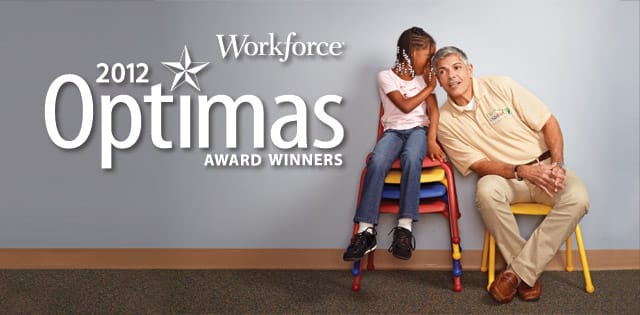
Workforce Presents the 2012 Optimas Award Winners

We are pleased to announce the winners of the 2012 Optimas Awards for exemplary achievements in workforce management. It has been a challenging time for many of our winners, which have found innovative ways to do more with less and meet the demands of a changing economy head on. For A to Z Machine Co., a manufacturer based in Wisconsin, the dearth of skilled workers led company leaders to partner with local high schools in promoting a youth apprenticeship program.

At Sodexo Inc., where diversity is a top priority, the fact that most minorities access the Internet through their phones sparked the development of a job-search mobile phone app. Another Optimas winner, Etisalat Misr, Egypt’s third-largest mobile network operator, managed to both cut costs and improve morale during a time of political and economic turmoil.

This year’s winner for General Excellence is ChildNet, a not-for-profit child-welfare agency in Florida that accomplished a dramatic turnaround in its culture and finances thanks to a series of initiatives to improve employee morale.

We congratulate all the winners for their efforts and their bottom-line results, and we encourage companies with innovative workplace management strategies to enter next year’s Optimas competition. (See competition details at workforce.com/optimas.)

Workforce Management, November 2012, p. 24 — Subscribe Now!

Posted on November 1, 2012August 6, 2018

Alliant Techsystems Inc.: Optimas Award Winner for Innovation

When more than half the jobs at your company require expertise so specialized that in some cases only one or two employees possess it, retaining workers becomes a unique challenge requiring an innovative approach. For weapons-maker Alliant Techsystems Inc., the answer is in the data.

The company, which is also known as ATK, has developed a flight-risk model using human resources data such as an employee’s age, tenure and marital status to predict which workers might leave because of retirement or for other opportunities. The initiative began in January 2010 at ATK’s Radford, Virginia, location, which employs about 1,200 people. In 2012 the program was rolled out to the company’s three divisions: aerospace, defense and sporting, says Cory Edmonds, manager of compensation and workforce analytics for the Minnesota-based firm’s 15,000 employees.

ATK is teaching managers and HR team members how to use the data to address talent management challenges. ATK is a leader in this area and was profiled in the March 2011 issue of Workforce Management. Edmonds says that the publicity generated some interest among the company’s HR professionals, but some managers were skeptical.

“The impression was that this is too theoretical,” he says. “Some got it right away, but others could not see that this had a direct impact on the business. We’re trying to educate managers and make the results more available to the HR community so they can start using it.”

Edmonds says that the system is fully automated and refreshed daily.

The information is also used to create a quarterly flight-risk report alerting managers to the number of employees who might leave during a specific time period. The goal of the project is to reduce costs through more effective talent management.

“You can get information on why people are leaving, but at that point they’re already gone,” Edmonds says. “The next step is predicting employee engagement. It’s about trying to make the correlation between engagement and business outcomes.”

For its pioneering work in using analytics to manage workforce issues, ATK is the 2012 winner of the Optimas Award for Innovation.

Rita Pyrillis is Workforce’s senior writer. Comment below or email editors@workforce.com.

Workforce Management, November 2012, p. 28 — Subscribe Now!

Posted on October 31, 2012August 6, 2018

Emergency Room Physician is Independent Contractor, Cannot Pursue Bias Claims: Court

A “balance of actors” indicate an emergency room physician was an independent contractor and not an employee, and she therefore cannot pursue her discrimination claims, said a federal appellate court in a ruling Wednesday.

Dr. Pooneh Hendi Glascock, a female physician of Iranian origin, had contracted with Cedar Rapids, Iowa-based Linn County Emergency Medicine P.C. to provide emergency medical services at Mercy Medical Center in 2007, according to the ruling in Pooneh Hendi Glascock v. Linn County Emergency Medicine P.C. by the 8th U.S. Circuit Court of Appeals in St. Louis.

The agreement with the physician group was to last one year and renewed for an additional year unless terminated by either party with 90 days’ notice. It provided Glascock would be offered an ownership position in the firm after one year of satisfactory performance and upon approval by a majority of the firm’s owners, said the ruling.

The firm provided professional liability insurance for Glascock, but no benefits or vacation pay. It guaranteed 15 shifts per month and an hourly rate of $130, among other provisions, but gave the physician group no “control or direction over the method or manner” in which she performed her professional services and duties, the ruling said.

Glascock charged that throughout her relationship with the group she was subjected to ongoing sexual harassment by other group physicians, including being called a “princess,” “cutie” and “babe,” as well as disparaging remarks about pregnancy. Group shareholders also allegedly made disparaging remarks about her national origin.

At the end of her first year, the clinic’s shareholders voted not to extend to her an ownership interest, but instead gave her a six-month probationary term. During the last week of her probationary term, she told the firm she was pregnant, and the shareholders subsequently voted to terminate her.

Glascock filed suit against the group under Title VII of the Civil Rights Act of 1964 and Iowa state law, charging discrimination on the basis of sex, pregnancy and national origin. A district court granted the group’s motion to dismiss the case.

“To determine whether a hired individual is an employee or an independent contractor, we primarily consider whether the hiring party was able to ‘control the manner and means by which a task is accomplished,'” said the 8th Circuit, in quoting the U.S. Supreme Court’s 1992 ruling in Nationwide Mutual Insurance Co. v. Darden.

Although evidence supporting the issue of control is “inconclusive” in this case, though, a number of factors in the Darden case “support a conclusion that Glascock was an independent contractor,” said a three-judge panel. Among these was that she received no benefits from the group, paid her own self-employment taxes and was licensed at her own expense.”

“Other factors which might favor employee status in this case are fewer in number and less in weight than those favoring independent contractor status,” said the court, in affirming the lower court’s ruling dismissing the case.

Judy Greenwald writes for Business Insurance, a sister publication of Workforce Management. Comment below or email editors@workforce.com.

Stay informed and connected. Get human resources news and HR features via Workforce Management’s Twitter feed or RSS feeds for mobile devices and news readers.

Posted on October 31, 2012August 6, 2018

How Do We Change Job Titles Fairly?

Dear Title Fight:

Job titling is usually fraught with risks. However, there are really two issues you need to address.

The first relates to the relative level of internal responsibility. The second issue is centered on compensation and external market competitiveness.

Internal levels of responsibility: It’s OK to have two different titles within the same salary grade. It doesn’t matter if the titles carry different levels of perceived authority or responsibility. What matters is that human resources and leadership have a defined and specific set of criteria for these positions.

Levels can be set, maintained and realigned as needed, using factors such as: the scope of a leader’s decision-making, the impact of those decisions on the organization, breadth of management, functional or subject-matter leadership. Factors such as years of experience and reporting relationships are marginal to the analysis. Numbers of direct or indirect reports and salaries should be irrelevant.

Make sure your criteria are specific enough so that one manager doesn’t report to another manager who occupies the identical grade level (such as a department head). These guidelines should determine the most appropriate titles for people, based on their level in your organization.

Compensation and market competitiveness add further complexity. The market value of a job typically determines where a job is placed, relative to grade. This helps you set the actual pay. Use appropriate and selective market data as you develop pay ranges.

However, pay ranges typically address only base compensation. Having two management positions in the same pay range is thus not only fine, but may be appropriate from the standpoint of the competitive labor market.

Keep in mind that a job grade affects its base pay only. It does not necessarily dictate how you handle other compensation elements, such as participation in bonus plans, eligibility for stock options or long-term incentive programs, and executive perks.

Instead, these elements can be defined based on grade, title, level in the organization, or any other relevant factor. Just as your firm will have a set of criteria for internal levels, it ought to have a set of criteria for participation in compensation programs. This avoids inequities or anomalies. Defined criteria will provide clarity around these decisions and enhance transparency.

SOURCE: Bob Fulton, The Pathfinder’s Group Inc., Chicago

LEARN MORE: Please read here for more information on this topic.

The information contained in this article is intended to provide useful information on the topic covered, but should not be construed as legal advice or a legal opinion. Also remember that state laws may differ from the federal law.

Posted on October 31, 2012August 6, 2018

How Do We Measure Innovation, Loyalty and Other Abstract Concepts?

Dear In Search of Answers:

Congratulations on having employees who work hard, care about the company and strive to do well. This is the definition of a fully engaged workforce. Whatever you are doing, keep doing it.

Though I do understand your desire, abstractions/feelings such as commitment and loyalty cannot be made concrete nor be accurately measured. Attempts to do so actually have a negative effect on performance. When you hold someone to a nebulous ideal, you inadvertently set him/her up to fail and you build distrust. This lowers commitment. Brainpower is also wasted.

You have concrete performance metrics such as projects completed on time, on or underbudget, safety records, profits, retention, etc. Those are clearly defined and objective. People respect those measures. Think for a moment about the statement: “We need to be more innovative.”

What is that ever going to mean?

Instead, asking “How do we come in underbudget next time?” is more likely to spur innovation and creativity and produce results.

Thusly, if you are measuring so as to increase commitment, innovation and so on, you risk the opposite will occur. The same is true for job competencies and descriptions since they are attempts to control performance rather than inspire it.

Abstracts are driven by a desire to do a better job and being able to exceed the expectations of the marketplace. Leadership fosters this by removing barriers and providing outstanding support—information, tools, training, goals/objectives, discipline, etc. The barrier could be a bad manager, lack of ability or bureaucracy. Finding these requires listening to the questions, suggestions and complaints of employees and responding to the satisfaction of employees. This is no small task and it is management’s most important role.

Now, since your management appears to know how to create engaged employees, I recommend you codify their methods. Then create a training program for new executives, managers and supervisors to replicate these actions. And finally, use a trained observer to detect deviations tending to reduce the level of engagement and take corrective action.

Let me end by saying that when management does its job to the absolute highest standard, everyone is going to rise up to meet it. And the difference in performance between disengaged and engaged employees is in the hundreds of percentage.

If you have any questions or need further assistance, don’t hesitate to contact me.

SOURCE: Bennet Simonton, Leadership Science, author of “Leading People to Be Highly Motivated and Committed.”

LEARN MORE: Please read “How Can We Be Certain Our Workers Perform at a High Level?” for tips on driving a high-performance workplace.

The information contained in this article is intended to provide useful information on the topic covered, but should not be construed as legal advice or a legal opinion. Also remember that state laws may differ from the federal law.

Posts navigation

Previous page Page 1 … Page 23 Page 24 Page 25 … Page 45 Next page


Webinars


White Papers


  • Topics

    • Benefits
    • Compensation
    • HR Administration
    • Legal
    • Recruitment
    • Staffing Management
    • Training
    • Technology
    • Workplace Culture
  • Resources

    • Subscribe
    • Current Issue
    • Email Sign Up
    • Contribute
    • Research
    • Awards
    • White Papers
  • Events

    • Upcoming Events
    • Webinars
    • Spotlight Webinars
    • Speakers Bureau
    • Custom Events
  • Follow Us

    • LinkedIn
    • Twitter
    • Facebook
    • YouTube
    • RSS
  • Advertise

    • Editorial Calendar
    • Media Kit
    • Contact a Strategy Consultant
    • Vendor Directory
  • About Us

    • Our Company
    • Our Team
    • Press
    • Contact Us
    • Privacy Policy
    • Terms Of Use
Proudly powered by WordPress