The recently amended ADA is expansive enough to cover most medical conditions. If most medical conditions are covered as disabilities, then most employees with medical conditions will likely, at some point during their tenure, need a reasonable accommodation. One accommodation that the EEOC considers presumptively reasonable is an unpaid leave of absence, even for employers too small to be covered by the FMLA…. If the ADA now covers most employees’ medical issues, and the ADA requires an unpaid leave of absence, hasn’t the ADA swallowed the FMLA, at least as employee medical leaves are concerned?
Last week, the 10th Circuit Court of Appeals clarified that while unpaid medical leaves are a possible reasonable accommodation, no employee is entitled to an indefinite leave of absence.
In Robert v. Board of Cty. Comm’rs of Brown Cty. Kan. (8/28/12), the 10th Circuit concluded that an indefinite leave of absence is per se unreasonable. Catherine Robert, who worked as supervisor of released adult offenders, developed sacroiliac joint dysfunction. After a lengthy leave of absence, including 12 weeks under the FMLA, Robert remained unable to perform all of her required duties—including visiting offenders at their homes or in jail, supervising drug and alcohol screenings, and testifying in court. She sued for disability discrimination following her termination.
In upholding the dismissal of her claim under the ADA, the court focused on the indefinite nature of her leave of absence:
Although site visits and other out-of-office work were an essential function of her position, Robert would be nonetheless qualified if she could have performed those duties with a reasonable accommodation…. In light of Robert’s complete inability to perform site visits at the time of her firing, the only potential accommodation would be a temporary reprieve from this essential function. Our precedents recognize that a brief leave of absence for medical treatment or recovery can be a reasonable accommodation…. There are two limits on the bounds of reasonableness for a leave of absence. The first limit is clear: The employee must provide the employer an estimated date when she can resume her essential duties. Without an expected end date, an employer is unable to determine whether the temporary exemption is a reasonable one. The second is durational. A leave request must assure an employer that an employee can perform the essential functions of her position in the “near future.”
There is no evidence in the record that Robert’s employer had any estimation of the date Robert would resume the fieldwork essential to her position…. As such, the only potential accommodation that would allow Robert to perform the essential functions of her position was an indefinite reprieve from those functions—an accommodation that is unreasonable as a matter of law. For that reason, she was not a qualified individual under the ADA and her claim of discrimination fails.
What does this case mean from a practical standpoint? That an indefinite leave of absence—one from which neither the employee nor his or her doctor can provide a date upon which the employee can return to performing the essential functions of the position—is per se unreasonable under the ADA. On the broader issue—how long of a leave is too long to be reasonable—the court punted. While the court passed on this important issue, it did suggest that six months might be too long, although a hard-cap on a duration of a leave as a reasonable accommodation is a moving target.
If you are granting a leave to an employee as an accommodation, your best defense to a potential ADA claim is to open a dialogue with the employee about a return date, and prepare to be flexible. While an indefinite leave almost always will be unreasonable, what is reasonable will depend on the nature of your business and how the employee’s position fits into your organization. You cannot make this determination without talking to the employee, gathering medical information, and making an informed decision about what works best for your company.
Stebbins’ package includes a $2.4 million cash severance payment and $10.2 million in instantly vested stock awards, according to the filing.
Visteon’s board accelerated vesting of stock awards for Stebbins that were intended to vest in October 2012 and 2013. Those awards were worth $10.2 million at the market’s open today with Visteon shares worth $41.91.
The board, however, canceled 22,266 restricted stock awards for Stebbins that would have vested over the next three years. It also canceled 127,141 shares of restricted stock options for Stebbins.
More than 41,000 shares will remain exercisable by Stebbins over the next year, but the option price is more than $30 higher than its current stock price — meaning the options are essentially worthless.
He could also receive as many as 46,517 shares pro-rated at the end of the fiscal year, depending on company performance. Those shares were worth nearly $2 million at market open today.
The ousted CEO will also maintain company health benefits over the next year and six months of outplacement services totaling no more than $25,000.
Stebbins’ compensation as chairman, president and CEO of the climate control and interiors supplier totaled more than $7.8 million last year and $26.9 million in 2010.
Stebbins joined Visteon in May 2005 as president and chief operating officer and was named CEO in June 2008.
As interim chairman and CEO, Tim Leuliette will receive a cash signing bonus of $500,000 and $95,833.33 monthly base salary. If Leuliette is terminated before March 1, 2013, he will receive a $650,000 in additional salary.
Visteon shares jumped more than 8.5 percent Monday following the announcement of Stebbins’ departure before settling at $41.91 at close. Today the shares fell 3.3 percent to close at $40.63.
It’s a looming battle between HR and procurement over who “owns” contingent labor. And I’m cheering on HR, for the sake of both companies and contingent workers.
For years, procurement departments have largely run the show with respect to temporary workers and independent contractors. Procurement, or purchasing, departments are the company officials responsible for buying the supplies a company needs to operate. These folks are great at pinching pennies. While in charge of contingents, they have put in software systems to cut costs and make it more efficient for managers to order up temporary workers through staffing agencies.
But there’s a downside to letting the people who buy staplers and cubicle furniture also oversee the placement of workers into those cubes.
As John Healy, a vice president at staffing provider Kelly Services notes, managing the contingent workforce is both an art and a science. Procurement has the science down. But they don’t have the art; they don’t have the part down that understands how companies may have to be flexible relating to high-skilled contractors; and they don’t have the part down that understands how to motivate temp workers so they’ll give their best efforts and want to come back.
That art piece is the province of HR.
And that piece is increasingly important as organizations ramp up their use of contingents, and more and more workers—especially those with specialized talents—choose to be free agents. Companies have to pay more attention to the engagement of contingents in order to get the best ones and get better quality work from them.
HR needs to get involved in managing contingent labor, says Jay Lash, a vice president at MBO Enterprise Solutions, a firm that helps organizations manage independent contractors. What’s more, Lash argues, HR officials should get involved soon, while the labor market still favors employers.
“If HR doesn’tget their arms around it now, when talent isn’t in as much demand, they’ll always be playing catch up,” Lash says.
Ideally, there’s a balance here—procurement and HR work things out. But such power-sharing is rarely smooth in real life. Departments set up fiefdoms and don’t want to let go of their turf, so HR probably is going to have to fight to get a piece of the contingent action.
HR pros might be thinking: Why would I want to add something else to my full plate, especially when it means likely getting into an interoffice scrap?
The answer is: That’s the price of leadership. You’ll be battling for a noble cause, a victory that will both make contingents happier and boost your company’s bottom line. So go ahead, HR. Tell procurement to put up its dukes.
Ed Frauenheim is Workforce Management’s senior editor. Comment below or email editors@workforce.com.
A freelance writer and editor based in San Francisco, Wood had worked hard for roughly two months for a client on a book. But she didn’t get invited to a launch party for the book last September—she only learned about the bash by reading a blog post about the event. The exclusion stung both personally and professionally.
“I wrote a quarter of it,” she recalls. “It just makes you feel like they don’t value your contributions.”
In years past, companies might have shrugged off this sort of complaint from a contractor as a minor matter or annoying whining. These days, they would do so at their peril.
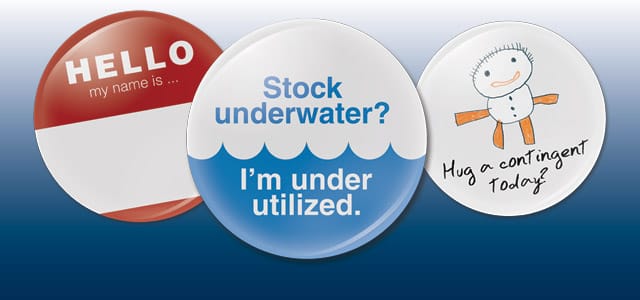
Organizations face a growing need to engage workers such as Wood just as they do their full-time employees to attract the best of contingents, get the best out of them, and preserve a long-term relationship with them. Why? A confluence of reasons. Companies rely more and more on contract and outsourced workers to deliver both their customer experience and strategic initiatives. Increasing amounts of work are going to higher-skilled contingent workers—to professionals such as engineers, graphic artists and nurses—whose talents can be pivotal for organizations. And many of today’s temps and contractors are millennials, an age cohort famous for needing more attention than older generations.
For the past few decades, the corporate agenda regarding temporary workers, contractors and independent consultants has been largely about cost-cutting and legal compliance. But amid greater interest in labor flexibility and a tight market for specialized skills, companies are starting to see contingent quality as key. This concern surfaced in a recent Workforce Management survey of almost 1,200 readers. Asked for their biggest concerns about using contingents, nearly 43 percent of respondents cited “quality of work”—making it the top response.
If companies are going to connect with the best of today’s contingents and elicit their best efforts, a new deal or relationship is in order. That relationship might be called the “arm’s-length embrace.” In it, companies respect contingents’ independence yet nonetheless show them more love—in the form of invitations to social gatherings, improved communication, greater recognition and the like. It also means a partnership approach to pay that includes a fair wage rate rather than a nickel-and-diming approach to free agents.
To be sure, there are categories of contractors and temps where a transactional, cost-conscious, impersonal exchange makes more sense. And attention to contingents cannot eclipse efforts to maximize the engagement and output of the regular workforce. But experts say the smartest companies are paying greater attention to contingent labor as they set overall workforce strategy, and that tighter ties with contingents are increasingly crucial.
So far, companies are giving scant attention to their bonds with contingents. The Workforce survey found that fewer than 30 percent of companies either have a plan to become a client of choice for contingents or are working on one. But wise firms will take relationships with contingent workers more seriously if they want to improve organizational agility, customer service and productivity, argues Brian Kropp, analyst with research firm the Corporate Executive Board.
“Organizations need to rethink their approach,” he says. “If you treat them as ‘hired help,’ then they will behave as ‘hired help.’ ”
Definitions of contingent work vary. But most observers agree the term at the very least encompasses temporary agency workers and independent contractors. The contingent workforce also can include individuals pitching themselves as business consultants. And some analysts argue companies should add in the employees of larger professional services firms who are engaged in project work.
About a decade ago, pundits including author Daniel Pink proclaimed the United States was morphing rapidly into a “free agent nation.” The transformation has proven to be slower than expected. But today free agency and other forms of contingent work are coming to fruition in dramatic fashion. Research firm Aberdeen Group estimates that nearly 26 percent of the average organization’s total workforce is contingent or contract-based. And the irregular workforce is growing quickly. Aberdeen says use of contingent labor has jumped over the past year alone by more than 12 percent.
Fueling the era of impermanent labor are factors including companies’ desire for greater flexibility amid economic uncertainty, the need to access scarce skills and the fact that some high-end professionals are choosing to work independently. That last trend could intensify thanks to the recently upheld federal Patient Protection and Affordable Care Act, which aims to make it easier for individuals to get coverage on their own.
To the extent that they have focused on contingents, companies have concentrated largely on labor costs and legal compliance. Organizations are keen to avoid calling people “temporary workers” or “independent contractors” when they actually qualify as employees. Microsoft Corp.’s landmark $97 million settlement with its “permatemps” in 2000 put the “co-employment” issue on employers’ agendas, and recently the Obama administration has made worker misclassification enforcement a priority.
Saving on labor costs has long been a rationale for using contingent workers, who typically don’t get health or retirement benefits and allow firms to avoid paying employment taxes. Still, a concern for many organizations is that departments and managers hire temps on their own, avoiding oversight and missing opportunities to save money through preferred vendor arrangements.
In part to save costs, industrial-packaging-maker Greif is working to standardize its use of contingent workers. But higher quality also is on the radar screen for Greif, which is based in Delaware, Ohio, and employs some 16,000 people worldwide. Steve Youll, human resources strategic planning analyst for Greif, foresees a future when individuals and small bands of highly skilled people will engage with companies on projects in information technology and other areas. Attracting them, vetting the effectiveness of their work and wooing the good ones back time and again will be crucial, Youll says.
“The HR trend is to look at contingent workers in the same way you look at your regular employees,” Youll says.
As it stands, though, companies tend to look at the two sets of workers quite differently. A key case in point is performance assessment. While most firms track their staffers’ performance in a formal process, contingent quality control is much less consistent, according to the recent Workforce survey. Not surprisingly, the quality of contingents often isn’t great, as indicated by the Workforce survey.
Mediocre or low quality poses a threat to organizations as they turn more and more work over to contingents. And much of that work touches customers directly or indirectly. The Workforce survey found that contingents affect customers’ experience to a moderate or significant extent at 31 percent of organizations. Nonregular employees shaping customer service levels is a growing concern, says the Corporate Executive Board’s Kropp. That is, companies increasingly are relying on their extended workforce to deliver a great experience—whether that’s a security guard, a call center worker or a nurse. “From a customer’s viewpoint, all these people are actually your people,” Kropp says.
Organizations ought to make contingent labor more central to their strategic workforce planning, says Barry Asin, president of Staffing Industry Analysts, a sister organization to Workforce Management. As Asin sees it, firms should “stop setting the contingent part of their workforce to the side.”
To help get their contingent houses in order, companies have purchased software tools called vendor management systems—though these have tended to focus on efficient use of temporary workers rather than quality (see “Tech Talk” below). Organizations also have turned to third-party managed-service providers, or MSPs, which promise to oversee contingent labor operations.
Among such MSP vendors is Kelly Services Inc. John Healy, vice president and talent-supply-chain strategist at Kelly, says MSPs have a responsibility to help clients figure out when to focus on efficiency with contingents and when to be more flexible for the sake of better talent. For example, he says, it may make sense to treat contingent assembly-line workers in a transactional way, because supply of this labor may exceed demand. But workers in more creative or critical roles may require a responsive, high-touch relationship, Healy says. “You have different models,” he adds.
The high-touch model may be especially effective with the legions of young people now in the workforce. Millennials—the roughly 80 million people born from the early 1980s to 2000—tend to want a great deal of guidance on the job. Call it the product of coddling parents or a healthy desire for self-improvement, this hunger for feedback makes it all the more vital for companies to connect with their contingents.
Mary Ann Davids has seen the payoff of a little TLC to young temps. Davids is a performance support specialist at a call center run by a large insurance company. A 16-year veteran at the company with a background in training, Davids took her current job about two years ago when the firm saw quality and attrition problems with its stable of temporary workers—who help handle calls and serve as a pool of candidates for permanent positions.
Before Davids came into the picture, temp-population attrition at the center was running about 95 percent annually. And the service quality of calls handled by temp workers was judged by officials to fall short of the company’s standard. The temps, from a major national staffing firm, have an on-site manager from the agency. But the insurance company put in Davids to beef up the coaching given to the temps. This comes in the form of weekly evaluations and live monitoring of calls.
So far the extra strokes to the youthful temps are paying off. Davids says temp call-service quality now exceeds the company standard, and attrition has plunged to about 25 percent. Davids says her young charges can’t get enough of her comments. “They’re so used to getting some sort of acknowledgement. They crave feedback,” she says. “Some of them will ask me every day, ‘How am I doing?’ ”
Another reason to reach out to temps and free agents is that many of them aren’t there voluntarily. The ranks of contingent workers are made up in part by people who would prefer the steadier work of regular employment. As game as they may be to do a good job, these folks may suffer from an inherent engagement deficit. Offering feedback and appropriate kudos can help fire up their performance.
Even voluntary independents are thirsty for signs that clients recognize their worth and potential. Take Jan Grose. Since 1999, Grose has had a consulting business helping companies with organizational development and HR projects, and she prefers life as an independent contractor.
Still, Grose chafes at the way clients penny pinch rather than value the insight she can bring from many years of experience in the field. For example, she once persuaded a client to consolidate its payroll systems worldwide through regional providers. The suggestion was outside the scope of her work, but she estimates her advice easily saved the client the equivalent of her fee.
“Companies should not be focused on just the rate,” Grose says. But “that’s the first thing they think about.”
Travis Coleman, a technology contractor based in the Seattle area, notes another problem that hurts both companies and contingents: a failure to give contract workers the “big picture” surrounding their assignments. When firms spell out a discrete set of tasks without a sense of the larger purposes of the work or the project’s timeframe, it makes it more likely that contractors will do the bare minimum for the client, Coleman says.
Coleman, who has been working for about a decade as a contractor on computer-support projects for companies including Bank of America Corp., Brio Realty and Microsoft Corp., says he does his best to combat the image of the disengaged contractor by going above and beyond client expectations.
But even he finds it frustrating when organizations do not share information about how a project is proceeding. For example, Coleman hates when, at the end of a week he thought was going well, the client supervisor suddenly reports the project is way behind schedule.
“There’s nothing worse,” he says.
Besides passing key information to contractors, there’s also gathering information from them. If companies want to optimize use of their contingents, they will want to learn about the skills, experience and passions of those impermanent workers. Organizations have begun to develop sophisticated databases about their in-house talent in order to best match assignments with employees. They aren’t as far along with that sort of talent tracking with their armies of contingents.
Consider Wood, the freelance writer. She says her publishing house clients typically don’t know her areas of expertise.
“They don’t do a very good job of finding out what my particular strengths and interests are,” Wood says. That disconnect not only has frustrated her over the years, but also, she believes, has kept clients from getting the most from her talents. Wood says she would never provide less-than-professional services. Still, projects on musicology and food in particular get her juices flowing, which leads to even better results. “I’m going to get much more excited about something that’s up my alley,” Wood says.
Overall, though, Wood says she has it good as a free agent. She treasures the flexibility, the lack of office politics and the diversity of assignments that come with working independently.
And sometimes clients do include her in fun, professionally helpful events. The same client that didn’t invite her to the party last year made up for it more recently. The organization flew her and other freelancers to New York, put them up in a hotel, talked about future strategy and took them out to a fancy dinner. “This client generally does the right things,” Wood says. The “right things” like involving key free agents in occasional strategy discussions and taking them out to dinner once in a while are likely to pay off for companies too—in the form of fresh ideas, increased loyalty and extra effort.
What Wood and many other contingent workers want is to remain independent yet grow closer to clients. To feel a sense of inclusion, even if at a distance. The arms-length embrace. It promises to warm the hearts of contingents and business executives alike.
Workforce Management, August 2012, pgs. 34-39 — Subscribe Now!
Six men received lengthy prison sentences and were ordered to pay $5.0 million in restitution for defrauding 42 staffing firms, the U.S. Attorney’s Office for the District of Colorado reported. Five of the men received sentences of more than 10 years while a sixth was sentenced to more than seven years.
All six were found guilty in a three-week trial that ended Oct. 20, 2011, with the six representing themselves in court, according to the U.S. Attorney’s Office. Sentencings began last week, and the last sentencing took place July 30.
The six defendants sentenced are:
David Banks, sentenced to 135 months in federal prison
Demetrius Harper, sentenced to 121 months
Gary Walker, sentenced to 135 months
Clinton Stewart, sentenced to 121 months
David Zirpolo, sentenced to 121 months
Kendrick Barnes, sentenced to 87 months
Each defendant was taken into custody after sentencing.
Banks and the co-defendants were developing a software program they claimed would help law enforcement agencies, according to the U.S. Attorney’s Office. They acted through companies known as Leading Team Inc., IRP Solutions Corp.and DKH in Colorado Springs, Colorado.
The six used staffing firms to payroll employees despite having no source of income to pay staffing firms, the U.S. Attorney’s Office reported. In many cases, a defendant would report hours to a staffing firm while another defendant approved those hours for payment by the staffing firm.
The incidents occurred from October 2002 to February 2005, according to the indictment in the case.
When staffing firms billed the defendants’ firms, they did not receive payment, according to the U.S. Attorney’s Office. The scheme also included submitting time cards containing false information to staffing firms.
Defendants defrauded staffing firms of $5.1 million, the U.S. Attorney’s Office reported.
“The sentences handed down to these defendants appropriately reflect the seriousness of the specific crimes they committed,” said FBI Denver Special Agent in Charge James Yacone. “The number of victims and amount of loss were significant. Hopefully, this will serve as a deterrent to others contemplating such crimes in the future.”
Filed by Staffing Industry Analysts, a sister company of Workforce Management. To comment, email editors@workforce.com.
In February, Oracle Corp. muscled its way into the cloud-based talent management industry by purchasing Taleo Corp. for $1.9 billion. One of many major acquisitions in the human capital management, or HCM, world this year, the move heralded Oracle’s commitment to ramping up its cloud computing infrastructure and tapping into the innovative products that smaller, more-flexible HCM vendors are offering.
It was a good move for the company, according to analyst R “Ray” Wang of Constellation Research. “Oracle was weak in the Strategic HCM space,” Wang says. “Taleo plays a key role in fulfilling this missing product line.”
The Taleo suite includes recruiting and onboarding, performance management and goal-setting, compensation, succession, and learning and development features. These tools, sometimes called “talent management applications,” are considered more strategic to companies than administrative applications such as employee record-keeping systems and benefits management software.
Oracles executives seem to agree. “Human capital management has become a strategic initiative for organizations,” says Thomas Kurian, executive vice president of Oracle product development, in a written statement when the acquisition was announced in February. He added that Taleo’s talent management cloud technology would be “an important addition to the Oracle Public Cloud.”
Cloud computing, sometimes called software as a service, or SaaS, refers to business applications delivered over the Internet and paid for on a subscription basis. It stands in contrast to the on-premise delivery approach that Oracle and SAP have used for years, whereby customers buy a license to use the software and install it on their own machines. Computing in the cloud is seen as allowing for faster implementations and fewer maintenance hassles compared with the on-premises method.
For years, Oracle scoffed at the benefits of cloud computing, with CEO Larry Ellison referring to it as merely a passing trend, back in 2008. However, the purchase of Taleo, along with cloud-based software provider RightNow in October 2011, signaled a change in opinion for Oracle, and has helped catapult the company from a laggard to a leader in cloud-based offerings.
In his June earnings conference, Ellison announced that Oracle is set to become the second-largest SaaS company in the world, behind Salesforce.com Inc., with a projected $1 billion in bookings this year. Much of this growth is being attributed to the company’s acquisition of cloud-based companies, and its promises to merge their tools with its Fusion Human Capital Management software.
In June, Oracle finally unveiled its much-touted and long-awaited Public Cloud offering, with a suite of more than 100 Fusion applications, including apps for financials, procurement, project portfolio management, and governance, risk and compliance, along with several human capital management applications.
“The main thing now is to see where Taleo fits into that suite,” Wang says. Oracle hasn’t yet stated which apps, if any, include the Taleo technology.
Analysts are also watching to see which key Taleo execs will jump ship in the wake of the acquisition. Taleo CEO Michael Gregoire left the company in May, according to his LinkedIn page. And in June Taleo lost two marketing executives—chief marketing officer Shail Khiyara who joined Spigit, a social innovation software and services firm; and Caroline Japic, former vice president of marketing who was hired by Bunchball, a gamification company. Taleo has also lost a smattering of sales and management people in the past few months, but Wang says these losses are neither surprising nor critical.
“Oracle tends to quickly consolidate overhead in the name of shareholder value, and once knowledge transfer has occurred, they eliminate redundancy,” Wang says. “If Oracle manages to keep 70 to 80 percent of the people they want, they will be happy, and it appears that most of the people they want will stay.”
Sarah Fister Gale is a freelance writer based in the Chicago area. Comment below or email editors@workforce.com.
Small and medium sized companies can be so focused on core business issues that they overlook one of their most potentially serious and costly issues — human resource compliance.
They often lack the time and resources to build infrastructure and processes that are beyond core business objectives. This is a must-read paper that discusses the top small business compliance concerns.
You entered into business to sell a product or provide a service, and generate revenue doing what you do best.
But HR is a necessity when you have employees. What could be better than taking a piece of your business and making it somebody else’s problem? This is what a PEO can provide and in this paper you’ll learn about all the benefits partnering with one provides.
Over the past 90 years, scores of people have changed human resources. But one of the most influential is clearly Edward N. “Ned” Hay, who not only founded the consulting firm Hay Group in 1943 but also served as publisher of Personnel Journal, the predecessor of today’s Workforce Management magazine. He held the post from 1947 through 1958.
Hay took over as publisher and editor of the Personnel Journal when Charles Slocombe died in December 1946. In February 1947, the Journal announced Slocombe’s death with a brief note at the bottom from Hay saying: “Arrangements are being made to continue publication of the Personnel Journal in its present form with the same editorial policy. Pending completion of these plans, I have been asked to become temporary editor.”
That’s how it began, but it certainly was not how it would end.
Hay’s legacy is profound. “He saw that the people side of management was neglected and underdeveloped,” points out Jim Bowers, a vice president at Hay Group. As a result, Hay laid the foundation for a radically different type of human resources. He was a pioneer in using job evaluations to determine an employee’s value and pay. “Prior to this, simple market pricing on job title comparisons was the primary tool,” Bowers says.
Hay’s stint at Personnel Journal helped infuse these ideas into the collective consciousness of a rapidly evolving business world. He put many of these concepts—centering heavily on rewards, talent development, organizational effectiveness and workforce engagement—into action while at Hay Group.
“The most successful companies of the future will be the ones that take full advantage of improved personnel techniques,” he once wrote.
Hay died in 1958, and his wife, Doris “D.D.” Hay, briefly served as editor of Personnel Journal in 1960.
Samuel Greengard is a writer based in West Linn, Oregon. Comment below or email editors@workforce.com.
If you are addressing pay, then an overall rating probably makes sense. However, the best way to allocate base salary is to determine current pay relative to overall performance. Typically, pay lower in range is reflective of “learning curve” performance, whereas higher pay reflects sustained levels of high performance. Many organizations use a matrix that bases pay increases on performance rating and pay position relative to a standard (e.g., market rate or salary range control point). If this approach is used, some determination of performance is required. Most organizations use between three and five performance categories, with the middle rating defined as meeting full job expectations.
The issue with performance relates to whether it is relative to others or based on absolute standards of performance. For development and performance improvement, it is best based on performance compared with pre-determined standards of performance. If a rating is to be used for pay purposes, it should be relative to others in similar jobs or job categories. This helps avoid the “Lake Wobegone syndrome” in which all employees are deemed above average.
The best practice is using performance appraisals both to boost employee performance and development and to determine pay. However, the one objective often works counter to the other. A person paid low in the range who is developing nicely but who still has things to learn should probably have a bigger increase than a higher-paid person who is meeting full job standards. Therefore, best practice is to assess performance by category relative to an absolute standard for development purposes. And for pay purposes, it should be based on performance relative to where on the development curve a person is and how other employees within this range are paid.
The information contained in this article is intended to provide useful information on the topic covered, but should not be construed as legal advice or a legal opinion. Also remember that state laws may differ from the federal law.


 Organizations face a growing need to engage workers such as Wood just as they do their full-time employees to attract the best of contingents, get the best out of them, and preserve a long-term relationship with them. Why? A confluence of reasons. Companies rely more and more on contract and outsourced workers to deliver both their customer experience and strategic initiatives. Increasing amounts of work are going to higher-skilled contingent workers—to professionals such as engineers, graphic artists and nurses—whose talents can be pivotal for organizations. And many of today’s temps and contractors are millennials, an age cohort famous for needing more attention than older generations.
