Employer review and jobs site Glassdoor named Christian Sutherland-Wong as its new chief executive officer on Monday, Aug. 26. Current Glassdoor CEO and co-founder Robert Hohman will step down but remain with the company as chairman. Both appointments will be effective on Jan. 6, 2020.
Christian Sutherland-Wong, incoming CEO, Glassdoor.
Sutherland-Wong was named Glassdoor president in early 2019 and appointed as the company’s COO in February 2018, overseeing day-to-day operations, strategy and business for Glassdoor. He joined the company in 2015 as vice president and general manager of monetization. Prior to Glassdoor, Sutherland-Wong was LinkedIn’s director of product, managing its premium subscription business, payment platform and API program. He also worked at Bain & Company.
“I am honored and thrilled to lead Glassdoor into our next chapter as we remain focused on achieving our mission of helping people everywhere find a job and company they love,” Sutherland-Wong said in a press release announcing his promotion. “My vision is to build on Glassdoor’s excellence, as a business and as an employer, that Robert has established over the past 12 years.”
Hohman co-founded Glassdoor in 2007 and launched it online in 2008. Employees and job candidates use the site to anonymously post reviews of employers, rate their CEO, share salary information and disclose interview questions. As of 2018, the company reported 59 million unique users per month and 7,000 corporate customers that pay to post job openings and use the company’s employer branding products.
In 2018, Glassdoor was purchased by Japan-based Recruit Holdings for $1.2 billion. Recruit Holdings is also the owner of jobs aggregator Indeed, which it acquired in 2012, as well as job search engine Simply Hired, bought in 2016.
The relationship between a CEO and chief human resources officer is arguably the most unique in the corporate world.
When fostered strategically, the dynamic between the person at the helm of the company and the head of human resources can drive a business to greater heights. However, when that dynamic is one of misalignment or blurred responsibilities, it can singlehandedly take an organization down unproductive paths.
Many key executives report directly to the CEO — for example, the chief financial officer. This is typically someone with a highly specialized background in finance who has grown through the management ranks into the executive level.
When CEOs and CFOs interact, the dynamic is one where the CEO relies heavily on a CFO’s extensive knowledge of financial best practices. The CEO sees a clear line between responsibilities for their role and the CFO’s role, and understands they must rely on the CFO to ensure financial processes and decisions support the overall strategy.
Oftentimes a CEO’s leadership team is viewed as a three-legged stool between the CEO, CFO and CHRO. Unfortunately, the relationship between the CEO and CHRO is not as clear-cut, causing confusion and frustration.
One study found that only 11 percent of CEOs view their HR chiefs as anticipators, able to forecast talent needs and provide the insights that support business planning. When HR is viewed as reactive and not strategic, CHROs are not given opportunity to demonstrate how their expertise can add value. Too often, this becomes a self-fulfilling prophecy relegating HR to an administrative, rather than strategic, function.
Trusted Adviser
Why are CEO-CFO relationships generally more productive than CEO-CHRO relationships? Many CEOs have spent meaningful time in P&L roles where they’ve gained a strong foundation in sales, marketing, finance and operations. Some have even held significant staff roles in those functions.
Very few have ever rotated through HR. Ironically, many CEOs fancy themselves as HR experts with an innate ability to identify, select and develop talent. Some do excel at this, but many do not. It’s a delicate situation for CHROs to address. It takes courage, finesse and credibility to become a trusted adviser.
Mary Barra, chairman and CEO of General Motors, is a rare example of a CEO who spent meaningful time in HR. From 2009 through 2011, Barra served as vice president, global human resources. Her earlier experience included stints in engineering, manufacturing and product development. Shortly after becoming CEO, Barra took a page out of her HR playbook when she decided to change GM’s archaic 10-page dress code policy to two words: “Dress Appropriately.”
On the surface, this might appear to be a mundane issue for a CEO to focus on. In reality, it was a brilliant move to send a clear message on empowering people to lead. Ironically, the HR department posed the biggest hurdle.
In a recent article in Entrepreneur, CEOs are said to want four things out of HR: match talent resources with company strategy; help attract the best and brightest; deliver excellence in the onboarding process; and foster employee engagement.
It’s interesting to note that, in Entrepreneur’s above four points, there is no mention of compliance, policies, cost-per-hire or other baseline tactical issues. Over the years, CFOs have earned a “seat at the table” by focusing on the more strategic issues while delegating day-to-day tasks such as accounting, controls and financial reporting. The truly exceptional CHROs have been able to do the same, however, their numbers are few. Many CHROs are still considered by the CEO to be administratively minded, and that’s why they are unable to attain or keep their seat at the table.
Moving Forward Collaboratively
There is another interesting phenomenon in the CEO-CHRO relationship. While most CEOs express a desire to have a strategic CHRO on his or her team, few really understand what that truly means. In some cases, they have had limited interaction with a strategic HR leader and can’t comprehend how that function will impact business. These CEOs often have a difficult time assessing CHRO abilities and actual performance. In other cases, the CEO understands the value of a strategic HR partner, but the organization is not ready for that type of transformational leader.
Naturally, every company has its own unique dynamics that shape the relationships within it, especially between the CEO and the CHRO. Jack Welch, former CEO of GE, is often credited with embracing the value of HR and changing the way the function is viewed. During his tenure as CEO, GE’s CHRO was Bill Conaty who had a great deal of business and financial acumen. As a result, Welch involved Conaty in most major business decisions.
Not every CEO will utilize the HR function to its fullest potential. For those who do, however, the results will be significant assuming the CHRO is up to the task.
It’s been just over 18 months since the National Labor Relations Board decided Boeing Co., perhaps its most significant decision in decades.
It rewrote more than a decade of precedent by overturning its Lutheran Heritage standard regarding when facially neutral employment policies violate the rights of employees to engage in concerted activity protected by section 7 of the National Labor Relations Act.
In Boeing, the board scrapped Lutheran Heritage’s “reasonably construe” test (a work rule violates section 7 if an employee could “reasonably construe” an infringement of their section 7 rights) with a test that balances “asserted business justifications and the invasion of employee rights” by weighing “(i) the nature and extent of the potential impact on NLRA rights, and (ii) legitimate justifications associated with the requirement(s).” It was a huge win for employers drafting and issuing workplace policies.
In applying this balancing, the NLRB announced the three-tiered approach to analyzing the legality of employee handbook and other workplace rules.
Category 1: Rules that are Generally Lawful to Maintain, which, when reasonably interpreted, do not prohibit or interfere with the exercise of rights guaranteed by the Act, or the business justification for which outweighs any potential adverse impact on protected rights
Category 2: Rules Warranting Individualized Scrutiny, which are not obviously lawful or unlawful, and must be evaluated on a case-by-case basis to determine whether the rule would interfere with rights guaranteed by the NLRA, and if so, whether any adverse impact on those rights is outweighed by legitimate justifications.
Category 3: Rules that are Unlawful to Maintain, which are generally unlawful because they would prohibit or limit NLRA-protected conduct, and the adverse impact on the rights guaranteed by the NLRA outweighs any justifications associated with the rule.
Last month, the NLRB Office of General Counsel released its advice memo in Coastal Shower Doors(curiously dated 8/30/2018), which passed judgment on the legality or illegality of 10 different handbook provisions under the Boeing standard.
“Obtaining unauthorized confidential information pertaining to clients or employees.” Lawful Category 1 confidentiality rule.
“Rude, discourteous or unbusinesslike behavior; creating a disturbance on Company premises or creating discord with clients or fellow employees.” Lawful Category 1 civility/disruptive-behavior policy.
“Soliciting, collecting money, or distributing bills or pamphlets on Company property by employees during non-working time, including rest and meal periods, is not restricted so long as such activity is in good taste.” Lawful Category 1 solicitation/distribution policy.
“Un-business-like conduct, on or off Company premises, which adversely affects the Company services, property, reputation or goodwill in the community, or interferes with work.” Lawful Category 1 on-duty conduct rule, and lawful Category 2 off-duty conduct rule.
“… all information gathered by, retained or generated by the Company is confidential. There shall be no disclosure of any confidential information to anyone outside the Company without the appropriate authorization. . . . nothing in this policy is intended to infringe upon employee rights under Section Seven (7) of the National Labor Relations Act (NLRA).” Unlawful Category 3 rule.
“Disparaging, abusive, profane, or offensive language (materials that would adversely or negatively reflect upon the Company or be contrary to the Company best interests) and any illegal activities—including piracy, cracking, extortion, blackmail, copyright infringement, and unauthorized access to any computers on the Internet or email—are forbidden.” Lawful Category 1 civility and on-duty misconduct rule.
“Employees should refrain from posting derogatory information about the Company on any such sites and proceed with any grievances or complaints through the normal channels.” Unlawful Category 3 rule.
“Employees may not post any statements, photographs, video, or audio that reasonably could be viewed as disparaging to employees.” Lawful Category 1 civility rule.
“Employees may not post to any on-line forums … providing any Company telephone number or extension. Do not create a link from any personal blog, website or other social networking site to a Company website without identifying oneself as an employee of the Company.” Part lawful Category 1 rule (as to self-identification) , and part unlawful Category 2 rule (as to telephone number ban).
“The use of personal cell phones or other mobile devices is prohibited during working hours for personal use, including phone calls, texting and downloading of web content.” Unlawful Category 2 rule.
This memo, which delves into a lot more detail on each of the 10 policies, is required reading for anyone drafting, rewriting or reviewing an employee handbook, and offers great insight into how the NLRB will judge policies under its relatively new Boeing test.
Mitsubishi Motors North America, Inc. announced the promotion of Angie O’Leary to the newly created position of vice president and chief human resources officer.
Angie O’Leary (Photo courtesy Mitsubishi Motors North America)
O’Leary joined Mitsubishi in 1988 and has held positions in all functions of human resources at the Cypress, California-based automaker, including management roles in HR systems, compensation, benefits, organizational development and training. Prior to her promotion, she was director of human resources and corporate services.
“Since I joined Mitsubishi Motors North America in April of 2018, one of my highest priorities was to build a world-class executive leadership team that would drive the rapid reinvention of Mitsubishi Motors in the U.S.,” said Fred Diaz, president and CEO of Mitsubishi Motors North America, in a press statement.
O’Leary was promoted along with a new general counsel for the company, a move that Diaz said was done with customers in mind. “These promotions add to an enviable group of leaders who are not afraid to challenge perceptions, question everything, and fight to make Mitsubishi Motors a great place to work,” he said in the same press release.
Mitsubishi Motors North America, a part of the Renault-Nissan-Mitsubishi Alliance of automakers, is responsible for sales, research and development, marketing and customer services for all Mitsubishi vehicles in the United States. The company will be relocating its headquarters from its Orange County home of 31 years to Franklin, Tennessee in 2019 to lower operating costs and be closer to the U.S. headquarters of alliance partners Nissan and Renault, according to a report in the Orange County Register.
It’s no secret that HR pros face a broad range of challenges every day.
And if, like me, you were waiting to hear the broad range of topics that the world’s largest HR association is addressing from the organization’s CEO as the first full day of the Society for Human Resource Management’s annual confab dawned in Las Vegas, you were probably pretty disappointed.
That said, if you were eager to hear about the untapped talent pool consisting of the formerly incarcerated, people living with disabilities, veterans, and those people considered to be too old for the workplace, well, spending a little time at the general session Monday morning in the Las Vegas Convention Center was your little slice of heaven.
SHRM CEO Johnny C. Taylor Jr.’s mini-keynoter before the real keynoter Brene Brown didn’t shed new light on the direction of his 300,000-member-plus association’s present or future. He skirted any potential controversies and closely stuck to the message of building a more inclusive, diverse and empathetic workplace. It was a valuable message, no doubt.
SHRM CEO Johnny C. Taylor
At times I felt like I was at a political rally. It’s clear that Taylor knows how to stoke an emotional response with videos and people’s up-close and personal stories. Taylor introduced four people representing underutilized pools of workplace talent to emphasize his signature push to put these people back in the workplace.
Taylor also reminded us that overlooking these potential employees not only causes them a disservice but tears at the “very social fabric” and causes harm for generations.
“Workplaces are where real social services begins,” Taylor said.
Taylor also noted that HR’s expanding role in talent acquisition is to remember that those who do not think, walk or talk like us deserve dignity of work. “As stewards we play huge role not keeping out wrong people but bringing in the right people,” Taylor said.
Then came a quick video set in a courtroom. The criminal was guilty and sentenced to life in prison.
That led to Alice M. Johnson, whose life sentence was commuted by President Trump after a push by Kim Kardashian, to walk onstage. Johnson, now an author, briefly and passionately told her story and offered a moving example of the second chance movement.
“There are so many more like me who are not so fortunate after serving their debt,” she said. “They were shut out and they only want to find their purpose in the dignity of work. HR pros like you can stop the cycle of poverty, you create a better world.” Her talk understandably drew a large round of applause.
Alice M. Johnson, whose life sentence was commuted by President Trump, was a surprise guest during Johnny C. Taylor’s keynote speech. SHRM photo.
“Millions are waiting for opportunities,” Taylor said. “Put biases aside. They’re not just charity cases, nor superheroes. They need an opportunity. They can become leaders, change makers.”
Taylor followed up by introducing three people with physical disabilities.
Taylor called them ambassadors for changing workplaces, adding that people with challenges like mental health and ADHD need to be supported by HR in the workplace.
“We all bring layers of challenges,” Taylor said. “HR has a profound responsibility to do our best to support these people.”
Taylor recognized veterans and then addressed the challenges older workers face by being aged out of the workforce.
“Ageism is illegal and it’s damaging to the bottom line,” Taylor said as a handful of older people dressed in all black formed a semi-circle behind him. It was a bit melodramatic but drove home Taylor’s point.
“We place premium on youth,” he said. “Aging is seen as debilitating. Let these people in. Recruit older workers.”
Taylor then closed his keynote by pounding home the benefits of a diverse workplace. “Different is beautiful,” he exclaimed. “Eliminate discrimination any time we see it.”
While it was a feel-good speech filled with personal examples, Taylor’s 26-minute reminder to hire disadvantaged talent pools was merely an extension of the initiative he launched about this time a year ago at SHRM 2018 in Chicago.
No doubt it was a moving and emotional speech, but if I’m an HR leader I know we face a shortage of talent and that it’s time to get creative with our hiring. And as Taylor implored the assembled crowd to hire these people, all I could think of was the “yes, but …” that was likely running through many SHRM members’ minds — or potentially will be after they return to their workplaces.
Taylor chose to stick to a recurring theme during his one chance to address the assembled SHRM membership. While finding talent is an important topic, HR leaders face a bevy of challenges beyond hiring. Young employees drowning in student debt; soaring health care costs; the #MeToo movement, which unfortunately seems to be yesterday’s news. We also have a president who wants to eliminate the Office of Personnel Management, the federal government’s HR department.Want to advocate for a membership’s cause? My guess is SHRM has a fair portion of OPM employees as members.
Yes, SHRM19 provides plenty of opportunities to air out these issues with cohorts and gather insight during sessions to solve problems back home. But Taylor could have used his half hour setting a broad tone for the conference by touching on several hot-button HR issues rather than polishing what sounded more to me like a political speech on a single topic.
It always seems like there’s a world-class soccer tournament simultaneously playing as the the Society for Human Resource Management opens its annual soiree.
Sure enough, the Women’s World Cup is on in France, and SHRM is opening in Las Vegas. And sure enough, Brazil and France were deadlocked 1-1 in overtime as Sunday’s opening session kicked off.
Timing wise that was fine because we should know who wins by the time Johnny C. Taylor Jr. gives the assembled HR faithful the annual CEO’s state of SHRM. Last year in Chicago, Taylor’s inaugural speech at the Sunday general session was a riveting blend of revival meeting and motivational speech about HR’s growing role in the workplace.
So, let’s check the boxes as we watch the first 20 minutes or so until Taylor speaks.
Huge conference space at the Las Vegas Convention Center? Check.
Record attendance? Oh yes … somewhere north of 20,000 people are here.
Glitz and glamour? Check and check. I mean, the opening act was iLuminate, a deft troupe that blends tech and theater. And the upcoming opening keynote was TV and media personality Martha Stewart.
Score still tied 1-1.
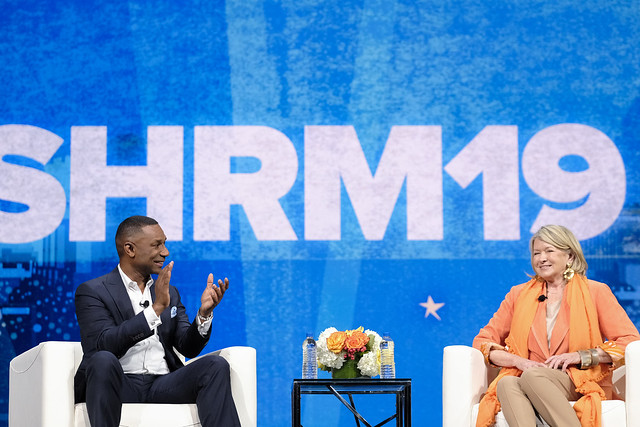
SHRM CEO Johnny C. Taylor with Martha Stewart. SHRM photo.
Event emcee Melissa Dawn Simkins offered up a plug for the SHRM Foundation and we heard about new initiatives — the SHRM Studio and Convos & Coffee, a clever little lounge with a weirdly intuitive floor that asks questions about such things as ageism and diversity of your workplace.
France goes ahead 2-1. Still 7 minutes left. Yikes.
Simkins introduced SHRM Board of Directors Chairman David Windley.
Pleasant enough speech. Windley noted the 20,000 people in attendance this year, 1,400 of whom belong to the public sector and a large number who practice HR internationally.
Windley also noted how people spend a third of lives at work and that there’s a growing level of trust between employees and their employers.
“People are losing trust in institutions but not in their workplaces,” Windley said. “The employer is most trusted — 75 percent more than NGOs, media and government. Employers are the key relationship in peoples’ lives. So we have a serious responsibility,” Windley added.
France still ahead, 2-1; 2 minutes left. Annnnd, I lose the feed. Noooooo ….. .
Oh well, Taylor will be on shortly.
Windley continues about SHRM’s second chance push for formerly incarcerated people and how advisors are on hand at the conference for HR practitioners who want to learn more about what has been Taylor’s signature initiative. And there was polite applause as Windley mentioned companies signing a pledge to give people a second chance in the workplace.
Match over; France advances. Full attention now as Windley concludes his talk.
“Learn, share, go back and build better workplaces for a better world,” Windley said as the assembled crowd applauds.
Behind him people scramble to set up two chairs and a table for the upcoming chat between Taylor and Martha Stewart.
But … out comes Stewart. And Taylor. Big applause.
And my jaw drops. What?!? No Johnny C. Taylor state of SHRM talk? I get a text from a colleague. “No JCT???”
No whipping the crowd into a frenzy over the second chance initiative? No firing up the HR base over building better workplaces?
I mean, the CEO’s talk — whether it was Taylor’s predecessor Hank Jackson or even dating back to Sue Meisinger — occurred Sunday, since it’s the big chance for all SHRM members to hear from their CEO before they begin hitting sessions and the expo hall (not to mention Las Vegas). Instead they get the chairman of the board — and I don’t mean Frank Sinatra.
So, maybe you were happy with Taylor and Stewart kibbutzing for 90 minutes. I thought Stewart was disappointing and all about herself with just a passing mention of her own incarceration. What a great opportunity to forward Taylor’s prime initiative.
Call me a creature of habit. Perhaps if I had read the schedule a bit more closely I would noticed that Taylor is set to give his take on all things HR on Monday morning before keynoter Brene Brown takes the stage.
As one SHRM media person told me, “Johnny likes to mix things up.”
Indeed he does.
So, France moves on to play again. And, it appears, so do the rest of us to hear about SHRM’s current and future state.
A strong international contingent leads the Class of 2019 Workforce Game Changers.
This marks the ninth year of the Game Changers, an awards program designed to recognize those in workforce management under 40 years old who are pushing the field forward with innovative people-management practices.
For the first time in the program’s history, judges selected 40 Workforce Game Changers. While the majority plies their trade in the United States, numerous winners also span the globe, from Nigeria to Norway to Bahrain, as well as several winners from across India.
The thread that ties them together, no matter the nation, is that their efforts engage employees and help their respective companies succeed.
“It’s important that HR not only changes along with the times, but also leads the way — recognizing that any organization’s strongest asset is its people. We applaud these HR professionals for taking the initiative to advance workforce management practices around the world,” said Rick Bell, Workforce editorial director.
Judges selected the Game Changers in part based on the nominees’ ability to drive measurable results within their organizations.
Much like past winners, this group of workforce management practitioners and strategists in human resources-related fields — all under 40 years old — didn’t focus their efforts on a single industry trend. In each instance, the Game Changer worked to incite change in a field that is often bogged down by protocol and leaders content with the way things have always been done.
Congratulations to all the winners. In alphabetical order the 2019 Workforce Game Changers are:
Bilal Ali
Head of HR, Sharif Group, Manama, Bahrain
Alycia Angle
Senior Talent Management Consultant, Ochsner Health System, New Orleans
Ebru Arslan
HR Business Partner, Continental Europe, Kronos, Brussels
Temitope Azeez
People Director, Jumia Global, Ikeja, Nigeria
Patricia Bagsby
Vice President, Organizational Consulting, Psychological Associates, St. Louis
Samina Banu
Specialist HR Senior Manager-TCS Research & Innovation, TCS, Mumbai, India
Valentina Baratta
Senior Manager, Human Resources, Kronos, Montreal
Rebecca Bettencourt
Corporate Workforce Planning and Training Senior Program Manager, E & J. Gallo Winery, Modesto, California
Jennifer Beyer
Global Employer Brand Manager, MicroStrategy, Tysons Corner, Virginia
Nearly a decade ago a well-intentioned group of HR leaders banded together to dispute several Society for Human Resource Management policies.
Not just some radical fringe group, the SHRM Members for Transparency questioned issues tarnishing the organization’s integrity, from doubling board members’ annual honoraria to allowing reimbursement for business-class travel to wanting more board members who carried HR credentials.
These veteran HR leaders had the pull to garner media attention as well as that of SHRM’s membership. And that caught SHRM’s attention. For a while, anyway.
Fast-forward to 2019 and we find a loose-knit group of today’s HR professionals taking to social media to dispute SHRM’s ties with the Trump administration and relationships with politically conservative companies, most notably the right-leaning Koch Industries. Like the transparency group, these are issues they believe harm SHRM’s reputation and mission. The objectors call themselves #fixitSHRM.
As we approach SHRM 2019 in mid-June in Las Vegas, #fixitSHRM’s protests aren’t aimed so much at internal SHRM policies as the perception of what SHRM represents.
The #fixitSHRM movement traces back to last August when relative unknown HR practitioner Victorio Milian originated the hashtag. Later that fall he fired off a string of tweets explaining the hashtag’s purpose to protest SHRM CEO Johnny C. Taylor Jr. and SHRM leadership embracing the “white supremacist Republican administration.”
Illustrated by a smiling Taylor — now in his second year as SHRM’s CEO — shaking hands with President Trump, Milian’s tweets continued, saying, “@johnnyctaylorjr shaking the current U.S. President’s hand was the spark that lit the #fixitSHRM movement. @SHRM’s ongoing silence to its members who are (rightfully, in my opinion), angry and disappointed about this alliance continues to keep the fire burning. … In my opinion, @SHRM’s alliance does not represent the ethical leadership that #HRpros should be demonstrating.”
Milian’s movement has garnered plenty of online support. Among many others, @k_boulder tweeted in mid-April, “Altered videos to promote racist tropes fanning the flames of hatred, & direction to underlings to break the law, promising no consequences. Ready to renounce this partnership yet, SHRM? #fixitSHRM”.
<blockquote class=”twitter-tweet”><p lang=”en” dir=”ltr”>Altered videos to promote racist tropes fanning the flames of hatred, & direction to underlings to break the law, promising no consequences. Ready to renounce this partnership yet, SHRM? <a href=”https://twitter.com/hashtag/fixitshrm?src=hash&ref_src=twsrc%5Etfw”>#fixitshrm</a></p>— Kelly (@k_boulder) <a href=”https://twitter.com/k_boulder/status/1117042317653757952?ref_src=twsrc%5Etfw”>April 13, 2019</a></blockquote> <script async src=”https://platform.twitter.com/widgets.js” charset=”utf-8″></script>
It’s also caught SHRM’s attention to the extent where Taylor doubled down on affirming SHRM’s relationship with the Trump administration as well as SHRM’s affiliation with Koch Industries, according to HRDive.
That doesn’t necessarily bode well for #fixitSHRM’s quest. Still, questioning the motives of SHRM’s relationship with those who do not share or represent their values — and in the larger picture the values HR should practice in every workplace — is inherently a good thing.
I get their frustration. The Trump administration has done most everything you don’t want in a company: constant turmoil and turnover among senior leadership, shunning of D&I, and if recent reports are true, attempting to dismantle the Office of Personnel Management, the federal government’s HR department for civilian employees.
And your HR association is complicit with that? I’d be angry, too.
Taylor’s response though makes it clear that sniping through social media won’t change anything, especially with the 800-pound gorilla known as SHRM. They won’t alter relationships because a social media crusade dislikes their ties with the Trump administration and a financial deal with Koch Industries. I’d also wager that a majority of SHRM members either don’t care, are completely oblivious or actually agree with SHRM’s business dealings.
That means #fixitSHRM’s options to modify SHRM’s operations are limited. But history may hold lessons that could offer them hope for change.
The transparency group had the presence and panache to draw SHRM into two meetings. SHRM then abruptly chose to stop meeting. One transparency group member told Workforce at the time, “Their tactic was delay, delay, delay. We realized that they weren’t going to change.” Disappointing, but if #fixitSHRM is serious they can still push for face time. It’s happened before.
If you can’t get SHRM’s attention in the board room, there’s always the ballot box.
Muster a slate of candidates, continue your barrage on social media and get out the vote. It’s a long shot. And FYI, the transparency group’s candidates never achieved its goal.
History offers a sobering realization that it will take more than a social media campaign to create change. Study the past, #fixitSHRM. Blend it with what you know and perhaps you’ll succeed where Members for Transparency couldn’t.
A group led by Australian technology entrepreneur Tasmin Trezise acquired Chicago-based Human Capital Media, the parent company of business-to-business publications Workforce, Chief Learning Officer and Talent Economy.
Trezise, 26, is the co-owner of Brisbane, Australia-based Tanda, a 7-year-old technology firm that produces time and attendance, scheduling and labor-compliance software.
“I look forward to working with the team as we continue to uphold the dignity, research and empowerment of the working man and woman,” Trezise said.
The Human Capital Media entities will operate separately from Tanda with a shared ownership, said Trezise, who will be president of Workforce, a multimedia publication that covers the intersection of people management and business strategy. Kevin Simpson will remain president of all other Human Capital Media properties, Trezise said.
“This is about serving the Workforce mission of bringing together HR, learning, engineering, research and stakeholders in the success of working people and I put the call out for them to join us,” Trezise said. “The vision is to deliver on my promise to resurrect the Workforce history and continue its rightful position as the ultimate source for how the way we work is changing.”
He pointed to the long history of Workforce as inspiration for its planned future. The publication’s history dates back to 1922 with the founding principles laid out by James R. Angell, former president of Yale University, Carnegie Corp. and the National Research Council, to coordinate the efforts of over 250 scientific, engineering, labor, management and educational bodies. Trezise aims to shape Workforce into the clearinghouse for the most advanced thinking and solutions on the future of work; and how to improve the happiness, welfare and efficiency of workers.
“I want to bring my background and experience to carry on the mission that was first formulated in 1922,” he said. “This means reuniting all engineering and technological bodies with critical research to help people leaders better connect and pursue the application of this knowledge for the benefit of their teams.”
Founded in 1999, Human Capital Media is an integrated information services and market intelligence company whose brands include Human Capital Media Research and Advisory Services, and Chief Learning Officer and Workforce magazines. Terms of the private deal, which closed April 30, were not disclosed.
Tinsley was so stressed that even something as simple as her co-workers at Caterpillar Financial Services bouncing stress balls off the ground would trigger her post-traumatic stress disorder.
Tinsley, who worked as a business system analyst for Caterpillar Financial, believed that the stress of her job was causing her to suffer adverse health issues. She emailed her supervisor, Paul Kaikaris, asking to be removed from a particular project, claiming that her “many [work] responsibilities … [were] causing [her] to be stressed beyond what [she was] physically able to handle,” which “negatively impact[ed her] work, sleep, and overall health.”
Kaikaris met with Tinsley and said he would see what he could do to take work off her plate. Six days later, however, Tinsey submitted a doctor’s note requesting four days off for a “confidential medical condition.” Upon her return, Kaikaris, good to his word, met with her and reassigned some of her projects.
Her job performance, however, continued to suffer. Kaikaris informed Tinsley that she was not following the prescribed methodology for completing her work, the quality of her work was subpar, and she had been leaving work early without prior approval. A poor formal mid-year review and a performance improvement plan followed.
In response, Tinsley claimed that Kaikaris rated her poorly and assigned the PIP in retaliation for her complaints that he had enabled a “hostile work environment” by permitting co-workers to bounce stress balls off the ground. Thereafter, Tinsley began submitting doctors’ notes ad seriatum requesting more time off for “mental and emotional duress brought on by an over-excessive workload, unrealistic deadlines, a hostile work environment and a manager’s reckless indifference to [her] mental and emotional well-being.” Those notes culminated in the company granting a five-week FMLA leave of absence.
At the end of Tinsley’s FMLA leave, her doctor cleared her to return to work “at full capacity.” However, because of her “post-traumatic stress disorder,” her doctor recommended that Caterpillar Financial return her “in a different work environment and specifically under a different manager.” The company refused the transfer or managerial change, but did permit her to take an additional eight weeks of medical leave (totaling 18 for the year).
At the end of that leave, and with Tinsley still insisting on a new manager, Caterpillar Financial decided that it had enough. It told her that it could not accommodate her “confidential” medical condition and that it did not believe that her request for a transfer to a different supervisor was a reasonable accommodation.
Tinsley has asserted that her impairment (PTSD) impacted only the major life activity of working.… Thus, we must now examine whether Tinsley’s PTSD sufficiently limited her ability to perform a class of jobs or a broad range of jobs. The evidence demonstrates that it did not.… [T]he record is replete with undisputed evidence showing that Tinsley’s issues stemmed directly from Kaikaris’ management style as opposed to the responsibilities of a broad range of jobs. The clearest example of this is when Tinsley told Human Resources that she would be able to continue in the same position so long as she was under the direction of a different supervisor because her disability was triggered by “the way [Kaikaris] managed … with all the balls bouncing.” … Tinsley’s diagnosis does not limit her ability to work a broad class of jobs; rather, it relates solely to her ability to work under a specific manager. Accordingly, she is not “disabled” pursuant to the ADA and was thus not entitled to a reasonable accommodation of additional time off or a transfer.
The ADA covers working as a major life activity. However, for an employee to be “substantially limited” in that major life activity, it is not enough to be unable to perform the specific job. The employee must be “significantly restricted in the ability to perform either a class of jobs or a broad range of jobs in various classes as compared to the average person having comparable training, skills, and abilities.”
This court reached the absolute correct result. It wasn’t that Tinsley couldn’t work as a business system analyst but that she just could not work under Kaikaris. Her own doctor said as much when he released her to return to work “at full capacity.”
If faced with a disabled employee claiming a substantial limitation in their ability to work, examine the request carefully. The ADA’s coverage of disabilities is broad. However, it is often difficult for an employee to establish “working” as a substantially limited major life activity. And, unless the employee cannot work in a class or broad range of jobs, the ADA does not cover them and you don’t have to offer to accommodate.