“Onionhead” teaches people to direct their emotions in a truthful and compassionate way.
It is central to the teachings of the Harnessing Happiness Foundation, a 501(c)3 nonprofit organization dedicated to emotional knowledge and intelligence, conflict resolution, and life handling skills.
Onionhead is also central to a religious discrimination lawsuit brought by the EEOC against United Health Programs of America and its parent, Cost Containment Group. The aunt of the defendants’ CEO is the creator of Onionhead.
According to the lawsuit, the defendants required its employees to participate in “group prayers, candle burning, and discussions of spiritual texts,” all as part Onionhead, and fired anyone who refused to participate. The EEOC alleged that Onionhead is a religion, and forcing it upon employees violates Title VII.
Last week, a unanimous Brooklyn federal jury agreed with the EEOC, and awarded 10 employees a total of $5.1 million.
According to EEOC Trial Attorney Charles Coleman, Jr., “This case featured a unique type of religious discrimination, in that the employer was pushing its religion on employees. Nonetheless, Title VII prohibits religious discrimination of this sort and makes what happened at CCG unlawful. Employees cannot be forced to participate in religious activities by their employer.”
He is 100 percent correct. If you’re thinking of holding a prayer meeting, conducting spiritual discussions or rituals, or doing anything else remotely related to religion at your company, don’t. Religion has no place at work. Your intentions may be absolutely pure. Your employees however, have the unfettered right to practice the religion of their choice, or not to practice any religion at all.
Whatever you call your deity — God, Jesus, Jehovah, Jehovah, Allah, Buddah, Krishna … or even Onionhead—leave it at home. The workplace and religion do not mix. An employer cannot force its employees to conform to, follow, or practice, the employer’s chosen religious practices and beliefs. Anything different violates Title VII.
“Give me a head with hair, long beautiful hair Shining, gleaming, steaming, flaxen, waxen Give me down to there hair, shoulder length or longer Here, baby, there, momma, everywhere, daddy, daddy Hair, hair, hair, hair, hair, hair, hair, hair Flow it, show it, long as God can grow it, my hair”
– “Hair”
My recent post about the beauty of baldness got me thinking about hair and employment law.
Or, more to the point, can an employer run afoul of discrimination laws by making an employment decision based on one’s hair style?
The answer is likely no.
Not that employees haven’t tried.
For example, Ewing v. United Parcel Service challenged UPS’s Personal Appearance Guidelines. With respect to hair color those guidelines stated: “Hairstyles and hair color should be worn in a businesslike manner.” Shenitta Ewing, African American, claimed discriminatory enforcement of the policy to prohibit her from coming to work with fuchsia-colored hair. The court disagreed, citing at least four examples of Caucasian employees fired or discipline because of their “extreme” hair colors.
Or consider Viscecchia v. Alrose Allegria LLC, which concerned a hotel’s “hair policy,” which required that hair “be clean, trimmed, well brushed, and neat at all times, prohibited “extreme styles,” and further prohibited the hair of its male employees from landing below the shirt collar. After repeated warnings, the hotel fired Richard Viscecchia for refusing to trim his long hair. He claimed sex discrimination, based on a policy that required men, but not women, to maintain short hair. The court disagreed, holding that gender-differentiated hair length standards do not violate Title VII, and “employers can prescribe different grooming standards for male and female employees.”
Or EEOC v. Catastrophe Management Solutions, which concerned an employer’s blanket prohibition against dreadlocks, and an African-American applicant’s rejected claim that such a policy intentionally discriminates on the basis of race.
One potential exception that could make hair discrimination unlawful is where an employee’s hair style is related to a sincerely held religious belief. In that case, an employer should consider possible reasonable accommodations to avoid a claim of religious discrimination.
Otherwise, to sum up this potentially hairy issue, as long as you are not intentionally targeting one protected group over another, you are free to regulate hair in the workplace.
Jon Hyman is a partner at Meyers, Roman, Friedberg & Lewis in Cleveland. Comment below or email editors@workforce.com. Follow Hyman’s blog at Workforce.com/PracticalEmployer.
Kayla Edwards worked as a cashier for Aramark at its location in Gettysburg National Park.
In February 2017, Edwards became pregnant with her third child.
That’s when her troubles at work began, at least according to Edwards’ lawsuit [pdf] (filed earlier this week in federal court in Pennsylvania).
Immediately upon hearing of the pregnancy, Edwards’ supervisor, Suzanne Curtian, is alleged to have called her “dumb.”
The alleged harassment when downhill from there:
While Edwards was experiencing pregnancy-related complications, Curtian allegedly expressed: “Well hopefully it’s just a tumor or something and you were wrong about the pregnancy. Nothing cancerous, just something they can remove and you can move on.”
As the complications progressed, Curtian allegedly commented, “Maybe you’re miscarrying. If so, that’s just God’s will and what’s best. And then you won’t have to worry about another kid or having to leave [work].”
Approximately nine weeks before Edwards’ scheduled C-section, Curtian allegedly instructed her to “keep [her] legs crossed,” so that she could continue working as long as possible.
Two weeks later, Curtian accused Edwards of theft and fired her.
If you call an employee’s pregnancy a “tumor” and tell her “keep you legs crossed” to remain at work longer, you might be the worst employer of 2018.
Jon Hyman is a partner at Meyers, Roman, Friedberg & Lewis in Cleveland. Comment below or email editors@workforce.com. Follow Hyman’s blog at Workforce.com/PracticalEmployer.
Remember Bailey Davis? She’s the New Orleans Saints cheerleader fired for violating the team’s social media policy.
Her offense? This photo, which she posted to her personal Instagram.
She’s already filed a civil rights complaint, and now she’s speaking out about her alleged discriminatory treatment and discriminatory policies in professional cheerleading in general.
If you think your male employees are “predators,” the answer isn’t to punish your female employees, or apply to them a different set of rules intended to protected them. Instead, you simply should deal with the predators.
I understand that we are talking about professional sports, and the predators are the money makers and meal ticket, but that in no way justifies condoning their behavior, or discriminating against your female employees.
If you weren’t angry about this issue before, you will be now.
Jon Hyman is a partner at Meyers, Roman, Friedberg & Lewis in Cleveland. Comment below or email editors@workforce.com. Follow Hyman’s blog at Workforce.com/PracticalEmployer.
Last week, the Department of Labor Wage and Hour Division resumed its practice of publishing Opinion Letters.
One of the first it published answers an interesting question about the intersection of the FLSA and the FMLA.
Must an employer pay an employee for FMLA-approved breaks taken during the work day?
I’ve taken some journalistic license and paraphrased the questions. The answers, however, are verbatim from the DOL Opinion Letter FLSA2018-19 [pdf]
Q: We have an employee who is on an approved intermittent FMLA leave for back issues. When he experiences a flare-up during the day, his FMLA papers permit him to take an unscheduled break. These breaks typically never last more than 15 minutes, and the employee is able to return to work. Yet, they are occurring eight times per day, resulting in only six hours of work during an eight-hour work day. I know that under the FLSA, breaks of 20 minutes or less must be paid. Yet, FMLA leave is unpaid? What do I do? Which law trumps, FLSA or FMLA? Must I pay this employee for his unscheduled medical breaks during the work day?
A: “The specific FMLA-protected breaks described in your letter, however, differ significantly from ordinary rest breaks commonly provided to employees. As you note in your letter, the 15-minute breaks at issue here ‘are required eight times per day and solely due to the needs of the employee’s serious health condition as required under the FMLA.’ Because the FMLA-protected breaks described in your letter are given to accommodate the employee’s serious health condition, the breaks predominantly benefit the employee and are noncompensable.”
Q: Got it. We don’t have to pay this employee for his FMLA-related breaks. Since he’s already taking two hours of breaks during the work day, I assume we do not have to permit him to take the two paid 15-minute breaks we provide all of our other employees. Right?
A: Wrong. “Employees who take FMLA-protected breaks must receive as many compensable rest breaks as their coworkers receive. For example, if an employer generally allows all of its employees to take two paid 15-minute rest breaks during an 8-hour shift, an employee needing 15-minute rest breaks every hour due to a serious health condition should likewise receive compensation for two 15-minute rest breaks during his or her 8-hour shift.”
Jon Hyman is a partner at Meyers, Roman, Friedberg & Lewis in Cleveland. Comment below or email editors@workforce.com. Follow Hyman’s blog at Workforce.com/PracticalEmployer.
Yesterday, I came across the very cool video for a new Speedy Ortiz song, “Villain.”
The song tackles issue of harassment, assault, and consent.
Rock music has always tackled the important social issues of the times, and #MeToo should be no exception.
Which got me thinking, what are some other songs that take on similar themes and issues? I came up with five.
War on Women, “Say It”
Sublime, “Date Rape”
Camp Cope, “The Face of God”
Bikini Kill, “Liar”
Liz Phair, “F*** and Run”
So what’s on your #MeToo playlist? Share in the comments below, or hit me up on Twitter with the hashtag #MeTooAnthems.
Jon Hyman is a partner at Meyers, Roman, Friedberg & Lewis in Cleveland. Comment below or email editors@workforce.com. Follow Hyman’s blog at Workforce.com/PracticalEmployer.
George Hirmiz, a front-desk clerk at a Travelodge Hotel, was caught on video sleeping in the hotel lobby while a fight broke out among its guests.
After the hotel fired him, he claimed disability discrimination. His disability? An alleged illness that he had contracted from long-term exposure to high levels of electromagnetic voltage at the hotel.
The 7th Circuit had little difficultly affirming the dismissal of his lawsuit:
There is debate in the medical community over whether sensitivity to electromagnetic voltage is a physical disorder or a psychological one.… If it is psychological, the symptoms might not constitute a disorder that would entitle Hirmiz to the protections of the Americans with Disabilities Act. A great deal of psychological distress is trivial — fear of black cats, for example. And indeed the district court found that Hirmiz had provided no evidence — medical or otherwise — that he suffers from any “impairment” that “substantially limits” any of his “major life activities,” as required to prove the existence of a disability under the Americans with Disabilities Act.
I thought of this case after listening to this week’s episode of the Marc Alifanz’s and Dennis Westlind’s Hostile Work Environment Podcast, in which they discussed, with their guests Jon Thurmond and Wendy Dailey, of the HR Social Half Hour Podcast, the story of a job candidate with triskaidekaphobia, who refused to accept a job on the 13th floor of an office building. The solution was to accommodate her in available space on the 14th floor.
I’m not sure whether “sensitivity to electromagnetic voltage” is, or is not, an ADA-protected disability. I’m also not sure what accommodation a hotel can make for night desk clerk who falls asleep on the job.
Regardless, an employer need not take an employee at their word regarding the need for a non-obvious reasonable accommodation.
Some accommodations, and their underlying supporting disabilities, will be obvious (e.g., a leg amputee requesting a chair). In those cases, it would likely be discriminatory to ask for medical documentation.
When the disability and/or the need for accommodation is not obvious, however, an employer is entitled to ask the individual for reasonable documentation about the disability and its functional limitations. According to the EEOC:
The request of the employee must be for “reasonable” documentation. An employer may require only the documentation that is needed to establish that a person has an ADA disability, and that the disability necessitates a reasonable accommodation. It would unreasonable, for example, to request a person’s complete medical records because they are likely to contain information unrelated to the disability at issue and the need for the accommodation.
An employer may require that the documentation come from an appropriate health care or rehabilitation professional, such as doctors (including psychiatrists), psychologists, nurses, physical therapists, occupational therapists, speech therapists, vocational rehabilitation specialists, and licensed mental health professionals. The appropriate professional will vary from case to case, and will depend on the disability and the type of functional limitation it imposes
In requesting documentation, employers should specify the types of information they are seeking regarding the disability, its functional limitations, and the need for reasonable accommodation.
An employer can ask the employee to sign a limited release allowing the employer to submit a list of specific questions to the health care professional.
Our sleeping front desk clerk lost his case because he offered zero medical evidence that his electromagnetic sensitivity was an actual medical condition.
In the case of the triskaidekaphobic applicant, the employer could have requested medical proof that the “condition” was a diagnosed phobia, as opposed to a mere superstition. Or, it could have done what the employer did in that case — ignored the ADA issues entirely and took the path of least resistance by placing the employee in an open spot on a different floor.
The point is that if you are faced with an individual with a non-obvious medical issue, you are within your rights to require that the employee submit reasonable documentation about the disability and its limitations before you engage in the interactive process and consider reasonable accommodations.
Jon Hyman is a partner at Meyers, Roman, Friedberg & Lewis in Cleveland. Comment below or email editors@workforce.com. Follow Hyman’s blog at Workforce.com/PracticalEmployer.
Former New Orleans Saints cheerleader Bailey Davis has filed a complaint with the EEOC accusing her former employer of having one set of rules for its male players, and another for its female cheerleaders.
The Saints fired Davis after it claimed she violated a rule prohibiting cheerleaders from appearing in photos nude, semi-nude, or in lingerie. She had posted a photo of herself in a one-piece outfit to her private Instagram.
The New York Times reports that the Saints maintain two sets of work rules, one for it all-female cheerleaders, and and other for its all-male players.
Cheerleaders must avoid any contact with players, in person or on social media. The players, however, are not similarly prohibited from initiating engagement with cheerleaders.
Cheerleaders must block players on social media and can not post photos of themselves in Saints gear. Players have no such restrictions.
Cheerleaders must not dine in the same restaurants as players, must leave a restaurant if they enter and a player is already there, and must leave if they are dining and a player subsequently enters. The Saints, however, impose no such limits on the players.
The Saints argue that the rules are necessary to protect the cheerleaders from harassment and other predatory behavior of the players.
According to Davis’s lawyer, Sara Blackwell, “If the cheerleaders can’t contact the players, then the players shouldn’t be able to contact the cheerleaders. The antiquated stereotype of women needing to hide for their own protection is not permitted in America and certainly not in the workplace.”
There is nothing inherently illegal about having different sets of work rules for different classes or groups of employees. The law merely requires that you apply similar treatment to similarly situated employees. And the Saints will argue that its cheerleaders and its players aren’t similarly situated.
However, one’s discrimination Spidey-sense should be going off when one of those groups is all male, and the other all female. Is there a legitimate business need to apply different work rules for these groups, or is it based on a outdated (and sexist) notion that women cannot protect themselves? It’s 2018; women are quite capable of managing their own inter-personal relationships without their employer’s interference.
No-fraternization policies are one avenue for an employer to limit its harassment liability. That avenue, however, cannot be one-way. The ban should apply equally to both genders. Otherwise, the liability limitations you think you are creating are being swallowed up by the gender discrimination problem you just created.
Jon Hyman is a partner at Meyers, Roman, Friedberg & Lewis in Cleveland. Comment below or email editors@workforce.com. Follow Hyman’s blog at Workforce.com/PracticalEmployer.
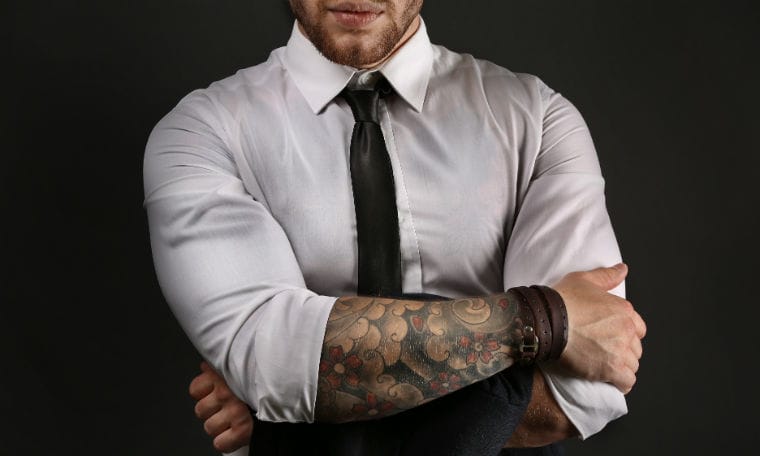
I am not a tattoo person. Yet, a whole lot of people are. And the numbers are increasing.
In fact, according to one recent survey, 3 in 10 Americans have at least one tattoo, up 50% in just four years. And, the younger you are, the more likely you are to sport a tattoo: 47% of millennials have a tattoo, as compared to 36% of gen Xers and only 13% of baby boomers.
With tattoos becoming more prevalent, it appears employers are becoming more accepting. The same poll revealed that tattoos are on the rise in professions ranging from teachers to doctors to judges.
Yet, your attitude may differ. You may demand a more traditionally professional look, and may not want someone with a tattoo representing your business or your brand.
There is nothing discriminatory on its face about refusing to hire someone with a tattoo. It may simply be a decision of the type of image that your company wants to project. Of course, it matters that such a policy is applied non-discriminatorily. In other words, a company can’t have two standards to visible body art—one for men and one for women, or one for whites and one for blacks.
Indeed, employers have gotten themselves in some legal trouble for using a tattoo as a proxy to reach an employment decision based on a protected class.
For example, in one case, a restaurant was alleged to have violated Title VII when it refused to hire a practitioner of Kemeticism (a religion with roots in ancient Egypt). The applicant he had tattoos on each wrist signifying the Egyptian sun god Ra. He argued that it would be a sin for him to hide the tattoos because of their religious significance.
In another case, an African-American employee claimed he was denied a promotion, and later fired, by his white supervisor, who bore a Confederate flag tattoo.
In yet another, UPS was accused of sexual harassment based on employees’ mistreatment of the plaintiff with a “lesbian tattoo.”
The first of these cases settled on the eve of their respective trials; the third resulted in a plainiff’s verdict.
So, what does all this mean? It means that while employers do have discretion in hiring or firing because of tattoos, they must be careful to ensure that such actions are (1) not because of a protected class, and (2) grounded in a legitimate business reason. Otherwise, the tattoo in question might be the employer getting tattooed with a big, fat verdict.
Jon Hyman is a partner at Meyers, Roman, Friedberg & Lewis in Cleveland. Comment below or email editors@workforce.com. Follow Hyman’s blog at Workforce.com/PracticalEmployer.
Yesterday, the 6th Circuit Court of Appeals joined a growing number of federal appellate courts to hold that Title VII’s prohibition against sex discrimination expressly covers LGBT employees.
The claimant inEEOC v. R.G. &. G.R. Harris Funeral Homes [pdf], Aimee Stevens (formerly known as Anthony Stephens) was born biologically male, and presented as such when hired. The funeral home’s owner and operator, Thomas Rost, fired her shortly after she informed him that she intended to transition from male to female and would represent herself and dress as a woman while at work.
“We hold that the EEOC could pursue a claim under Title VII on the ground that the Funeral Home discriminated against Stephens on the basis of her transgender status and transitioning identity. The EEOC should have had the opportunity, either through a motion for summary judgment or at trial, to establish that the Funeral Home violated Title VII’s prohibition on discrimination on the basis of sex by firing Stephens because she was transgender and transitioning from male to female. …
Discrimination against employees, either because of their failure to conform to sex stereotypes or their transgender and transitioning status, is illegal under Title VII. The unrefuted facts show that the Funeral Home fired Stephens because she refused to abide by her employer’s stereotypical conception of her sex, and therefore the EEOC is entitled to summary judgment as to its unlawful-termination claim.”
The court also rejected the employer’s claim that applying Title VII’s proscriptions against sex discrimination to the Funeral Home would substantially burden Rost’s religious exercise.
Bravo, 6th Circuit, bravo.
I fully expect an appeal to the Supreme Court.
Fingers crossed hard that when SCOTUS finally takes up this issue, it does the right thing, the more thing, the just thing, and decides this issue once and for all in favor of LGBT civil rights.
Jon Hyman is a partner at Meyers, Roman, Friedberg & Lewis in Cleveland. Comment below or email editors@workforce.com. Follow Hyman’s blog at Workforce.com/PracticalEmployer.



 The first of these cases settled on the eve of their respective trials; the third resulted in a plainiff’s verdict.