Skip to content

Workforce

Category: Legal

Posted on July 18, 2016July 25, 2018

Courts Take Closer Look at Noncompete Clauses

gavel, legal, OSHA

Companies seeking to enforce post-employment restrictive covenants — agreements restricting an individual’s ability to compete with their former employer or solicit its customers or employees — should be aware of current litigation trends surrounding what constitutes “adequate consideration” for a restrictive covenant.

Consideration — the mutual exchange of something of value — is an essential element of an enforceable contract. As with all other contracts, restrictive covenants must be supported by “adequate consideration” to be enforceable.

In the past few years, courts have been re-examining what constitutes adequate consideration for a restrictive covenant. In 2013, the Illinois Court of Appeals held, contrary to longstanding precedent, that in the absence of other considerations, mere employment constitutes adequate consideration for a restrictive covenant only if the employee remains employed for at least two years after signing the restrictive covenant.

This two-year rule applies regardless of whether the employee signed the restrictive covenant as a new or existing employee and regardless of whether the employee voluntarily resigned or was fired. Notably, multiple federal district courts in Illinois subsequently declined to apply the bright-line rule, instead considering other factors such as compensation, raises and bonuses, and the terms of the employee’s termination.

Similarly, since 2014, Kentucky, North Carolina and Pennsylvania courts have each issued decisions requiring some consideration beyond mere continued employment to enforce a noncompete. For example, in Employment Staffing Group v. Little, the North Carolina Court of Appeals upheld as adequate a $100 payment made to the defendant employee in conjunction with signing a midemployment noncompete. The court upheld the $100 direct deposit payment to the employee in exchange for signing the restrictive covenant, even where the payment was not directly referenced in the agreement terms.

On the other hand, in 2015, the Wisconsin Supreme Court held in Runzheimer International v. Friedlen that employers may require existing at-will employees to sign noncompete agreements without offering additional consideration beyond continued employment, although the court did not provide clear guidance as to the period of time that the employment must continue after the noncompete is signed. The court reasoned that although an employer could theoretically terminate an employee’s employment shortly after having the employee sign a restrictive covenant, the employee could challenge the enforcement of the restrictive covenant through other contract formation principles such as fraudulent inducement or good faith and fair dealing.

All of these decisions demonstrate the recent willingness of parties to challenge existing notions of consideration when it comes to restrictive covenants; additional challenges are anticipated nationwide.

What then should an employer do to ensure that a restrictive covenant is supported by adequate consideration?

First, depending on the state of employment, employers may want to provide consideration in addition to an offer of initial or continued employment. Examples of possible “additional consideration” include a cash payment; stock options; training; education; a raise; additional paid time off; guaranteed severance; or a promotion. In the absence of judicial guidance, it would be prudent to be as generous as possible and to provide consideration that is more than de minimis. Regardless of the “additional consideration” ultimately decided upon, the restrictive covenant itself should both explicitly recite the consideration provided to the employee for signing it and further provide that the employee acknowledges the consideration and its adequacy.

Second, the employer may agree to continue the employee’s salary during any restricted period, thereby alleviating concern about consideration being illusory.

Third, employers may consider trying to evade consideration concerns entirely by having employees agree to a “garden leave” or “required notice” clause, rather than a traditional noncompete or nonsolicit clause. Under such a provision, an employee is required to give advance notice of their resignation (e.g., 30 to 90 days) and, during the notice period, the employee remains on the payroll and owes the employer a fiduciary duty of loyalty (and therefore cannot work for a competitor during that period). Because the employee remains on the payroll and because garden leave provisions tend to be shorter in duration than traditional restrictive covenants, they are less onerous to the individual and thus more likely to be enforced.

Fourth, when drafting a restrictive covenant, employers should include a contractual choice-of-law provision that specifies which state’s laws will govern the agreement. Ideally, there will be a reasonable connection to a state with favorable laws regarding the enforceability of restrictive covenants, and that state’s laws can be designated as the governing laws.

Examples of possible states to be chosen include the state where the employer’s headquarters is located or where the employee actually works. Unless the choice-of-law provision violates the fundamental public policy of a state with a materially greater interest in the situation, or the parties and contract do not have a substantial relationship with the chosen state, courts will generally enforce such provisions.

Finally, on an annual basis, employers should have their restrictive covenants reviewed by a knowledgeable attorney to make sure they are still up-to-date and fully compliant with current court decisions and state statutes.

As courts increasingly address challenges to the adequacy of consideration in restrictive covenants, employers can take measures to ensure that a restrictive covenant will be enforced. By simply remaining aware of fluctuating state laws, employers can structure employment agreements to incorporate adequate consideration under applicable state law.

Peter A. Steinmeyer is a member of the law firm Epstein Becker & Green, P.C. in the Employment, Labor & Workforce Management practice. He co-leads the firm’s non-competes, unfair competition and trade secrets strategic initiative. Scarlett L. Freeman is an associate in Epstein Becker & Green, P.C.’s litigation practice and a member of the firm’s non-competes, unfair competition and trade secrets strategic initiative.

Posted on July 18, 2016June 29, 2023

Court OKs Using Employee’s Own Facebook Posts in Race-Bias Case

WF_WebSite_BlogHeaders-09

I read with interest a post on Eric Meyer’s Employer Handbook Blog, titled Court says employee’s Facebook page on race stereotypes is fair game at trial. The post discusses a recent federal court decision which permitted an employer to impeach at trial a race-discrimination plaintiff with her own racial Facebook posts.

No doubt that some of the comments on plaintiff’s Facebook page are prejudicial to her case. Indeed, some of plaintiff’s comments on her Facebook actually support the claims she asserts in this case and plaintiff has used these posts to substantiate her claims. … It also relates to whether plaintiff was offended by such conduct at work and whether this conduct forced her to resign since she herself participated in comments containing racial stereotypes and jokes on her Facebook page which were, in part, insensitive and demeaning. …

[T]here is evidence in this case that at times plaintiff initiated and engaged in racial jokes and comments while at work with co-workers. … [T]he comments made by plaintiff and the comments liked by her on her Facebook page can be used by the Hospital to challenge her credibility at trial. As mentioned, the credibility of the witnesses is for the jury to weigh. This evidence is also relevant to whether plaintiff truly found the comments made by co-workers as offensive and unwelcomed.

Here’s my question. How is this different than impeaching a sexual-harassment plaintiff with her provocative clothing, or personal pornography habit? Just because one finds some sexual or racist content unoffensive doesn’t mean that one welcomes all such content, especially at work.

Food for thought, and another reason why employees need to be extraordinarily careful with what they share via social media.

Jon Hyman is a partner at Meyers, Roman, Friedberg & Lewis in Cleveland. To comment, email editors@workforce.com. Follow Hyman’s blog at Workforce.com/PracticalEmployer.

Posted on July 14, 2016July 25, 2018

The ‘Substantially Younger’ Test for Age Discrimination

Martha Knotts worked for the Grafton City Hospital until she was terminated at age 65. The hospital hired replacements who were 12 and 24 years younger than Knotts, but were over 40 years old.

Knotts filed a lawsuit in state court under the West Virginia Human Rights Act alleging age discrimination. The state circuit court held that Knotts could not establish a prima facie case of discrimination because her replacements were both over 40 and part of the protected class.

The West Virginia Supreme Court overturned its own “over 40/under 40” precedent, and reversed the circuit court’s decision. Instead, the state Supreme Court adopted the U.S. Supreme Court’s ruling in O’Connor v. Consolidated Coin Caterers Corp., holding that a prima facie age discrimination case’s focus should be on whether the discrimination occurred, rather than on whether a replacement’s age falls outside the protections for those 40 and older. A determination of whether a replacement is “substantially younger” than a terminated employee is a more “reliable indicator” of age discrimination than whether the replacement is not a member of the protected class. Knotts v. Grafton City Hospital, Case N. 14-0752, Supreme Court of Appeals of West Virginia (April 14, 2016).

IMPACT: Given today’s trend of “older” workers remaining in the workforce, it is not unusual for individuals 40 or older being hired and/or replacing older employees. Significant age disparity can be evidence of age discrimination even if the comparative employee is over 40, if that employee is substantially younger than the employee allegedly being discriminated against.

Mark T. Kobata and Marty Denis are partners at the law firm Barlow, Kobata and Denis, which has offices in Beverly Hills, California, and Chicago. Comment below, or email editors@workforce.com.

Posted on July 14, 2016July 25, 2018

Complications From Postpartum Depression


Postpartum depression can cause problems for employees — and painful lawsuits against employers.

In 2008, Congress passed amendments to the Americans with Disabilities Act — the ADA Amendments Act, or ADAA — greatly expanding what impairments are covered as disabilities under the statute. The ADA has always covered both mental and physical disabilities that interfered with a major life activity.

Prior to 2009, however, the U.S. Supreme Court took a very restrictive view of what facts constituted interference with a major life activity, in particular finding that impairments that were episodic or of short duration did not qualify for coverage under the Americans with Disabilities Act. In enacting the amendments, Congress explicitly rejected the approach. Now, under the newly amended ADA, courts are instructed to give the definition of disability a broad interpretation, which means that many conditions — even ones of short duration — enjoy protection under the ADA.

There have been numerous decisions since passage of the amendments in which courts have found that postpartum depression can be a disability under the amended ADA.

One recent example is Seema Nayak, M.D. v. St. Vincent Hospital and Health Care Center. In Nayak, the plaintiff was a medical doctor employed by St. Vincent as a resident in the OB/GYN program. Following a difficult multiple pregnancy in which one of her twins died, Nayak returned to her residency program where she, according her supervisors, experienced numerous performance problems. The program director, in raising this concerns with Nayak, said that others on her team were concerned because she “appeared distracted, sad and tearful.” When the director later declined to renew Nayak’s contract, he notified the American Board of Obstetrics and Gynecology that, “Due to a medically complicated pregnancy and significant concerns regarding her academic progress, our program decided not to extend her contract beyond this academic year.”

Nayak sued the hospital on numerous grounds, including that it had discriminated against her because, among other things, it regarded her as depressed and therefore having a disability. (Nayak had in fact been diagnosed with postpartum depression but did not tell her supervisors, claiming that she was afraid to do so.)

When St. Vincent later filed a motion asking the court to kick out Nayak’s disability claim, the court declined finding that the statements about her mood and the hospital’s admission that it fired her because of “a medically complicated pregnancy” were sufficient to support this claim. The court further found the fact that, according to the hospital, Nayak had performance problems before her pregnancy was not sufficient for the hospital to establish that it fired her for performance reasons.

However, it is important for employers and employees to note that a diagnosis of depression — postpartum or otherwise — does not insulate an employee from lawful termination. The case Eisner v. New York City Law Department, et al. provides employers an example of both the potential liabilities under the Americans with Disabilities Act as well as an example of how to successfully handle a termination under the statute.

In this case, plaintiff Susan Eisner, who worked as an attorney for the city in its appellate division, filed an EEOC charge in 2009 when she received a negative performance review after being diagnosed with “major depression, severe, single episode … induced postpartum following the birth of a child.” Eisner claimed that her supervisor at the time had said that Eisner was “not high-functioning” and that “no magic pill can fix you.” The city settled the case with Eisner, who remained in the appeals division.

Citing performance reasons, the city terminated Eisner in 2013. Eisner sued claiming discrimination based on disability and retaliation. In denying all of Eisner’s claims, the court found that she had to prove that her disability was the “but for” cause of her termination.

The Supreme Court in two cases Gross v. FBL Financial Services Inc. and University of Texas Southwestern Medical Center v. Nassar found that the appropriate standard of proof under the Age Discrimination in Employment Act and Title VII of the Civil Rights Act is the “but for” standard rather than the arguably lower “motivating factor” test. The Supreme Court, however, has not opined on the proper standard of proof under the Americans with Disabilities Act. The court in Eisner reasoned that the language in the act is sufficiently similar to both the ADEA and Title VII to warrant applying the same standard. (Eisner has appealed the court’s ruling.)

Though, given the court’s analysis of her Americans with Disabilities Act claim, it appears the court would have dismissed her claim regardless. As the court noted, “Eisner has failed to adduce any facts that would give rise to an inference of disability discrimination. She contends that ‘every single adverse action against [her] flows from her initial disclosure of her disability.’ Such a temporal argument is unavailing.” The court noted that her initial request for accommodation occurred in 2009, some four years earlier.

The lesson of these two cases is that postpartum depression can be covered by the Americans with Disabilities Act, so employers need to be prepared to provide reasonable accommodations when requested. However, just because an employee suffers from postpartum depression does not mean she is immune from lawful termination. Still, in those situations an employer needs to proceed with extreme caution and strong evidence that the disability was not the factor driving the termination decision.

Tom Spiggle is author of “You’re Pregnant? You’re Fired: Protecting Mothers, Fathers, and Other Caregivers in the Workplace.” He is founder of the Spiggle Law Firm with offices in Arlington, Virginia, and Nashville, Tennessee. To comment, email editors@workforce.com.

Posted on July 14, 2016June 29, 2023

When COBRA and Workers’ Comp Collide

WF_WebSite_BlogHeaders-09

Every now and again I get a question from a client to which I don’t know the answer, or the answer surprises me. It doesn’t happen that often, and when it does I’m man enough to admit it.

I received just such a question. Must an employer continue the health insurance of an employee out of work with a workers’ compensation injury? 

The answer? It depends. (Did you expect anything else?) If facing this issue, ask yourself these two questions.

1. Is the employee on an FMLA or other statutorily approved leave of absence, which protects the employee’s health insurance?

Under the FMLA, if you provide an employee group health insurance, the employee is entitled to the continuation of such coverage during the FMLA leave on the same terms as if he or she had continued to work (including family coverage), provided that the employee continues to make his or her normal contributions to the premiums. So, in this case, follow the FMLA and continue coverage.

2. What does the plan say?

If the employer is not FMLA-covered, the employee is not FMLA-eligible, or the employee has exhausted available FMLA leave, then the employer will need to review the plan to determine coverage during a workers’ comp leave. Most plans have minimum-hours-worked requirements (i.e., “An employee needs to work __ hours during a week to be eligible for coverage.”). If that is the case, the workers’ comp leave will leave the employee working zero hours, rendering them ineligible for coverage. You will then issue a COBRA notice to the employee, since a “reduction of hours of the covered employee’s employment” is a “qualifying event” under COBRA. Otherwise, if your plan’s eligibility requirement permits coverage during a workers’ comp leave of absence, then follow the plan and continue covering the employee.

In the event coverage terminates, you can assure the employee that you are not engaging in sweep-the-leg tactics by leaving the work-related injury uninsured. Workers’ comp should continue to cover the injury-related medical expenses.

Jon Hyman is a partner at Meyers, Roman, Friedberg & Lewis in Cleveland. Comment below or email editors@workforce.com.

Posted on July 12, 2016June 29, 2023

The EEOC on Paternalism Vs. Pregnancy Discrimination

WF_WebSite_BlogHeaders-09

Paternalism and pregnant workers do not mix. Case in point? According to this EEOC press release, the agency has sued a North Carolina retail-furniture franchise for pregnancy discrimination.

According to EEOC’s complaint, the company hired Chantoni McBryde on June 1, 2015, and assigned her to work as a shop apprentice at the company’s temporary training facility in Dunn, North Carolina. The job required the use of various chemicals to repair furniture. On June 3, McBryde informed the company’s shop trainer that she was pregnant. Later that same day, McBryde was pulled into a meeting with the company’s shop trainer, shop manager and regional shop manager and was asked to confirm that she was pregnant. EEOC said that during the meeting, the regional shop manager showed McBryde a can of lacquer thinner that contained a warning that the contents could potentially pose a risk to a woman or her unborn child, and discussed the warning with McBryde. EEOC said that McBryde was then told that because she was pregnant, she could no longer work at the facility.

It appears that this employer was acting out of good intentions. It feared (reasonably or unreasonably) for the safety of this employee’s unborn child. That concern, however, does not excuse pregnancy discrimination. EEOC Charlotte District Office regional attorney Lynette Barnes puts it best: “Pregnant women have the right to make their own decisions about working while pregnant, including the risks they are willing to assume. Companies must not impose paternalistic notions on pregnant women as doing so can result in unlawful discrimination.”

Fears or outdated paternalistic notions about pregnancy (and the limits it may, or may not, impose on an employee) are off limits for employers. An employer has zero business trying to protect a pregnant worker or her fetus. Those decisions are left to the employee, and, as this case illustrates, the EEOC will not hesitate to help prove that point.

Jon Hyman is a partner at Meyers, Roman, Friedberg & Lewis in Cleveland. Comment below or email editors@workforce.com.

Posted on July 7, 2016June 29, 2023

Will Work for Beer

WF_WebSite_BlogHeaders-09

According to Boy Genius Report, archeologists in Iraq recently discovered a 5,000-year-old Mesopotamian tablet, which the site artfully describes as a “pay stub for beer due.” If the interpretation of the tablet is to be believed, ancient Mesopotamians were paid in beer for their labor.

“That was 3000 B.C., and this is 2016 A.D.,” you’re saying to yourself. “What possible relevance does this story have to modern employers?” The answer may surprise you.

Believe it or not, it is not illegal under the Fair Labor Standards Act to pay employees in kind, that is, with food or lodging. Thus, this story helps illustrate this lesser known provision of the FLSA.

Section 3(m) of the FLSA provides:

“Wage” paid to any employee includes the reasonable cost, as determined by the Administrator, to the employer of furnishing such employee with board, lodging, or other facilities, if such board, lodging, or other facilities are customarily furnished by such employer to his employees.

The leading case on the issue of meal credits as FLSA wages is Herman v. Collis Foods, Inc. (6th Cir. 1999), which establishes that an employer who wishes to claim the section 3(m) meal credit must establish each of the following four factors:

  1. The meal is regularly provided by the employer or by similar employers;
  2. The meal is furnished in compliance with applicable federal, state, or local law;
  3. The meal is provided primarily for the benefit of the employee rather than the employer; and
  4. The employer maintains accurate records of the costs incurred in furnishing the meal.
Herman specifically rejected the DOL’s argument that the employee must voluntarily accept the meal for it to count as payment in lieu of wages. While the DOL still formally maintains this position, in a Field Assistance Bulletin it makes it clear that because courts have rejected the DOL’s position, it no longer enforces the voluntary requirement. Thus, employees need not voluntarily accept meals instead of cash wages for an employer to count the reasonable cost or fair value of the meal toward its minimum wage obligation.
To calculate an hourly rate including the section 3(m) credit, the value of the meal is added to cash wages (excluding overtime compensation) and divided by the hours worked in a given week. The credit goes toward the employer’s minimum wage obligation and is included in the determination of the employee’s regular rate of pay for purposes of calculating any overtime compensation due for that work week.
So, there you have it. Under the right circumstances, an employer can pay an employee (at least in part) with a meal. And who am I to judge whether beer qualifies as a meal?
Jon Hyman is a partner at Meyers, Roman, Friedberg & Lewis in Cleveland. Comment below or email editors@workforce.com.
Posted on June 30, 2016June 29, 2023

FMLA Does Not Excuse Poor Performance

WF_WebSite_BlogHeaders-09

Earlier in the week, I discussed Tilley v. Kalamazoo, in which an employer took one on the chin for disciplining an employee for not doing his job while on an FMLA leave. That case, however, does not mean that the FMLA excuses prior poor job performance, or that an employer must ignore or excuse an employee’s performance deficiencies once an employee takes FMLA leave. Indeed, as Checa v. Drexel University [pdf] points out, it’s just the opposite.

Debbie Checa, a manager at the Drexel University College of Medicine, suffered from carpal tunnel syndrome. She sought, and was provided, a 12-week FMLA leave of absence for corrective surgery (which Drexel agreed to extend further after Checa’s mother died).

On her first day back at work, Checa claimed that her boss ambushed her during her “first day back” meeting with a list of incomplete tasks she had allegedly agreed to complete before taking leave. In response, Checa quit and (surprise) sued Drexel for FMLA retaliation. She claimed her boss orchestrated the “first day back” meeting as a “planned attack.”

The court dismissed Checa’s retaliation claim, concluding that the “first day back” meeting was not an adverse employment action.

The “first day back” meeting, and the issues discussed at the meeting, do not qualify as a materially adverse employment action. Under Checa’s reasoning, an employer should forget about pre-leave performance deficiencies or deliver them in a more courteous manner. But our workplace discrimination laws are not designed to remedy everyday slights or “trivial harms.” We see no basis for extending Congress’ remedial mandate to this type of employer conduct.

What a nice, common-sense result. While Tilly reaches the correct result that an employer cannot hold an employee accountable for work not completed during an FMLA leave, the result in Checa is equally correct. The FMLA is not a personnel-file eraser. One does return from an FMLA leave with a clean performance slate. Instead, one returns with the same warts with which they left. And, if those warts merit discipline, or (gasp) even termination, then so be it.

Jon Hyman is a partner at Meyers, Roman, Friedberg & Lewis in Cleveland. Comment below or email editors@workforce.com.
Posted on June 29, 2016June 29, 2023

Your Employees Are Using Social Media at Work; Deal With It


WF_WebSite_BlogHeaders-09

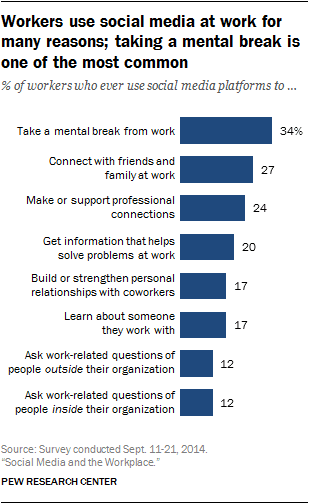
A recent survey conducted by the Pew Research Center confirmed what I have long thought. Your employees are using social media at work — 77 percent of them. And I believe even that number is low.

Meanwhile, another recent survey, this one by CareerBuilder (h/t Ragan.com) attributes smartphones to the fact that 20 percent of full-time workers say they work less than five hours per day.

It’s not all bad news for employers. The same study found that evidence that workplace social media policies concerning impact on-the-job use. Workers whose companies have policies regulating social media use at work are less likely to use social media in certain ways:

  • 30 percent of workers whose companies have an at-work social media policy say they use social media while on the job to take a break from work, compared with 40 percent of workers whose employers do not have such policies.
  • 20 percent of workers whose employers have at-work social media policies say they use social media to stay connected to family and friends while on the job, compared with 35 percent  of workers whose social media use is not regulated at work.
  • Only 16 percent of workers whose companies regulate social media at work say they use social media while working to get information that’s helpful to their job, compared with 25 percent of those whose workplaces have no such regulations.

What does all this mean? Despite the help that social media policies provide, employers that try regulate personal social media use out of the workplace are fighting a losing battle. I call it the iPhone-ification of the American workforce. No matter your policy, if your employees can take their smartphones out of their pockets to circumvent the policy, how can you possibly police workplace social media access? Why have a policy you cannot police and enforce? And, don’t forget, the NLRB is watching, too.

Instead of regulating an issue you cannot hope to control, treat employees’ use of social media for what it is — a performance issue. If an employee is not performing up to standards because he or she is spending too much time on the internet, then address the performance problem. A slacking employee will not become a star performer just because you limit his or her social media access; he or she will just find another way to slack off.
Jon Hyman is a partner at Meyers, Roman, Friedberg & Lewis in Cleveland. Comment below or email editors@workforce.com.
Posted on June 14, 2016July 26, 2018

‘Concussion,’ Retaliation and Whistleblower Protections

Even if you haven’t seen the 2015 film “Concussion” starring Will Smith, you’ve undoubtedly seen the clip from the trailer of Smith intensely and emotively pointing his finger forward at two doctors and saying “Tell the truth” about concussions.

“Concussion” tells the story of Dr. Bennet Omalu, M.D., a forensic pathologist in Pittsburgh. The doctor discovered the slowly developing brain disease resulting from head injuries among NFL football players. He labeled it CTE, which is short for chronic traumatic encephalopathy.

Omalu also discovered that the NFL and its doctors did not welcome his discovery of this illness. Without giving away a good story, I can say that people discouraged Omalu’s work and attempted to undermine his credibility.

Of course, people can get concussions in various sports and activities and from accidents at home or work. Often, people are able to recover from such injuries. This story concerns recurring head traumas and the effects that show up many years later. Such brain damage has been hard to detect. Many people have not sought treatment and did not recover from CTE. (On March 28, JAMA Neurology published a new study on a biomarker that may help with early detection.)

Intimidation and Retaliation

Omalu’s story can also shed light on the well-known intimidation of and retaliation against whistleblowers in U.S. Veterans Affairs Department hospitals and in other organizations. It is important to keep in mind that when Omalu discovered that repetitive brain traumas produced an effect similar to early onset Alzheimer’s, he was a pathologist for Allegheny County, Pennsylvania. He was not an employee of the NFL.

He was harassed, intimidated and retaliated against, but not by his employer. He was not demoted, transferred or terminated by his employer. He did not suffer from “an adverse personnel action” by his employer.

The Problem

The Whistleblower Protection Act of 1989 protects whistleblowers from retaliation in the form of an adverse personnel action (or threat of one) by their employers. By the limited definition of retaliation under the act, Omalu was not the subject of retaliation.

Conscientious, responsible managers in environmental and occupational safety and health do want to hear the bad news, so they can take steps to deal with the problems. Conscientious, responsible managers in any business or government activity want to hear about problems so they can deal with them. Patrick Pizzella, former assistant secretary of labor for administration and management at the U.S. Labor Department (now a Member of the Federal Labor Relations Authority) is an example. While I worked on his safety and security planning committee for six years, Pizzella regularly asked: “Does anyone have any questions or comments?” And he acted on what he learned.

On the other hand, some do not want to hear about problems and they do not want anyone else to know about problems. These people sometimes intimidate or retaliate against people who report problems. This is not good for an organization, its employees or its clients/customers. “Don’t Nobody Tell Me No Bad News” is a great song from the musical “The Wiz,” but it is not good policy for those who follow it.

A Look at the VA

The problems at the VA hospitals and retaliation against VA whistleblowers received national publicity. Detailed allegations of many problems at VA were detailed in a 40-page document by the American Federation of Government Employees Local 17 in July 2015 with little visibility. In December 2015, Government Executive magazine reported that management at the VA would take no action on the problems alleged in the report.

Unlike the case of Omalu, the whistleblowers at the VA were employees. However, with a few possible exceptions, retaliation against complainers and whistleblowers did not involve demotion, transfer or termination. So the harassment and torment of the whistleblowers was not covered by the Whistleblower Protection Act. For example, purposeful public humiliation is psychological violence but, by itself, it is not retaliation under the act. (It is workplace violence.)

The brilliant Omalu is an exceptional man. Still, even he needed support from his faith community in Pittsburgh to get through the hassle of telling the truth about the NFL players’ injuries. Is it reasonable to expect the same courage and mental toughness from the average workers who desire to point out the problems they see?

This suggests to me that we do not have adequate tools to deal with those who intimidate and harass people who point out problems in the workplace.

Edward Stern served the U.S. Labor Department for 40 years as a senior economist and policy program analyst. He also has worked extensively with the Occupational Safety and Health Administration and is an expert on workplace bullying. To comment, email editors@workforce.com. Follow Workforce on Twitter at @workforcenews.

Posts navigation

Previous page Page 1 … Page 37 Page 38 Page 39 … Page 70 Next page


Webinars


White Papers


  • Topics

    • Benefits
    • Compensation
    • HR Administration
    • Legal
    • Recruitment
    • Staffing Management
    • Training
    • Technology
    • Workplace Culture
  • Resources

    • Subscribe
    • Current Issue
    • Email Sign Up
    • Contribute
    • Research
    • Awards
    • White Papers
  • Events

    • Upcoming Events
    • Webinars
    • Spotlight Webinars
    • Speakers Bureau
    • Custom Events
  • Follow Us

    • LinkedIn
    • Twitter
    • Facebook
    • YouTube
    • RSS
  • Advertise

    • Editorial Calendar
    • Media Kit
    • Contact a Strategy Consultant
    • Vendor Directory
  • About Us

    • Our Company
    • Our Team
    • Press
    • Contact Us
    • Privacy Policy
    • Terms Of Use
Proudly powered by WordPress