Henry v. Abbott Laboratories (6/10/16) [pdf] is what I would call a curious case, and one that I plan to liberally use any time I’m defending a case in which claims both of discrimination/retaliation and constructive discharge are asserted.
A constructive discharge is when an employer makes ones working conditions so intolerable that a reasonable person under such circumstances would have felt compelled to resign. It is not an independently unlawful act, and must be tied to some underlying illegal conduct (i.e., unlawful discrimination, harassment, or retaliation) to support a claim. Thus, if the misconduct is alleged to have violated Title VII, and if the employee resigns in the face of such circumstances, Title VII treats that resignation as tantamount to an actual discharge.
It seems pretty cut and dry, then, if an employee resigns because she feels that she was retaliated against for engaging in some protected conduct, the resignation should rise to the level of a constructive discharge, if the underlying retaliation is also unlawful.
Not so cut and dry, however, to the 6th circuit court of appeals, which, in Henry v. Abbott Laboratories, concluded that the alleged retaliation alone does not suffice to support a constructive discharge claim, and that the underlying retaliatory adverse actions must independently rise to the level of severity such that a reasonable person would have felt compelled to resign.
If unlawful retaliation isn’t sufficiently intolerable such that it would support a constructive discharge claim, then what is? Or, looking at it another way, the 6th Circuit Court seems to be saying that one cannot look to the alleged statutory violation to support a constructive discharge claim, but instead to the conduct that underlies the alleged violation—in this case, a low performance evaluation, increased scrutiny, a letter of expectations threatening further action if performance did not improve, and being kept on the training line. Yet, if those adverse actions support a retaliation claim, as the court held a jury should conclude, shouldn’t a jury also have the opportunity to decide whether a resignation in the face of such alleged retaliatory adverse actions supports a constructive discharge claim?
While this case certainly favors employers, it is nevertheless one that I think should have gone the other way on this issue.
Jon Hyman is a partner at Meyers, Roman, Friedberg & Lewis in Cleveland. To comment, email editors@workforce.com.
Of course, workers’ caregiving responsibilities are not limited to child care, and include many other forms of caregiving. An increasing proportion of caregiving goes to the elderly, and this trend will likely continue as the Baby Boomer population ages. As with child care, women are primarily responsible for caring for society’s elderly, including care of parents, in-laws, and spouses. Unlike child care, however, eldercare responsibilities generally increase over time as the person cared for ages, and eldercare can be much less predictable than childcare because of health crises that typically arise. As eldercare becomes more common, workers in the “sandwich generation,” those between the ages of 30 and 60, are more likely to face work responsibilities alongside both childcare and eldercare responsibilities.
Between 1998 and 2012, federal employment discrimination cases declined overall. But not employee lawsuits over family-leave discrimination: They shot up 590 percent. In the past 10 years … the fastest-growing type — up 650 percent — was brought by employees who were taking care of elderly relatives. Nor is this a “women’s issue.” Well over a third (39 percent) of those eldercare actions were brought by men, who also filed 336 percent more paternity-leave lawsuits than in the decade before.
For employers, this gets expensive. Plaintiffs have been winning cases about 70 percent of the time, the study says, or more than twice as often as they prevail in other kinds of employment suits. Altogether, litigation over what the study calls “FRD,” for family responsibilities discrimination, has cost employers almost half a billion dollars ($477,009,417) between 2006 and 2015, more than double what it cost in the previous decade. And that’s a conservative estimate, because it doesn’t include the cost of confidential out-of-court settlements.
This issue hits workers my age particularly hard, as we are bookended by caregiving responsibilities. We not only have our children to which to attend, but also our parents. Employers that mis-perceive employees’ dedication to their families as a lack of dedication to their jobs are missing the bigger picture. It is not only the right thing to grant your employees the flexibility to attend to family issues when they arise, but it is also the legal thing. Because $477 million dollars suggests that employers, unfortunately, have not received this message.
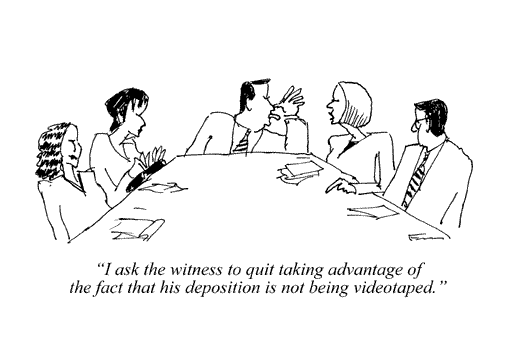
I spent yesterday in a deposition. That fact is not all that unusual for a litigator. What makes yesterday’s exercise stand out is that I was the deponent, not the attorney. I spent my day under oath, answering questions.
As the mind of a blogger works, I thought to myself, “How can I turn this experience into a blog post?” And then I realized that I already had, six years ago, in a post entitled, 10 tips for preparing for your deposition. So join me on this trip back through the archives.
Tell the truth. Enough said.
Answer the specific question asked. Do not volunteer other information. Do not explain your thought process. You are only required to answer the question that is asked. The lawyer on the other side is being paid to ask specific questions to elicit the specific information being sought. Do not do his job for him by unnecessarily offering other information.
If you do not understand a question, do not answer. Simply say that you do not understand. It is the lawyer’s job to formulate understandable questions, and not your job to guess at what is trying to be asked of you.
Do not guess. If you cannot remember something, your answer should simply be: “I do not remember.” If you have a vague memory, give that vague memory with a qualification.
A deposition isn’t a memory test. If you are asked for a time or date, and you cannot recall specifics, it is okay to give an approximation. Just qualify the answer by saying that it is an approximation or an estimate.
Beware leading questions. An examiner is usually allowed to try to put words in your mouth with leading questions. Do not agree to inaccurate statements contained within the question. To same end, do not automatically accept the questioner’s summary of your prior testimony, unless it is 100% accurate.
Give complete answers, and then stop. Always finish your answer. If you are interrupted, let the lawyer finish the next question, and then go back and finish your prior answer. If you are finished with an answer and it is complete, accurate, and truthful, stop talking and stay silent. Do not add to your answer because you feel a need to fill the silence.
Documents. If you think you need a document to help you truthfully and accurately answer a question, ask for it. But, do not agree to supply any documents requested by the questioner. All such requests should go through your lawyer.
Objections. Even if your lawyer objects, you usually still have to answer the question. You will only not answer if your lawyer expressly instruct you accordingly (usually because the other lawyer is asking about attorney-client communications).
Humor doesn’t work. Sarcasm and humor do not translate well on the written page. Also, never express anger or argue with the questioner, or use even the mildest of off-color language. A deposition is a professional event, and you should act professionally.
Brittany Tovar claimed that her employer, Essentia Health, discriminated against her when her employer-sponsored medical insurance denied her son gender reassignment services and surgery.
In Tovar v. Essentia Health (D. Minn. 5/11/16), the court had little issue dismissing Tovar’s claims because the alleged target of the discrimination, her son, was not an employee protected by Title VII:
There are no allegations that Tovar herself is transgender or was denied health benefits…, let alone denied benefits because of her sex. Instead, she assumes the discrimination against her transgender son was also discrimination against her. This assumption confuses the true target because it was not Tovar who was discriminated against; it was her son (a non-employee and non-party) who was the sole object of the discrimination. This does not support a claim of discrimination.…
Tovar has alleged no … discriminatory conduct or adverse action taken by Essentia against her. Instead, she argues “she is entitled to the full enjoyment of the privileges of her employment, including access to and use of her health care benefits equal to that of other employees.” Yet, there are no facts in the Complaint to support that she was ever personally denied the benefits or privileges of her employment or personally experienced anything less than full coverage of the benefits provided.
This holding is very different from Thompson v. North Am. Stainless, in which the Supreme Court recognized a claim for “associational retaliation.” In that case, both the complaining employee and the terminated employee were both employees, and the alleged discriminatory action was against an employee. In Tovar, the alleged victim of the discrimination was not an employee.
So, what does this case mean? Title VII protects employees, not non-employees, even if the non-employee is closely related to an employee. Title VII prohibits adverse employment actions, not adverse actions against those related to employees.
Vice President Joe Biden, Sen. Sherrod Brown and Secretary of Labor Tom Perez will appear at Jeni’s Ice Cream in Columbus, Ohio, May 18 to announce the Department of Labor’s new overtime rule.
The rule, as expected, increases the salary level at which one qualifies as an exempt white-collar employee ($913 per week; $47,476 annually), while leaving alone (for now) the duties one also must meet to qualify. It is expected that 4.2 million white-collar workers will now qualify for overtime.
The effective date of the final rule is Dec. 1, giving employers more than six months to digest the new rules, reclassify workers and comply with the new salary test.
In advance of today’s announcement, late yesterday the DOL published the Final Rule, along with some guidance for employers. It also published this handy chart, comparing the current regulations, last year’s proposed regulations, and the final regulations.
What does the DOL want you to know about the new rule? It …
Only applies to the administrative, executive, and professional exemptions.
Sets the salary level at the 40th percentile of earnings of full-time salaried workers in the lowest-wage Census Region, currently the South ($913 per week; $47,476 annually).
Sets the total annual compensation requirement for highly compensated employees (HCE) subject to a minimal duties test to the annual equivalent of the 90th percentile of full-time salaried workers nationally ($134,004).
Establishes a mechanism for automatically updating the salary and compensation levels every three years.
Permits employers to use non-discretionary bonuses and incentive payments (including commissions) to satisfy up to 10 percent of the new standard salary level (this is new to the FLSA, and a pleasant surprise for employers).
I will say, while a 50 percent increase in the salary test is significant, the Final Rule is not nearly as bad for employers as it could have been or was feared.
The salary test is based on the lowest-wage Census area (the South);
It will update every three years (not every year, as feared);
It left the duties test alone (for now);
It providers a much longer than feared six months until effective; and
It introduced the inclusions of bonuses and commission into the salary calculation.
Perhaps what is most interesting, however, is the guidance that the DOL chose to publish along with the Final Rules. Much of the criticism lobbed at the DOL over the increased salary test related to the higher salary level’s impact on small businesses, non-profits, higher-education institutions, and governments. Not so coincidentally, take a look at the guides and fact sheets the DOL published alongside the Final Rule:
Employers, you have a little more than six months to get your wage-and-hour houses in order. You need to figure out which of your exempt employees make less than $47,476, and determine what you are going to do with them—switch them to non-exempt or gross-them up to the new salary level.
If you switch them to non-exempt, you will have to deal with the employee-relations issues that arise from tracking (or restricting) overtime and limiting flexibility. If you gross them up to keep them exempt, you will have to deal with the employee-relations issues that arise from salary contraction. Will your manager be happy that she is being paid nearly the same as her assistant manager/supervisor?
There are no easy answers, but you have until Dec. 1 to figure it out.
The EEOC published May 16 its long-awaited rules that describe how the Americans with Disabilities Act and the Genetic Information Nondiscrimination Act apply to wellness programs offered by employers that request health information from employees and their spouses. Both rules take effect July 18, 2017.
The EEOC has made the following documents available:
What do employers need to know about these rules? The two biggest takeaways are: (1) wellness programs are voluntary (and therefore do not violate the ADA or GINA) as long as an employers’ incentives or discounts don’t exceed more than 30 percent of the cost of an employee’s individual “self-only” health coverage; (2) employers still have obligations under both laws to keep confidential employee medical and genetic information provided through a wellness program.
Given the surging cost of health insurance and the massive burden those costs place on employers and employees, it is relief that the EEOC is leaving intact these beneficial programs popularized by the Affordable Care Act. Moreover, the EEOC’s 30 percent hard cap is certainly more palatable than a fuzzy “reasonableness” standard that begs for litigation and uncertainty. While both employers and employees can quibble over whether 30 percent is too low, too high, or just right, I’d rather have this Goldilocks debate over a number we can see than a different debate over a fuzzy standard that we cannot.
“I continue to support a minimum wage increase if mandated by the state or federal government and not just for the city of Cleveland. For the full economic impact this has to be a united effort throughout Ohio and the United States.”
There is much debate over the positive or negative impact of a $15 minimum wage. Where you fall on the debate depends on whether you are pro-employee or pro-business, and, if you look, you can find empirical evidence to support either argument.
Here’s one argument, however, that I have not come across. If the minimum wage rises to $15 an hour, what happens to all of those employees already earning $15 an hour? What happens to the employee, hired 10 years ago at $7 an hour, who worked his butt off for the past decade, and, through a series of promotion and raises, earned his way up to $15 an hour? Those employees will not receive a proportional raise to keep pace. The $15 minimum wage will convert these millions of workers into minimum-wage employees. And, for better or worse, there is a certain stigma with being classified as minimum wage — especially if you’ve worked hard for years not to be minimum wage.
There is no easy answer or quick solution to providing people with a livable wage. There is lots to discuss before we make the reflexive decision to cure the wage gap in this country by increasing the minimum wage. One issue that cannot be discounted is the employee-relations nightmare that we will create for those already earning this new minimum wage.
President Obama signed into law the Defend Trade Secrets Act of 2016 on May 11. It creates a uniform, federal standard for the protection of corporate trade secrets.
What do employers need to know about this new law?
1. It creates a uniform federal cause of action for the misappropriate of trade secrets. Thus, companies, particularly, but not limited to, those that operate in more than one state, can seek nationwide relief from the misappropriate of trade secrets, without regard to differences in state law. Also, because it creates a federal cause of action, it grants access to federal court without regard to the state of citizenship of the parties.
2. It does not circumvent state laws regarding the enforceability of non-competition agreements. Employers are still free to limit their employees’ post-employment activities, subject to applicable state laws.
3. It does not preempt state trade secrets laws, to the extent they provide greater protections.
4. It creates a mechanism for the civil seizure of stolen trade secrets. In “extraordinary circumstances” a federal court may order the civil seizure of property “necessary to prevent the propagation or dissemination of the trade secret that is the subject of the action.” Moreover, interestingly, one of the pre-conditions on this seizure is that the “applicant has not publicized the requested seizure.”
5. One who claims to have an interest in any seized material move the court “to encrypt any material seized or to be seized … that is stored on a storage medium.”
6. Aside from this newly created civil-seizure remedy, other more traditional remedies are also available—injunctions, compensatory damages, exemplary damages, and attorneys’ fees.
7. Injunctions, however, are not intended to serve as back-door non-competition agreements. Instead, injunctions are limited in scope to what is necessary to “prevent any actual of threatened misappropriation” of the trade secret. This is one area where state-law inevitable disclosure remedies might prove more favorable than this federal law.
8. Exemplary damages (limited to two times the amount of compensatory damages) and attorneys’ fees are only available upon proof that the misappropriation was “willful and malicious.”
9. Attorneys’ fees are also available against a plaintiff if the defendant can show that the claim was brought in “bad faith,” or that a motion to terminate an injunction was opposed in “bad faith.”
10. Disclosure of trade secrets are protected if made in confidence to a government official, or to an attorney, solely for the purpose of reporting or investigating a suspected violation of law, or if made in a complaint or other legal document filed under seal in a lawsuit or other proceeding.
While this law may not change the legal status of trade secrets it does add another arrow to the corporate quiver of trade-secret protections, which most (honest) employers should welcome.
If your company has policies prohibiting audio or video recording or taking pictures in the workplace and restricts cellphone use at work to nonworking times or nonwork areas, then beware.
A recent National Labor Relations Board decision calls into question the validity of such policies. Even if not promulgated in response to any union activity or otherwise intended to interfere with employees’ rights under the National Labor Relations Act, such policies could still be found unlawful.
In Whole Foods Market Inc., the NLRB was presented with the issue whether the grocery chain violated Section 8(a)(1) of the NLRA by maintaining two similar work rules that prohibited recordings in the workplace without prior management approval. An administrative law judge found the no-recording rules did not explicitly restrict employees’ rights because the rules did not prohibit employees from engaging in protected, concerted activities under Section 7 of the NLRA. Additionally, the judge did not view the act of making recordings in the workplace as its own protected right. Contrary to the sound decision of the judge, a divided NLRB found the rules unlawfully infringed upon employees’ Section 7 rights.
Illustration by Mike Centeno
Section 7 gives employees “the right to self-organization, to form, join or assist labor organizations, to bargain collectively through representatives of their own choosing, and to engage in other concerted activities for the purpose of collective bargaining or other mutual aid or protection.”
Whole Foods is yet another in a long series of NLRB decisions broadening its interpretation of employees’ Section 7 right to engage in other concerted activities for the purposes of mutual aid or protection by finding a seemingly neutral and benign company policy unlawful under the NLRA. While the act of recording generally is an individual act and prohibiting such recordings does not, in and of itself, prevent an employee from voicing concerns about terms and conditions of employment, the NLRB nevertheless found the rules unlawful.
Based on this finding, one might think Whole Foods had no business reason for its rules or that the rules were intended to interfere with employees’ Section 7 rights, but that simply was not the case. The rules set forth the grocer’s legitimate business justification for the recording restriction, which was “to encourage open communication, free exchange of ideas, spontaneous and honest dialogue and an atmosphere of trust.” Further, the rules were in no way discriminatory.
They applied to both supervisors and employees, they applied all of the time, and they applied whether employees were engaged in protected, concerted activity. Whole Foods also supported its business rationale with evidence that the rules aided the grocer in fostering free and open dialogue in three areas:
· Group meetings, which included discussions of employee complaints as well as discussions of proprietary business information.
· Peer review panels that reviewed termination decisions.
· Meetings where employee requests for emergency assistance were discussed, which often included discussions of very private information about employees, including personal health issues.
Whole Foods simply wanted to ensure these types of candid exchanges continued in its stores. The board majority, however, did not find these to be overriding business reasons for the rules.
And while the NLRB did not hold that companies are prohibited from having any policies that restrict recording in the workplace, it held that such policies must be narrowly tailored such that employees “understand that Section 7 activity is not being restricted.” The problem with this holding is that it is unclear how significant an employer’s business interests must be for a no-recording policy to pass muster.
Based on this decision, it is not enough that an employer seeks to continue open and honest exchanges in the workplace.
It likewise seems that a policy simply prohibiting all use of cellphones or other recording devices during working time or in working areas could be found overly broad. Thus, the NLRB offers as examples of protected, concerted conduct the photographing of unsafe equipment and the recording of discussions about terms and conditions of employment — both of which are likely to occur during working time and in work areas.
The NLRB did not, in Whole Foods, overrule earlier precedent that found lawful a hospital’s policy restricting employees from recording images in a patient-care setting, but employers are left to wonder what business considerations short of patient privacy will suffice to justify no-recording policies.
Arguments can be made that employers should be allowed to protect things like trade secrets and proprietary equipment or processes, and perhaps there will be other sanctioned policies to protect the privacy of other types of customers or clients. These, however, are unanswered questions following the Whole Foods decision.
While Whole Foods is being appealed to the U.S. Court of Appeals for the 2nd Circuit, the NLRB will likely continue to scrutinize these types of policies.
In the meantime, companies should closely examine their own recording and cellphone usage policies and assess the risks vs. the reward of such policies. At a minimum, companies should understand the potential risks of maintaining no-recording policies and define their best business case for maintaining such policies.
Tanja L. Thompson is co-chair of the Traditional Labor Practice at Littler Mendelson in Memphis, Tennessee. Comment below, or email editors@workforce.com.