The HR tech space saw its first major deal of 2017 as Saba Software is acquiring Halogen Software. Illustration by Anna Jo Beck
While consolidation in the HR technology space isn’t much of a surprise anymore, Saba Software’s announced acquisition of Ottawa, Canada-based Halogen Software was a bit unexpected.
The deal, worth a reported $293 million, is expected to close in the second quarter of 2017.
Though it’s certainly not on the scale of cloud-based talent management software blockbusters like 2012’s $1.9 billion Oracle-Taleo deal or 2011’s $3.4 billion SAP-SuccessFactors acquisition, this could be the next wave in smaller companies building broader HR technology suites.
The thinking could be that bigger indeed is better. According to a joint release, the deal “will extend Saba’s position as a leading provider of end-to-end SaaS talent management solutions. Combined, Saba and Halogen will serve more than 4,000 customers worldwide, and together, increase value to the customers they serve with the strength, size and scale to deliver rapid innovations in talent management.”
Saba’s expertise lies in the L&D space, while Halogen’s software focuses on performance management. Not surprisingly, the release noted that the deal combines learning and performance in a way not yet realized in the market.
“Saba has a clear vision for the future of talent development and understands the powerful role learning and engagement experiences play in driving individual and business performance,” said Pervez Qureshi, CEO of Saba, which was acquired by private equity firm Vector Capital in 2015. “Combining Saba’s unrivaled learning and engagement capabilities with the proven innovation Halogen brings to performance management, we expect to accelerate delivery against this vision and rapidly create new value for our joint customers. This strong foundation for growth and innovation and our combined expertise will enable Saba to meet the ever-changing workplace needs of people and help organizations more effectively adapt, perform and thrive.”
Michael Slaunwhite, executive chairman of Halogen, was equally as effusive of the deal. “We have built Halogen into a market leader in performance management by investing in the talented and innovative team that began here in Ottawa more than 20 years ago.I look forward to joining forces with Vector Capital and Saba. Together, we have the opportunity to scale faster and lead the way in performance, learning, and engagement and expand our global impact.”
Rick Bell is editorial director for Workforce. Comment below or email editors@workforce.com.
I’ve previously suggestedthat your employees are your company’s weakest link, and therefore, your greatest threat to suffering a cyber-attack and resulting data breach. While employee negligence (that is, employees not knowing or understanding how their actions risk your company’s data security) remains the biggest cyber risk, another is growing and also demands your attention — the malicious insider.
Dark Reading reports on a recent survey titled, “Monetizing the Insider: The Growing Symbiosis of Insiders and the Dark Web.”
Recruitment of insiders is increasing, and the use of the dark web is the current methodology that malicious actors are using to find insiders,” explains researcher Tim Condello, technical account manager and security researcher at RedOwl.
Cybercriminals recruit with the goal of finding insiders to steal data, make illegal trades, or otherwise generate profit. Advanced threat actors look for insiders to place malware within a business’ perimeter security. …
Think your business is safe? Think again. All insiders pose a risk, regardless of their seniority or technical ability, experts say. As major data breaches continue to make headlines, people are recognizing the tremendous impact leaked data can have on a business—and how they can profit from it.
There are three types of people who fall into the “insider” category, says Condello: negligent employees who don’t practice good cyber hygiene, disgruntled employees with ill will, and malicious employees who join organizations with the intent to defraud them.
No amount of training, however, will stop a disgruntled employee with ill intent, or a malicious employee who joins to do harm.
These latter two categories need more specialized attention—an insider threat program. The Wall Street Journal explains:
Companies are increasingly building out cyber programs to protect themselves from their own employees. … Businesses … are taking advantage of systems … to find internal users who are accidentally exposing their company to hackers or malicious insiders attacking the company.
These “systems,” however, can prove costly, especially for the small-business owner. While investment in a technological solution is one way to tackle this serious problem, it’s not the only way. Indeed, there is lots any company, of any size, with any amount of resources, can do to develop an insider threat program.
Aside from the expense of costly monitoring programs, what types of issues should employers include in an insider threat program? Here are four suggestions:
Extra monitoring of high-risk employees, such as those who previously violated IT policies, those who seek access to non-job-related business information, and those who are, or are likely to be, disgruntled (i.e., employees who express job dissatisfaction, who are on a performance improvement plan, or who are pending termination).
Inventories and audits for computers, mobile devices, and removable media (i.e., USB and external hard drives), both during employment and post-employment.
Pre-employment background checks to help screen out potential problem employees before they become problems.
No company can make itself bulletproof from a cyber attack. Indeed, for all businesses, data breaches are a when issue, not an if issue. However, ignoring the serious threat insiders pose to your company’s cybersecurity will only serve to accelerate the when.
Jon Hyman is a partner at Meyers, Roman, Friedberg & Lewis in Cleveland. Comment below or email editors@workforce.com. Follow Hyman’s blog at Workforce.com/PracticalEmployer.
While Uber has HR pros performing traditional duties, someone else is exploring self-driving autos. It’s talent acquisition minus the talent.
While many people were surprised by Brexit, the United Kingdom’s decision to leave the European Union, I’m hoping you might consider another once-unthinkable idea — the case for HRexit.
Please note: I don’t mean the secession of the HR profession from the corporate landscape. Rather I’m highlighting the need to completely rethink the way that HR leaders serve the individuals and organizations we work for as a result of two main paradigm shifts: the role of technology in the evolution of work and the gig economy.
Let’s start with the second of these important changes. Some 51 percent of executives plan to increase or significantly increase the use of contingent workers in the next three to five years. In fact, already more than one-third of U.S. workers are freelancers, so this is hardly a new concept. But millennials are arguably the first generation to embrace the notion that “work” has evolved into a temporary construct that will continue to evolve and change more and more rapidly in large part due to technology.
Take Brent Lager, co-founder of community improvement nonprofitThe Call KC (and a millennial). Lager decided early on in his career that stability took a back seat to purpose. While he has been working to get his organization off the ground he frequently takes temporary substitute teaching gigs or other project-oriented work to stay afloat.
“I have no illusion that there is an employer out there that will guarantee me a job for the next 20 years, and frankly I’d rather focus on ways I can give back to my local community than maintain a steady income,” he said.
The legal and regulatory challenges created by this new model have been well-publicized as organizations like Uber attempt to avoid the idea that their drivers are actually employees versus independent contractors. In reality, it won’t be long before this is a moot point, as Uber has made it clear — based on their technology investments — their long-term bet is on self-driving cars. Uber is arguably among the most fascinating organizations in the world considering the fact that they will acutely face these two paradigm shifts as intensely as any other company.
While Uber has HR professionals to perform traditional duties (for its actual employees), someone else is likely exploring the idea of replacing their drivers (their humans) with machines. It’s talent acquisition minus the talent. So where does that leave HR? There is arguably no simple answer.
The Deloitte report suggests that 76 percent of the executives surveyed expect automation will require new skills in the workforce in the next one to three years. So, we could refocus our efforts on the people side of our organizations and ignore the idea that artificial (not human) resources may well be best positioned to deliver results for our organizations. Or we can find a way to partner with IT, R&D and other internal stakeholders to completely reimagine how we create value for our employees and our shareholders.
The removal of menial tasks by robots and learning machines may be welcomed if we provide tools and resources for people to gain new, higher-level skills. And the ability to find and adopt new technology to remain competitive will become as important as any functional skill in the organization.
If HR doesn’t do it, someone else will.
Marcus Mossberger is senior director, health care HCM Strategy, at New York-based Infor. Comment below or email editors@workforce.com.
Mobile apps are one to to enhance the employee onboarding experience.
Every year more than 25 percent of the U.S. working population changes jobs, according to research by the SHRM Foundation. This means at least 25 percent of the workforce annually goes through the onboarding process that aims to make a new hire an inherent part of the organization. Human resources normally handles onboarding, and the faster and smoother the process, the sooner and more effectively a newcomer can contribute to the company.
Software can effectively support the onboarding process, and apps can aid what SHRM calls its “4 levers of successful onboarding”: role clarity, self-efficacy, social integration and knowledge of culture.
Depending on the role and the industry, onboarding may take from one week to 90 days. Many large organizations think of onboarding as a longer and a more delicate process: IBM’s assimilation process plan integrates a new hire into a company for a year, while L’Oréal offers its newcomers an onboarding program that lasts two years.
The use of IT is one reason why companies can afford such prolonged, multi-level and deep employee assimilation. Onboarding software can help employees complete onboarding in 30 days or less and helps reduce managerial efforts.
Having their own approach to introducing new employees to the business, every company can benefit from technologies in different ways. Foodmaker Kellogg Co. used a “track record tool” that helped to tailor an onboarding plan according to employees’ descriptions of their previous onboarding experience, while Microsoft has come up with an entire computer-based onboarding program.
Consultancy Deloitte’s research targeted at HR management shows that mobile employee apps increase employee engagement, real-time response as well as workforce satisfaction. However, 50 percent of the HR professionals admitted not using apps for onboarding and named the need to integrate an app with their existing HRM processes and corporate software as the main impediment.
That said, an onboarding app can be introduced to companies both with an onboarding IT system in place and without one. Even if not developed as a part of an onboarding solution from the very start, a mobile app can complement the existing onboarding software by either replicating its functions or extending them, being integrated via a backend. Alternatively, a mobile app can be a standalone tool with self-sufficient features. Native or not, mobile apps can be brought in to any infrastructure, so the choice of a mobile development platform is not the matter of technological aptness. If there’s no preference over a certain mobile brand in the company, a good chance to reach out to newcomers will be with cross-platform mobile development.
Onboarding With an App
SHRM’s research introduced the HR community to its four levers of successful onboarding: role clarity, self-efficacy, social integration and knowledge of culture. An app is one way to get the most out of each.
Role Clarity
If expectations and responsibilities are stated clearly at the very beginning, onboarding will lead to better job satisfaction. Being able to check with a portable onboarding plan, a new hire will get a comprehensive understanding of their role in the company along with the objectives they are to achieve. A mobile plan can also help employees fall into the habit of their daily activities by sending reminders about the next necessary step.
Self-efficacy
It’s important for a new hire to gain confidence in their skills at a new place. An interactive manual in a mobile app could get them accustomed to new procedures such as handling certain equipment/business-specific software or installing a product on a customer’s premises. The app can help a new employee feel less stressed and pressured even while going through their onboarding in the field.
Social Integration
An onboarding app with a calendar can inform workers about corporate holidays and birthdays with customizable notifications, while a special guide can, for instance, let a new hire find out about the nearby places to have lunch. The app also can help newcomers navigate the company office. At large offices, some gaming elements can be added to raise motivation to explore the property; for instance, a new employee could earn an achievement badge for discovering certain locations for the first time.
Knowledge of Culture
A company can introduce its both formal and informal regulations in a mobile handbook. Apart from mere ‘static’ rules, the handbook feature can contain tools that will get a new hire accustomed to behavior, generally accepted by the company’s culture. For example, a new hire in a restaurant can make use of a checklist that reminds to greet a client, a special offer after taking the order and thank them — all in the manner specific to the company.
When automated with the help of an app, onboarding turns into a process that is deeper at its core but easier on human resources and line management. Replicating an existing onboarding solution, extending its functionality or creating a standalone app — the choice is up to every company and depends on particular business needs. Yet regardless of the specifics, such an app can support all onboarding with onboarding plans, interactive manuals, training and review modules, as well as handbooks and office augmented reality maps.
Tatiana Lebedzeva is a business analyst at ScienceSoft, a software development and consulting company in McKinney, Texas. With three years’ experience as a human resources manager, Lebedzeva has expertise in staff performance, HR administration and HR software.
In late September, Accenture’s Ellyn Shook welcomed 1,200 new female engineers to the company at an onboarding event at its offices in India.
“That day was one of the most memorable in my career,” the consulting giant’s chief human resources officer said. The welcome party was hardly unique for Accenture, which has enjoyed great success in attracting female tech candidates. In 2015, the company set a goal that 40 percent of new hires — most of which are engineering roles — would be women by the end of fiscal 2017, then exceeded that goal a year early. As of August 2016, 41.1 percent of the 90,000 new hires at Accenture were women.
This accomplishment is especially impressive considering the dearth of women entering tech fields. According to data from CompTIA, a nonprofit association for the technology industry, more than 5.1 million people worked in core technology jobs in the United States at the end of 2015, but just 25 percent of those jobs were held by women. And the numbers appear to be dropping, not climbing.
“Despite being digital natives, girls’ interest in tech jobs decreases dramatically by the time they enter high school,” said Carolyn April, CompTIA’s senior director of industry research. The study shows just 18 percent of girls entering high school report an interest in a tech career, down from 27 percent in middle school.
If recruiters want to hire women into tech roles, they can’t wait until college to start looking for them, April said. Boston-based CompTIA encourages companies to begin engaging with girls as early as high school and even middle school by supporting tech curriculum development efforts, meeting with girls associations, and support summer camps and high school internship programs. “We need to raise awareness among younger girls that these are great careers,” she said.
Another popular option is partnering with Girls Who Code, a nonprofit group that hosts coding camps and immersion programs to attract girls to tech career paths. Girls Who Code and Accenture released research in October showing the number of U.S. women in technology jobs will fall to a new low over the next 10 years, despite efforts to close the gender gap in tech. The report, “Cracking the Gender Code,” identifies strategies to drive girls’ interest in computing, and includes things like supporting tech-focused summer camps geared toward girls, and offering all undergraduates on-campus and summer immersion programs in computing/coding.
“Too often girls don’t pursue computer science because they’ve never been exposed to it, or they don’t see the impact it can make on the world,” said Girls Who Code founder and CEO Reshma Saujani. “By actually embedding classrooms in today’s leading companies that create products girls use every day, we show them, ‘Look, you can do this. You can code this. This is a world that is open to you, and once you learn this skill set, the possibilities are endless.’ ”
“Once you learn this skill set, the possibilities are endless,” said Girls Who Code founder and CEO Reshma Saujani.
Accenture is one of 60 companies that partners with Girls Who Code to support their camps and research efforts. The company is also increasing its presence on engineering-focused college campuses through sponsorships, participation in curriculum development, and hosting hackathons, innovation initiatives and other on-campus events. These long-term strategies help build relationships and brand awareness with female engineering students.
“You can’t just say, ‘We want to hire more women,’ ” Shook said. “We are trying to show these women that we are worthy of hiring the best talent.”
Hiring is just the first step. A report from the National Society of Women in IT shows 56 percent of women in tech leave their jobs mid-career, which is incredibly costly for the companies that train them.
To reduce that attrition, companies need to think more strategically about what women need in the workplace to succeed — and what is standing in their way, Shook said. She points to a conversation she had with a new mom who after returning from maternity leave asked Shook if the company would pay to have her breast milk shipped home when she was working at client sites.
Shook agreed, but the request spurred her team to look more closely at the true source of the problem: nursing moms being away from their children. A month later, the company implemented a policy that new parents don’t have to work outside their home city for the first year of their child’s life.
“That program reduced attrition among new moms by 30 percent in the first year,” she said.
In a similar effort, the company created a development track for female engineers in India to pursue a certified technical architect degree, which is one of the most highly sought-after skill sets in the tech world. The certification allows engineers to “write their own ticket and to work where and when they want,” Shook said.
It gives them more power to achieve the work-life balance they need to support their families while staying actively engaged in their career. The key is looking for the root cause of the problem, then figuring out how to address it, Shook said. “You can’t make significant improvements without disrupting the way you do things.”
That level of change can be difficult to achieve, but for business leaders who want to build a diverse and engaged workforce and a strong female engineering staff, it needs to be done, April argued. “They need to think more creatively about how they are going to feed their talent pipelines with female candidates,” she said. “There are no quick fixes, but organizations that advocate for women will see a strong return on these investments down the road.”
Dinner is always a bit of cluster in my house. We are a home of two working parents, and, with music lessons and band rehearsals three nights a week, it seems that we are always scrambling for our evening meal. More often than not, we end up eating out, which is neither good for our wallets nor our waistlines.
Yet, winter is coming, which means crockpot season. The problem with some crockpot recipes, however, is that they cook for far fewer than the 10-plus hours we are out of the house every day. Wouldn’t it be great if there was a way to connect your slow-cooker to your WiFi network and control it via an app from your phone? That way, I could start the meal at 2 p.m. and not not worry about coming home to a tarry, burnt mess of chicken and sauce (yes, this has happened, and, yes, we ate out that night).
“Today’s your lucky day,” you say. “Behold, the Wifi-Enabled Slow Cooker. There’s just one drawback. Cyber criminals can seize control of it to take down websites and access your smartphones and home networks.” Yikes!
If you have an internet-connected home appliance, such as a crock-pot, a lightbulb, or a coffee maker, you can control it from the comfort of your smartphone. But a bug in the Android app that controls some of those devices made by a popular manufacturer also allowed hackers to steal all your cellphone photos and even track your movements.
Security researchers found that the Android app for internet-connected gizmos made by Belkin had a critical bug that let anyone who was on the same network hack the app and get access to the user’s cellphone. This gave them a chance to download all photos and track the user’s position … .
This problem is not small or inconsequential. The White House is even paying attention. Just yesterday, it issued sweeping guidelines for IoT (Internet of Things) Cybersecurity [pdf]. The paper calls for an engineering-based approach that bakes security systems directly into Internet of Things devices and technology.
Research before purchasing your smart home products. Consumers need to research the security protocols that their connected devices follow, and pay attention to how device makers issue security updates for devices’ software.
Update the firmware of your devices. The WSJ recommends regularly updating devices, even new ones, as security updates could be released or change on a daily basis.
Change the password for your smart home devices. Most hackers attempt to obtain a universal password for users so they can hack into all of the connected devices in the home.
Secure your router. This means updating your firmware more frequently or simply setting your router to the WPA2 security setting, which can help a great deal.
Create a separate network for your devices. By setting up a separate router and network for smart home devices, users can prevent them from being hacked by PCs.
Point connected cameras in the right direction. Your connected cameras can be among the most easily hackable devices. Because of this, consumers should not have connected cameras pointed in the direction of their bedrooms, living rooms, or other very personal areas of the home.
Ask your service provider about device security. They are the ones that should know all of the security precautions that users of their devices should be taking.
Buy new devices, especially if your connected devices are older models.
If one good thing came out of the 2016 presidential election it’s that cybersecurity came to the forefront and entered our collective consciousness. If people were not previously aware of cyber-risks, they are now, thanks to Wikileaks. Employers should take advantage of the moment and capture employees’ attention with cyber policies and training.
Jon Hyman is a partner at Meyers, Roman, Friedberg & Lewis in Cleveland. Comment below or email editors@workforce.com. Follow Hyman’s blog at Workforce.com/PracticalEmployer.
I’ve often thought it might help to curtail police brutality and murder if white and black, or white and some other minority, officers were routinely paired as partners.
Partners spend lots of time together each day. They eat together, travel together, and they act in concert, often in dangerous situations where their safety — and the safety of innocent civilians around them — depends on how well they have each other’s back. Essentially, I thought, if a white officer got to know, intimately, a black or a Hispanic one, it would help to humanize the suspected perps they encounter on the street. Then, when push came to shove, they might hesitate to pull the trigger or to use excessive force.
The point of my theory is, let’s help the white police officers understand how much they have in common with their minority peers, and how much their perceptions and bias impact their behavior. Thanks to technology, there may be a way to achieve the same goal without needing the actual ride along.
Virtual reality startup SPACES Inc. has created an implicit bias virtual reality program that enables participants to embody or to mirror a minority. I spoke to John Singh, a representative for SPACES, and he said basically, participants put on a headset. They see a mirror in front of them, have simple tasks they can perform, but they see themselves as a person of a different color or gender. He said research indicates even relatively short exposure to this kind of mirroring or embodiment can have a measurable impact on efforts to reduce implicit bias.
And before you say, that’s great, but I’m not biased. I blah, blah, blah, blah. No. Everyone has bias about something, and implicit bias is particularly virulent because people hold stereotypes and perceptions they are often completely unaware of. They’re ingrained.
When we spoke, Singh only mentioned being able to do certain tasks while in the VR program, but if it’s not already part of the package, I’m sure as technology advances the tasks one can engage in will become more complex. Eventually, a black male executive might be able to spend the day or even longer as a white, blonde assistant, dealing with all the things she encounters — the rudeness, the sexism, the insults to her intelligence, the disregard for her time and efforts when it comes time for rewards and recognition — things that shouldn’t be present in a conscious, inclusive workplace.
Or, a white man might be able to spend a few hours as a black man, so he’ll understand just how much privilege insulates him from a lot of unnecessary crap he never realized was so challenging, time consuming and emotionally and physically draining to deal with. It might even do someone like me some good to walk around as a white man. Nah, I might have too much fun.
Initially developed to facilitate academic research on implicit bias, the SPACES program is now available for scientific researchers, corporate trainers and law-enforcement organizations. Singh told me the tool is best used as part of a larger training program to develop greater sensitivity.
But I think sensitivity is just the tip of the iceberg here. Think what a difference this virtual reality body mirroring could make in the workplace. To quote Audrey Hepburn in “Breakfast at Tiffany’s,” “I must say, the mind reels.” If participants were open and willing to act on lessons learned and new information gathered after they step back into their own “skin,” behavioral, even policy changes are right around the corner. Well, one hopes.
But VR can shine a light on how implicit bias affects our world view, our communication styles and the way we work and interact with others. Singh said, “This is a way for someone to truly experience, to suddenly realize that you are different than you imagined.”
Sometimes we need to be shocked or surprised. We need to have those light-bulb moments so that knowledge can stick, and we adapt our behavior accordingly. If we have to virtually step into someone else’s shoes to get there, so be it.
Kellye Whitney is associate editorial director for Workforce. To comment, email editor@workforce.com.
Yesterday, I noted that the EEOC is examining the impact of big data on how employers reach employment decisions.
Looking at an issue and doing something about it, however, are two entirely different animals. I wonder what business the EEOC has looking at this issue at all. The EEOC’s mission is to eliminate discrimination from the workplace. Certainly, there is no claim that neutral data points intentionally or invidiously discriminate based on protected classes.
In that case, the only purpose the EEOC could hope to serve by looking at the impact of big data on employment practices is to determine whether its use disparately impacts a protected group.
“What is disparate impact,” you ask? A disparate impact claim involves an employment practice that is neutral on its face, but, as applied and to a statistical significance, it falls more harshly on one group over another. It has significant implications in race and sex discriminate claims. One federal appellate court recently and notably, however, called into question its application in age claims.
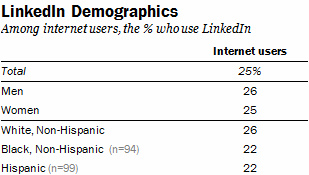
Unless big data has a disparate impact, the EEOC has no business examining this issue. So, what says the data? For purposes of this post, consider the use of social media as a recruiting tool. If an employer is relying primarily on LinkedIn to source and recruit candidates, does its use disparately impact one race or sex over another?
According to the most recently available data (c/o the Pew Research Center), the answer is no.
If men vs. women, or whites vs. blacks, or whites vs. Hispanics, are using LinkedIn in similar percentages, then, based on the data, it will be difficult to make a disparate impact claim on this big-data issue. Granted, the EEOC examined issues much more broadly than just social recruiting, but at least on this issue, and at least according to the available actual data, it looks like employer should be free to use LinkedIn to source candidates without fear of a discrimination claim.
Kudos to the EEOC for thinking outside of the box in trying to discover new paths of discrimination to address. I wonder, however, if when the EEOC gets around to opening that box, instead of finding Pandora’s evils, it will find a whole bunch of nothing.
Jon Hyman is a partner at Meyers, Roman, Friedberg & Lewis in Cleveland. To comment, email editors@workforce.com. Follow Hyman’s blog at Workforce.com/PracticalEmployer.
Workforce editors Rick Bell and Frank Kalman discuss a new study showing that holding face-to-face meetings with clients results in substantial amount of money in the form of new business. Also, some thoughts and takeaways from this year’s HR Technology & Exposition in Chicago; and what job tops the American Staffing Association’s most difficult positions to fill list? Hint: It’s not journalist …
I attended the Workday Rising conference in Chicago, my first major HR conference.
Almost 7,000 people attended. HR software company Workday released information about new products, features and partnerships. We’re going to take a break from my normal beat of wellness for a moment and consider two other workplace issues that I encountered at the conference: learning and recruiting.
James Cross, director of product strategy at Workday, spoke of the increasing relevance of video in today’s workplace learning. For example, Workday is incorporating video learning on its platform, and users can create their own content from their own phones. They can post it in seconds onto the platform for learners to watch.
The rising importance of video is as significant as the rise of mobile a few years back, Cross said, paraphrasing Facebook’s Mark Zuckerberg who saw the increasing importance of video and developed Facebook Live.
Video has always been powerful, Cross said, but it’s only recently that it’s been at the reach of your average person or consumer. And because people consume so much video content in their everyday lives, they want their learning content to look the same.
But this explosion of video in the consumer world — think YouTube — hasn’t been as quick to spread to the enterprise market, which is why Workday is investing so much time in developing a simple, effective video learning system.
The other gem of this conversation: Cross started out his career as a high school music teacher, which is when he realized how video could have such a strong impact on learning. At the time though, video was difficult enough that other teachers didn’t necessarily use it in the same way. Now in 2016, video is so simple anyone with a phone can create video content.
My conversation with Cross was valuable, first of all, because I used to write mostly for our sister magazine Chief Learning Officer about learning and development. Now, on my benefits and wellness beat I wonder: If the rise of video is such a noteworthy development, how might video be incorporated in wellness programs, benefits communications and the like? The rise of telemedicine, for example, is related to the increased availability of video chatting and the convenience of speaking to a doctor or counselor via a phone or computer. Increased access to video and increased simplicity in creating video content is something that could impact other parts of a business outside of learning.
I also spoke with Kelly Swanson, director of HR operations at FICO, the leading data analytics software company. The company is now using Workday’s platform and especially found value in the recruiting capabilities. What was especially interesting about this conversation was how FICO used very focused data to recruit a particular type of person: students.
Whereas before their internship program was not robust, now internships are key to FICO’s growth strategy. The company looks at developing interns for full time positions, Swanson said. They use this recruiting system, which allows them to focus the search and find the right people who are interested in working in the industry.
Also key to this conversation: the unification of HR processes. For example, FICO uses Workday, which unifies everything from recruiting to onboarding to compensation under one platform and which does so across all of FICO’s 38 global offices.
Simplifying HR processes is something I hear a lot about now, and as I head to my next HR conference next week, I’ll be sure to look out for more about it.
Andie Burjek is a Workforce associate editor. Comment below, or email at aburjek@humancapitalmedia.com. Follow Workforce on Twitter at@workforcenews.






 In late September, Accenture’s Ellyn Shook welcomed 1,200 new female engineers to the company at an onboarding event at its offices in India.