Skip to content

Workforce

Author: Andie Burjek

Posted on February 28, 2020June 29, 2023

Mental health in low-wage workers

employers mental health; Millennials and mental health

Mental illness impacts people from every demographic — be it age group, race, job type, socioeconomic group or gender. Still, despite these similarities, low-wage workers face unique challenges to addressing their mental health concerns. 

employers mental health; Millennials and mental healthThe Midwest Business Group on Health held a one-day conference on mental health access and stigma in the workplace last week, and one theme that came up in a few presentations was addressing mental health in low-wage workers.  

Also read: Mental illness cuts across the workplace hierarchy

Bruce Sherman — chief medical officer at the National Alliance of Healthcare Purchaser Coalitions, longtime researcher of health issues, and medical director, population health management at Conduent HR Services — did a presentation called “Do wages buy happiness?” He confirmed that, yes, wages are important in the sense that in the past 15 to 20 years, low-wage workers have gotten the smallest pay increases in relation to their income and high-wage workers have gotten the largest pay increases in relation to their income. 

Needless to say, wages do matter.

The conversation goes past that, though. Sherman is currently working on a research project on this topic whose results are not public yet, but he also provided a high level overview of some the issues low-wage workers may face with mental health care and access.

Worsening income inequality is one reason these workers may face trouble. Another major reason is productivity demands, Sherman said. 

Rising productivity expectations is not a surprise to me. Research for a few recent stories have led me to data points or findings that support this. For example, according to the 2018 European Agency for Safety and Health at Work report, “Managing Performance Enhancing Drugs in the Workplace: An Occupational Safety and Health Perspective,” workers in low-paid jobs that are not protected under standard labor laws may feel increased pressure to hit certain productivity levels, especially since they are increasingly being monitored by their employers. Not wanting to lose a job they rely on, they may turn to smart drugs. “Electronic means of monitoring employees are likely to be accompanied by an increase in the stresses on workers,” the article noted.

Also read: The workplace is not immune to the impact of social determinants of health

Working Well workplace health blog, Andie Burjek Sherman also informed the audience at MBGH’s event that the perception of mental health stigma may vary by socioeconomic status. There are two types of stigma — public stigma refers to discrimination or stereotyping from other people and private stigma refers to people internalizing stigma in a way that eats away at their self-worth. Low-wage workers often have a greater sense of personal stigma with behavioral health disorders, Sherman said. 

This type of personal barrier also exists among cost issues and broader, structural barriers, like the lack of available psychiatrists in their insurance network or the the lack of nearby mental health care based on where they live.  

Sherman suggested a few types of ways employers can address these issues. Through benefits design, they can consider eliminating mental health copays for employees so they can access behavioral health services. Ocean Spray is an example of a company who has done this, as of July 2019. 

In an article Workforce published last March, Sherman gave more suggestions for changes in benefits design to address mental health in low-wage workers: 

“Some employers offer hourly employees a half day every year specifically to see their doctor for preventive care services, he said. Other employers offer paid sick leave to all employees, including hourly workers. And other employers have ditched ‘just-in-time’ scheduling practices and opted for fixed work hours for all employees — a perk for hourly employees since variable scheduling limits predictable income for employees living paycheck to paycheck.”

Organizations can also leverage community social services that employees could take advantage of, Sherman said. Further, they can consider what workplace contributors may add to behavioral health problems and address those workplace issues. 

Also read: Business group releases employer guide for managing diabetes in low-wage employees

One final suggestion to address mental health in low-wage workers relates to mental health stigma, and I found it rather interesting. Diversity programs could include information that addresses the negative stereotypes associated with mental health problems. I don’t know of any diversity programs doing this, but I’d be interested in hearing from anyone who is involved with a program like that!

Final takeaways from the MBGH conference:

1. Jeremy Nobel —  the founder of The Unlonely Project who currently serves on the faculty of the Harvard Medical School in the Department of Global Health and Social Medicine — spoke about the negative impact of loneliness on people. He mentioned that LGBTQ+ employees, minorities and people with major illnesses or disabilities are especially susceptible to isolation, and mentioned some activities to help them feel connected.

This was interesting and valuable in its own way, but what I found was missing from his presentation was what external factors might make some of these groups of people feel isolated at work. These are groups of people that are likely to be discriminated against in the workplace compared to straight people, white people or people without disabilities. If your organization is pushing for these deeper connections between people but not addressing the reality that even casual discrimatation or harassment will stifle these connections, can it really address this issue?

2. What’s the actual definition of a crisis? Any time I attend a health-related conference, most every public health issue is deemed a crisis. While I understand some of this mentality, I also wonder how we as individuals, governments or organizations are supposed to pay attention to so many health crises at the same time and give them all the proper attention.

3. I wrote a little about generational stereotypes about mental health last week. My overall argument was that both older and younger employees have health issues, and only paying attention to how millennials or Generation Z “can’t handle stress” or whatever can be infantilizing. Also, it leaves older people out of a very important discussion about finally getting help for mental health issues.

I want to add one more thought. Business/health conferences tend to have an older crowd. That makes sense; they’re professionals who have a deep history in the industry. But where’s the voice of these “young people” who apparently have so many more mental health issues than generations before them?

What I think would be interesting is if there was a way for teenagers or young 20-somethings to share their perspective on the mental health of their generation versus older ones. It could be an opportunity for people in different generations to share their stories. For every “Kids these days get all their self-esteem from social media and that destroys their mental health!” from a 40-something parent, maybe a 16-year-old could clarify how common or uncommon that actually is. It could be an opportunity to address certain generational stereotypes head-on. 


Posted on February 27, 2020June 29, 2023

DO NOT use social media to determine applicants’ race and gender

Person on laptop

Almost as long as social media has existed, employers have searched social media to dig up dirt on prospective employees. There is nothing illegal about these searches … provided you don’t use the information unlawfully. For example, to discriminate on the basis of a protected class.

If Lisa McCarrick, a former Amazon manager, wins her lawsuit against the online retailer, Amazon is going to learn this lesson the hard way.

According to NBC News, McCarrick claims that Amazon fired her after she complained to her supervisor about being made to scour the social media accounts of applicants to determine their race and gender.

McCarrick joined Amazon as a loss prevention manager in July 2018 and was promoted to a regional manager five months later, the suit says.

After her promotion, her supervisor instructed McCarrick to go through the social media profiles of job candidates “for the purpose of ascertaining race/ethnicity and gender,” according to the lawsuit.

In September, she submitted a written complaint raising her concerns about being told to scour applicants’ social media accounts…. Two months later, in November, she was called into a meeting with human resources and the director of loss prevention informing her that she was fired.

I am not going to begin to suggest that employers refrain from searching publicly available information on social media to help screen candidates. Social media can provide a treasure trove of information that could disqualify someone from employment. Wouldn’t you want to know, for example, if a prospective employee trashed a former employer, or shared a former employer’s confidential information, or posted racist comments?

What you cannot do, however, is use social media to screen candidates on the basis of race, gender, or any other protected class. This should be common sense, right? Right?

Also read: NBC reignites privacy debate by requiring job seekers’ social media passwords 
Also read: Requiring social media passwords from candidates is a bad idea
Posted on February 27, 2020June 29, 2023

The workplace is not immune to the impact of childhood trauma

trauma-informed workplace training, Baltimore, Youth Healing Team

There is increasingly a greater understanding that one’s work life impacts their personal life and vice versa. The two do not exist in separate bubbles.

Adverse childhood experiences — potentially traumatic events that occur in childhood — can impact how people cope with stress, how their brains develop and how much risk they have toward certain health issues, according to the Centers for Disease Control and Prevention. ACEs include violence, abuse and growing up in a family with mental health or substance use problems. While 61 percent of adults in the U.S. have at least one ACE, 16 percent have at least four. 

Even though ACEs occur long before people enter the workforce, they’re still relevant to a person in adulthood. And employers can take certain steps to create a “trauma-informed workplace,” said Kate Daugherty, community impact director at Hopeworks. Education management company Hopeworks has been trauma-informed since 2012, and Daugherty leads the Youth Healing Team, which trains other organizations in how to have this culture. 

The Youth Healing Team has led training for schools, health care organizations and nonprofits, but this type of knowledge is useful for people in any industry, Daugherty said. 

trauma-informed workplace training, Baltimore, Youth Healing Team
The Youth Healing Team provided training for the city of Baltimore, which is now a trauma-informed city. Photo credit: Hopeworks.

The City of Baltimore had the team provide training on the weekend of Feb. 8-9, when Mayor Jack Young signed the Elijah Cummings Healing Act, officially making Baltimore a trauma-informed city. The bill requires the city to train employees on trauma-responsive and trauma-informed care and services.

City Councilmember Zeke Cohen sponsored the bill. Cohen, who is also Chairman of The Education & Youth Committee, recounted a mass shooting in his district, the First District, in which four people were shot and two people were critically injured. The mass shooting took place at 3:45 in the afternoon, when two different schools were dismissing. Many children witnessed the mayhem. 

“The thing that was perhaps most disturbing to me is when I went to visit one of the schools the next day, there was no additional support. No clinicians, no crisis response team. It just happened,” he said. “And what we know about trauma and the brain is that unless treated, that exposure to violence can have an indelible impact on the long term health outcomes and well-being of young people.”

On another occasion, a group of high school students whose school recently had a school shooting approached the education committee and challenged them to work more on reducing trauma, Cohen said. The committee worked with the students on the bill to make Baltimore a trauma-responsive city. 

Interestingly, Cohen said, one type of business helped create a groundswell of support for this bill: Barbers and beauticians. In some Baltimore communities, people of color distrust getting psychiatric care in the hospital or health care setting because of mental health stigma, Cohen said, and barbers have become the unofficial clinicians of these communities. They cut the hair of and have conversations with people who may be the victims or shooters in mass shootings.

The support of businesses like barbers and beauticians was important to the cause, Cohen said. 

“Even if the bill is great, if we don’t have a groundswell of people and organizations standing with it, we’ll miss an opportunity,” he said. 

Part of the training which Hopeworks provides organizations and the city of Baltimore is learning about buffering factors, Daugherty said

People with ACEs may develop coping skills that got them through traumatic times in the past, but those skills aren’t appropriate for a professional setting, she said. And employers shouldn’t demonize employees for their coping skills. 

She gave the example of a Youth Healing Team employee who was a smoker. Upon talking to him, they found out that he liked having that opportunity to stop and breathe. The Youth Healing Team suggested that, when he was stressed, he try standing still and taking 10 deep breaths. Then, he could reassess how he was feeling and decide if he still felt like he needed to smoke. 

“Sometimes it worked and sometimes it didn’t, but slowly over time we started to see that he needed to use that adverse coping skill less and less often,” Daugherty said. 

Cohen stressed the importance of continued support of individuals, nonprofits and businesses if this bill that encourages Baltimore to train its employees to be trauma-responsive is to remain durable. Different organizations and nonprofits tend to operate in silos.  

“What’s been gratifying to me about this work has been to have all these organizations working collectively. It’s been exciting,” he said. “It’s hard for a number of reasons for organizations to think about collective impact outside their own institutional needs.” 

Posted on February 26, 2020July 24, 2024

Immigration update: Employers must use a new I-9 form for 2020

immigration law, I-9 forms

The federal government recently released an updated Form I-9, and although employers aren’t required to use the new version until May 1, 2020, best practices dictate that they should start using it immediately. The Form I-9 verifies the identity of new hires and ensures they are authorized to work in the United States, and it is the first update from the United States Citizenship and Immigration Services in a few years. 

With this recent announcement, employers should take immediate steps to ensure compliance with the new form —  or risk financial penalties.

Minor, but important changes 

There has only been a subtle change to the form itself. Specifically, USCIS revised the Country of Issuance field in Section 1 and the Issuing Authority field (when selecting a foreign passport) in Section 2 to add Eswatini and Macedonia, North, because those countries recently announced name changes.

immigration law updatesThis change is visible only when completing the fillable Form I-9 on a computer. The paper version of the new I-9 will look identical to the current version dated July 17, 2017.

However, changes to the form’s instructions are more substantive:

  • Updated website addresses and other contact information: The instructions no longer contain contact information for the Immigrant and Employee Rights Section of the Department of Justice.
  • Clarification as to who can act as an authorized representative on behalf of an employer: The instructions make clear that employers can designate “any person” to complete and sign Section 2 of the I-9 on the employer’s behalf. The instructions also make clear that the employer, not the authorized representative, is liable for any violations committed in connection with the I-9. The lesson here is that while you may choose anyone to serve as an authorized representative, choose carefully and make sure they understand how to correctly fill out Section 2.
  • Instruction that employers who enter information in Section 2, List A should not enter N/A in Lists B and C (and vice versa).
  • Updates on the process for requesting paper Form I-9s (as an alternative to printing them from the USCIS website) and an updated Department of Homeland Security Privacy Notice.

Begin using new form immediately

Although employers can continue using the previous Form I-9 through April 30, 2020, it makes sense to scrap the use of the July 17, 2017 version and begin using the updated version right away. Employers should recycle all older blank versions they already have printed and instruct their hiring managers and human resources representatives to download the new Form I-9 for use with new hires going forward.

On May 1, 2020, all employers will be required to use the revised form, so they should avoid any delay and begin using the new version immediately. It’s important to remember, however, that they should not require current employees to fill out the new I-9 form. Rather, they should use the new Form I-9 only for new hires moving forward.

Also read: 3 ways HR leaders can stay ahead of changing immigration policies

Non-compliance can be costly

Although the changes to the Form I-9 and its instructions are slight, failure to use the new form and comply by the May 1 deadline can result in large fines. I-9 audits have increased threefold in recent years (from 1,360 to 5,981 per year), while worksite investigations have increased even more dramatically (from 1,691 to 6,848 per year).   

Potential fines are also increasing — paperwork violation fines can now range between $230 to $2,292 per employee. Civil penalties for knowingly  hiring or employing unauthorized workers currently range from $573 to $4,586 per employee for the first violation. Second- and third-violation civil penalties can range between $4,586 up to $22,972 per employee. Arrests and criminal convictions for knowingly hiring or employing unauthorized workers are on the rise as well.

Conclusion

It is unlikely that the Trump administration will slow down DHS’s employer-driven immigration compliance mechanisms. Based upon recent actions from the administration to increase enforcement and hire more ICE agents, along with statistics demonstrating significant increases in I-9 audits and worksite investigations, it is increasingly likely you could face enforcement actions in the form of ICE audits, workplace raids and employee detention. Accordingly, now is the time to review your I-9s and your compliance policies to minimize exposure should the government show up on your doorstep demanding to see your I-9s.

Also read: Do you know what to do if ICE shows up at your business?

Posted on February 24, 2020June 29, 2023

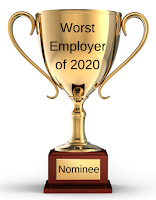
The 4th nominee for the Worst Employer of 2020 is … the Perverted Peking-duck Purveyor

sexual harassment prevention requirements

worst employer of 2020 trophy Every year I worry about how I’m going to fill my annual list of worst employers. I’ve yet to be disappointed.

The EEOC recently filed suit against a Medford, Oregon, Chinese restaurant after its middle-aged night-shift manager repeatedly sexually harassed young female employees.

The allegations are horrific. The manager is accused of the following.

  • Repeatedly making sexual comments, sexual innuendos, and remarks to female employees.
  • Repeatedly touching female employees’ backs, shoulders, waist, hip/crotch area, buttocks, rubbing his body up against female employees’ bodies, and standing close behind female employees and staring at them.
  • Repeatedly touching the breasts of female employees including putting his hand under a female employee’s shirt and bra.
  • Pulling on the shirt and bra of a female employee to expose her nipple.
  • Asking a 15-year-old female employee to send him naked photos of herself.

Yet, those allegations, as awful as they are, aren’t what earned this employer its nomination. It’s what happened after the victims complained that placed this employer on this year’s list.

According to the EEOC—

Even after the manager … was arrested at work and booked for sexual abuse of the restaurant’s minor employee, he was permitted to return to work.… Despite repeated employee complaints and the manager’s guilty plea to misdemeanor harassment, the restaurant failed to stop his behavior or discharge him. Instead, New China fired one female employee soon after she reported his inappropriate conduct and another female employee felt she had no choice but to resign.

If you enable your 50-something manager to sexually harass your teenage workforce, even after employees complain and he’s arrested for and convicted of harassment, you might be the worst employer of 2020.

Previous nominees:

The 1st Nominee for the Worst Employer of 2020 Is … the Repeat, Repeat Offender

The 2nd nominee for Worst Employer of 2020 is … the Uncaring Chief

The 3rd nominee for the Worst Employer of 2020 is … the Arresting Retaliator

Posted on February 21, 2020June 29, 2023

Effective onboarding can be done on a budget

Onboarding Blue Marker
Cheryl Strizelka
Design Interactive, Inc.’s Cheryl Strizelka.

Creating an effective onboarding process is vital when it comes to employee engagement and retention. While it may seem tedious and time consuming, there are many ways to implement a successful onboarding program without breaking the bank.

The onboarding process should be well-thought-out and not done on a whim. Keeping in mind the new employee and the nerves that come with starting a new job goes a long way. 

Cheryl Strizelka, director of human resources at technology company Design Interactive, Inc., said that it is essential to consider the little things. New hires should be equipped with all the tools and information they need to easily transition into their new position. This includes everything from the smallest details like providing pens and notepads to the bigger priorities like making sure they have a dedicated person to guide them through their transition. 

Giving a facility tour early on in the process and providing the new hire with several points of contact in case they have questions also helps make them feel more at home as quickly as possible. “These intangible considerations don’t cost a penny, yet make a huge difference,” Strizelka said.

Also read: How to create a formal onboarding program

One of the most vital parts of onboarding is introducing the new employee to their team. It’s also common for managers to take their new employees to lunch or for the company to host a breakfast on their first day to get to know the new hire better. “Those things cost money, but you wouldn’t believe how much it changes somebody’s first day and their first week because they’ve met everybody,” Strizelka said. “You want to get them integrated as quickly as possible, creating some familiarity so they feel like they’re a part of the company, even if it’s early.”

There are also crucial conversations to have with new employees that give them a sense of what their role’s purpose is in the company, as well as what workplace culture is like. 

“New employees should know almost immediately how their role directly impacts the company’s vision and mission,” Strizelka said. “It’s also important that they understand how they will interface with colleagues that aren’t in their immediate circle.”

One invaluable gift that Strizelka advises all organizations to take advantage of is employee feedback. Asking employees who have recently started their positions to look back at their onboarding experience and give input on what was good and what needed improvement can be helpful. “I see a lot of HR professionals who get offended by that. They take it personally,” Strizelka said. “But when it comes down to it, that’s a gift they’re giving you. They’re giving you your next hack for your next onboarding.”

Also read: Constant connection is key to engagement of a global workforce

An onboarding program is usually owned by both the operations and HR teams within an organization. Strizelka said. While it’s common for these teams to feel like they’re going head-to-head, it is important for both to continuously work hand-in-hand, since this process exceeds much longer than just an employee’s first day or week. 

“Sometimes we find ourselves performing onboarding activities well into the first year of employment, and the [operations] team plays a huge role in this if executed successfully,” Strizelka said.

Churning people through the onboarding process just to check off all the boxes and get it over with quickly will only hurt the organization in the long run as high turnover rates are extremely costly, Strizelka said. It is essential to think about each person as an individual when going through this process and not just something to check off of a list.“The most expensive part of onboarding is doing it wrong,” she said. 

An effective onboarding program will protect the company’s investment in new employees and help create engaged and motivated team members, ultimately boosting employee retention, she said. 

“The onboarding experience for an employee sets the tone for an entire employment experience,” she said. “It may be cliche, but it’s true — you never get a second chance to make a first impression.”

Posted on February 20, 2020June 29, 2023

How to create a formal onboarding program

onboarding strategy small business

Brad’s Deals didn’t always have a formal onboarding program. New hires would have meetings with the hiring manager and HR, but there was something lacking that could improve the employee experience, said Jessica Adams, vice president of people at Brad’s Deals and 2018 Workforce Game Changer. 

“You spend a lot of time trying to find the right fit for your organization in a really competitive recruiting environment,” she said. “So you need to work to make [new hires] feel welcome and incorporated as a team member as soon as possible.”

Employee engagement starts at the beginning of the recruitment process and continues through onboarding, said Jennifer Duff, co-founder of Totem Consulting, which has built many onboarding programs for its clients. These experiences that happen early on set the stage for the way in which employees will engage with the organization moving forward. 

New hires partly assess their new job by asking themselves if working at this company was really what they were promised during the recruiting process, Duff said. This is why employees should think more broadly about onboarding, past the basic HR tasks like signing forms. Consider “whatever you want your employee experience to look like as an organization and your employer brand, and then weave that into your onboarding,” she said. 

If employees are sold on a company through the recruiting process and then their onboarding experience does not live up to their expectations, there may be some negative impacts for employers, she said. Employers may see high attrition rates because new employees leave after a few months. 

To avoid this, employers have the power in those first few months to shape a new hire’s employee experience during onboarding rather than letting other parties set the tone. 

“If you’re not managing that conversation up front and if you’re not owning that conversation, that conversation will get owned through water cooler conversation, and that can undermine what the employer is trying to do in terms of the employer brand or the employee experience they’re trying to create,” she said. 

Your Onboarding Timeline

Brad’s Deals’ onboarding process has changed over the years through a process that allows for actionable feedback and constant improvement. 

Also read: 5 easy onboarding strategies for small businesses

Before a new hire starts, they receive at least three phone calls or emails from HR about how excited the team is to have them on staff, what time they should come in and how to dress on their first day, Adams said. Meanwhile, before the employee’s start date, the head of each of the organization’s eight departments sit down and decide, based on the role of the new hire, the most important people they should meet in each department during their first, second and third weeks.

The questions people have in their first week versus the end of the first month are very different, Adams said. While they tend to have more general questions at first, the longer they’re at the organization, the more focused their questions are based on what they’ve observed about their job or around the office. This is why meeting with people from each department on a weekly basis is valuable. 

Jessica Adams, Brad's Deals
Jessica Adams, Brad’s Deals

In addition to these meetings, Brad’s Deals does check-ins with new hires after week one, week two and week four through online surveys. Questions include: How are you doing? Who have you met? How else can we support you? And, what questions do you still have?

New hires also have face-to-face meetings with their manager after three months and after one year, Adams said.  

“Traditional literature says that someone is considered a new hire for three months, but I think there is also some benefit to looking at someone as a new hire for their first year,” she said. “Every company has their busy season, [and] they have their slower season. You want to give that new hire the opportunity to experience the entire cycle your organization goes through each year.” 

Brighid Courtney, client leader at Wellable and a WELCOA Institute faculty member, built Wellable’s first onboarding packet and procedure, and she also included a well thought-out timeline. 

In their first two weeks, Wellable’s new hires have “highlighted meetings for the day” in which they meet with the different departments and learn about what they do and how they contribute to the overall goals of the company. 

Then, the new employees receive a task for the day, based on these meetings. For example, a new project management hire meets with the customer support team one day. They may sit in with support employees and learn about some of the user issues people have with a type of software. Then, their task would be to answer some user tickets to help them further understand the user experience. 

Also read: Onboarding tips HR leaders can adopt from the first day of school

“As you’re looking to build a collaborative environment, it’s important for people coming in to be able to build those relationships early on to make sure they can always go there for help or for resources,” Courtney said.  

The company also makes sure to space out these meetings and tasks so that the employee is not overwhelmed with new information, she added. 

Value of Constructive Feedback

While employee feedback is valuable to any process, it’s especially important when an organization is starting something new, Courtney said. There’s room for growth, and tweaking anything that needs improvement will help the program grow in the right direction. 

Brad’s deals uses its regular new hire check-ins both to make sure the employee has their questions answered and to get feedback on where there’s room for improvement in the onboarding process, Adams said. But the company also uses feedback from candidates who did not receive job offers to make improvements. 

“Getting feedback from people who were not hired is valuable to us to ensure that we are being clear, authentic, and realistic about the projects and the opportunities and our expectations of someone in the role,” she said. 

One time, the company received feedback that a candidate had to wait 15 minutes for their second interviewer to come into the room. Learning this, Brad’s Deals was able to ensure that they could improve the process and not make any candidate have to wait anymore.

“Onboarding is so greatly impacted by the preboarding phase and the recruiting phase that you really have to keep it in mind before someone’s even walked through the door of your organization,” Adams said. 

Big Picture Guidance for Employers 

While this process may seem overwhelming to employers who are creating their first formal onboarding program, Duff recommends that organizations try not to take on too much, overextend themselves and underdeliver. The best thing an organization can do is create small improvements consistently and iteratively over time, she said. 

Practically, how this might pan out is that once every month, the organization makes one change in the onboarding process. That might mean something as manageable as starting to have the CEO send a welcome email or regularly send a simple pulse survey. 

“People get daunted easily by overhauling a program, and I try to encourage my clients to look at it through small impactful changes, because it gets people used to seeing [that] small things can be done, and you can implement feedback quickly,” she said. “It’s about building small wins.”

Creating a flexible timeline is one of the most important parts of making a formal onboarding program, Courtney said. 

“For anyone with a limited budget, time is such a valuable resource,” she said. Organizations must make sure they give new hires enough time to work on the tasks they need to complete. It also helps if there is room built in their schedule to make adjustments and change the timeline, if necessary. 

She suggests that employers carefully plan out that first month with flexibility in mind and come up with the most vital objective and goals for new hires to reach in that time frame. 

Using consistency to help with retention and attrition rates is a major part of Brad’s Deals overall strategy, Adams said. Their process in which new hires meet with people in every department ensures that every new employee has the same meetings that last the same amount of time and gets the same information. The importance of consistency starts well before these meetings, though. 

“If we’re not level-setting with someone during their interviewing process, they’re going to be surprised or they’re not going to be happy when they get here,” she said.

And as HR professionals, we know the worst thing is for an employee to be surprised about what they’re experiencing or the message they’re getting.” 


Posted on February 19, 2020October 12, 2021

5 ways to inspire employee engagement today

employee engagement tips

Employee engagement is not something you can achieve overnight. 

It takes time, dedication and leadership commitment for those HR leaders who want their workplaces to become a great place to work. Even Jim Harter, chief workplace scientist for Gallup, admits that seeing a significant change in engagement scores could take years. 

But don’t be discouraged. There are many things that can be done immediately that will start moving the needle on employee engagement. Here are five places to start.

1. Say something shocking. 

“Engagement is like a river,” said Greg Barnett, senior vice president of science for HR consultancy Predictive Index in Boston. “Sometimes you have to do something dramatic to change the way it flows.”

To do that, Barnett suggests leaders figure out what is missing from their culture, then make a grand gesture to demonstrate that things are going to be different. It could be sharing previously guarded company information, publicly celebrating employees for their hard work, or discussing the bad news that everyone has heard rumors about but no one is willing to discuss. “Shocking them with transparency is a great way to get everyone’s attention,” Barnett said.

2. Practice gratitude. 

“Showing employees that you value what they do is critical for engagement,” said Sarah Hamilton, senior director of HR for North America at Workhuman in Framingham, Massachusetts. “It shows them that what they do matters and helps them see how their work drives the company forward.”

Showing gratitude doesn’t require a sophisticated reward system or official gratitude program. It can be as simple as congratulating teams on the company’s social media platform, sending a personal note of thanks, and acknowledging their hard work in every conversation. “It feels good to be recognized but it also feels good to recognize others,” Hamilton said. “It is a powerful experience for everyone.”

3. Help them plan their careers.

Fully 94 percent of employees say they would stay at a company longer if the organization invested in their development. The ability to learn new skills makes them feel engaged and appreciated and shows them that the company is willing to invest in their future, Barnett said. “Managers can quickly make a short-term impact on engagement simply by paying attention to employees’ career development.” 

He encourages managers to build training plans around employees’ goals even if they extend beyond a career at the company. “Start by listening to what employees want for the future,” he said. Then if possible, help them find the training, mentoring and career advice to make it possible.

Some companies are tackling this goal head on. For example, Amazon’s Career Choice program covers tuition for employees who want training in any in-demand field — even if it has no relevance to the company; and McDonald’s new career exploration app, Archways to Careers, offers employees career advice to help them map out their professional career wherever it may take them. 

“Building an entire career development program requires coordinated effort,” he admitted. But taking the time to ask what employees want to do with their lives then offering to help is a great first step. 

4. Provide constant feedback.

The annual performance review is unofficially dead. If you want people to see the connection between their hard work and the company’s success, then constantly talk to them about it, Hamilton said. Workhuman uses the company’s Conversations platform to enable easy regular check-ins between managers and employees and between peers. 

She noted that teammates and colleagues often have a better sense of how work gets done and who is contributing than managers. Encouraging peer-to-peer feedback creates a culture of engagement and ensures hard work gets acknowledged. “A continuous feedback loop motivates and empowers employees, and makes everyone feel appreciated,” Hamilton said. 

5. Don’t stop.

All of these strategies can have a short-term impact on employee engagement, but the change will be fleeting unless you stay committed to these actions. That means continuing to be transparent, support career development, provide feedback and practice gratitude on a daily basis. “Engagement programs often fail because after a few months everyone moves on to the next thing,” Barnett said. 

So don’t do it unless you are willing to make changes that will stick.

Posted on February 13, 2020June 29, 2023

Why ethics is the crux of employee engagement

protest, employee rights

Throughout 2019, numerous factors forced companies to recognize the importance of ethical leadership. 

Barcelona, Catalonia. Thousands of people took to the streets as part of the worldwide movement. Global Climate Strike, international, protests and action against climate change.From Google’s employee protests and walkouts to the onset of GDPR and data privacy troubles of companies like Facebook, ethics has not only dominated the headlines but also become a catalyst of both employee satisfaction and business success.

In this climate, employee alignment is simultaneously more important and difficult than ever to achieve. Employers are demanding more out of their employees, but at the same time, face a range of evolving preferences and digital distractions that make it difficult to capture their attention and trust. Business and HR leaders must adopt an ethos of ethical leadership while thoughtfully implementing engagement strategies or risk losing top employees and the ability to recruit the best as the war for talent rages on.

Ethical practices or a lack thereof will give organizations a competitive advantage or become their demise. 

Set the tone at the top

While they may seem insignificant at the time, small actions and decisions by company leadership can add up to big consequences and contribute to the ethical fabric of the workplace. First and foremost, business and HR leaders must prioritize a renewed commitment to transparency — and make it known. Then, they can incorporate tools and strategies to make their values more visible across the entire company, including frontline and deskless workers (i.e., the 80 percent of the workforce that doesn’t sit at a computer).

Also read: 5 ways leaders ruin employee engagement 

An authentic presence of leaders is the most important element in building trust with employees. This not only boosts productivity and performance but also prevents behavior that creates a toxic work environment. Leaders who are genuine and open in their communications can also help thwart digital water coolers from spreading misinformation around the workplace, especially with today’s social and collaboration platforms that make it easy for anyone to spread misinformation.

When challenges do arise, it is critical to get ahead of the conversation through proactive, honest communication, sharing the “why” behind decisions so employees hear it straight from the source. Business and HR leaders should be vigilant in sharing these types of company updates to instill trust and reinforce values. 

Shockingly, only 16 percent of employees worldwide consider themselves fully engaged. And in the face of an engagement crisis, annual or quarterly surveys don’t cut it to ensure employees’ needs are met. Instead, an approach that focuses on data from employee behavior and pulse polls delivered at optimal times can give leaders a real-time temperature on their organization. These insights can quickly be turned into action to most efficiently reach and engage all employees.

The most effective way to align the workforce must take employee preferences into account. For example, some workers may find nontraditional and more interactive forms of communications to be a welcome change from email or chat, which can create an “always on” culture and lead to burnout. 

More vibrant media, such as audio and video methods, makes the quality of interactions far richer, facilitating community-building and allowing distributed workers to feel closer to the business. Whatever their preferences may be, tailoring engagement strategies through a data-based, personalized approach ensures all employees get the information they need to build trust.

Empower employees to speak up

In an era of employee activism, organizations must not only support but actively encourage employees to make themselves heard. Instead of top-down communications, establishing two-way communication channels and mechanisms for feedback gives employees the opportunity to provide perspectives and ask questions in a way that holds leaders accountable. 

With this in mind, organizations should acknowledge and ensure that all employee feedback is heard and proper action is being taken. HR managers should use the data and insights from these channels and programs to reevaluate their diversity, equal pay or other policies and make sure they are as impactful as possible. They should also use these tools and insights to implement valuable recognition programs, whether rewards, promotions, bonuses or other programs so employees feel motivated to do their best work. 

In 2020, ethical leadership will no longer be an option, but an imperative that directly impacts the bottom line, pushing companies to build ethics into policies and practices, place a renewed focus on culture and seek ways to measure the impact of their efforts. 

In a digital workplace, business leaders must adopt tools, technologies and practices to create a more connected, engaged and productive workforce or risk losing trust in an era when it’s needed most.

Posted on February 11, 2020June 29, 2023

CBD: What employers need to know

cbd oil, employer questions

cbd oil, employer questionsEmployers don’t have to be operating in states where marijuana is now legal to be impacted by its changing status. Cannabidiol, a compound derived from the cannabis plant, is already available legally in every U.S. state. CBD oil and products containing CBD are impacting workplace drug policies in ways that are still unclear.

Confirm BioSciences, a national provider of drug testing supplies and laboratory services, has issued a report on the effect of CBD. As the medical review officer of the organization, here I answer the most common questions employers ask about this increasingly popular substance.

Q: What exactly is CBD?

A: CBD, the shortened name for cannabidiol, is an extract from cannabis, the plant that produces marijuana. It can also be obtained from the hemp plant, another form of cannabis that has extremely low levels of THC, the substance that instills a high. Hemp became legal to grow commercially in every U.S. state in 2018.

Also read: Opening up the workplace medicine cabinet

Q: What are the legitimate uses for CBD? Are there any uses that can be prescribed by a physician?

A: From a scientific perspective, the only medical condition for which CBD has been approved is a certain type of seizure disorder. The medication is called Epidiolex, and it was approved in 2018. As far as other conditions for which medical providers may recommend CBD oil, the problem is that there have been a very limited number of medical studies, with conflicting results. We’re simply not there yet in terms of scientific support.

Q: Will using CBD compromise employee performance in any way?

A; To answer this, we run into the question of whether the CBD is 100 percent pure, which is defined as containing less than 0.3 percent THC. If a product contains pure CBD, there should not be any employee performance issues. The challenge is that the vast majority of CBD products are not pure. Up to 70 percent of CBD products are mislabeled. According to a recent Journal of the American Medical Association study in which 84 different CBD products were analyzed, THC was present in 18 of the products in varying amounts.

Q: Are there any circumstances or occupations in which CBD should never be used by employees?

A: If the product used by the employee meets CBD purity standards, there should be no physical or mental impairment. The real issue is purity.

Q: How long will CBD stay in a person’s system?

A: It depends on the individual. For some, CBD oil will remain in the system for two to five days. For others it can take weeks to resolve. The typical time is around one to two weeks.

Q: If CBD is legal, why are workers using CBD-infused products failing drug tests?

A; The challenge with CBD in the workplace is that, either knowingly or unknowingly, people are using CBD tainted with THC. So people might be buying a product with CBD to help them sleep, and if that product also contains THC, it may be the THC that is impacting their sleep instead of the CBD.

Also read: Managing people in the growing cannabis industry

Q: What can be done to ensure that CBD-infused products are pure and don’t contain THC?

A: Currently no governing or regulatory body is tasked with ensuring the purity of CBD. The oversight just isn’t there to ensure that when people are buying a CBD product, they are getting pure CBD oil. For workers and employers to be adequately protected, this situation has to change.

Q: If an employee using a CBD, or a CBD-infused product, fails a drug test, what then? Whose responsibility is it to determine if the employee hasn’t violated workplace policies?

A: It’s not the employer’s responsibility to ensure that drugs do not show up on an employee’s drug screen. The employer’s role is simply to make sure that the chain of custody is intact. If the individual has signed documentation confirming that the sample provided is theirs and the sample was sealed in their presence, the employer should not be held liable.

There is another issue, however, due to the changing legality at the state level for recreational and medicinal marijuana. In states where marijuana is legal, a company may still be able to have a zero-tolerance policy (please refer to your state’s specific law regarding recreational and/or medical marijuana use). And for companies subject to federal standards, marijuana is still a Schedule 1 drug under the U.S. Controlled Substances Act. It’s in those states in which marijuana has been legalized recreationally that a many employers look for guidance.

Q: What steps should employers be taking in regard to CBD?

A: For employers with a stated drug policy, it makes sense to educate their workers about the risks inherent in CBD oil. If they don’t feel comfortable providing that information firsthand, they should partner with a qualified third party who can provide it. The employer should never put itself in the position of contradicting an employee’s physician. That way if an employee is considering using a CBD product, they can discuss their employer’s drug testing program with their doctor. 

Q: Should employers be concerned about the proliferation of CBD as a legal substance?

A: It would be wise for employers to educate their workers about CBD. The ultimate responsibility, however, lies with the employee. It’s up to every individual to know exactly what they’re putting in their body and what may happen as a result.


 .


Posts navigation

Previous page Page 1 … Page 11 Page 12 Page 13 … Page 38 Next page


Webinars


White Papers


  • Topics

    • Benefits
    • Compensation
    • HR Administration
    • Legal
    • Recruitment
    • Staffing Management
    • Training
    • Technology
    • Workplace Culture
  • Resources

    • Subscribe
    • Current Issue
    • Email Sign Up
    • Contribute
    • Research
    • Awards
    • White Papers
  • Events

    • Upcoming Events
    • Webinars
    • Spotlight Webinars
    • Speakers Bureau
    • Custom Events
  • Follow Us

    • LinkedIn
    • Twitter
    • Facebook
    • YouTube
    • RSS
  • Advertise

    • Editorial Calendar
    • Media Kit
    • Contact a Strategy Consultant
    • Vendor Directory
  • About Us

    • Our Company
    • Our Team
    • Press
    • Contact Us
    • Privacy Policy
    • Terms Of Use
Proudly powered by WordPress