Skip to content

Workforce

Author: Andie Burjek

Posted on January 8, 2020June 29, 2023

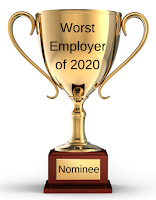
The 2nd Nominee for the Worst Employer of 2020 Is… the Uncaring Chief

Jon Hyman The Practical Employer

Three posts into 2020 and we already have our second nominee for the year’s worst employer. And this one is just plain awful.

From Salt Lake City’s Fox 13 News:

A mother is filing a lawsuit against a Salt Lake City-based company after she claims they fired her once they learned her son had cancer.

Becky Claussen has worked for a Salt Lake City Company called The Summit Group for 13 years.

Working remotely in Virginia, Claussen said things changed after her 10-year-old son Cameron was diagnosed with Leukemia in April.…

Claussen took paid time off and when she went back to work, she said her job assignment changed and she received an email saying, “I think we both know you can’t perform the account manager position adequately under the new circumstances.”

In July, Claussen said her boss flew from Utah to Virginia to meet up.

“I went down to the hospital lobby and I met with him,” said Claussen. “That’s where he told me they were ending the business relationship.”

In that moment, Claussen said her boss fired her.

Returning to Cameron’s hospital room, Claussen explained what had happened—he then turned to her and said, “I’m sorry I got cancer cause it made you lose your job.”

If you fly across the country to fire an employee while she is in the hospital with her child battling Leukemia, you might be the worst employer of 2020.
*Silver lining: after five rounds of chemotherapy, the cancer is in remission.
**The company fully denies the allegations, stating, in part: “We are saddened about this situation. The allegation that we let someone go because of a family health situation is categorically untrue. We have been a small business operating in Utah for nearly 40 years and have countless examples of supporting both our employees and their families in the midst of various life trials. We also took reasonable steps to try to accommodate Becky, by granting all of her requests for time off and her request to be relieved of some of her job duties. We provided a flexible working schedule for her at her request. Becky confirmed to me via email that ‘you guys did what works for my family.’”
Other Nominees:
The 1st Nominee for the Worst Employer of 2020 Is … the Repeat, Repeat Offender
Posted on December 16, 2019June 29, 2023

Court Finds That the ADA Does Not Protect Employee’s Dormant Genetic Condition

Genomic Medicine EmployersSherryl Darby has the BRCA1 gene, otherwise known as the breast cancer gene, the best known gene associated with breast-cancer risk. Approximately two months after she started working as an administrative assistant at Childvine, an early childcare provider, Darby opted to have a double mastectomy to decrease her risk of developing breast cancer in the future. Two weeks later, Childvine fired her.

Despite the close-in-time link between Darby’s surgery and her termination, the district court dismissed her ADA lawsuit.

While “normal cell growth” is a major life activity the ADA protects, the court could not find that the BRCA1 gene is a physical impairment that substantially limits normal cell growth.

Although mindful that the ADA is to be broadly construed, the Court concludes that Plaintiff fails to state a claim upon which relief can be granted. Plaintiff has offered no statutory, regulatory, or caselaw support for her “legal conclusion couched as a factual allegation” that the BRCA1 gene, like cancer itself, is a physical impairment that substantially limits normal cell growth. And the Court’s own research has found none.

It is true that the Sixth Circuit has held that some conditions, even when dormant, may constitute a physical impairment.… But this is not a circumstance akin to remission of cancer. Rather, it is, presently, the absence of cancer.

The Court’s decision should not be read to trivialize Plaintiff’s legitimate fear of developing breast cancer or minimize the transformative measures she took to avoid it. It merely recognizes that this Court’s role is to interpret, not legislate. To expand the definition of physical impairment to include a condition that might lead to a disability in the future effectively puts every employee under ADAAA protection.

Whatever issues I have issues with this decision (and I have some big ones) could have been cured by pleading this case differently. I question why Darby pleaded her protected disability as an actual disability instead of a regarded as disability. I think she would have a had a much better chance at surviving dismissal if she framed her claim as one in which her employer terminated her based in its perception of her having a disability (which does not require any proof of any actual disability) instead of any actual disability itself.

Moreover, in many cases its largely irrelevant whether the ADA covers a dormant genetic disorder because another statute already does—GINA, the Genetic Information Nondiscrimination Act. GINA prevents employers from using genetic information in employment decisions. GINA likely wouldn’t have helped Sherryl Darby, because it does not appear the issue of her having the BRCA1 gene arose until her lawsuit (and long after her termination).

This case will be often be cited for the proposition that the law does not protect an employee’s dormant genetic condition. While that is true based on how Darby pleaded her claims in this case, employers should not treat Darby as a license to discriminate, as doing so will likely violate both the ADA and GINA in many cases.

Posted on December 13, 2019June 29, 2023

What to Do When the CEO Is a Bully

One of the biggest challenges a person will face in their working lives is dealing with a bully, and unfortunately it happens to pretty much everyone. In the past, our parents told us that this was “character building” and something that “everyone has to go through,” but that’s rubbish.

The culture of the organization should never make excuses for the behavior of its managers

Denigrating the thoughts and actions of another human being has never been acceptable. However, some organizations have been great at finding excuses for it and in some instances even encouraging it.

According to research from the Trades Union Congress, 29 percent of people in the United Kingdom are bullied in work. Another survey from SME Loans found that the number is 1 in 4.

Having to deal with poorly behaving employees is something that every culture — even those ranked as best places to work — will deal with at some stage. Often the problem with poorly behaving staff is a result of two things: the emotional intelligence of the individual and the culture that lets the person get away with behaving that way.

Managers Aren’t Necessarily Leaders

There’s an assumption that once a person achieves a particular role within a company’s hierarchy, they are automatically a leader.

Managers are good at their jobs, but leaders do that as well as motivating people by role modeling the behaviors they expect of others. This is what the great CEOs around the world do. They run the business efficiently, make good decisions, deal with issues quickly and ensure that a safe space exists for staff to be able to do their best work.

These are the kinds of people we want running our businesses. Not only are these organizations great places to work, but they’re profitable as well.

Researchers Burton and O’Reilly found this in 2000, writing, “Behavioral theories concentrate on what a leader does rather than who a person is. However, studies show that followers tend to look first at who a leader is.”

Direct Style or Bullying?

It’s important to recognize the difference between personality and behavior. Sometimes people confuse a direct management style for bullying. But other times, the CEO sets the wrong tone and is the person bullying others.

A CEO with a direct style of management doesn’t say please or thank you, will often use language that others don’t appreciate, can be blunt in the way that they provide feedback and can often makes decisions that go against the prevailing mindset. These leaders can become more emotionally intelligent, recognize how off-putting their management style can be, and adjust their style accordingly.

Bullies, however, place unreasonable demands on staff, use threatening verbal and physical language, don’t listen, are unapproachable, actively create divisions and treat people differently based on their gender, sexuality, race or skills.

People who behave in this way have no place in business, and it’s up to the people within the culture to reject this. Steve Jobs is one such example of a bully whose staff challenged him when his behaviors got the better of him.

If you’re on the receiving end of this kind of behavior from the CEO or any member of the senior management team, then it’s important to make notes about the interaction and speak with the HR manager. Their position doesn’t mean that they get to behave differently. On the contrary, they need to set the example.

It is the job of the HR manager to ensure that every member of staff upholds the behaviors and values expected. If you’re the HR manager, then you may seek to discuss your approach with your peers and jointly speak to the CEO.

Once the conversation has taken place, then you need to confirm in writing the nature of the discussion and what needs to change. This is often outlined in a process which must be followed in case follow-up action is necessary. A second conversation on behaviors must be followed by a disciplinary hearing in order to send the message that poor behavior won’t be tolerated.

The culture of the organization should never make excuses for the behavior of its managers and should deal with issues in the same way as they would for all. If the CEO doesn’t set the behavioral tone, they should be told to do so. Otherwise, the staff will suffer and so will the bottom line.


Posted on December 5, 2019October 13, 2021

A Fun Culture Isn’t Enough to Retain and Engage Top Talent

In today’s job market, companies are under pressure to not only attract top talent but retain it as well. The allure of flexible hours, unlimited time off and craft beer on tap may speak to the promise of a fun culture, but don’t hold much weight when an employee considers greener pastures.

Employee benefits programs  are a strong deciding factor when people consider staying with or leaving their company.  A recent study found that 78 percent of employees would be more likely to stay at their current job because of the benefits they receive. With benefits holding a priority position on employees’ pro and con checklists, it’s imperative for employers to offer coverage that is not only valuable but competitive in the marketplace.

Absence and disability programs are two primary areas of employee benefits that are undervalued in the U.S. workforce. Based on a survey of HR decision makers by The Standard, 23 percent of companies embrace a holistic approach to accommodating disabilities. Further, less than 33 percent of companies have embraced the need for family and medical leave that is more comprehensive than current laws permit. Based on these findings, it’s no surprise that only 1 in 4 employees see their employer as a leader in managing absence and disability. This poses an opportunity for companies to prove they are in touch with employee needs and offer benefits that are both valuable and competitive.

In particular, companies should consider accommodations for employee mental health conditions if they want to retain talent and increase job satisfaction. The rate of millennials experiencing a mental health condition continues to rise and conversations about employee burnout, anxiety and depression are becoming more prevalent. According to Pew Research Center, millennials make up the largest sector of the U.S. workforce with Gen Z following close behind. The impact of mental health in the workplace will only continue to grow as baby boomers and Gen X retire and exit the workforce. Millennials are more open about mental health conditions than any previous generation and expect their employers to both support them and provide realistic accommodations.

Companies are struggling with this shift. The Standard’s research found that 71 percent are not confident in managing employee mental health conditions. Moreover, 63 percent of organizations do not feel prepared to accommodate absence or disability related to behavioral health conditions. It’s time for companies to rethink their approach to employee mental health if they want to be viewed as positive places to work.

Organizations that are committed to improving their approach to behavioral health can incorporate a variety of tactics. First, company leaders can offer explicit support to employees experiencing mental health or substance abuse issues. Public communications, such as email campaigns and company-wide meetings, should aim to address and reduce the stigma around behavioral health conditions in the workplace. A strong wellness campaign backed by manager training on issues such as depression, anxiety and addiction can further bolster a strong behavioral health strategy.

In addition to a company culture that supports and responds to mental health and substance abuse needs, employers can search for a behavioral health benefits program that attracts and retains valuable talent. Organizations should consider implementing a formal wellness program that factors in “mental health days,” flexible work schedules, subsidized employee subscriptions for mental health, parental leave and other key benefits. While accommodating these needs is not always easy territory to navigate, employers who provide workers with the tools they need to address mental health and substance abuse will enjoy the benefits of employees who are far better equipped to meaningfully contribute to the company mission.

Offering absence and disability programs that accommodate behavioral health conditions while destigmatizing workplace discussions around mental health are key to the development and execution of a successful program. Behavioral health assessments can create open discussions about mental health in the workplace, but findings show that only 10 percent of companies are offering them. These assessments can help employees understand if they are likely to suffer from a mental health condition.

The U.S. workforce is undergoing a generational shift, and employers are trying to retain employees in a job market where many new opportunities abound. Companies that come out on top will do so by expanding and improving their employee benefits programs. At the end of the day, people stick with companies that value and support them through life’s ups and downs.


Posted on December 2, 2019September 21, 2022

How Companies Can Embed Purpose in Their Employees for Higher Engagement and Retention

Millennials are now the largest generation in the U.S. workforce, but they’re increasingly unhappy at their jobs. According to the 2019 Deloitte Global Millennial Survey, 49 percent of millennials would quit their current jobs in the next two years if they could.

One likely reason for this is a lack of purpose at work. In fact, the Deloitte study found that only 37 percent of millennials think business leaders “make a positive impact on the world.”

A company with strong core values and a clear mission aligns people of every generation and role to perform their best, feel like they’re making a difference and stick around for a longer tenure.

To champion happy, engaged employees and send retention rates soaring, HR leaders need to cultivate a sense of purpose among their employees. Here’s how they can do that.

Hire for Purpose

You can’t create a culture of purpose without purpose-driven individuals, and it’s difficult to instill a sense of purpose in those who don’t have one. Your best bet is to screen for purpose during the hiring process.

Enthusiastic, mission-driven candidates will help uphold a larger sense of purpose in your organization. They’ll also likely lead by example. A Harvard Business Review study found that positive behaviors and attitudes are contagious and are often passed from manager to employee. Finding mission-driven workers at every level can help you weave purpose into your organization.

To find purpose-driven employees, ask candidates about their values during an interview, add an application question about defining purpose and outline your company’s mission in job postings.

Incorporate Core Values into the Onboarding Process

A longer and more meaningful onboarding process is tied to higher rates of retention, according to Harvard Business Review. Be sure to introduce new hires to your organization’s core values and mission from day one.

Then show them these values in action with stories about current colleagues living the purpose. New hires will feel more connected to your company and more inclined to forge meaningful relationships with their co-workers. That way, they’ll feel compelled to embody these values — with like-minded colleagues — as part of their job.

Give Your Employees Purposeful Gifts

More companies are using gifts to show employee appreciation. But most corporate gifts are generic and forgettable. Branded mugs and t-shirts can’t capture a company’s values in a meaningful way.

Purposeful gifting is an excellent way to demonstrate your company’s commitment to social impact and community engagement. Mission-driven employees, especially millennials, care deeply about environmental and social causes.

A 2019 Gallup poll revealed that millennials’ concern about global warming is at a high point, and the Case Foundation’s “Millennial Impact Report” shows that millennials care about social issues rather than institutions and believe in the power of activism.

Gifts can simultaneously support those causes and show gratitude to your employees. These gifts could include a food basket filled with snacks from a company that employs survivors of abuse, a backpack created from recycled materials, or a tumbler and coffee set whose manufacturer offers jobs to individuals with disabilities.

Send these gifts during important milestones in your employees’ tenures. For instance, consider sending a food basket during onboarding or a backpack to accompany a prospective employee’s offer letter. Gifts can show gratitude in a concrete way that emails, letters and words may not be able to.

Leadership Should Embody Your Organization’s Core Values

Your organization’s leadership should be constantly reinforcing your core values, purpose and mission. As an HR leader, you can broadcast that vision to every employee at your company.

Identify company thought leaders — inside or outside of the C-suite — and highlight their perspectives on company value-driven goals and initiatives through internal newsletters and media. Purpose feels more genuine when it’s voiced by a real person at your company.

Offer Opportunities for Employee Development

Organizational purpose should nurture an individual sense of purpose. According to a 2016 Gallup poll, 87 percent of millennials consider training and development opportunities important when considering new jobs. When employees feel supported to pursue their own career and self-fulfillment goals, they’ll feel better aligned with their company.

Create room for employees to have purpose-based goals in addition to performance-only evaluations. Then, give them the resources they need to achieve those goals: one-on-one mentorship, leadership development programs, retreats, volunteering and enrichment activities such as cultural competency training. When their employer encourages and invests in them, employees want to stay and keep growing.

Purpose Drives Satisfaction and Retention

Today’s workers are increasingly looking beyond the old indicators of job satisfaction, such as job security and fixed salary.

Through hiring strategies, onboarding, gifting, leadership and employee development, HR leaders have a chance at every step of the employee timeline to show each employee how they can enact their personal and company values.

Purpose is a two-way street: you can demonstrate your company’s values in the same breath that you demonstrate how you value your employees. Values, after all, mean nothing if they’re not put into action.

Posted on November 25, 2019June 29, 2023

How to Hire Your First HR Leader

So, business is good, growth is strong and you’re ready to hire your first HR leader. That’s great news. Congrats!

Now comes the hard part.

This column is not meant to help those looking for their first HR hire, which is generally an individual added by small to medium-sized business when transactional items like payroll and compliance overwhelm an office manager or similar administrative employee with another job to do.

That was your first HR hire. You’ve likely made that hire at least a year or so ago. You thought that person was going to shore up your recruiting issues and get to needed projects in performance, training and other areas. You were wrong.

So here we are. You just posted an opening for an HR manager/director — your first HR leader. If you’re going to invest the money, you need the person to innovate and deliver the return in all your areas of need related to talent.

Finding the right hire in this situation is hard, and misses occur often. Here are ideas to assist in your search:

Experience matters, so prepare to dig. If you’re looking for someone to come in and build your next-level HR platform, you’re going to need to make sure they’ve done it before. The biggest lie the devil ever told the world about HR is that titles equate to ability. That’s not only false in the world of HR, it’s dangerous.

There’s a high degree of variability across HR manager/director candidates. To ensure you end up with what you need, pick your top three HR areas of need, then prepare to interview candidates purposefully on how they have built strong programs in those areas.

Ask candidates to bring a portfolio of examples of their work in each domain. Make sure the experience is real, not hypothetical or you’re going to be less than satisfied in under a year.

Company size of current and past employers is important. As a growing company, you’re going to be naturally attracted to HR leaders in small companies. While that’s one path to success, you shouldn’t discount HR pros who want to downshift from a mega-company existence to the SMB life.

There’s a high degree of variability across HR Manager/director candidates. Pick your Top Three areas of need, then interview purposefully.

Big company HR pros have the benefit of growing up with great tools and resources in the areas important to you. The best ones (who are a motivational fit for life in a smaller company) can use that experience to build your HR platform in a meaningful, progressive way.

Consider recruiting backgrounds as an alternative. Most growing businesses seek to add their first HR leader at around the 100-employee mark. You’re likely adding this leadership team member due to growth, which means recruiting is almost always a pain point. For best results, look to add candidates to your hiring process that have been pure recruiters in their past in addition to holding pure HR positions. Interview to understand their success and satisfaction in the former recruiting role. If your first HR leader has past success as a recruiter and enjoyed that life, you’ll be set up for success.

Of course, all of those tips are related to candidate backgrounds and what you’ll see on résumés. To truly win with your first HR leader hire, you’re also going to have to be brutally honest with yourself related to your company environment and the behavioral DNA you need in a candidate that provides the best match.

My new book, “The 9 Faces of HR,” digs deep into the behavioral DNA of HR pros. Here’s the must-haves I’d recommend for anyone seeking to hire their first HR leader:

Quick on the draw. Taking in large amounts of data/feedback and making quick, accurate decisions is key. Things move pretty fast at a high-growth company, and the right candidate for you will need to match the speed.

Fearless. Your new HR leader needs to be naturally inclined to deal with challenges head on. The right candidate for you will have a bias toward action.

Loves chaos. Let’s face it, you have a cool company but it’s a freak show, as all high-growth organizations are. The right candidate is going to view chaos as a ladder, not a barrier.

Successfully hiring your first HR leader is about finding a candidate in the sweet spot — the intersection of hustle, hard work, innovation and the ability to create product and services others will use to move your company forward.

The right one is out there, but only if you go into the search with a clear plan of what you are looking for. Don’t settle!

Posted on November 19, 2019June 29, 2023

Monitoring Emotions at Work

With emotional well-being in the workplace, “prevention is better than intervention,” said one author and entrepreneur.

Steve Curtis

Marc Brackett, founder and director of the Yale Center for Emotional Intelligence, argues in his new book “Permission to Feel” that the workplace tends to deny healing.

“You check your feelings at the door because you’re there to do business,” he said. “What people have to realize is emotions don’t get checked at the door. They are at the seat of every table. They’re on the phone with every client and are influencing all aspects of performance.”

Emerging technologies are helping employees assess the impact of their emotional state on work performance.

One platform in the development stage, Evolve Biologix, uses the heart’s electrical signals through an ECG measurement tool wrapped around the chest to correlate with a range of emotions to develop emotional awareness and learn techniques to manage it individually and in relationship to others.

People already are using devices connected to the body such as a watch, but having something connected closer to their heart is new, said Evolve Biologix CEO Steve Curtis.

Evolve Biologix differs from other platforms in that while others are self-reporting, its focus is on gathering real-time electrical signals from each heartbeat.

“An ECG wave has different peaks with electrical signals firing through our brain,” said Curtis, whose company is in a corporate environment beta stage as Curtis seeks partners to collaborate on the notion that it can serve as a health benefit. “We’re utilizing data science and machine algorithms to understand the specific signatures of these body systems to draw out emotions, build a group performance dashboard and optimize algorithms that drive content interventions and suggestions at an organizational level.”

Marc Brackett

An Evolve Power Index score, which is displayed on a phone, represents the user’s emotional level. The higher the score, the more the end user is believed to be in alignment with their emotional state, which can range from shame and guilt to peace and enlightenment.

Regarding privacy concerns, Curtis said results aren’t connected to individuals but provide a picture of group dynamics down to work groups of three.

“[HR] departments are continually challenged with how to keep innovation alive in their organization, increase the change readiness, manage empathy in environments where people are becoming progressively more technical in nature and how to get people to care about each other and function as a cohesive team,” he said. “It’s imperative to be able to view these kinds of metrics.”

Brackett foresees a time when employee benefits will include more emotional wellness technologies.

“There’s a benefit-cost analysis to taking seriously people’s development of skills, teaching emotional self-awareness and emotion regulation as opposed to treating it once you have a full-blown anxiety disorder or depression,” he said.


Posted on November 13, 2019June 29, 2023

New Concerns Form Smokescreen Over Vaping at Work

The surging popularity of e-cigarettes and the recent spate of illnesses associated with them have caught public health officials and health care providers by surprise and left many employers wondering whether to allow their use in the workplace and what kind of policies are needed to manage the practice.

An e-cigarette is an electronic device that heats up small amounts of liquid nicotine and other substances into an aerosol that can be inhaled, also known as vaping. E-cigarette use among teenagers has skyrocketed in recent years, but others see vaping as a safe alternative to smoking and a tool to quit, an issue that is up for debate.

“Given the recent stories, employers are catching up with how to think about vaping,” said Dr. Mary Kay O’Neill, senior clinical adviser in Mercer’s Total Health Management practice. “E-cigarettes kind of exploded. An early sales pitch was that it’s a safer way to use tobacco than smoking but I think that was more marketing than science. We’re finding a lot problems with that theory.”

While the Food and Drug Administration has not found e-cigarettes to be a safe or effective smoking cessation method, a 2019 study in the New England Journal of Medicine found that smokers who vaped were more likely to quit smoking than people who used nicotine patches, gum or similar products. On the downside, those who quit often became hooked on e-cigarettes.

The largest group of e-cigarette users, however, is teenagers — a trend that has alarmed school and public health officials. In 2018, 37 percent of high school seniors reported vaping, compared to 28 percent in 2017, according to a University of Michigan study.

In response to health concerns, a number of states have banned e-cigarettes and vaping in workplaces and public areas. So far, 17 states have passed general workplace bans — most recently Minnesota, South Dakota, Florida and New Mexico. In June, San Francisco officials voted to ban the sale of e-cigarettes in the city. San Francisco is the headquarters of Juul Labs, the nation’s largest producer of vaping devices.

While most employers ban smoking, few have policies around e-cigarettes, according to Amanda Graham, head of the Innovations Center at Truth Initiative, a national public health organization that also offers a smoking cessation program, called the EX Program, to employers.

“There’s a lot of interest and questions from employers around what to do with vaping,” Graham said. “Do we add it to our smoking policy? What if we have a senior leader who believes in vaping? How do we handle that? It’s important to have consistency in the handling of all tobacco products.”

Mark Johnson, an employment law attorney with Ogletree Deakins in Milwaukee, advises employers to review their current smoking policy and make sure that it complies with state and local laws and that it clearly addresses vaping. Some employers add the use of electronic smoking devices to the definition of “smoking” in an existing no-smoking policy, according to Johnson. A separate policy is not always necessary, he said.

“The number of states and municipalities that have banned vaping in the workplace continues to grow and even if applicable law does not expressly ban vaping in the workplace, laws prohibiting smoking in the workplace may be interpreted to include vaping, Johnson said in an email. “For other locations, it may not be clear whether vaping is regulated. There does not appear to be any location that requires employers to permit vaping at work.”

For employers weighing whether to allow vaping at work, the effects of second-hand exposure to e-cigarettes also need to be addressed, according to Graham.

Much about the health effects of vaping remains unknown and for that reason employers must educate themselves on the risks, O’Neill said.

“We’ve studied tobacco for a long time but not what’s in the liquids found in vaping,” she said. Employers should consider offering smoking-cessation programs to help employees quit through methods that are safer and more effective, according to O’Neill.

Posted on November 11, 2019

EEO-1 Reporting Update: How We Got Here and What You Need to Know

wage and hour law compliance, wages

Nov. 11, 2019 is the last day for employers to submit reports detailing their employee compensation data to the Equal Employment Opportunity Commission.

Under the new reporting requirement, employers with at least 100 employees must report information to the EEOC regarding employee wages and hours worked by job category, race, ethnicity and gender. The EEOC is continuing to collect this data for 2017 and 2018 in advance of the Nov. 11 deadline, but the new requirement appears to be short-lived. On Sept. 12, 2019, the EEOC announced that after this year’s deadline, employers will no longer be required to submit compensation data, also known as “Component 2” data.

The EEOC first proposed this additional collection of pay data in 2016, and the reports were slated to be due Mar. 31, 2018. In announcing the new requirement, EEOC Chair Jenny R. Yang explained that the collection of pay data was meant to “assist employers in evaluating their pay practices to prevent pay discrimination and strengthen enforcement of our federal anti-discrimination laws.” The EEOC ultimately reversed course, explaining that the “unproven utility” of the pay data collection is “far outweighed by the burden imposed on employers that must comply with the reporting obligation.”

After Nov. 11, covered employers can return to the EEOC’s previous data collection practices, in which it has required employers to report demographic information (now called “Component 1” data) using the EEO-1 form. Since 1966, employers with more than 100 employees have been required to report the number of individuals employed by job category, race, ethnicity, and gender.

For federal agencies like the EEOC to collect information from the public, they need approval from the Office of Management and Budget, so the EEOC sought approval from the OMB to collect Component 2 data using a revised EEO-1 form.

In 2017, the OMB stayed the requirement to report Component 2 data. Thereafter, several advocacy organizations brought an action against the OMB to end the stay and reinstate the revised EEO-1 reporting requirements and collection of Component 2 data. On Mar. 4, 2019, the U.S. District Court for the District of Columbia ruled that the OMB failed to demonstrate good cause to uphold the stay and permitted the collection of Component 2 data using the revised EEO-1 form. While the Department of Justice filed an appeal on May 3, this did not stay the reporting requirement.

The initial deadline to collect Component 2 data was Sept. 30, 2019, but it has taken a substantial amount of effort for employers to provide the requested pay data information. Before the collection of Component 2 data was officially underway, the EEOC estimated that adding Component 2 data would increase the burden of EEO-1 reporting by 90 percent. Given the difficulty of completing this reporting, it comes as no surprise that the data collection and submission of the revised EEO-1 reports have not been seamless. As of Oct. 8, 2019, only 75.9 percent of covered employers had submitted the requested data by the initial deadline. This is far lower than the response rates for prior EEO-1 Component 1 data collections, which exceeded 90 percent.

It remains unclear how the newly collected Component 2 data will be used, especially since it only includes pay information for 2017 and 2018. The EEOC has stated that, as a general matter, EEO-1 data is used “for a variety of purposes including enforcement, self-assessment by employers, and research.” The EEOC has also published aggregated EEO-1 Component 1 data, in addition to periodic industry specific reports.

While any potential uses for the data are uncertain, the EEOC has implemented procedures “to ensure the protection of identifiable information of our survey respondents and maintain EEOC’s commitment to protect the data confidentiality.” This should allay concerns that an individual employer’s EEO-1 data could be made public.

As for lessons learned in the aftermath of this extensive data collection, employers could use the information gathered to conduct internal pay analyses. While employers will no longer be subject to this particular reporting requirement, prudent employers will still gather pay data by job category, race, ethnicity and gender to take proactive measures to avoid pay equity lawsuits.

Posted on November 7, 2019June 29, 2023

Eggnog With a Splash of Paid Time Off

holiday vacation, paid time off

Providing employees extended time off at the end of the year is one way to add a bit of holiday cheer.

Office closures during the holidays — typically the days between or immediately around Christmas and New Year’s Day — can enhance employee productivity, according to a November 2018 survey of 2,000 full-time employees conducted by Chicago-based consulting firm West Monroe Partners. The study explored employee productivity during the holiday season and gauged how additional days off during the holidays affected that productivity. It found the “employees at offices that close additional days during the holidays are significantly more likely to report higher productivity during the time that they’re actually in the office” — 42 percent compared to 17 percent in offices that don’t shut down outside of federal holidays.

The study suggested that employers close the office on days beyond federal holidays, when feasible.

Some employers look at this potential benefit and can’t see past the missed productivity of those three or four days between Christmas and New Year’s, said Michael Hughes, a managing director with West Monroe and lead of the firm’s Operations Excellence practice. But they’re not considering the return on investment.

Also read: Experts Advise Revising Ailing Time-Off Policies

“In a tight job market, the ROI from deciding to close the office becomes very real,” he said. “We’ve tried this at our own company and [we] see the benefits of it year after year in terms of retention and productivity.”

According to the International Foundation of Employee Benefit Plans’ 2018 “Employee Benefits Survey,” 12 percent of organizations offer the full week between Christmas Day and New Year’s Eve as a paid holiday, compared to 9 percent of organizations in 2016.

If a company can withstand the hiatus from the client delivery and service perspective, it should strongly consider doing so.

Michael Hughes

Especially at a time with a tight labor market, employers are looking for new, innovative ways to attract talent and increase morale, said Julie Stich, vice president of content at the foundation. An extended vacation during the holiday season is one way to vie for candidates’ attention.

Michael Hughes, West Monroe Partners

This makes sense in some industries more than others. The top three industries that offer holiday time off perks include education, technology and manufacturing. Conversely there are many industries in which virtually no companies offered such perks, including banking, finance, food service and health care, Stich said.

The top three industries provide examples for the type of environment that can more naturally offer this perk, Stich said. People in education may already have that downtime over winter break. Tech companies tend to be innovative in the benefits they offer. And manufacturers sometimes need to shutter their shops and turn off the machines for a week for maintenance. Offering that week between or around Christmas and New Year’s Day could fit in with a business need as well as give many employees the perk of a longer break, she added.

Hughes said that if a company can withstand the hiatus from the client delivery and service perspective, it should strongly consider this time off.

At West Monroe Partners, the finance and accounting teams are often working at the office or at home during this time of the year to meet end-of-year deadlines. The same goes for IT, as clients’ expectations of getting the necessary tech guidance does not stop just because it’s the holiday season.

One year a client experienced a ransomware attack the week between Christmas and New Year’s, Hughes said, and employees on the cybersecurity team stepped up, working on Christmas Eve and the days following Christmas. Instead of time off, these employees were recognized and rewarded in other ways for going above and beyond in their jobs.

“Folks in these positions understand this is a busy time based on their role in the company,” Hughes said. “As long as you provide them with a similar benefit — paid time off during another non-busy time in the year — or rotate who’s ‘on call’ from year to year, they are less affected by the decision.”

“If it’s not possible for your business to close for additional days during the season, then it’s even more important to offer workers alternative ways of disconnecting and recharging, such as greater scheduling flexibility,” he added.

Customer relations are something else to keep in mind. Organizations need to let their clients or customers know in advance that they will not be providing services over a certain period of time. They can’t just rely on an update on their website to get the message across, Stich said.

Posts navigation

Previous page Page 1 … Page 13 Page 14 Page 15 … Page 38 Next page


Webinars


White Papers


  • Topics

    • Benefits
    • Compensation
    • HR Administration
    • Legal
    • Recruitment
    • Staffing Management
    • Training
    • Technology
    • Workplace Culture
  • Resources

    • Subscribe
    • Current Issue
    • Email Sign Up
    • Contribute
    • Research
    • Awards
    • White Papers
  • Events

    • Upcoming Events
    • Webinars
    • Spotlight Webinars
    • Speakers Bureau
    • Custom Events
  • Follow Us

    • LinkedIn
    • Twitter
    • Facebook
    • YouTube
    • RSS
  • Advertise

    • Editorial Calendar
    • Media Kit
    • Contact a Strategy Consultant
    • Vendor Directory
  • About Us

    • Our Company
    • Our Team
    • Press
    • Contact Us
    • Privacy Policy
    • Terms Of Use
Proudly powered by WordPress